The FiiO K7 occupies a specific position in the desktop DAC/amp market: it is the unit you buy when you want balanced headphone output and are not willing to spend $400 or more to get it. At $219.99, it delivers 2W into 32Ω via 4.4mm Pentaconn balanced output, dual AK4493S DAC chips in a fully balanced dual-mono configuration, and THX AAA 788+ amplifier technology. It was the balanced pick in the best DAC/amp combo under $250 roundup for one reason that matters more than any other: no other unit at this price delivers a genuine fully balanced output path from a properly specified amp circuit.
This review covers exactly who needs the balanced output, what the THX amplifier technology contributes, where the K7 is the correct purchase, and — importantly — where the FiiO K5 Pro ESS at $50 less is actually the stronger choice. If you do not use or plan to use balanced headphone cables, read that last point carefully before deciding.
Quick Answer: The FiiO K7 is the right choice if you use or plan to use 4.4mm balanced headphone cables — the 2W balanced output is the highest in this category and the THX AAA 788+ amplifier delivers near-zero distortion. If your headphones are single-ended only and you have no plans to go balanced, the FiiO K5 Pro ESS delivers more single-ended power at $50 less and is the better value purchase. The K7’s advantage is exclusively the balanced output path.
This article contains affiliate links. If you purchase through them, we may earn a commission at no extra cost to you. This helps support AmplifierZone and allows us to keep creating in-depth, unbiased audio guides.
Who Is the FiiO K7 For?
Specifically, the K7 is built for one primary listener: someone who owns or is planning to buy premium headphones that support 4.4mm balanced termination, and who wants the full performance those headphones are capable of delivering. Indeed, balanced output is not a marketing feature on the K7 — it is the technical foundation of the entire unit’s design. The dual-mono DAC configuration, the THX AAA amplifier circuit, and the 2W output figure are all oriented around providing the cleanest possible balanced signal path. Consequently, for that listener, the K7 is the correct answer at this price with no meaningful competitor.
Furthermore, beyond the balanced use case, the K7 also suits listeners who want the technical best available under $250 and are willing to pay $50 more than the K5 Pro ESS for measurably lower distortion, a superior amp circuit, and the dual-chip DAC architecture. Indeed, even in single-ended mode, the THX AAA 788+ circuit is audibly cleaner than most alternatives. For listeners still deciding whether a dedicated amp makes a meaningful difference before investing at this level, the headphone amp guide covers that question before the K7’s price is worth considering.
The single question that decides it: Do your headphones have a 4.4mm balanced termination option, or are you planning to re-cable or buy a replacement cable? If yes — the K7 is the correct purchase. If no, and you have no plans to change that, the FiiO K5 Pro ESS delivers better single-ended performance at $50 less and there is no compelling reason to choose the K7.
FiiO K7 — Key Specifications
FiiO K7 Balanced Desktop DAC and Headphone Amplifier
- DAC chips: Dual AKM AK4493S — fully balanced dual-mono configuration
- Amplifier technology: THX AAA 788+
- Headphone power (balanced): 2,000mW into 32Ω via 4.4mm Pentaconn
- Headphone power (single-ended): 1,200mW into 32Ω via 6.35mm
- Headphone outputs: 6.35mm single-ended + 4.4mm balanced
- Digital inputs: USB, Optical Toslink, Coaxial
- Analogue input: RCA line-in — use as pure headphone amp with external DAC
- Line output: RCA stereo
- Resolution: Up to PCM 384kHz/32-bit, DSD256
- RGB indicator: Blue ≤48kHz, yellow >48kHz, green DSD
- Bluetooth: No
- Power supply: Dedicated DC — not bus-powered
- 2W balanced output via 4.4mm — highest in this price category
- THX AAA 788+ amplifier — near-zero distortion, exceptional transparency
- Dual AK4493S in fully balanced dual-mono — one chip per channel
- Both 6.35mm SE and 4.4mm BAL outputs — covers all headphone terminations
- RCA line-in — functions as pure headphone amp for external DAC
- USB/optical/coaxial/RCA inputs — comprehensive input coverage
- RGB sampling rate indicator — visual confirmation of input resolution
- No Bluetooth — wired sources only
- No remote control
- Single-ended output power (1.2W) is lower than FiiO K5 Pro ESS (1.5W)
- RGB indicator light cannot be disabled
- Balanced advantage requires 4.4mm headphone cable — most headphones need separate purchase
Approx. price: $219.99. Best balanced pick — 2W via 4.4mm Pentaconn, dual AK4493S, THX AAA 788+. Most technically capable unit under $250.
Design and Build Quality
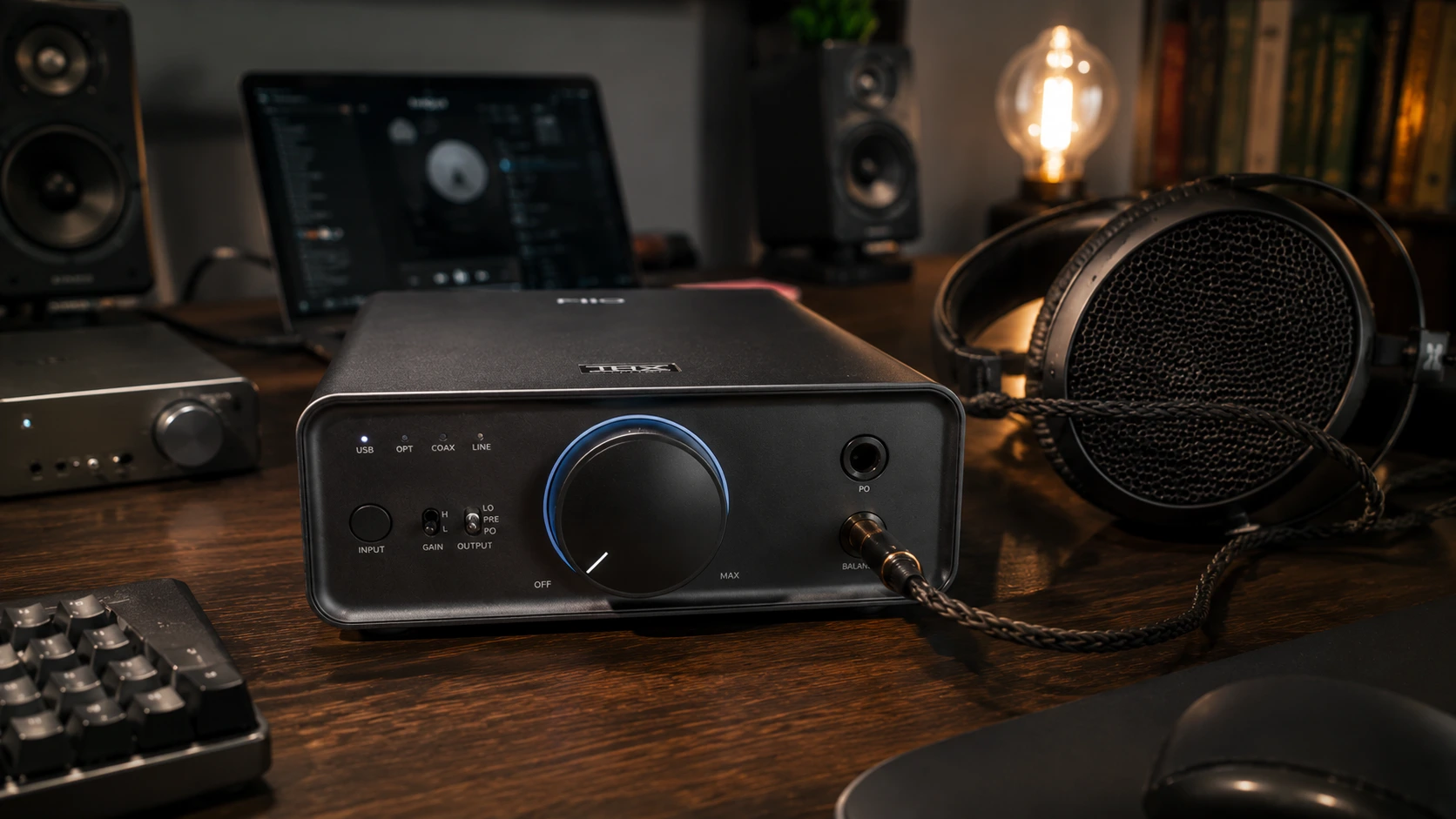
The K7 is a substantial, well-built desktop unit — all-metal chassis, a large and well-damped volume knob, and a front panel that communicates purpose rather than consumer electronics compromise. Specifically, the dual headphone outputs are prominently placed on the front face: the 6.35mm single-ended jack on the left, the 4.4mm Pentaconn balanced jack in the centre. Both are correctly labelled and physically distinct enough to avoid confusion.
Specifically, the RGB sampling rate indicator on the front panel is a feature that divides users. Specifically, it provides genuinely useful information — blue confirms the signal is at or below 48kHz (standard streaming), yellow confirms higher-resolution playback, and green confirms DSD. Specifically, for listeners who want visual confirmation that their music player is sending the correct signal format, it serves a real purpose. For listeners who find coloured LEDs distracting in a dark room, it is an annoyance with no disable option in the current firmware. FiiO’s app allows limited control of some K7 settings but does not address the LED at the time of writing.
Specifically, the rear panel includes USB-B input, optical Toslink, coaxial, RCA line-in, and RCA line-out. The DC power input is also on the rear. The layout is logical and the connectors are well-spaced. Overall, the K7’s build quality is appropriate to its price point — it feels like a serious audio device rather than consumer electronics.
Balanced Output — What It Actually Means for Performance
Specifically, balanced audio transmission uses two signal paths per channel — one carrying the signal, one carrying an inverted version of the same signal. At the headphone driver, these two paths are combined, and any noise or interference that was introduced equally on both paths (common-mode noise) cancels out. The result is a lower noise floor, better channel separation, and — in practice — a more open, cleaner presentation of the recording.
Specifically, the K7’s balanced output delivers 2,000mW into 32Ω — nearly double the 1,200mW available from its own single-ended output. Indeed, this power increase is not incidental: the balanced circuit uses both the positive and negative signal paths to drive the headphone driver, which doubles the voltage swing and consequently doubles the available power. For demanding headphones at high listening volumes, this headroom matters — transient peaks in music have more current available before the amplifier clips.
However, the balanced advantage is only accessible when the headphone cable terminates in a 4.4mm Pentaconn plug. Most premium headphones support balanced termination via a detachable cable system — Sennheiser HD 600/650/6XX, Beyerdynamic DT series, HiFiMan planar magnetics, and Audeze LCD series all have aftermarket balanced cable options. Budget and mid-tier headphones with fixed cables do not support balanced termination without modification. Consequently, for listeners whose current headphones use a fixed non-removable cable, the K7’s balanced output is inaccessible without replacing the headphones.
Sound Quality
The K7 sounds transparent, controlled, and technically precise. The THX AAA 788+ amplifier circuit contributes very low distortion and noise, which means the sonic character is primarily determined by the dual AK4493S DAC chips — smooth, detailed, and slightly warm compared to ESS-based units. Specifically, the combination produces a sound that is both technically accurate and musically engaging, without the hyper-analytical edge of ESS units or the soft-focus warmth of some other AKM implementations.
In balanced mode (4.4mm)
Specifically, in balanced mode, the K7 produces a noticeably blacker background than in single-ended mode. Channel separation is wider, the noise floor is lower, and transient definition is sharper. Specifically, on open-back headphones with wide soundstage characteristics — Sennheiser HD 600, Beyerdynamic DT 990 Pro, HiFiMan HE-400se — the balanced output increases the sense of space and air in the recording perceptibly. Indeed, for listeners who have previously only heard these headphones through single-ended output, the improvement is not subtle on a direct comparison.
In single-ended mode (6.35mm)
Specifically, the single-ended output delivers 1,200mW into 32Ω through the 6.35mm jack. This is adequate for most headphones but marginally less than the FiiO K5 Pro ESS (1,500mW) in the same mode. Consequently, for listeners who use the K7 exclusively in single-ended mode without plans to use balanced, they are paying $50 more than the K5 Pro ESS for marginally less single-ended power, with the THX amp circuit as the primary sonic advantage. That advantage is real but audibly subtle to most listeners — the K5 Pro ESS sounds good in single-ended mode too.
With the THX AAA circuit
THX AAA (Achromatic Audio Amplifier) technology uses a patented feed-forward error correction circuit that achieves extremely low harmonic distortion — measurably lower than conventional amplifier topologies at comparable price points. Specifically, in practice, the audible benefit is most apparent at high volume levels and on complex musical passages where a conventional amplifier begins to introduce intermodulation distortion. For casual listening at moderate volumes the difference between the THX circuit and the K5 Pro ESS’s conventional amp is small. For critical listening at high volumes, the K7’s technical superiority is audible.
FiiO K7 — balanced vs single-ended: what actually changes?
- Power: 2W balanced vs 1.2W SE — nearly double the headroom
- Noise floor: Lower in balanced — common-mode noise cancels
- Channel separation: Better in balanced — fully independent signal paths
- Soundstage: Wider and more open in balanced on compatible headphones
- Requirement: 4.4mm balanced headphone cable — most require separate purchase
Connectivity and Inputs
Specifically, the K7 offers USB, optical Toslink, coaxial, and RCA analogue line-in — the same four-input configuration as the FiiO K5 Pro ESS. USB is class-compliant and supports up to 384kHz/32-bit PCM and DSD256 — slightly lower maximum resolution than the K5 Pro ESS’s 768kHz/DSD512, though above the ceiling of every current music streaming service and the vast majority of local audio files. Optical handles 24-bit/192kHz, covering every TV and console source correctly.
The RCA line-in allows the K7 to operate as a pure headphone amplifier with an external DAC connected via analogue — bypassing the K7’s internal DAC entirely. Indeed, this is the same upgrade flexibility that the K5 Pro ESS offers: the amplifier can remain while the DAC is upgraded separately. Additionally, the RCA line output allows the K7 to feed powered bookshelf speakers with a fixed-level line signal.
There is no Bluetooth and no remote control — both of which the Topping DX3 Pro+ provides at $20 less. For listeners who want wireless capability, the K7 is the wrong choice regardless of its technical merits. However, for wired desktop setups, the absence of Bluetooth is irrelevant.
How the FiiO K7 Compares
FiiO K7 vs FiiO K5 Pro ESS
Specifically, this is the most important comparison for most buyers. The K5 Pro ESS costs $50 less and delivers 1,500mW single-ended — 300mW more than the K7 in single-ended mode. The K7’s advantages are the balanced output (2W via 4.4mm), the dual-chip DAC configuration, and the THX AAA 788+ amplifier circuit. Consequently, for listeners without balanced headphone cables, the K5 Pro ESS is the stronger wired single-ended choice. For listeners with balanced cables or plans to upgrade, the K7 is the correct investment.
FiiO K7 vs Topping DX3 Pro+
The DX3 Pro+ costs $20 less and adds LDAC Bluetooth and a remote control. The K7 adds balanced headphone output and a technically superior amp circuit. Indeed, these two units serve entirely different primary use cases — wireless convenience vs balanced output. Specifically, there is no meaningful overlap between the listener who needs LDAC Bluetooth and the listener who needs 4.4mm balanced output. Choose based on the feature that matters to your actual listening setup.
FiiO K7 vs units above $250
Specifically, the K7 represents the balanced output ceiling in the under-$250 category. Units above $250 — the Topping A30 Pro, Schiit Magni with Modi stack, or iFi iDSD Diablo — begin to offer better DAC chip selections or higher balanced output power. For listeners who are invested in the balanced headphone ecosystem and want to step beyond the K7, the next meaningful upgrade typically requires spending $400 or more as a combined DAC/amp outlay. Consequently, for many listeners the K7 represents a long-term purchase rather than a stepping stone.
Best Headphone Pairings
The K7 performs best with headphones that have balanced cable options and impedances of 32Ω and above. Below is a practical guide with recommended output and gain settings:
| Headphone | Impedance | Balanced Available? | Recommended Output | Result |
|---|---|---|---|---|
| Sennheiser HD 600 | 300Ω | Yes — aftermarket 4.4mm | 4.4mm balanced | Full authority, wide soundstage, correct bass weight |
| Sennheiser HD 6XX / HD 650 | 300Ω | Yes — aftermarket 4.4mm | 4.4mm balanced | Notably better than single-ended — blacker background, more air |
| Beyerdynamic DT 990 Pro 250Ω | 250Ω | Yes — aftermarket 4.4mm | 4.4mm balanced or 6.35mm SE | Controlled, detailed, well-driven at both outputs |
| HiFiMan HE-400se | 25Ω (planar) | Yes — detachable cable | 4.4mm balanced | Bass extends fully, dynamics correct — significant improvement over SE |
| Audeze LCD-1 | 16Ω (planar) | Yes — detachable cable | 4.4mm balanced | Full planar driver control, clean midrange, proper current delivery |
| Sennheiser HD 560S | 120Ω | No — fixed cable | 6.35mm SE | Well-driven via SE — balanced advantage inaccessible with fixed cable |
| Sensitive IEMs | 16–32Ω | Some — 4.4mm IEM cables available | 4.4mm balanced or 6.35mm SE low gain | Low noise at low gain — usable with no hiss |
Is the FiiO K7 Worth It?
Specifically, at $219.99 with balanced output, the FiiO K7 is worth buying for any listener whose headphones support 4.4mm termination and who wants to hear what those headphones are fully capable of. The 2W balanced output, THX AAA 788+ circuit, and dual AK4493S configuration combine to make it the strongest technical unit available under $250 — and the only one with a proper fully balanced signal path from DAC to headphone driver.
However, it is not worth buying if your headphones do not support balanced termination. The single-ended output at 1,200mW is marginally weaker than the FiiO K5 Pro ESS, the circuit is technically superior but audibly similar at moderate volumes, and paying $50 more for single-ended use is difficult to justify on a practical level. Know your headphone cable situation before spending the extra.
Check your headphone cable before ordering. Most headphones require a separate balanced cable purchase to use the 4.4mm output — typical cost $20–$80. Factor this into the total investment. Additionally, confirm your headphones have a detachable cable system — headphones with fixed cables cannot use balanced termination without modification.
Final Verdict
Specifically, the FiiO K7 is the correct purchase for one specific, well-defined listener: someone with balanced-capable headphones who wants the best available under $250 and is willing to accept no Bluetooth and no remote control in exchange for the balanced output and THX amplifier circuit. Consequently, for that listener, it is the clear answer — no competing unit at this price delivers a comparable balanced output path.
For every other listener, the choice is more nuanced. Specifically, without balanced cables, the K5 Pro ESS is stronger in single-ended mode and costs $50 less. With Bluetooth as a priority, the Topping DX3 Pro+ delivers wireless at $20 less. Indeed, the K7 does not try to cover every use case — it does one thing exceptionally well, and that thing is balanced output with a world-class amplifier circuit at a price point where it has no real competition.
For the complete comparison of every unit at this price range, the best headphone amplifier guide maps the logical decision for every listener profile and budget.
Approx. price: $219.99. Best balanced pick — 2W via 4.4mm Pentaconn, dual AK4493S, THX AAA 788+. No Bluetooth, no remote.
Frequently Asked Questions
Does the FiiO K7 need a special cable for the balanced output?
Yes. The 4.4mm balanced output requires a headphone cable with a 4.4mm Pentaconn plug at the amplifier end. Most premium headphones with detachable cables have aftermarket balanced cable options available from FiiO, Hart Audio, and other manufacturers, typically for $20–$80. Budget headphones with fixed cables cannot use the balanced output without modification. Confirm your headphones have a detachable cable system before purchasing the K7 specifically for the balanced output.
Is the FiiO K7 better than the FiiO K5 Pro ESS?
For balanced use: yes. The K7’s 4.4mm balanced output delivers 2W — the K5 Pro ESS has no balanced output at all. For single-ended use: no. The K5 Pro ESS delivers 1,500mW single-ended versus the K7’s 1,200mW, and costs $50 less. The K7 is the correct purchase specifically for listeners with balanced headphone cables. For single-ended use, the K5 Pro ESS is the stronger value.
What is THX AAA technology and does it make an audible difference?
THX AAA (Achromatic Audio Amplifier) is a patented feed-forward error correction circuit that achieves extremely low harmonic and intermodulation distortion — measurably lower than conventional amplifier designs at this price. The audible benefit is most apparent at high volume levels on complex musical passages. At moderate listening volumes the difference compared to a well-designed conventional amp is subtle. The primary practical advantage is increased technical headroom — the K7’s amp circuit reaches its limits at higher output levels than most alternatives.
Can I use the FiiO K7 without a computer — from a TV or phone?
Yes. The optical Toslink input handles TV audio directly — connect a Toslink cable from the TV’s optical output to the K7’s optical input. The coaxial input handles CD players and some streamers. The K7 has no Bluetooth, so phone connection requires either a USB cable (some phones support USB audio output) or routing through the TV’s optical output. For wireless phone streaming, the Topping DX3 Pro+ with LDAC Bluetooth is the better-suited unit.
Does the FiiO K7 support DSD and high-resolution audio?
Yes. USB input supports up to 384kHz/32-bit PCM and DSD256. The RGB indicator confirms the incoming signal format — blue for standard resolution (up to 48kHz), yellow for high resolution (above 48kHz PCM), and green for DSD. Optical input supports up to 192kHz/24-bit. These specifications cover every current music streaming service’s maximum resolution and the vast majority of high-resolution local audio files.