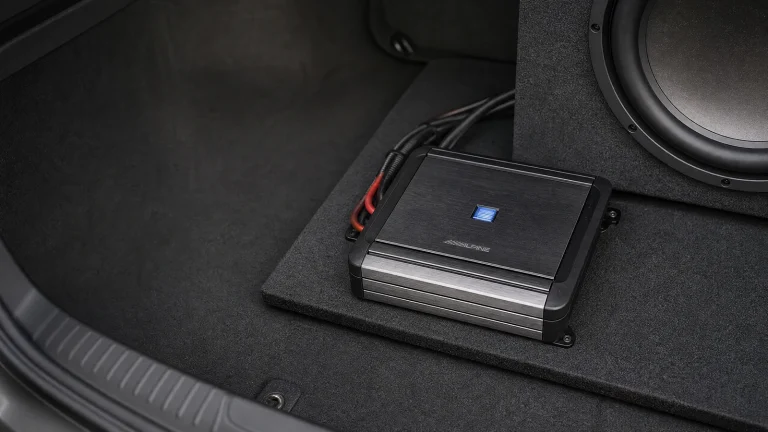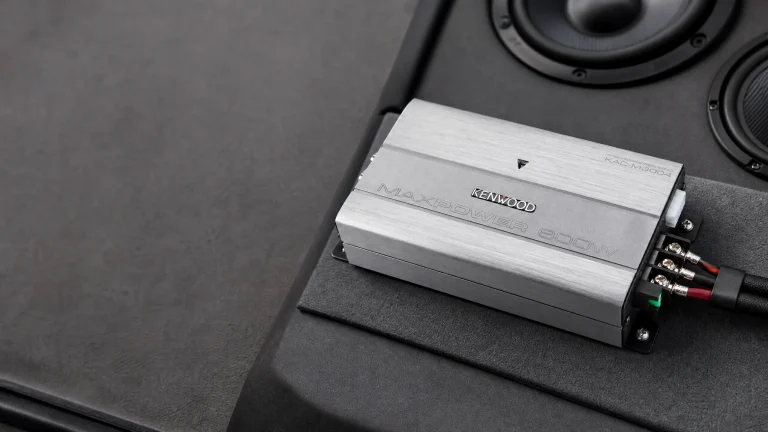
Ask anyone who’s mounted a car amplifier on a boat what happened after one season, and you’ll usually hear some version of the same story — corroded terminals, a dead board, or an amp that worked fine until the first humid week. The Kenwood KAC-M3001 was designed around avoiding that outcome. It won’t out-power the Alpine S-A60M or the Kicker 46CXA800.1, and it isn’t trying to. This Kenwood KAC-M3001 review looks at what you’re actually paying for when you choose durability over headroom, and whether that trade makes sense for your install.
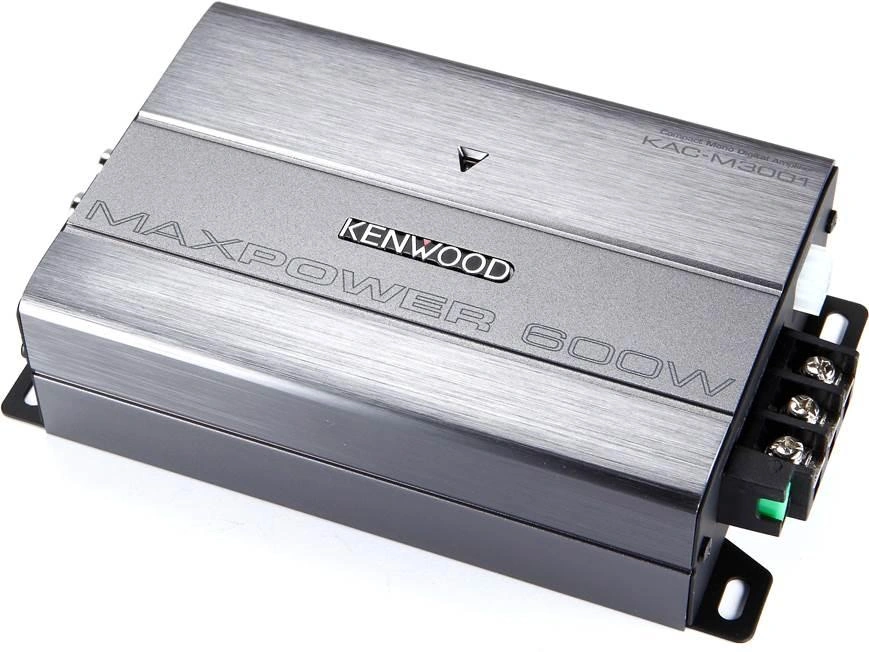
Specs at a Glance
| Spec | Detail |
|---|---|
| RMS Power | 200W @4Ω / 300W @2Ω |
| Class | Class D monoblock |
| Standard | CEA-2006 compliant |
| Signal-to-Noise | 97 dB |
| Filters | Variable low-pass, 50–200Hz @ 24dB/octave |
| Construction | Conformal-coated circuit board |
| Dimensions | 5-11/16″ W x 1-3/4″ H x 3-7/8″ D |
What the Coating Actually Protects Against
The failure mode that kills most amplifiers in marine or powersports use isn’t a single dramatic event — it’s slow. Humidity settles on the exposed circuit board, corrosion starts at solder joints and connector pins, and over a season or two, resistance builds up until the amp either sounds wrong or stops working entirely. Vibration from an engine or rough terrain accelerates the process by working connections loose.
Kenwood sprays the KAC-M3001’s board with a conformal coating — a thin polymer layer that seals the components against moisture without insulating the electronics themselves. It’s the same category of protection used on marine electronics generally, not something unique to car audio, and it’s the reason this amp is rated for environments a standard monoblock isn’t.
Worth setting realistic expectations here too: conformal coating meaningfully extends how long this amp survives in a harsh environment, but it isn’t permanent protection. Years of repeated humidity cycling, salt exposure, and vibration will eventually degrade any coating at the margins, typically starting at connector edges or solder points rather than failing all at once.
If you start noticing intermittent audio cutout during vibration, or a crackling sound that shows up specifically on bass-heavy passages, that’s often an early sign the coating is breaking down at a connection point — worth investigating before the amp fails outright. Our car amplifier no-sound troubleshooting guide covers how to track down exactly where a connection is failing.
The coating does most of the work, but a few installer habits meaningfully extend how long it stays effective. A drip loop in the power wire — a deliberate dip below the amp before the cable runs back up to the connection — lets water run off and drip away instead of following the cable straight into the housing. Mounting the amp with its terminals facing downward helps for the same reason: any moisture that does reach the connections sheds instead of pooling. A light coat of dielectric grease on the terminal connections themselves adds a second layer of protection at the one point the factory coating can’t fully seal, since the terminals have to stay exposed to make contact.
On realistic longevity: conformal coating isn’t permanent armor, and it’s worth setting honest expectations rather than treating “coated” as a solved problem. In a genuinely wet environment — regular spray exposure, high humidity, salt air — three to five seasons of reliable service is a reasonable expectation before the coating’s protection starts to degrade at the margins. Early signs worth watching for are intermittent cutout in humid conditions or a faint crackle on bass-heavy passages that wasn’t there when the amp was new — both point to corrosion starting at a connection point even while the board itself is still protected.
How Much Power You’re Giving Up
200W RMS at 4Ω and 300W at 2Ω, both CEA-2006 verified, puts the KAC-M3001 roughly a third below what the Alpine or Kicker deliver at similar money. That gap is real, and if raw output is your priority, it’s worth being honest about upfront rather than glossing over it.
What softens that tradeoff: a single compact subwoofer in a boat or on a motorcycle rarely needs 600–800W to sound good in that environment. Ambient noise from wind, water, and engine drown out a lot of the fine detail that extra headroom would otherwise buy you, so the practical gap feels smaller on the water than it does on paper.
Where This Makes Sense — and Where It Doesn’t
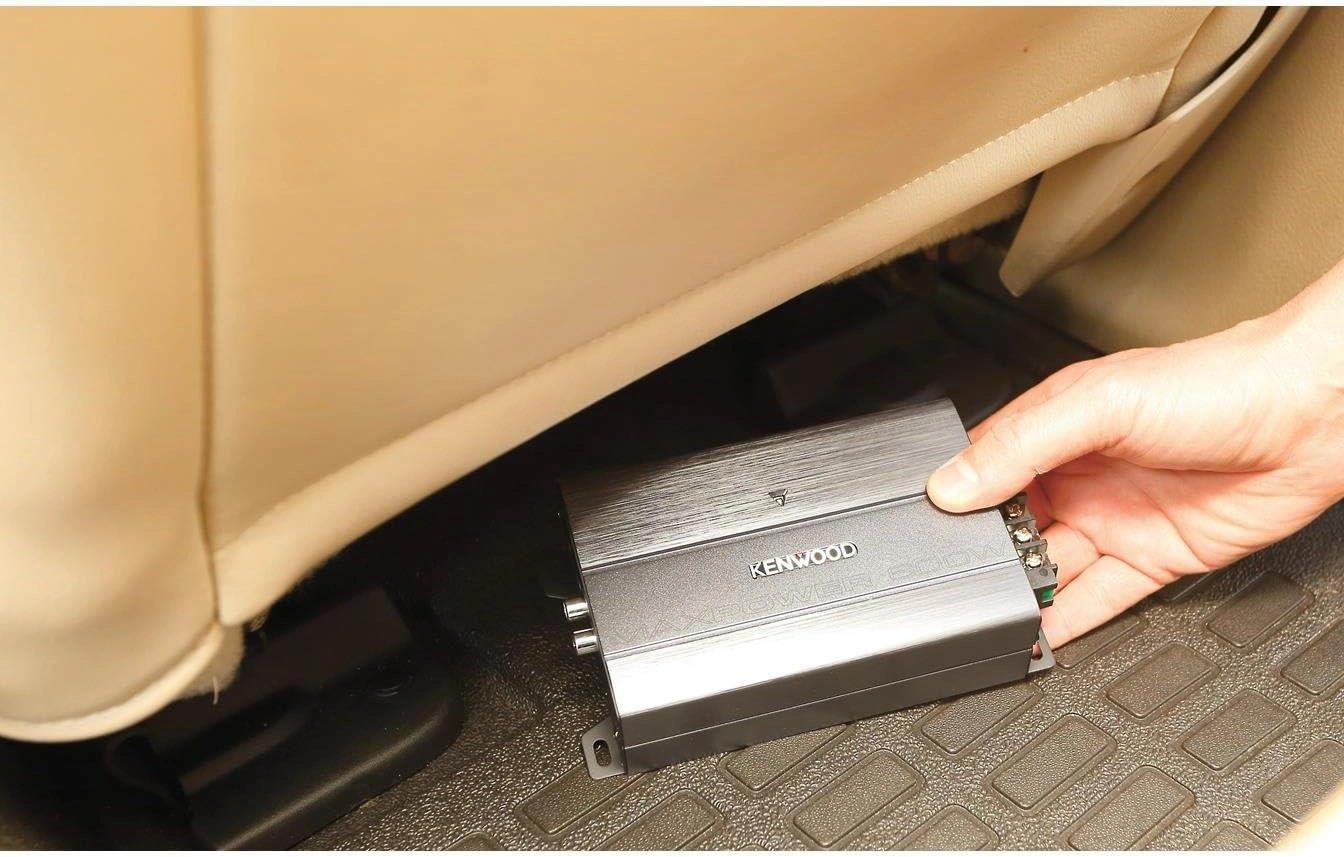
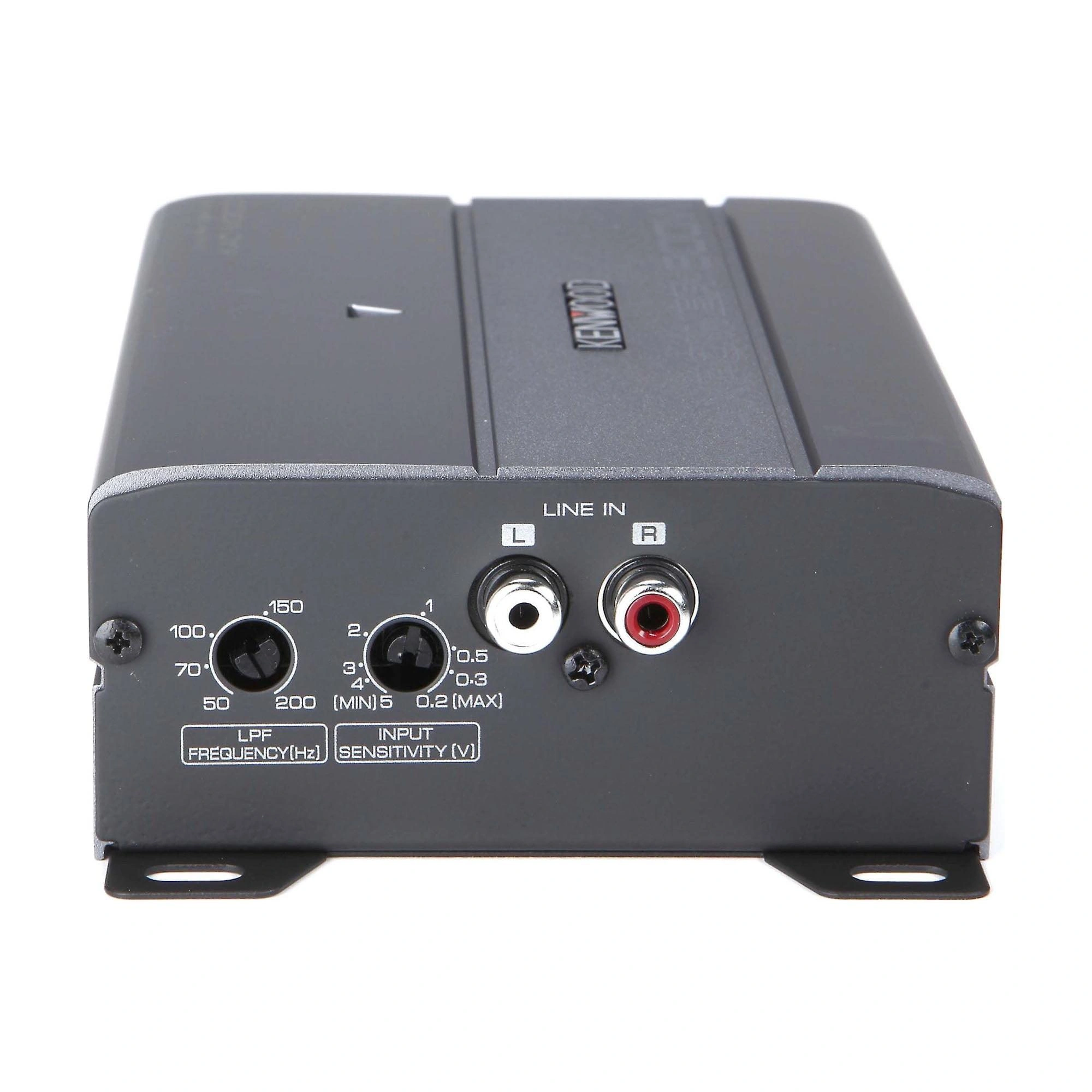
This amp earns its price in a narrow set of installs, and it’s worth being clear about which ones. At 5-11/16″ wide and just 1-3/4″ tall — barely taller than two stacked smartphones — the height is usually the dimension that decides whether it actually fits, since it’s slim enough to slide into spaces a standard car amp’s bulkier chassis can’t reach:
- Boat console or hull-mounted storage — routine exposure to humidity and spray, exactly the scenario the coating is built for
- Motorcycle saddlebag or fairing compartment — vibration and weather exposure over years of riding
- ATV or UTV storage bay — dust and moisture together, a harder combination than either alone
- A dry garage-kept car — technically works, but you’re paying for weatherproofing that never gets tested
Getting It Wired In
The KAC-M3001 accepts speaker-level input with automatic signal-sensing turn-on, so it can tap directly into most factory audio systems without running a dedicated remote-on wire — a genuine time-saver when the alternative is threading extra cable through a boat hull or under a motorcycle tank. Kenwood specifies 10-gauge power and ground wiring with a 30-amp fuse, which is appropriately sized for the amp’s power draw rather than oversized for a higher-output unit you’re not actually installing.
A few installer-level habits matter as much as the coating itself for how long this actually lasts. A small dab of dielectric grease on the power, ground, and speaker terminal connections before buttoning everything up blocks moisture from reaching the metal-to-metal contact points where corrosion actually starts — the coating protects the board itself, but exposed terminal connections are still a weak point.
Running the power wire with a drip loop, a low point in the cable before it reaches the amp, lets water follow gravity down and off the wire instead of tracking straight into the housing. Where the install allows it, mounting the amp with its terminals facing down rather than up means any moisture that does reach the connections sheds off instead of pooling against them. Our general amplifier install guide covers these wiring fundamentals in more depth if this is your first amp install.
One consideration that’s easy to miss coming from car audio: motorcycle charging systems are nowhere near as robust as a car’s. A typical car alternator puts out somewhere in the 1,000–3,000W range, so adding a 200–300W amp is a minor draw on the system.
A motorcycle’s charging system is a different story — output commonly runs anywhere from roughly 150W on smaller bikes to 400–600W on larger touring models, meaning this amp’s draw can represent a meaningful chunk of the bike’s total electrical budget rather than a rounding error. Check your specific bike’s charging output before wiring this in, especially if you’re already running heated grips, extra lighting, or other accessories off the same system.
One thing worth checking before buying, if this is going on a motorcycle specifically: charging system capacity works very differently than it does in a car. A typical car alternator puts out somewhere between 1,000 and 3,000 watts, so adding a 200-300W amp barely registers against the total budget. A typical motorcycle charging system often produces only 200-400 watts total, meaning this amp alone could account for a meaningful share of everything the bike’s electrical system has to offer — battery, lights, ignition, and everything else included. It’s rarely a dealbreaker, but it’s worth confirming your bike’s charging output can comfortably cover the addition before wiring it in, rather than finding out the battery drains on longer rides.
Coat every connection point — power, ground, and speaker terminals — with dielectric grease before buttoning up the install, even though the amp’s board is already protected. The grease seals out moisture at the one point the conformal coating can’t reach: the exposed metal-to-metal contact of the terminals themselves, which is where corrosion actually tends to start on a marine install.
Is the Durability Worth the Tradeoff?
Put plainly: if your amp will only ever see a dry trunk, buying the Alpine S-A60M or Kicker 46CXA800.1 instead gets you meaningfully more power for the same or less money — the coating on the KAC-M3001 would be doing nothing for you. But if there’s any real chance of sustained moisture exposure, the calculation flips. Replacing a corroded amp every season costs more over time than paying up front for one that’s built to survive the environment.
Pros & Cons
- Coated board survives conditions that kill standard amps — humidity, salt air, vibration
- Small enough for genuinely cramped mounting spots
- Wires into factory audio without a separate turn-on lead
- Power ratings hold up under CEA-2006 testing
- Roughly a third less power than a similarly priced car-only monoblock
- The weatherproofing is wasted money in a dry install
Best Alternatives to Consider
- Alpine S-A60M — better value if your install stays dry
- Kicker 46CXA800.1 — significantly more power for dedicated car sub duty
- Rockford Fosgate P500X2 — 2-channel option if your build also needs speaker power
Final Verdict
Judged purely on watts, the Kenwood KAC-M3001 loses to almost everything else in this price range. Judged on whether it survives a season on a boat, it wins by default — most competitors weren’t built to try. That makes this an easy skip for a dry car install and an easy yes for anything that regularly sees water, humidity, or serious vibration.
Frequently Asked Questions
How much RMS power does the Kenwood KAC-M3001 actually deliver?
Is the KAC-M3001 fully waterproof?
Should I buy this for a normal car install?
What wiring does the KAC-M3001 require?