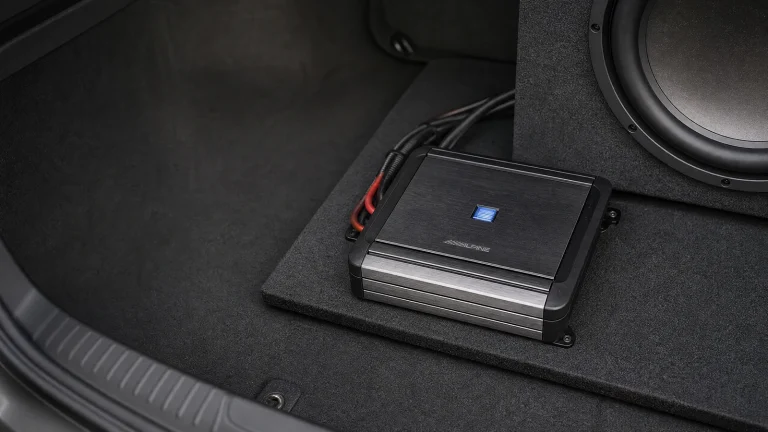
The Kenwood KAC-M3004 solves a specific installation problem: adding four channels of useful amplification when a conventional chassis will not fit. Its compact Class D design can run four speakers, or two bridged channels when the system needs a different balance of output and channel count. This Kenwood KAC-M3004 review focuses on the details that make this model different from a generic small car amplifier: its unusually short chassis, signal-sensing turn-on, 2-ohm four-channel capability, bridge-mode flexibility, and conformal-coated circuit board for carefully protected marine and powersports installations.
- KAC-M3004 Specs at a Glance
- What Makes the KAC-M3004 Distinctive
- Kenwood KAC-M3004 Product Image
- Installation and Connection Flexibility
- Four-Channel Versus Bridged Operation
- Independent Dyno Results
- Cars, Boats, Motorcycles, and ATVs
- Sound and System Matching
- How to Set the Gain
- How It Compares With Similar Amplifiers
- Who Should Buy It—and Who Should Skip It
- Final Verdict
- Kenwood KAC-M3004 Product Box
- FAQ
Kenwood KAC-M3004 Specs at a Glance
| Spec | Detail |
|---|---|
| Amplifier topology | Class D, four channels |
| Rated output at 4 ohms | 50 W RMS × 4 |
| Rated output at 2 ohms | 75 W RMS × 4 |
| Bridged output | 150 W RMS × 2 at 4 ohms |
| Chassis dimensions | 6-1/2 × 1-3/4 × 3-7/8 inches |
| Input and turn-on fit | RCA and speaker-level integration with signal-sensing turn-on |
| Environmental design note | Conformal-coated circuit board |
These figures come from Kenwood’s official KAC-M3004 specifications. They describe the amplifier’s rated operating modes, not a promise that every speaker, vehicle, or installation will produce the same real-world result.
What Makes the KAC-M3004 Distinctive
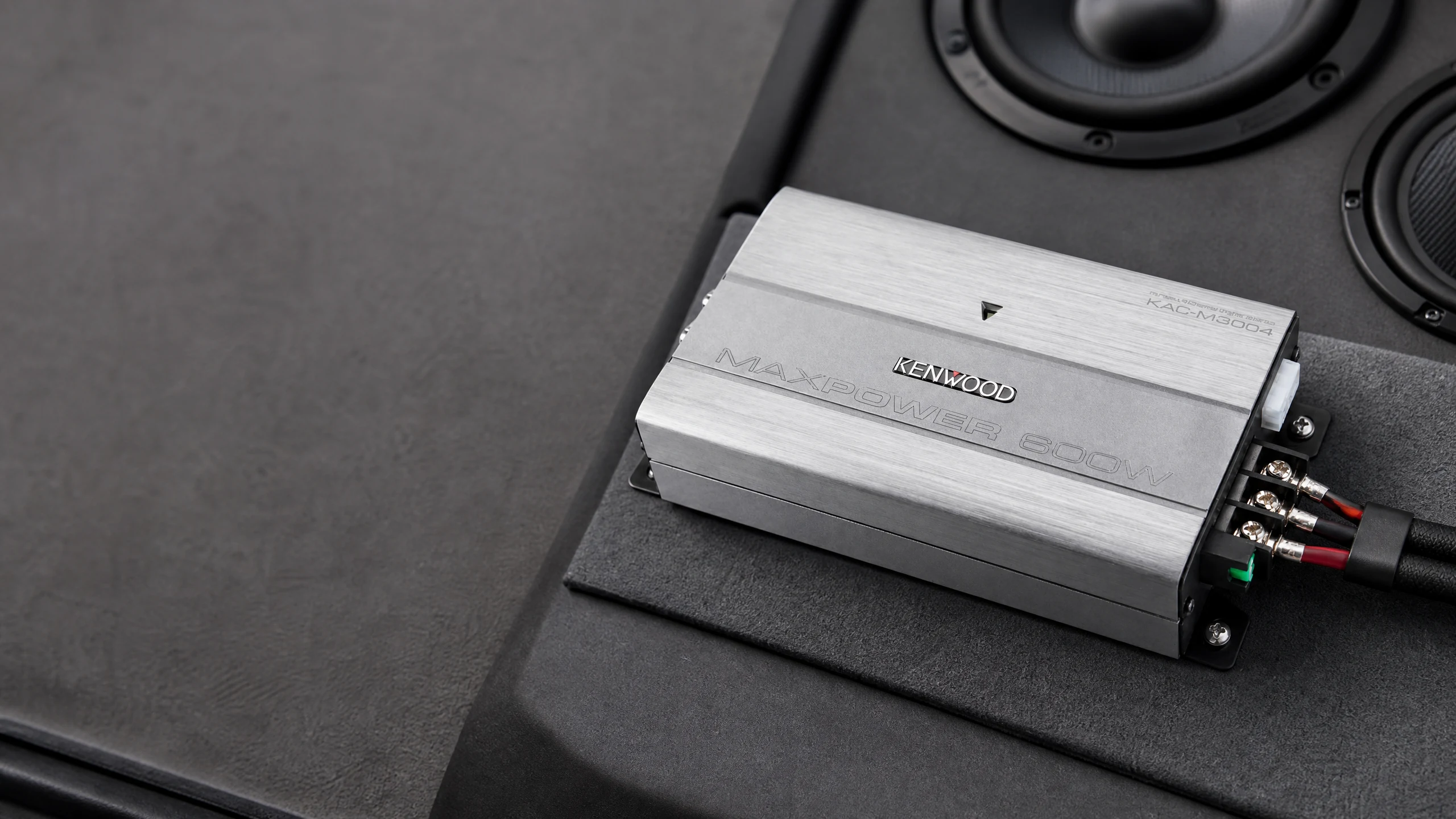
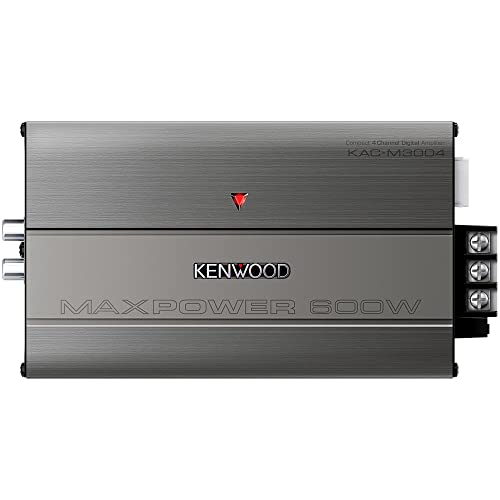
The KAC-M3004’s defining feature is not a high headline wattage. It is the combination of a very short chassis and four-channel flexibility. At only 1-3/4 inches high and less than seven inches long, it can fit in places where a typical trunk amplifier cannot: behind a seat, under a dash, beside a factory source, or inside a carefully protected powersports enclosure. That makes it a practical packaging solution rather than simply a smaller version of a larger amplifier.
Its second useful distinction is the way the channel count can change with the system. In four-channel mode, the amplifier can support a front-and-rear speaker layout or another four-speaker arrangement. In bridged mode, two channel pairs become two higher-output channels. That does not make it a dedicated subwoofer amplifier, but it gives an installer more ways to use the same compact chassis as the system evolves.
The signal-sensing turn-on is another meaningful fitment feature. A factory radio or powersports source may not provide a conventional remote lead, so the ability to respond to an incoming audio signal can reduce integration work. It still needs to be verified with the specific vehicle because factory audio systems differ in their signal behavior, delay logic, and noise-management systems.
Installation and Connection Flexibility
The KAC-M3004 makes the most sense when the installation needs more than one channel but the vehicle does not offer a convenient full-size amplifier location. Before running any cable, map the power, ground, signal, speaker, and ventilation paths. Our car amplifier installation guide covers the broader routing and protection process; the KAC-M3004’s small chassis does not remove the need for a properly fused power feed, a solid ground, secure terminals, and serviceable cable routing.
For a factory radio, speaker-level inputs and signal-sensing turn-on can simplify integration because the amplifier can respond to the source signal instead of depending on an aftermarket head unit with a conventional remote lead. When RCA outputs are available, the installation can use the line-level path instead. The right choice depends on the source unit, the vehicle’s factory processing, and whether the new amplifier is replacing or supplementing the factory power stage.
Speaker matching deserves the same care. Use the amplifier and car-speaker matching guide to compare the speaker’s nominal impedance and continuous-power needs with the amplifier’s operating mode. The 2-ohm rating may be useful for a compatible multi-speaker arrangement, but it is not an invitation to combine loads without checking the final impedance seen by each channel.
Finally, treat the compact body as a fitment advantage, not as permission to bury it in insulation or place it against a hot surface. Leave enough room for wiring, inspection, and heat to leave the installation area. A small amplifier is easier to hide; it is not easier to service when every connector is trapped behind trim.
Four-Channel Versus Bridged Operation
In its straightforward configuration, the KAC-M3004 supplies four amplified channels for a front-and-rear speaker system or another four-speaker layout. The published 50 W RMS × 4 at 4 ohms is the most useful reference point for typical full-range speakers, while the 75 W RMS × 4 at 2 ohms applies only when the connected loads and wiring are appropriate for that operating condition.
Bridging changes the role of the amplifier. By combining two channels, the KAC-M3004 is rated for 150 W RMS × 2 at 4 ohms. That can make sense when the system needs more output for two channels and does not need all four channels independently. It also changes the impedance each channel section sees, so the speaker impedance and the specific bridge wiring pattern matter. Never assume that any 2-ohm speaker arrangement is safe in bridged mode.
Our guide to bridging a four-channel car amplifier explains the general wiring logic, while the more specific guide to bridging a four-channel amplifier to one subwoofer clarifies the channel and impedance trade-offs. Use those guides for the wiring concepts, then confirm the KAC-M3004’s terminal layout and allowable load in the Kenwood documentation before making the connection.
Independent Dyno Results
The manufacturer ratings are useful starting points, but an independent test gives the KAC-M3004’s output claims more context. In a Williston Audio Labs dyno video documented in the accompanying Steve Meade Designs test thread, the amplifier completed a certified 4-ohm bridged run at approximately 13.93 VDC and below 1% THD. The video shows 192 watts on one bridged channel and 187 watts on the other, compared with Kenwood’s published 150 W RMS × 2 bridged rating.
What that result means: the measured certified output was roughly 25–28% above the published bridged rating under that test condition. It is useful evidence that this small amplifier has real output reserve, but it is not a promise that every vehicle, power supply, speaker load, or installation will reproduce the same numbers. The video also includes dynamic burst tests; those should not be confused with continuous RMS output, and the 2-ohm bridged stress run should not be treated as a recommended operating mode.
Cars, Boats, Motorcycles, and ATVs
The KAC-M3004 is unusually versatile on paper because the same space-saving problem appears across several vehicle types. In a car, its short chassis can help when the only realistic mounting area is behind a seat, under a dash, or near a factory source. In a boat, motorcycle, or ATV, the same footprint can simplify packaging around storage compartments and existing harnesses, provided the enclosure protects the amplifier from direct exposure.
Kenwood’s conformal-coated circuit board is best understood as an extra layer of environmental protection, not as waterproof construction. The KAC-M3004 still needs a dry, ventilated, mechanically secure location with connectors protected from direct spray, standing water, heavy dust, excessive heat, and prolonged humidity. It can be considered for marine and powersports installations when mounted inside a suitable protected enclosure; it should not be bolted into an exposed splash zone and left to deal with the weather on its own.
Sound and System Matching
The KAC-M3004’s value is primarily about system architecture, not a claim of a particular sonic signature. A clean installation with compatible speakers, an adequate power feed, and sensible gain settings should be the goal. The amplifier’s 50 W RMS per channel at 4 ohms is a natural match for many efficient full-range car speakers that need more headroom than a factory radio can provide, especially when the goal is clearer output at normal listening levels rather than competition-level volume.
The 2-ohm mode can be useful in systems that intentionally present a compatible lower-impedance load, but it increases the importance of wiring, ventilation, current capacity, and careful setup. If the system uses demanding speakers, a large cabin, or a subwoofer that needs substantial continuous power, the compact KAC-M3004 may not offer enough reserve. In that case, a more powerful four-channel amplifier or a dedicated monoblock is the more coherent solution.
How to Set the Gain
Gain is not a volume control; it matches the amplifier’s input sensitivity to the source. After the speakers and crossover settings are chosen, set the source to a clean test track or test tone and begin with the amplifier gain at minimum. For a more repeatable setup, disconnect the speakers and use a multimeter set to AC volts: a 4-ohm channel targeting 50 W needs about 14.1 VAC, a 2-ohm channel targeting 75 W needs about 12.2 VAC, and a 4-ohm bridged pair targeting 150 W needs about 24.5 VAC across the bridged output.
Practical sequence: use a clean 0 dB test tone appropriate to the system, raise the source only to the highest level that remains clean, then increase the amplifier gain until the calculated target voltage is reached. Stop if the waveform clips on an oscilloscope, a clipping detector indicates distortion, or audible harshness appears. Reconnect the speakers, confirm polarity and channel balance, and leave some source-level margin rather than treating the maximum test-tone setting as a normal listening level. Our car-amplifier testing guide covers the broader verification process.
How It Compares With Similar Amplifiers
The alternatives mentioned throughout this review serve different system goals. This table puts their basic power, channel count, and physical scale next to the KAC-M3004 so the choice does not depend on scattered references in the narrative.
| Model | Channels | RMS power reference | Dimensions (W × H × D) | Best fit |
|---|---|---|---|---|
| Kenwood KAC-M3004 | 4 | 50 W × 4 @ 4 Ω; 75 W × 4 @ 2 Ω; 150 W × 2 bridged @ 4 Ω | 6-1/2 × 1-3/4 × 3-7/8 in | Compact four-speaker or flexible bridged installation |
| Kenwood KAC-M3001 | 1 | 200 W × 1 @ 4 Ω; 300 W × 1 @ 2 Ω | 5-11/16 × 1-3/4 × 3-7/8 in | Compact subwoofer-first system |
| Rockford Fosgate P500X2 | 2 | 150 W × 2 @ 4 Ω; 250 W × 2 @ 2 Ω; 500 W × 1 bridged @ 4 Ω | 7.76 × 2.38 × 13.28 in | Higher-output two-channel or bridged subwoofer system |
| Alpine MRV-F300 | 4 | 50 W × 4 @ 4 Ω; 75 W × 4 @ 2 Ω; 150 W × 2 bridged @ 4 Ω | 7.0 × 2.1 × 6.8 in | Compact four-channel alternative with a larger chassis |
The KAC-M3004 and Alpine MRV-F300 occupy a similar four-channel power class, but the Kenwood is notably shorter and lower. The KAC-M3001 and P500X2 make more sense when the system is centered on one or two higher-output channels rather than four independent full-range channels. Dimensions and ratings should be checked against the current manufacturer or product documentation before purchase.
Who Should Buy It—and Who Should Skip It
Choose it when: the system needs four channels in a very small mounting area; the source is a factory radio that benefits from speaker-level integration and signal-sensing turn-on; or the vehicle is a car, boat, motorcycle, or ATV that needs a compact amplifier in a carefully protected location.
Think twice when: the main goal is high-power subwoofer output, the amplifier would be exposed directly to water or extreme heat, or the system needs substantially more headroom than a compact 50 W-per-channel design can provide.
Consider another path when: only two channels are required, the system is centered on a dedicated monoblock, or the installation has enough room for a larger amplifier with greater continuous-power reserve. The Kenwood KAC-M3001 review is the closer same-brand reference for a subwoofer-first system, while the Rockford Fosgate P500X2 review is a more relevant two-channel comparison.
For a broader four-channel comparison, see our Alpine MRV-F300 review and four-channel amplifier buying guide. A system built around one subwoofer should start with the monoblock amplifier guide, while a two-channel system can begin with the two-channel car amplifier guide.
AmplifierZone Editorial Rating
A compact Class D four-channel with clean output at rated power and solid thermal management — reliable for component speakers or a mixed speaker/sub setup.
Reviewed by AmplifierZone Editorial Team · September 2026
Final Verdict
The Kenwood KAC-M3004 earns its place by solving a real packaging problem without giving up four-channel flexibility. Its compact Class D chassis can power four compatible speakers, operate with a suitable 2-ohm load, or shift into a two-channel bridged role when that better suits the installation. Signal-sensing turn-on and the conformal-coated board add practical value for carefully protected car, marine, motorcycle, and ATV systems.
It is not a universal answer. The output class is better suited to moderate-power full-range speaker systems than to a demanding subwoofer-first build, and the independent test does not change the need to match the amplifier to the installation. If the project needs compact four-channel amplification and the installation can provide proper protection, the KAC-M3004 is a thoughtful space-saving option. If it needs much more headroom, exposed-weather durability, or dedicated bass power, choose an amplifier around the system’s required channel count, load, environment, and reserve instead.
Frequently Asked Questions
How much RMS power does the Kenwood KAC-M3004 produce?
Can the KAC-M3004 run four speakers at 2 ohms?
What does bridging the KAC-M3004 do?
Is the KAC-M3004 waterproof or suitable for open-air installation?
Can it turn on from a factory radio without a traditional remote lead?