
Choosing between 7.1 and 5.1.2 is less about counting speakers than deciding where you want the extra layer of sound to come from. A 7.1 system adds two surround-back speakers behind the seating position. A 5.1.2 system keeps five ear-level speakers but adds two height or overhead speakers for Dolby Atmos effects.
That difference matters because the best layout depends on your room, seating distance from the back wall, receiver channels, and willingness to install speakers overhead. This guide explains the trade-off in practical terms so you can choose a layout that will work in your actual home theater rather than chasing a larger number on a specification sheet.
What 7.1 and 5.1.2 mean
Home-theater notation describes speaker groups in a fixed order. The first number is the number of standard ear-level speakers, the second is the number of subwoofers, and the third is the number of height speakers. Dolby uses this format in its Atmos setup guidance.
In 7.1, the seven main speakers are normally a left and right front pair, a center speaker, left and right side surrounds, and left and right surround-back speakers. The “.1” represents one subwoofer channel, although many receivers provide two subwoofer outputs. The defining addition is the rear-surround pair behind the listening position.
In 5.1.2, the five main speakers are left and right fronts, center, and left and right surrounds. The “.1” again represents the subwoofer channel. The final “.2” adds two height speakers, which can be in-ceiling, on-ceiling, or Dolby Atmos-enabled upward-firing modules supported by the receiver and room.
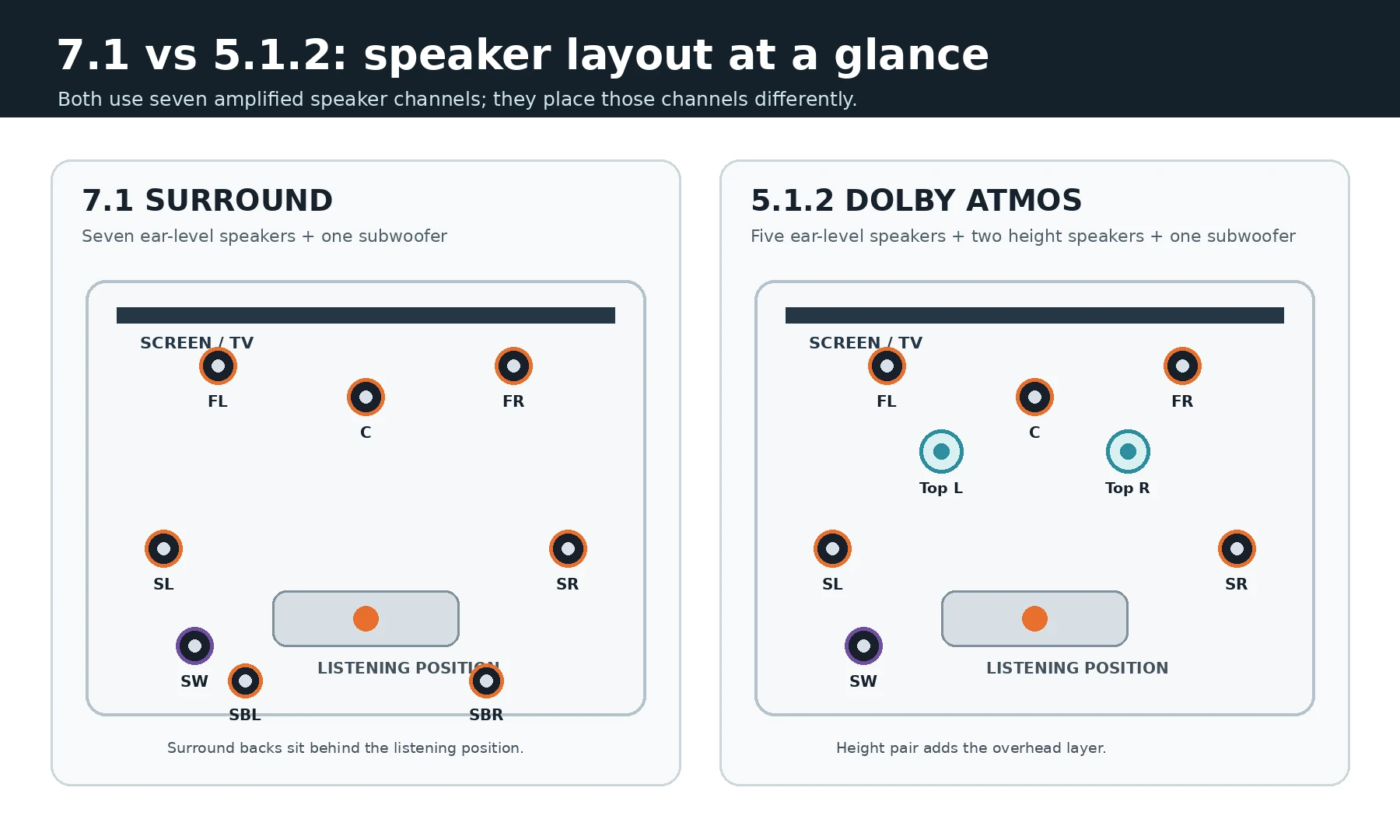
In short, 7.1 extends horizontal rear envelopment, while 5.1.2 adds a vertical dimension for overhead effects and ambience.
7.1 vs 5.1.2: quick comparison
| Consideration | 7.1 | 5.1.2 |
|---|---|---|
| Ear-level speakers | Seven main speakers | Five main speakers |
| Extra speaker pair | Surround-back speakers behind seating | Height or overhead speakers above the listening area |
| Best room shape | Seating well away from the rear wall | Room with workable ceiling or upward-firing reflection conditions |
| Main advantage | More rear-to-side envelopment at ear level | Dolby Atmos height effects and vertical spaciousness |
| Main limitation | Rear surrounds are ineffective when seats touch the back wall | Height speakers lose value when placement or reflection angles are poor |
| Receiver requirement | Seven amplified channels with 7.1 processing | Seven amplified channels with 5.1.2 or Atmos amp assignment |
Neither layout is automatically higher quality. The receiver may be capable of both, but the room decides whether the extra pair can do its job. Speaker position and calibration are more important than simply filling every available terminal.
What 7.1 adds
A 7.1 system extends a conventional 5.1 layout by adding left and right surround-back speakers. The side surrounds remain to the left and right of the main seats,