Every other desktop DAC/amp in the under-$250 category uses either an ESS or AKM DAC chip. The iFi Zen DAC 3 uses a Burr-Brown True Native chip — and that single design choice produces a genuinely different listening experience that the measurement-optimised competition does not replicate. At $229, it sits at the top of the price range in the best DAC/amp combo under $250 roundup, and it earned its place there specifically because its sonic character occupies a category that nothing else at this price fills.
This review covers who the Zen DAC 3 is actually built for, what the Burr-Brown character sounds like in practice across different music genres and headphone types, where the power limitation becomes a real problem rather than a theoretical one, and how it compares to the wired alternatives. If you already know what Burr-Brown sounds like and are deciding whether to upgrade from the original Zen DAC V2, this review covers that comparison specifically.
Quick Answer: The iFi Zen DAC 3 is the right choice for listeners who find ESS and AKM DAC signatures too analytical or fatiguing over long sessions — specifically for acoustic, jazz, classical, and vocal music where Burr-Brown’s organic midrange character adds musical engagement that other chips do not provide. It includes 4.4mm balanced output and useful tuning features. The limitation is power: at ~280mW single-ended and ~330mW balanced, it does not suit demanding 250Ω+ dynamics or planar magnetics.
This article contains affiliate links. If you purchase through them, we may earn a commission at no extra cost to you. This helps support AmplifierZone and allows us to keep creating in-depth, unbiased audio guides.
Who Is the iFi Zen DAC 3 For?
Specifically, the Zen DAC 3 is built for listeners who have heard ESS-based units and found them slightly cold, over-precise, or fatiguing on long listening sessions — and who want a desktop DAC/amp that prioritises musical engagement over measurement optimisation. Indeed, that is a specific and legitimate preference, not a compromise. Burr-Brown’s organic midrange character has a long history in high-end audio equipment precisely because it suits the way many listeners experience music emotionally rather than analytically.
Specifically, three profiles fit this unit well. Listeners who primarily play acoustic music — jazz, classical, folk, vocal recordings — where the Burr-Brown midrange adds tonal density and realism to instruments and voices. Listeners who own warm-leaning headphones and want a DAC that complements rather than amplifies that character with the precision of an ESS chip. And listeners who want 4.4mm balanced output at this price from a unit with genuine sonic character rather than a neutral measurement platform.
However, the Zen DAC 3 is less suited to listeners with demanding high-impedance headphones. At approximately 280mW single-ended and 330mW balanced, its output power is the lowest in this group — not appropriate for 300Ω dynamics or planar magnetics that require significant current. For those headphones, the headphone amp guide covers the power requirements clearly, and the FiiO K5 Pro ESS or K7 are the correct tools.
The listening test that decides it: Put on an acoustic guitar recording or a jazz vocal through your current setup. If it sounds detailed but slightly thin or clinical, a Burr-Brown unit like the Zen DAC 3 will add the tonal warmth and organic texture you are missing. If your current setup already sounds warm and you want more precision, an ESS-based unit like the Topping DX3 Pro+ is the better direction.
iFi Zen DAC 3 — Key Specifications
iFi Zen DAC 3 Desktop DAC and Headphone Amplifier
- DAC chip: Burr-Brown True Native (Texas Instruments)
- Headphone power (SE): ~280mW into 32Ω via 6.35mm
- Headphone power (BAL): ~330mW into 32Ω via 4.4mm Pentaconn
- Headphone outputs: 6.35mm single-ended + 4.4mm balanced
- Digital input: USB-C only
- Line output: RCA stereo
- Bluetooth: No
- Balanced output: Yes — 4.4mm Pentaconn
- Tuning features: TrueBass | PowerMatch gain | iEMatch for sensitive IEMs
- Resolution: Up to PCM 768kHz/32-bit, native DSD512
- Power supply: USB-C bus-powered
- Burr-Brown True Native chip — warm, organic midrange distinct from ESS/AKM alternatives
- 4.4mm balanced output — available at this price with this DAC technology
- TrueBass, PowerMatch, iEMatch — three practical tuning options in one unit
- Native DSD512 and 768kHz/32-bit — maximum resolution support
- Both 6.35mm SE and 4.4mm BAL outputs — covers all headphone terminations
- Compact, distinctive industrial design — smallest footprint in this group
- USB-C bus-powered — no separate power adapter
- Lowest output power in this group — not for 250Ω+ dynamics or planars
- USB-C input only — no optical, coaxial, or analogue RCA input
- No Bluetooth, no remote control
- Most expensive unit in this group at $229
- Single digital input limits multi-source flexibility
Approx. price: $229.00. Best warmth pick — Burr-Brown True Native, 4.4mm balanced, TrueBass and iEMatch. Most expensive unit in the group; USB-C only input.
Design and Build Quality
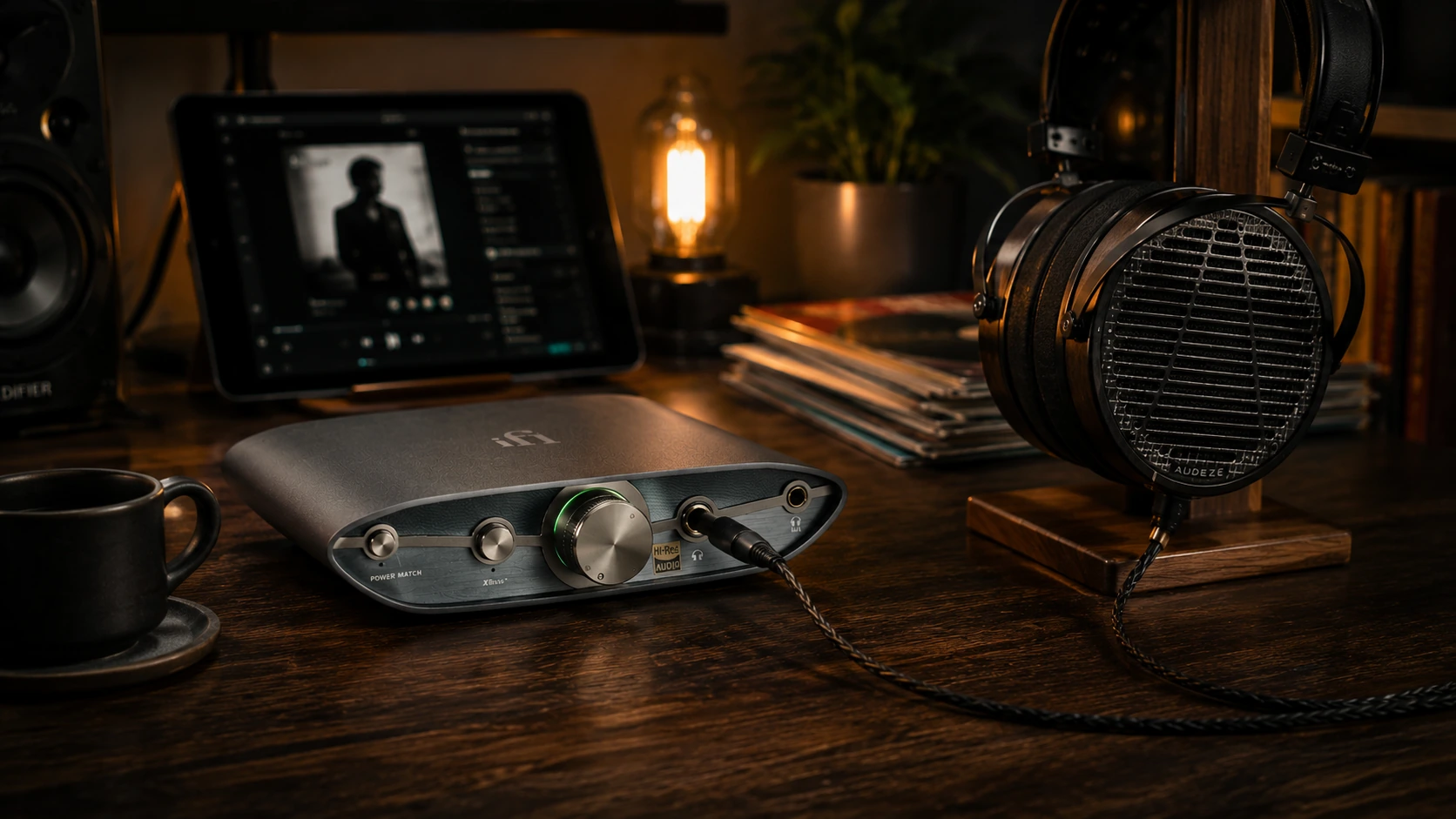
The Zen DAC 3 is compact — the smallest unit in this group — with an angular, dark-grey industrial design that is immediately distinctive. The aluminium enclosure is solid, the volume knob is smooth and well-damped, and the front panel is uncluttered: 6.35mm and 4.4mm headphone outputs on the left, three function buttons in the centre (TrueBass, PowerMatch, iEMatch), and the volume knob on the right.
The three function buttons are backlit and clearly indicate their active state. Specifically, the iEMatch button engages a high-impedance output attenuator specifically for sensitive IEMs — reducing the output impedance to prevent tonal colouration that occurs when a low-impedance IEM is driven from a higher-impedance source. Specifically, this is a feature that most DAC/amps in this category do not offer and that matters practically for IEM listeners who want accurate tonal response at low volume levels.
The rear panel is minimal: one USB-C input and one pair of RCA line outputs. The USB-C port handles both data and power — the unit is bus-powered entirely from the USB connection, which keeps the desk cable count low. However, the single-input limitation is the Zen DAC 3’s most significant practical constraint. Unlike every other unit in this group, there is no optical, coaxial, or analogue RCA input. The Zen DAC 3 connects to one source device — a computer — and nothing else without additional hardware.
The Burr-Brown Character — What It Sounds Like and Why It Matters
Specifically, the Burr-Brown True Native DAC chip handles PCM and DSD natively — it does not convert DSD to PCM internally before playback, which is the approach most DAC chips take. Specifically, this native processing is iFi’s primary argument for Burr-Brown over ESS and AKM: the claim is that native DSD playback preserves more of the original recording’s character without the artefacts of DSD-to-PCM conversion. Whether this is measurably significant at normal listening levels is debated — but the sonic character of Burr-Brown implementations is consistently described by experienced listeners as warmer, more organic, and more natural-sounding than comparable ESS chips.
Specifically, in practice, the character manifests in the midrange and upper bass. Specifically, ESS chips tend towards a more analytical, precise presentation — excellent measured performance with a slightly clinical character that resolves fine detail at the cost of some tonal warmth. By contrast, Burr-Brown adds a tonal density to instruments and voices in the 200Hz–3kHz range that makes acoustic recordings sound more physically present and less processed. Consequently, the effect is most noticeable on acoustic guitar, piano, strings, jazz vocals, and orchestral recordings — the genres where midrange tonal density matters most.
However, it is important to understand that this character is a design choice, not a measurement advantage. ESS chips measure better on standard audio benchmarks. Burr-Brown chips are chosen specifically for their sonic character by manufacturers who believe measurements do not fully capture what makes music engaging to listen to. Indeed, both positions have merit — and the correct choice depends entirely on what you want from your listening experience.
Sound Quality by Genre and Headphone Type
Acoustic and classical music
Specifically, this is where the Zen DAC 3 is most clearly differentiated from the competition. Specifically, acoustic guitar recordings have a woody resonance and physical body through the Burr-Brown chip that ESS-based units do not reproduce in the same way. Furthermore, piano has more weight in the lower octaves. Orchestral strings have a warmth and bloom that sounds natural rather than processed. Specifically, for listeners whose primary musical diet is jazz, classical, folk, or chamber music, the Zen DAC 3 produces a listening experience that is more engaging and less fatiguing than technically superior alternatives.
Electronic and modern production
However, the Zen DAC 3 is less obviously suited to highly produced electronic music, modern pop, or genres where analytical precision and tight bass definition are the primary sonic priorities. Specifically, the Burr-Brown warmth that adds body to acoustic instruments can make synthesised bass lines sound slightly softer and less defined than through an ESS-based unit. For listeners whose primary genre is electronic, hip-hop, or heavily produced modern music, the FiiO K5 Pro ESS or Topping DX3 Pro+ are likely more appropriate.
With sensitive headphones and IEMs
Specifically, the Zen DAC 3 works exceptionally well with sensitive, easy-to-drive headphones in the 16–150Ω range. The iEMatch feature specifically addresses IEM compatibility — engaging it reduces the output impedance and eliminates the frequency response colouration that sensitive IEMs experience when driven from higher-impedance outputs. The noise floor is low despite bus-powered operation. For IEM listeners who want Burr-Brown’s midrange character in a compact, desk-friendly unit, the Zen DAC 3 is genuinely difficult to beat at this price.
With demanding headphones
However, the power limitation becomes relevant above 150Ω. Sennheiser HD 600 at 300Ω can be driven to comfortable volume levels in balanced mode, but bass authority and dynamic headroom are noticeably reduced compared to the FiiO K5 Pro ESS or K7 at the same impedance. Planar magnetics require current delivery that the Zen DAC 3 cannot provide. Consequently, for listeners whose primary headphones are demanding, the Zen DAC 3 is the wrong tool regardless of how much they prefer the Burr-Brown character.
iFi Zen DAC 3 — best genres and headphone matches:
- Excellent: Jazz, classical, acoustic, folk, vocal — Burr-Brown adds organic body
- Good: Rock, indie, pop — character suits most guitar-based music well
- Moderate: Electronic, hip-hop — warmer presentation suits some, not others
- Best headphone match: 16–150Ω sensitive dynamics and IEMs
- Not recommended for: 250Ω+ dynamics or planar magnetics
Tuning Features — TrueBass, PowerMatch, iEMatch
The three front-panel buttons add practical flexibility that no other unit in this group offers. Each targets a specific listening scenario:
TrueBass applies a psychoacoustic bass enhancement using iFi’s Z-Buffer circuit — specifically designed to add low-frequency weight and extension without the bloat of conventional bass boost EQ. Useful for headphones with limited bass extension or listeners who want more low-frequency presence without changing the overall tonal balance significantly. Not a substitute for a more powerful amplifier with demanding headphones, but a legitimate tool for tuning the listening experience with efficient headphones.
PowerMatch is a two-stage gain selector — standard and high gain. In standard mode, the Zen DAC 3 provides fine volume control for sensitive headphones and IEMs. High gain is intended for less sensitive, higher-impedance headphones where standard mode reaches its limits before the desired listening volume. Specifically, for most headphones below 150Ω, standard mode is correct. Furthermore, high gain extends the usable range for headphones in the 150–250Ω range, though it will not adequately drive 300Ω dynamics to their full capability even in high gain mode.
iEMatch inserts a high-impedance attenuator into the signal path specifically for sensitive IEMs — reducing the output level and matching the output impedance to prevent tonal colouration. Consequently, IEMs that exhibit bass roll-off or brightness changes when driven from standard headphone outputs perform more accurately with iEMatch engaged. This is the most audiophilically precise of the three features and the one that matters most for critical IEM listeners.
How the iFi Zen DAC 3 Compares
iFi Zen DAC 3 vs FiiO K5 Pro ESS
The K5 Pro ESS costs $60 less and delivers more than five times the headphone output power — 1,500mW versus ~280mW. Specifically, for demanding headphones, the K5 Pro ESS is the correct choice with no meaningful comparison required. For easy-to-drive headphones where power is not the constraint, the Zen DAC 3’s Burr-Brown character is genuinely more engaging for acoustic listening than the K5 Pro ESS’s AKM presentation. Additionally, the Zen DAC 3 adds the 4.4mm balanced output and three tuning features. The K5 Pro ESS adds three digital input options the Zen DAC 3 completely lacks. Choose based on headphone impedance and musical priorities.
iFi Zen DAC 3 vs FiiO K7
The K7 at $220 — $9 less than the Zen DAC 3 — offers more output power (2W balanced, 1.2W SE), dual AK4493S chips, THX AAA amplifier, and three digital inputs. The Zen DAC 3 offers Burr-Brown character, iEMatch, TrueBass, and a more compact design. Consequently, for balanced output with demanding headphones, the K7 is the stronger tool. For sensitive headphones where the Burr-Brown midrange character is the priority, the Zen DAC 3 produces a more musically engaging result despite its lower technical specification. Indeed, these are not competing for the same listener.
iFi Zen DAC 3 vs iFi Zen DAC V2
Specifically, the V2 is the direct predecessor. The Zen DAC 3 adds several meaningful improvements: an updated Burr-Brown chip with improved measured performance, a refined amplifier stage with lower output impedance, and more consistent iEMatch attenuation. Specifically, for existing V2 owners, the upgrade is worthwhile if you primarily use sensitive IEMs — the lower output impedance improvement benefits IEM performance directly. For full-size headphone users at moderate volumes, the difference is smaller but still audible in direct comparison.
Best Headphone Pairings
The Zen DAC 3 is matched for headphones in the 16–150Ω range. The Burr-Brown character pairs most naturally with headphones that have a neutral to slightly bright tonal balance — the warmth it adds complements rather than doubles the character of an already warm headphone.
| Headphone | Impedance | Tonal Character | Result with Zen DAC 3 | Recommended? |
|---|---|---|---|---|
| Sennheiser HD 560S | 120Ω | Neutral, slightly bright | Burr-Brown adds midrange warmth — excellent pairing for classical | Yes — highly recommended |
| Audio-Technica ATH-R70x | 470Ω | Reference neutral | Underpowered at 470Ω — not recommended despite tonal match | No — insufficient power |
| Beyerdynamic DT 880 Pro 250Ω | 250Ω | Neutral, extended treble | High gain mode needed, borderline power — acceptable at moderate volume | Marginal — K5 Pro ESS better |
| Grado SR80x | 32Ω | Forward midrange, bright | Burr-Brown tames the Grado brightness — natural, engaging result | Yes — excellent pairing |
| Shure SE535 IEM | 36Ω | Warm, smooth | iEMatch engaged — low noise, accurate tonality, musical character | Yes — ideal IEM pairing |
| Moondrop Aria IEM | 32Ω | Neutral-warm | iEMatch optional — clean, musical, well-matched character | Yes — very good pairing |
| Sennheiser HD 600 | 300Ω | Neutral, reference | Power-limited — lacks bass authority and dynamic headroom | No — use FiiO K5 Pro ESS or K7 |
Is the iFi Zen DAC 3 Worth It?
Specifically, at $229, the iFi Zen DAC 3 is worth buying for listeners who want Burr-Brown’s musical character in a balanced-output desktop unit and whose headphones are under 150Ω. For that listener, it delivers a sonic experience that none of the competing units at this price provide — genuinely different, not just marginally better in one specification. The three tuning features add practical flexibility, and the compact design suits limited desk space well.
However, the case becomes difficult outside that profile. At $229 — the most expensive unit in this group — the Zen DAC 3 offers the least output power, a single digital input, and no wireless capability. Compared to the FiiO K7 at $220, it costs more for less power, fewer inputs, and a different (not superior) DAC chip. The Zen DAC 3 justifies its price through its character, not its specification. Consequently, for listeners who prioritise technical performance and specification over sonic character, the K7 is the better investment.
Single input limitation is a real constraint. USB-C only means the Zen DAC 3 connects to one source. No TV connection via optical, no CD player via coaxial, no second computer via switching. If your listening setup involves multiple source devices, the Zen DAC 3 requires a USB switch or limits you to one source. Every other unit in this group handles multiple sources natively.
Final Verdict
Specifically, the iFi Zen DAC 3 is a genuinely distinct unit in a category that otherwise converges on similar ESS and AKM implementations. The Burr-Brown True Native character is real, consistent, and specifically suited to the listener who finds modern analytical DAC signatures fatiguing over long sessions — particularly on acoustic, jazz, classical, and vocal music. At $229 with 4.4mm balanced output and three practical tuning features, it represents fair value for the listener it is designed for.
However, the limitations are equally real: lowest power in the group, single USB-C input, and a price premium that is justified by character rather than specification. For listeners with demanding headphones, the FiiO K5 Pro ESS is the correct choice. For listeners who want balanced output with maximum power, the FiiO K7 is the correct choice. For listeners who want warmth and musical engagement from a compact, well-specified unit with easy-to-drive headphones — the Zen DAC 3 is the only unit in this price range that delivers it.
For the complete comparison of every unit in this price range, the best headphone amplifier guide covers every option and listening profile side by side.
Approx. price: $229.00. Best warmth pick — Burr-Brown True Native, 4.4mm balanced, TrueBass and iEMatch. USB-C only, lowest power in the group.
Frequently Asked Questions
What makes the iFi Zen DAC 3 different from other DAC/amps at this price?
The Zen DAC 3 uses a Burr-Brown True Native DAC chip while every other unit in this price range uses ESS or AKM chips. The Burr-Brown character produces a warmer, more organic midrange that many listeners find more musically engaging on acoustic, jazz, and classical music — particularly over long listening sessions. Additionally, the three tuning features (TrueBass, PowerMatch, iEMatch) give it more practical adjustment options than any competitor at this price.
Is the iFi Zen DAC 3 good for IEMs?
Yes — it is specifically well-suited to sensitive IEMs. The iEMatch feature inserts a high-impedance attenuator that prevents tonal colouration from impedance mismatch, lowers the noise floor for sensitive in-ears, and provides fine-grained volume control at safe listening levels. The Burr-Brown character adds warmth and body that many IEM listeners prefer for long sessions. Engage iEMatch for sensitive IEMs and use standard gain (PowerMatch off) for most in-ear monitors.
Can the iFi Zen DAC 3 drive Sennheiser HD 600 or HD 650?
Technically yes, but not to their full potential. At 300Ω, both headphones require significantly more current than the Zen DAC 3’s ~330mW balanced output provides. You will reach comfortable listening volumes, but the bass will lack authority and dynamic peaks will feel compressed compared to what these headphones deliver from a more powerful amp. For HD 600 and HD 650, the FiiO K5 Pro ESS or K7 are the appropriate choices. The Zen DAC 3 is suited to headphones under 150Ω.
What is the difference between the iFi Zen DAC 3 and the Zen DAC V2?
The Zen DAC 3 updates the predecessor with an improved Burr-Brown chip delivering better measured performance, a refined amplifier stage with lower output impedance (which benefits IEM tonality directly), and more consistent iEMatch attenuation behaviour. For V2 owners primarily using sensitive IEMs, the lower output impedance improvement is the most practically significant change. For V2 owners using full-size headphones at moderate volumes, the difference is audible on direct comparison but not dramatic enough to require immediate upgrade.
Does the iFi Zen DAC 3 work with iPhone?
Yes, via USB-C with a USB-C to Lightning or USB-C to USB-C adapter (depending on iPhone model). The Zen DAC 3 is USB audio class-compliant — no drivers or apps required. On iPhone, use the Apple Camera Connection Kit (Lightning to USB adapter) to connect the Zen DAC 3’s USB-C cable. The iOS device will recognise it automatically as an audio output. Volume control works from either the iPhone or the Zen DAC 3’s knob.