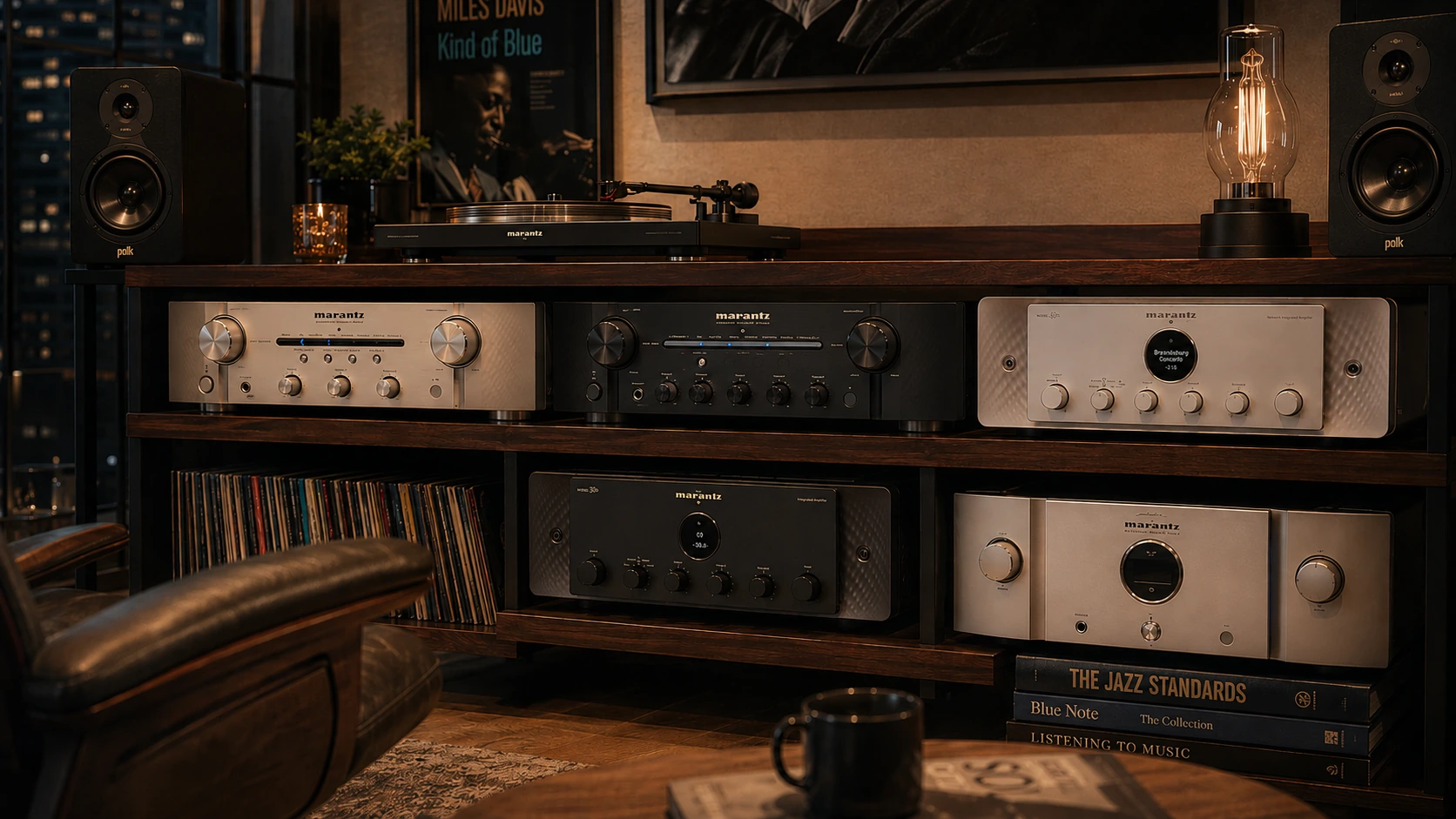
Marantz makes some of the most consistently musical amplifiers on the market — and has done so for over seventy years. The problem is their lineup. A new buyer looking at the PM6007, PM8006, Model 40n, and PM-10 has no obvious way to understand what separates them, whether the price differences are justified, or which one suits their speakers and listening preferences. Specifically, this guide maps every current Marantz amplifier series clearly: what each one does, who it is built for, what the price premium between tiers actually buys, and where each model sits in the competitive landscape. For buyers still deciding whether a dedicated stereo amplifier is the right step at all, the best stereo amplifiers under $200 guide covers the entry-level comparison before Marantz becomes relevant.
Quick orientation: Marantz makes three categories of amplification — stereo integrated amplifiers (PM and Model series), streaming-capable integrated amplifiers (Model series with network), and AV receivers (CINEMA series). This guide focuses primarily on the stereo integrated amplifiers, which are what Marantz is best known for and where their sonic character is most consistently expressed.
This article contains affiliate links. If you purchase through them, we may earn a commission at no extra cost to you. This helps support AmplifierZone and allows us to keep creating in-depth, unbiased audio guides.
- The Marantz Sound — What It Actually Means
- HDAM Technology — Why It Appears Across the Range
- PM Series — Entry and Mid-Tier Integrated Amplifiers
- Model Series — Premium and Network-Capable Amplifiers
- Reference Series — PM-10 and PM-12
- CINEMA Series — AV Receivers
- Which Marantz Amplifier Should You Buy?
- Marantz vs the Competition
- FAQ
The Marantz Sound — What It Actually Means
Marantz amplifiers have a consistent sonic character that persists across price points — described consistently by reviewers and owners as warm, smooth, and musical rather than analytical. Specifically, compared to brands like Cambridge Audio or Rotel at equivalent price points, Marantz amplifiers tend to emphasise the midrange and present the upper-frequency range with a slightly softer edge. The result is a sound that is forgiving of bright recordings and bright speakers — less fatiguing on long listening sessions, and particularly well-suited to vocal music, jazz, and acoustic recordings.
Specifically, this character is not a measurement result — it is a deliberate design philosophy that Saul Marantz established in the 1950s and that the engineering team has maintained through successive ownership changes. Consequently, Marantz amplifiers pair exceptionally well with warm-voiced bookshelf speakers like the Wharfedale Evo range, ELAC Debut series, and KEF LS50 — where their midrange warmth adds density rather than muddiness. They are less obviously suited to dark or bass-heavy speakers where additional warmth compounds, though this is a matter of degree rather than incompatibility.
The other consistent characteristic is imaging — Marantz amplifiers produce a coherent, well-centred soundstage that places instruments and voices precisely within the stereo field. Furthermore, this is a quality that scales with price in the Marantz range: entry-level PM series amplifiers are competent, and the Model and Reference series are genuinely exceptional.
HDAM Technology — The Circuit Behind the Marantz Character
HDAM — Hyper Dynamic Amplifier Module — is Marantz’s proprietary discrete amplifier circuit, used in place of standard op-amp integrated circuits in their analogue signal path. Specifically, HDAM circuits use discrete transistors configured to achieve very high slew rates — the speed at which the amplifier responds to rapid signal changes. The practical result is a more immediate, detailed response to transient musical events without the rounding that conventional op-amp circuits can introduce at audio frequencies.
HDAM appears across the Marantz range in different implementations. Entry-level models use a cost-optimised version. The PM8006 and Model series use a refined HDAM-SA2 implementation. The Reference series uses HDAM-SA3. In practice, the difference between HDAM generations is most audible in the midrange resolution and the preservation of fine detail in complex passages — the higher-generation implementations reveal more of the recording’s original character. However, all HDAM implementations share the fundamental sonic signature that distinguishes Marantz from brands using conventional op-amp circuits.
PM Series — Entry and Mid-Tier Integrated Amplifiers
PM5005 — Entry Point (discontinued but widely available)
The PM5005 is Marantz’s most accessible integrated amplifier — 40W per channel, MM phono input for turntable connection, and the fundamental Marantz sonic character in a compact, simple unit. It has been succeeded by updated models but remains widely available used and as old stock. Specifically, for first-time stereo amplifier buyers who want the Marantz character at the lowest possible price, the PM5005 represents the entry point. The HDAM circuit is present but in its most basic implementation — the warmth and musical engagement are there; the fine detail resolution of higher-tier models is not.
PM6007 — The Volume Purchase
Specifically, the PM6007 is the most purchased Marantz integrated amplifier at £599 / approximately $700 — the sweet spot where Marantz’s sonic character becomes fully realised without the premium of the mid-tier models. At 45W per channel, the PM6007 drives most bookshelf speakers and smaller floor-standers without power limitations. Specifically, the MM phono stage is well-implemented for a unit at this price, making it a strong choice for vinyl listeners who want a single-unit solution. Furthermore, the HDAM implementation is a meaningful step above the PM5005, and the overall resolution and imaging is noticeably improved. The full assessment of what the PM6007 delivers and where it limits is covered in the PM6007 review.

PM8006 — The Performance Step
The PM8006 moves to 70W per channel, adds an MM and MC phono stage (accommodating both cartridge types for vinyl), and uses the HDAM-SA2 circuit implementation. Specifically, the step from PM6007 to PM8006 is audibly meaningful — improved bass control, more refined high-frequency detail, and a more confident presentation of complex musical passages. Specifically, the PM8006’s power advantage becomes relevant with speakers below 87dB sensitivity or with 4Ω nominal impedance loads where the PM6007 can compress dynamically. For listeners with demanding speakers, the PM8006 is the correct starting point in the Marantz range rather than the PM6007.
Model Series — Premium Integrated and Network Amplifiers
Model 30 — Traditional Premium
The Model 30 represents Marantz’s premium traditional integrated amplifier — 100W per channel, dual HDAM-SA3 circuits, and a physical design that references the company’s heritage aesthetics with modern engineering. Specifically, the Model 30 drives demanding floor-standing speakers that the PM series cannot control adequately, and its soundstage presentation and midrange resolution are a significant step above the PM8006. However, the Model 30 lacks network streaming capability — it is a pure analogue integrated amplifier. For listeners who want a single unit that handles both streaming and amplification, the Model 40n is the correct choice.
Model 40n — Network Streaming Integration
The Model 40n adds HEOS network streaming directly to the amplifier chassis — Spotify Connect, Tidal, Qobuz, internet radio, and AirPlay 2 are all accessible without a separate streamer. At 70W per channel, it uses HDAM-SA3 circuits and a fully discrete amplifier stage. Specifically, for listeners who want to eliminate a separate streaming device from their signal chain, the Model 40n is the most complete single-unit Marantz solution at its price point. The full assessment of the Model 40n’s streaming performance and sound quality is in the Model 40n review.
Specifically, the trade-off of the Model 40n versus the Model 30 is straightforward: streaming capability in exchange for 30W less output power and some circuit complexity that the pure analogue Model 30 avoids. Consequently, for listeners whose primary source is digital streaming, the trade-off is worthwhile. For listeners who prefer analogue sources and do not need network streaming, the Model 30 is the stronger pure amplifier at a similar price point.
Model 50 — Phono-Centric Premium
The Model 50 sits alongside the Model 40n in the premium tier but emphasises analogue source quality — specifically vinyl playback. It includes a dedicated MM and MC phono stage of exceptional quality, a moving magnet cartridge capability that approaches the performance of separate phono preamplifiers at similar price points, and 70W per channel through HDAM-SA3 circuits. Consequently, for listeners who have an extensive vinyl collection and want the best phono performance integrated into a single Marantz unit, the Model 50 is the specific recommendation over the Model 40n.
Reference Series — PM-10 and PM-12
PM-12 SE — High-End Performance
The PM-12 SE is Marantz’s upper-tier reference integrated amplifier — 100W per channel in Class AB from a discrete dual-mono circuit with HDAM-SA3 modules throughout the signal path. At this level, the Marantz character is fully mature: the warmth is present without softness, the detail resolution approaches reference-grade transparency, and the driving capability handles the most demanding speaker loads without compression. The PM-12 SE is built for dedicated listening rooms with high-quality speakers — it represents an amplifier that will not be the limiting factor in most domestic listening systems.
PM-10 — Reference Flagship
The PM-10 is Marantz’s flagship integrated amplifier and one of the most technically accomplished integrated amplifiers in production at any price. A fully balanced differential circuit, 200W per channel in Class AB, dual toroidal transformers, and HDAM-SA3 circuits throughout make it a reference-grade design in every respect. Specifically, the PM-10 is not a casual purchase — it is an end-game amplifier for serious listeners with reference-quality speakers. At its price point, the PM-10 competes with the best integrated amplifiers available from any manufacturer and consistently performs at that level.
CINEMA Series — AV Receivers
Marantz’s CINEMA series AV receivers are separate from the stereo amplifier range in design philosophy — they are multi-channel processors designed for home theatre, with Dolby Atmos, DTS:X, and HDMI switching built in. The CINEMA 40, 50, 60, and 70s models cover the range from accessible entry-level to high-power reference. Specifically, the CINEMA series shares the Marantz sonic character in its stereo performance — two-channel music listening through a Marantz AV receiver sounds more musically engaging than the same through many competing receivers. However, for listeners whose primary use is stereo music, a dedicated stereo integrated amplifier from the PM or Model series will outperform any AV receiver at the same price. For listeners who need both home theatre and quality stereo music, the CINEMA series is the practical compromise. For a fuller comparison of whether a stereo amplifier or AV receiver better suits different use cases, the receiver vs amplifier guide covers the decision framework in detail.
Which Marantz Amplifier Should You Buy?
Marantz amplifier selector — by use case:
- First stereo amplifier, bookshelf speakers, under $800: PM6007 — the sweet spot in the range
- Demanding speakers (below 87dB or 4Ω), more power needed: PM8006 — 70W with MM/MC phono
- Premium analogue listening, turntable-primary: Model 50 — best integrated phono stage in the range
- Network streaming + premium amplification in one box: Model 40n — HEOS + HDAM-SA3
- High-end analogue, no streaming needed: Model 30 — 100W, dual HDAM-SA3, traditional design
- Reference performance for serious systems: PM-12 SE or PM-10
- Home theatre + music: CINEMA series AV receiver
Understanding the price ladder
Specifically, each step up in the Marantz range delivers three improvements in combination: more output power (which matters for speaker matching), a more refined HDAM circuit implementation (which improves resolution and imaging), and better power supply quality (which improves dynamic headroom and low-frequency control). Specifically, the most significant step in the range is from the PM6007 to the PM8006 — the power increase from 45W to 70W is meaningful for speaker matching, and the HDAM-SA2 refinement is audible in direct comparison. The step from PM8006 to Model series is more about resolution and imaging than raw power. Beyond the Model series into the Reference tier, improvements become incremental rather than transformative for most listening contexts.
What wattage actually means for speaker matching
Marantz amplifier wattage figures should be understood in context. A 45W Marantz PM6007 is a genuinely capable amplifier for speakers of 88dB sensitivity or above in rooms up to approximately 25m². Consequently, the majority of bookshelf speaker owners will not find the PM6007 power-limited in normal domestic use. The PM8006 at 70W becomes relevant when speaker sensitivity is below 87dB, speaker impedance dips significantly below 8Ω at certain frequencies, or when the listening room is large enough that high volume levels are required regularly.
Marantz vs the Competition
Marantz vs Cambridge Audio
Specifically, Cambridge Audio is the most common alternative comparison for Marantz at every price point. The fundamental difference is character: Cambridge amplifiers are more neutral and analytical, Marantz amplifiers are warmer and more forgiving. Cambridge suits bright speakers and listeners who want maximum detail resolution. Marantz suits warm-leaning speakers and listeners who prioritise long-session engagement over analytical precision. The full comparison of the specific models most commonly compared is covered in the Cambridge vs Marantz guide.
Marantz vs Denon
Specifically, Marantz and Denon share a parent company (Sound United / D&M Holdings) and some engineering resources, which leads many buyers to assume the products are similar. Specifically, indeed, they are not — Denon amplifiers tend towards a more dynamic, punchy presentation suited to rock and electronic music, while Marantz leans towards musical warmth suited to acoustic, jazz, and classical. The detailed comparison of specific competing models from both brands is in the Denon vs Marantz comparison guide.
Marantz vs NAD
Specifically, NAD amplifiers are typically more neutral and measurement-focused than Marantz, with the Hypex class D modules in NAD’s current range offering very high power efficiency and low distortion figures. Consequently, NAD suits listeners who prioritise measured performance and driving efficiency, while Marantz suits listeners who prioritise sonic character and the company’s decades-long design philosophy. Neither is objectively superior — the correct choice depends on the listener’s speakers and musical priorities.
Frequently Asked Questions
What is the Marantz sound and is it right for me?
The Marantz sound is warm, smooth, and musical — specifically, amplifiers that emphasise midrange presence and present high-frequency content with a softer edge than analytically neutral competitors. It suits listeners who find bright or analytical amplifiers fatiguing over long sessions, and pairs well with neutral to bright-sounding speakers. If you primarily listen to jazz, classical, acoustic music, or vocals, the Marantz character is likely to suit you well. If you primarily listen to electronic music, hip-hop, or want maximum detail resolution, a more neutral alternative like Cambridge Audio may be a better match.
What is the difference between the PM6007 and PM8006?
The PM8006 adds 25W of output power (70W vs 45W), an MC phono input alongside the MM (accommodating both cartridge types), and uses the HDAM-SA2 circuit rather than the basic HDAM in the PM6007. The additional power matters for speakers below 87dB sensitivity or 4Ω impedance. The HDAM-SA2 delivers improved midrange resolution and imaging in direct comparison. For listeners with efficient bookshelf speakers in a normal room, the PM6007 is adequate. For listeners with demanding speakers or larger rooms, the PM8006 is the correct starting point.
Does Marantz make a good amplifier for turntables?
Yes — most Marantz integrated amplifiers include an MM phono input, and the PM8006 and Model series add MC capability. The PM6007’s MM phono stage is well-implemented for its price. The Model 50 has the most capable integrated phono stage in the current Marantz range — suitable for mid-range MC cartridges without needing a separate phono preamplifier. For vinyl listeners, Marantz’s combination of phono capability and warm sonic character makes it a particularly natural choice.
Understanding Marantz technology
What is HDAM and why does Marantz use it?
HDAM (Hyper Dynamic Amplifier Module) is Marantz’s proprietary discrete amplifier circuit that replaces standard op-amp integrated circuits in the analogue signal path. It uses discrete transistors configured for very high slew rates — improving the amplifier’s response to rapid transient musical events. In practice, HDAM contributes to the fine detail resolution and imaging precision that Marantz amplifiers are known for. Higher-tier models use more refined HDAM implementations (SA2, SA3) that progressively improve resolution and reduce distortion.
Marantz for home theatre
Should I buy a Marantz integrated amplifier or AV receiver?
If your primary use is stereo music listening, a dedicated stereo integrated amplifier from the PM or Model series will significantly outperform a Marantz AV receiver at the same price for two-channel performance. AV receivers allocate budget to HDMI switching, multi-channel processing, and room correction — features that add no value for stereo listening. If you need both home theatre with surround sound and quality stereo music, a CINEMA series AV receiver is the practical choice. If stereo music is the priority, choose a PM or Model series integrated amplifier.