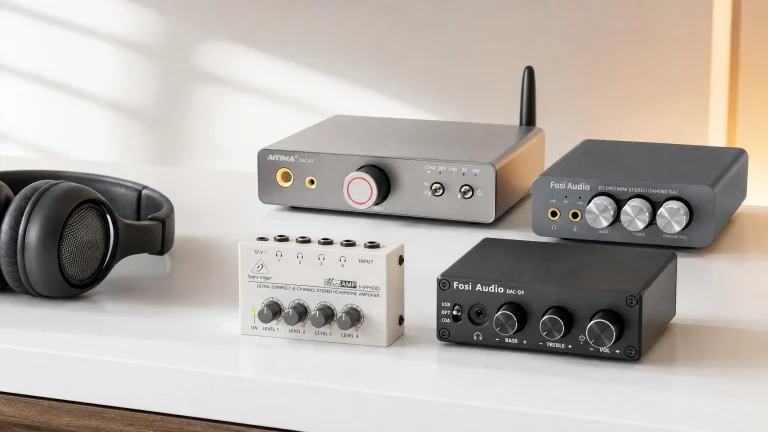
Specifically, a DAC/amp combo eliminates a problem that most headphone listeners do not realise they have: the audio output built into a laptop, phone, or desktop PC is genuinely poor — high noise floor, limited power, and output stages that were never designed for critical listening. Consequently, connecting a single dedicated unit changes what you hear immediately. The best DAC amp combo under $250 replaces two separate boxes with one, handles everything from sensitive IEMs to demanding planar headphones, and connects to any source via USB, optical, or coaxial in seconds. If you are still deciding whether you need one at all, the headphone amp guide covers that question honestly. For players who want to understand how a DAC integrates with an existing amplifier setup, the DAC with amplifier guide covers the full picture.
Every unit here has been individually assessed. Each one targets a different listener — from the desktop PC user who wants a clean upgrade for under $70 to the audiophile who wants balanced output and a flagship DAC chip in a single box under $250.
Quick Picks
- Best entry pick: Fosi Audio Q4 — USB/optical/coaxial, 3.5mm headphone + RCA out, Amazon’s Overall Pick under $70
- Best for power: FiiO K5 Pro ESS — 1.5W into 32Ω, AKM AK4493EQ DAC chip, drives demanding full-size headphones
- Best for Bluetooth: Topping DX3 Pro+ — LDAC Bluetooth 5.0, ES9038Q2M chip, remote control, pre-amp function
- Best balanced pick: FiiO K7 — 2W balanced via 4.4mm, dual AK4493S + THX amp, the most powerful unit here
- Best for warmth: iFi Zen DAC 3 — Burr-Brown True Native chip, 4.4mm balanced, musically distinct character
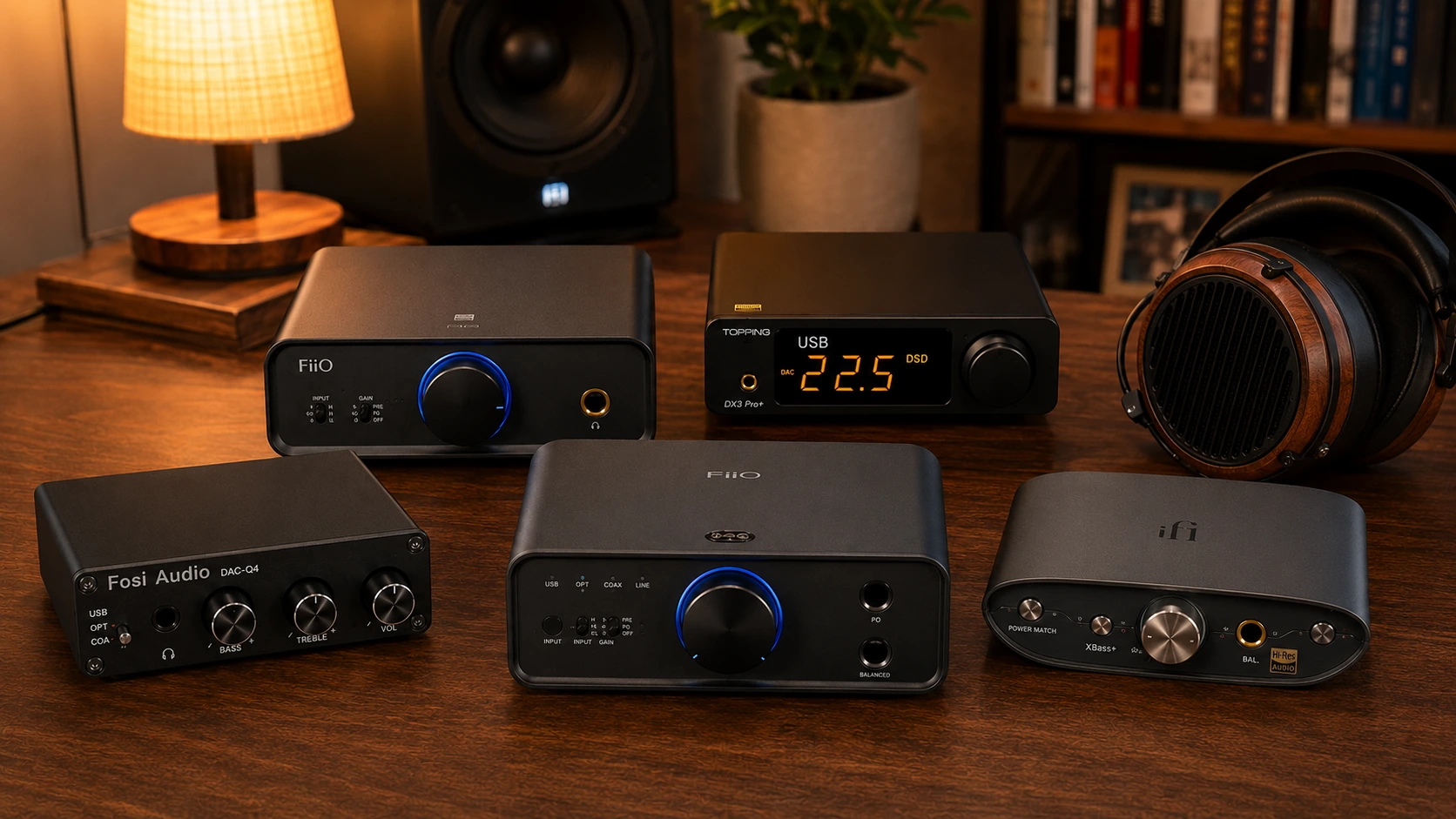
This article contains affiliate links. If you purchase through them, we may earn a commission at no extra cost to you. This helps support AmplifierZone and allows us to keep creating in-depth, unbiased audio guides.
Best DAC/Amp Combos — Comparison
Five units mapped by DAC chip, headphone power, balanced output, and Bluetooth so you can match your headphones and use case before reading the full reviews.
| Unit | DAC chip | Power (SE) | Balanced out | Bluetooth | Best For |
|---|---|---|---|---|---|
| Fosi Audio Q4 | Cirrus Logic | ~150mW / 32Ω | No | No | Entry pick |
| FiiO K5 Pro ESS | AKM AK4493EQ | 1,500mW / 32Ω | No | No | Power pick |
| Topping DX3 Pro+ | ESS ES9038Q2M | 1,000mW / 32Ω | No | Yes — LDAC | Bluetooth pick |
| FiiO K7 | Dual AKM AK4493S | 1,200mW / 32Ω | Yes — 4.4mm (2W) | No | Balanced pick |
| iFi Zen DAC 3 | Burr-Brown True Native | ~280mW / 32Ω | Yes — 4.4mm | No | Warmth pick |
Here is what each unit delivers in practice — and the specific listening situations where each earns or loses the recommendation.
Best DAC/Amp Combos — Top Picks Reviewed
1. Fosi Audio Q4 DAC Headphone Amplifier
Best for: Listeners who want an immediate upgrade from laptop or PC audio without spending much — USB, optical, and coaxial inputs, 3.5mm headphone output, and RCA line out in a unit that costs under $70

- DAC chip: Cirrus Logic
- Inputs: USB (PC), optical (Toslink), coaxial (RCA)
- Headphone output: 3.5mm single-ended
- Line output: RCA — connects to powered speakers or stereo amplifier
- Bluetooth: No
- Balanced output: No
- Resolution: Up to 24-bit/192kHz
- Power supply: USB bus-powered
The entry point that actually works
The Fosi Audio Q4 is Amazon’s Overall Pick in this category — and the purchasing volume behind it confirms what the spec sheet suggests: at under $70, it delivers a genuine, measurable improvement over built-in laptop and PC audio. Specifically, the difference between listening through a laptop headphone jack and listening through the Q4 is immediately audible — the noise floor drops, channel separation improves, and headphones that sounded flat and thin gain definition and dynamic range. Specifically, the three digital inputs cover every source a desktop listener is likely to own: USB from a computer, optical from a TV or game console, coaxial from a CD transport or streamer. Furthermore, the RCA line output allows the Q4 to feed a pair of powered speakers or a stereo amplifier simultaneously, making it a dual-purpose desktop hub rather than a headphone-only device.
What the Q4 does not do
The Q4’s headphone output power is modest — adequate for easy-to-drive headphones and IEMs under 150Ω, but insufficient for demanding planar magnetics or high-impedance dynamic headphones like the Sennheiser HD 600 or HD 650. Additionally, there is no Bluetooth, no balanced output, and no remote control. For listeners who need more headphone power or wireless connectivity, the FiiO K5 Pro ESS or Topping DX3 Pro+ are the next steps. The full breakdown covers exactly what the entry point delivers and who it suits.
- Amazon’s Overall Pick — most validated entry DAC/amp at this price
- USB, optical, and coaxial inputs — covers every common source
- RCA line output — doubles as a DAC for powered speakers
- Immediate, audible improvement over built-in PC audio
- Bus-powered — no separate power cable needed
- Lowest price in this group by a wide margin
- Limited headphone output power — not suitable for demanding headphones
- No Bluetooth, no balanced output, no remote
- Cirrus Logic chip — less resolving than AKM or ESS chips in the group
Best entry pick — USB/optical/coaxial inputs, 3.5mm headphone + RCA out, bus-powered. Amazon’s Overall Pick under $70.
2. FiiO K5 Pro ESS Desktop DAC and Headphone Amplifier
Best for: Listeners with demanding full-size headphones — 1.5W into 32Ω drives almost any dynamic or planar headphone on the market, including the Sennheiser HD 600/650, HiFiMan Sundara, and Audeze LCD series
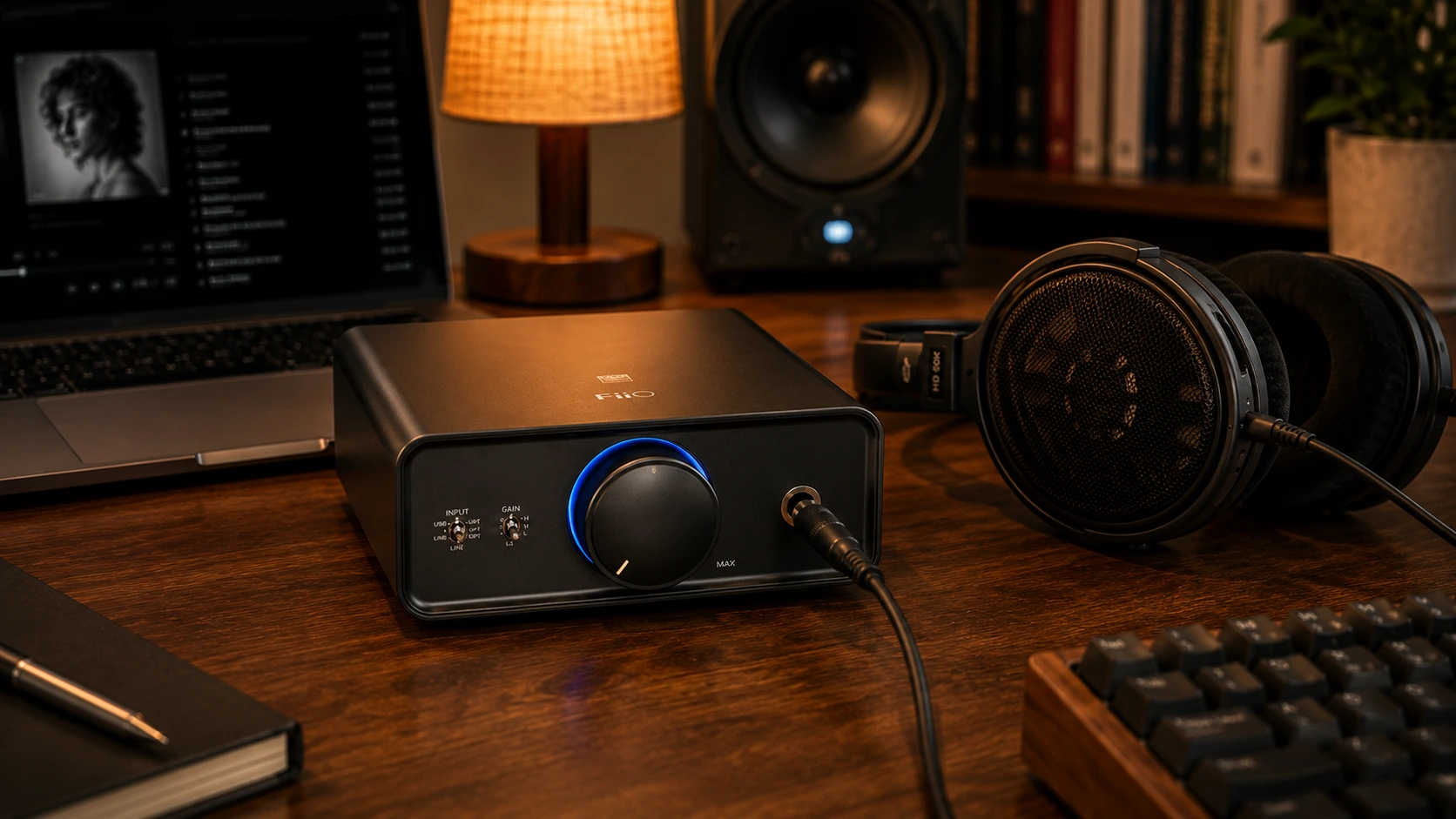
- DAC chip: AKM AK4493EQ (ESS variant uses ESS ES9038Q2M)
- Headphone power: 1,500mW into 32Ω
- Inputs: USB, optical, coaxial, RCA line-in
- Headphone output: 6.35mm (quarter-inch)
- Line output: RCA
- Gain levels: 4 — L1/L2/H1/H2
- Resolution: Up to 768kHz/32-bit, native DSD512
- Power supply: Dedicated DC 15V — not bus-powered
The power advantage explained
At 1.5W into 32Ω, the K5 Pro ESS produces more than ten times the headphone output power of the Fosi Audio Q4. In practice, this means headphones that sound flat and congested through lesser units — particularly high-impedance dynamics and planar magnetics — open up with proper dynamic range, accurate imaging, and the bass extension their drivers are capable of. Specifically, the four-level gain control (L1, L2, H1, H2) allows precise matching between sensitive IEMs and demanding full-size headphones without the channel imbalance that occurs when a powerful amp runs at the bottom of its volume range. The AKM AK4493EQ DAC chip delivers smooth, detailed reproduction that complements FiiO’s well-regarded analogue output stage. Furthermore, the RCA line input allows the K5 Pro to function as a pure headphone amplifier for an existing DAC, adding flexibility that the Fosi Q4 and Topping DX3 Pro+ do not offer. Amazon’s Overall Pick status and sustained purchasing confirm genuine real-world satisfaction at this price.
The K5 Pro vs the FiiO K7
The K5 Pro ESS sits $50 below the K7 in this group. Specifically, its single-ended power (1.5W) actually exceeds the K7’s single-ended output (1.2W) — the K7’s advantage is exclusively its balanced 4.4mm output at 2W and its newer dual DAC configuration. For listeners who do not use balanced cables, the K5 Pro ESS provides equivalent or superior single-ended performance at a lower price. However, for listeners who want to unlock the full balanced output of their headphones, the K7 is the correct upgrade path.
- 1.5W into 32Ω — drives demanding full-size headphones and planars
- Four-level gain control — precise IEM to full-size headphone matching
- AKM AK4493EQ — smooth, detailed DAC chip with proven performance
- USB/optical/coaxial + RCA line-in — most input options in this group
- Native DSD512 and 768kHz/32-bit — maximum resolution support
- Amazon’s Overall Pick — highest validation in the mid-tier
- No balanced output — single-ended 6.35mm only
- No Bluetooth
- Requires separate power supply — not bus-powered
- Larger footprint than the Q4 or Zen DAC 3
Best power pick — 1.5W into 32Ω, AKM AK4493EQ, four-level gain, USB/optical/coaxial/RCA inputs. Amazon’s Overall Pick.
3. Topping DX3 Pro+ LDAC DAC and Headphone Amplifier
Best for: Listeners who stream wirelessly from a phone and want LDAC-quality Bluetooth — the only unit in this group that accepts high-resolution Bluetooth audio without a wired connection to the source
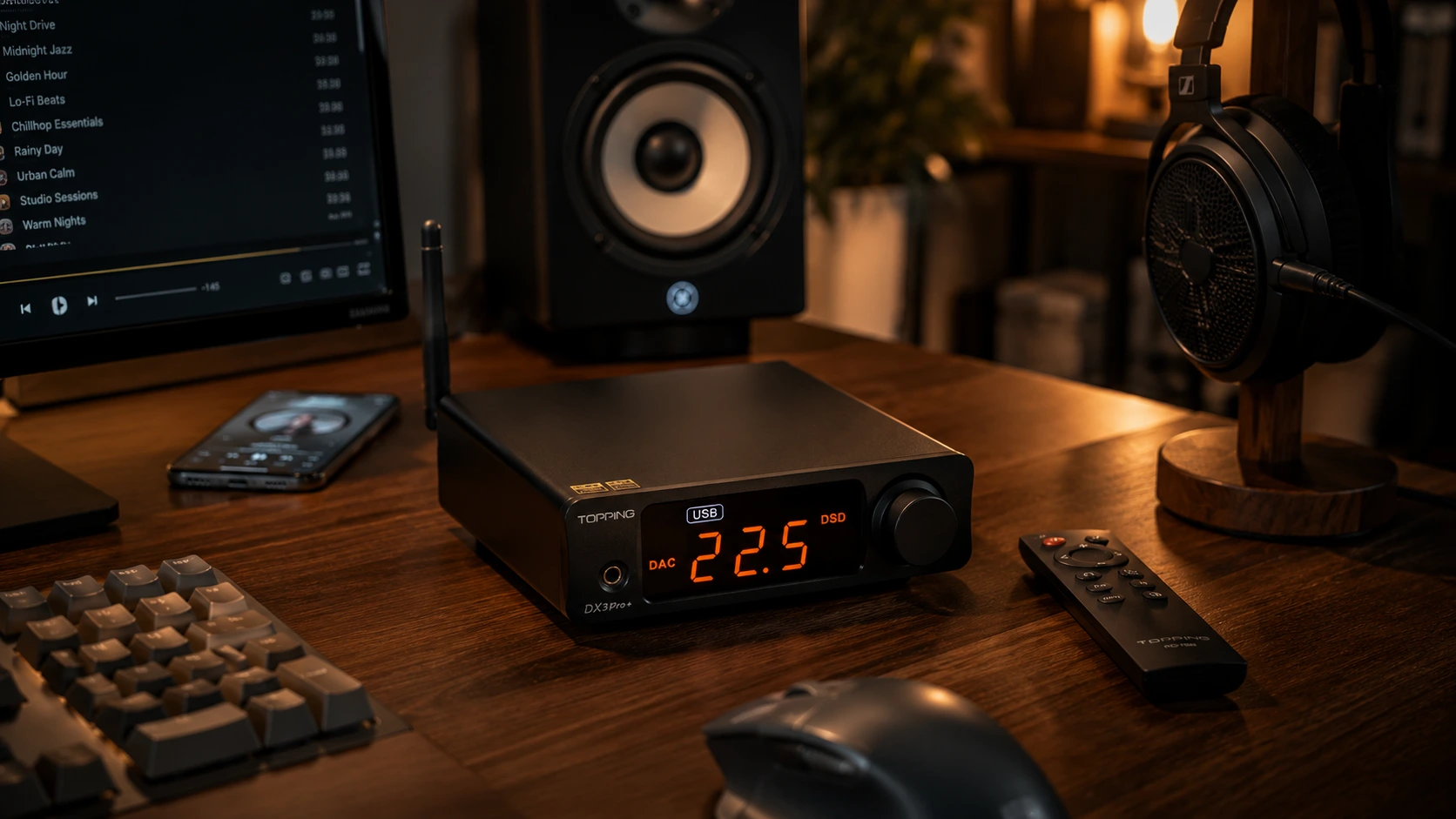
- DAC chip: ESS ES9038Q2M
- Bluetooth: Bluetooth 5.0 with LDAC (990kbps) — highest-quality wireless audio codec
- Headphone power: ~1,000mW into 32Ω (NFCA amp circuit)
- Inputs: USB, optical, coaxial, Bluetooth
- Headphone output: 3.5mm single-ended
- Line output: RCA (fixed and variable)
- Pre-amp function: Yes — variable RCA output for active speakers
- Remote control: Yes — included
- Resolution: Up to 32-bit/768kHz
What LDAC Bluetooth actually means for sound quality
LDAC is Sony’s high-resolution Bluetooth codec, transmitting audio at up to 990kbps — approximately three times the data rate of standard SBC Bluetooth and significantly above the 320kbps ceiling of aptX HD. In practice, LDAC at its highest setting delivers wireless audio that approaches wired quality for most listeners, making the DX3 Pro+ genuinely useful as a wireless desktop hub rather than a compromise. Consequently, listeners who primarily stream from a phone via Tidal, Apple Music, or Spotify at high quality can benefit from the wireless connection without the audible degradation of standard Bluetooth. Additionally, the included remote control adds a convenience that no other unit in this group offers — volume, source switching, and mute from across the room. The pre-amplifier function additionally allows the DX3 Pro+ to feed a pair of active speakers with volume control, making it a versatile desktop audio hub. For more on how Bluetooth DAC/amps compare, see the Bluetooth DAC/amp guide.
The LDAC trade-off vs raw power
The DX3 Pro+’s NFCA headphone amplifier delivers around 1,000mW into 32Ω — less than the K5 Pro ESS and without a balanced output. Specifically, for listeners who primarily use easy-to-drive headphones or IEMs and value wireless convenience, this is not a practical limitation. However, for listeners with demanding planar magnetics who also want wireless capability, the DX3 Pro+ may not provide quite enough drive — in that case, the K5 Pro ESS handles the power requirement and the wireless audio can come from a separate Bluetooth receiver upstream.
- LDAC Bluetooth 5.0 — highest-quality wireless audio codec at this price
- ESS ES9038Q2M — flagship-tier DAC chip for the price
- Remote control — only unit in this group with one included
- Pre-amp function — variable RCA output for active speakers
- USB/optical/coaxial/Bluetooth inputs — comprehensive source coverage
- No balanced output — 3.5mm single-ended headphone output only
- Lower power than K5 Pro ESS — less suitable for demanding headphones
- Third-party seller on Amazon — verify listing carefully before purchase
Best Bluetooth pick — LDAC 990kbps, ES9038Q2M, remote control, and pre-amp function in the only wireless unit here.
4. FiiO K7 Balanced Desktop DAC and Headphone Amplifier
Best for: Listeners who want the full balanced output path — 2W into 32Ω via 4.4mm Pentaconn, dual AK4493S DAC chips, and THX AAA amplifier technology in a single desktop unit under $250
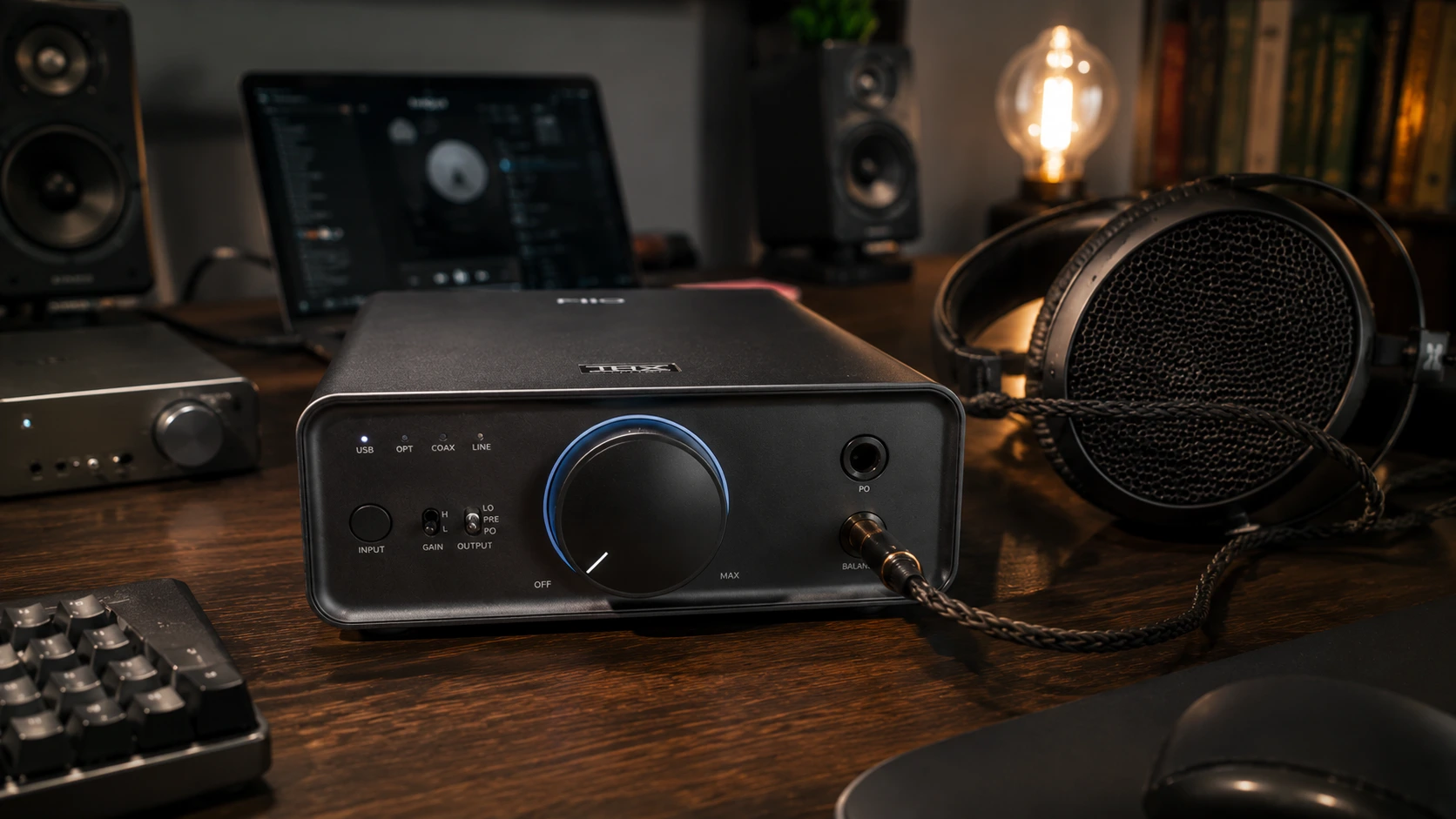
- DAC chips: Dual AKM AK4493S (fully balanced dual-mono configuration)
- Amplifier technology: THX AAA 788+
- Headphone power (SE): 1,200mW into 32Ω via 6.35mm
- Headphone power (BAL): 2,000mW into 32Ω via 4.4mm Pentaconn
- Inputs: USB, optical, coaxial, RCA line-in
- Outputs: 6.35mm SE, 4.4mm balanced, RCA line-out
- Resolution: Up to PCM 384kHz/32-bit, DSD256
- RGB indicator: Blue ≤48kHz, yellow >48kHz, green DSD
Why balanced output matters at this price
The K7’s 4.4mm balanced output delivers 2W into 32Ω — nearly double the 1.2W available from the single-ended output and the highest power figure in this group. Balanced audio transmission uses two signal paths that are phase-inverted relative to each other, which cancels common-mode noise at the headphone driver. In practice, the result is a lower noise floor, better channel separation, and more headroom on demanding transients. Specifically, for headphones that have balanced termination options — most premium dynamic and planar headphones — the K7’s balanced output represents a meaningfully different listening experience from the single-ended alternatives in this group. The THX AAA 788+ amplifier technology contributes the ultra-low distortion performance that makes the K7’s transparency particularly notable. Furthermore, the dual AK4493S configuration (one chip per channel) provides the fully balanced dual-mono architecture that separates it from the K5 Pro ESS’s single-chip design.
When the K5 Pro ESS is the better choice
However, for listeners who do not have balanced headphone cables and are not planning to upgrade, the K7’s primary advantage over the K5 Pro ESS disappears. The K5 Pro’s single-ended output actually exceeds the K7’s single-ended output by 300mW — making it the stronger single-ended choice at a lower price. The K7 is the correct purchase specifically for listeners who are using or planning to use balanced headphone termination.
- 2W balanced output via 4.4mm — most powerful unit in this group in balanced mode
- Dual AK4493S in fully balanced dual-mono configuration
- THX AAA 788+ amplifier — ultra-low distortion, exceptional transparency
- 6.35mm SE + 4.4mm BAL headphone outputs — covers both terminations
- RCA line-in — also works as a pure headphone amp for an existing DAC
- RGB sampling rate indicator — blue, yellow, green by resolution
- No Bluetooth
- No remote control
- Balanced advantage is wasted without a balanced headphone cable
- RGB light cannot be disabled — a minor annoyance for some users
Best balanced pick — 2W via 4.4mm Pentaconn, dual AK4493S, THX AAA amp, the most technically capable unit here.
5. iFi Zen DAC 3 Desktop DAC and Headphone Amplifier
Best for: Listeners who find ESS and AKM DAC signatures too analytical — the Burr-Brown True Native chip produces a warmer, more musically engaging character that specifically suits acoustic music, jazz, classical, and vinyl rips
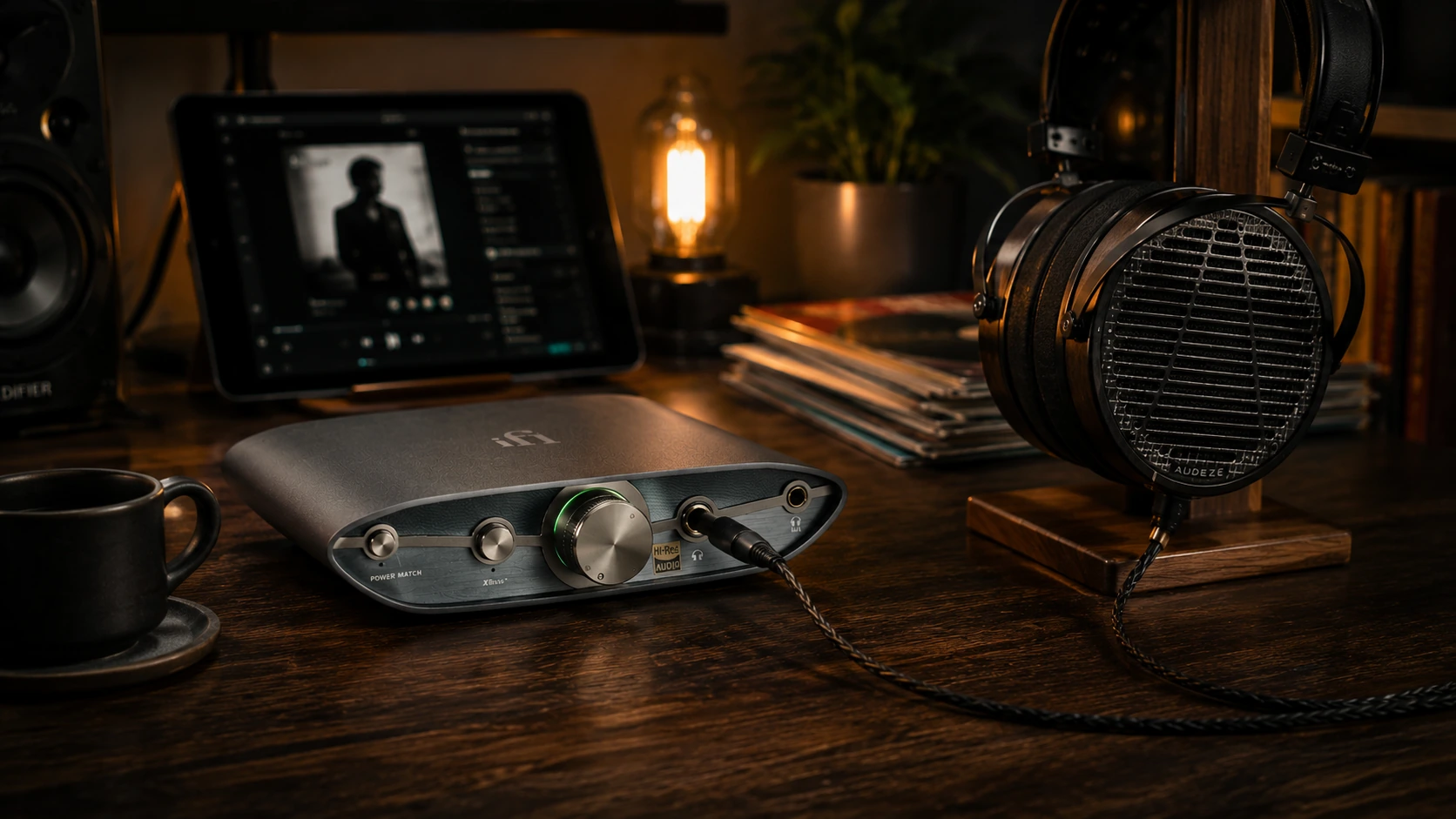
- DAC chip: Burr-Brown True Native (Texas Instruments)
- Headphone power (SE): ~280mW into 32Ω via 6.35mm
- Headphone power (BAL): ~330mW into 32Ω via 4.4mm Pentaconn
- Inputs: USB-C only
- Headphone outputs: 6.35mm SE and 4.4mm balanced
- Line output: RCA
- Features: TrueBass button, PowerMatch gain button, iEMatch for sensitive IEMs
- Resolution: Up to PCM 768kHz/32-bit, DSD512
The Burr-Brown character — what it actually sounds like
The Zen DAC 3 uses a Burr-Brown True Native DAC chip — a Texas Instruments design that handles PCM and DSD natively rather than converting DSD to PCM internally. The character this produces is distinct from ESS and AKM chips: where ESS tends towards analytical precision and AKM towards smooth detail, Burr-Brown delivers a warmer presentation with a natural, organic midrange that many listeners find more musically involving over long listening sessions. Specifically, acoustic instruments — guitars, pianos, vocals, strings — have a tonal density through the Zen DAC 3 that the technically superior but cooler-sounding ESS units in this group do not always match. Additionally, the 4.4mm balanced output is included at $229, a competitive position for a balanced unit with this DAC technology. The TrueBass, PowerMatch, and iEMatch features add practical tuning options that no other unit in this group provides.
The power limitation to understand
The Zen DAC 3’s headphone output power is the lowest in this group — approximately 280mW single-ended and 330mW balanced into 32Ω. Consequently, it is not suitable for high-impedance or low-sensitivity headphones. The Sennheiser HD 600 at 300Ω, HiFiMan Sundara, or any planar magnetic requiring significant current will not perform optimally. However, for listeners with sensitive headphones and IEMs — which covers a large proportion of the headphone market — the Zen DAC 3’s character advantage over the more powerful units is accessible and genuinely meaningful.
- Burr-Brown True Native chip — warm, musical character distinct from ESS/AKM
- 4.4mm balanced output — available at this price with this DAC technology
- TrueBass, PowerMatch, iEMatch — practical tuning for different headphone types
- Native DSD512 and 768kHz/32-bit — maximum resolution support
- Compact, attractive industrial design
- Lowest headphone output power in this group — not for demanding headphones
- USB-C input only — no optical or coaxial digital inputs
- No Bluetooth, no remote control
- Most expensive unit in this group at $229
Best warmth pick — Burr-Brown True Native chip, 4.4mm balanced, TrueBass and iEMatch, a musically distinct character from ESS and AKM alternatives.
How We Chose the Best DAC/Amp Combos
Selection criteria
Every unit was evaluated against four criteria: DAC chip quality and measured noise floor performance, headphone output power and its suitability for the intended headphone load, input flexibility (how many source devices can connect without additional hardware), and feature value relative to price. Specifically, units were excluded if they delivered insufficient improvement over built-in PC audio to justify the purchase, or if their stated specifications were not reflected in measured performance. For listeners comparing dedicated DAC/amp combos against separate component stacks, the best headphone amplifier under $200 guide covers the dedicated amplifier options in more detail.
DAC chip differences — what they actually mean
The three DAC chip families in this group — Cirrus Logic, ESS, AKM, and Burr-Brown — each have measurable and audible characteristics. ESS chips (ES9038Q2M in the Topping) tend towards maximum measured performance: low noise, low distortion, and a precise, analytical presentation. AKM chips (AK4493EQ and AK4493S in the FiiO units) deliver smooth, detailed sound with a warmer character than ESS. Burr-Brown (iFi Zen DAC 3) produces the most organic, musical midrange of the three families — at the cost of outright measured performance. Cirrus Logic (Fosi Q4) is the least resolving at this price but still delivers a meaningful improvement over onboard PC audio. Indeed, none of these is objectively superior — the correct chip family depends on the listener’s headphones and musical preferences.
Why all-in-one vs separate components
Indeed, separate DAC and amplifier stacks frequently outperform all-in-one units at equivalent total price — a $100 DAC and $109 amplifier often measure better than a $250 combo. However, all-in-one units have practical advantages that matter for many listeners: one power outlet, one USB connection, one device to manage, and a smaller desk footprint. For first-time buyers and desktop listeners who do not want to manage two-component chains, the combo units here represent the correct starting point.
Which DAC/amp combo is right for you?
- First upgrade from laptop audio, budget-conscious: Fosi Audio Q4
- Demanding full-size headphones, maximum single-ended power: FiiO K5 Pro ESS
- Wireless streaming from phone via LDAC: Topping DX3 Pro+
- Balanced headphone cables, maximum power and transparency: FiiO K7
- Warm, musical character for acoustic listening: iFi Zen DAC 3
Best DAC/Amp Combos — Final Verdict
One question narrows the choice immediately
Specifically, the most useful question in this category is: what headphones are you driving, and do you need Bluetooth? Those two factors eliminate most of the wrong choices before anything else matters.
For most desktop listeners
The Fosi Audio Q4 is the default recommendation for listeners upgrading from built-in PC audio for the first time — it delivers the immediate, audible improvement the category promises at the lowest price in the group. For listeners with demanding full-size headphones who need real output power, the FiiO K5 Pro ESS is the correct step up — 1.5W single-ended drives almost every headphone on the market adequately at a price that leaves room in the budget for better headphones. Read the full FiiO K5 Pro ESS review for the complete power and performance picture. Read the full Fosi Audio Q4 review to understand exactly what the entry point delivers.
For specific requirements
Additionally, for listeners who want to stream wirelessly from a phone at LDAC quality, the Topping DX3 Pro+ is the only unit in this group with that capability — the remote control and pre-amp function additionally make it the most versatile desktop hub here. Read the full Topping DX3 Pro+ review for the complete wireless performance breakdown. For listeners with balanced headphone cables who want the full balanced output path and THX amplifier technology, the FiiO K7 is the correct investment — the 2W balanced output is the best technical specification in this group and justifies the price premium over the K5 Pro ESS specifically for balanced use. Read the full FiiO K7 review for the balanced output breakdown. Furthermore, for listeners who find ESS and AKM units too analytical and want a warmer, more musically engaging character, the iFi Zen DAC 3 is a genuinely different-sounding unit that suits acoustic, jazz, and classical listening in a way the measurement-optimised competition does not replicate. Read the full iFi Zen DAC 3 review for the full character assessment.
Frequently Asked Questions
DAC/amp combo basics
Do I actually need a DAC/amp combo or will my laptop audio do?
It depends on your headphones and what you are hearing. If your headphones sound flat, thin, or noisy through a laptop headphone jack — particularly with high-impedance or planar magnetic headphones — a dedicated DAC/amp combo will produce an immediately audible improvement. If your headphones are low-impedance, highly sensitive IEMs and you do not notice any noise or thinness, the improvement may be marginal. Specifically, the most reliable test is whether you can hear hiss or noise in quiet passages through your current setup. If you can, a dedicated unit will eliminate it.
What is the difference between a DAC and a headphone amplifier?
A DAC (Digital-to-Analog Converter) converts the digital audio signal from a computer, phone, or streamer into an analogue signal. A headphone amplifier increases the power of that analogue signal to drive headphone drivers properly. Your laptop or phone contains both — but the built-in versions prioritise cost and space over performance. A dedicated DAC/amp combo performs both functions with components specifically designed for audio quality, producing a measurably lower noise floor and more output power than any built-in solution.
Choosing between units
Is the FiiO K7 worth the extra money over the K5 Pro ESS?
Only if you use or plan to use balanced headphone cables. In balanced mode via 4.4mm, the K7 delivers 2W into 32Ω — nearly double its own single-ended output and the most powerful headphone output in this group. However, in single-ended mode, the K5 Pro ESS actually outputs more power (1.5W vs 1.2W) at a lower price. If your headphones are terminated in a standard 3.5mm or 6.35mm single-ended cable and you have no plans to upgrade to balanced, the K5 Pro ESS is the better value purchase.
What does LDAC Bluetooth mean and does it actually sound better?
LDAC is Sony’s high-resolution Bluetooth codec, transmitting at up to 990kbps — approximately three times the bandwidth of standard SBC Bluetooth. At its highest quality setting and with a strong Bluetooth connection, LDAC approaches wired audio quality for most listeners. The practical benefit is that streaming Tidal, Apple Music, or Qobuz lossless tracks from a phone to the Topping DX3 Pro+ wirelessly produces noticeably better sound than the same stream via standard Bluetooth. It is not identical to a wired USB connection but the difference is small enough that wireless convenience becomes realistic for critical listening.
More questions
Can I use a DAC/amp combo with powered speakers instead of headphones?
Yes — all five units in this group include RCA line outputs that connect to powered (active) speakers. The Topping DX3 Pro+ additionally has a variable RCA output with pre-amplifier function, meaning its volume control adjusts the speaker output directly — the most useful configuration for a mixed headphone and speaker desktop setup. The other units have fixed-level RCA outputs, which work correctly but require the speakers’ own volume control for level adjustment.
Should I buy a DAC/amp combo or separate DAC and amp components?
Indeed, separate components frequently outperform all-in-one units at the same total price — a $100 DAC paired with a $100 amplifier often measures better than a $250 combo. However, all-in-one units require one power outlet, one USB cable, one device to manage, and one space on the desk. For first-time buyers, the simplicity of a single unit is a genuine advantage. The moment to consider separates is when you want to upgrade only one component — better DAC without changing the amp, or vice versa — or when your headphones are demanding enough that a dedicated amplifier’s power matters specifically.