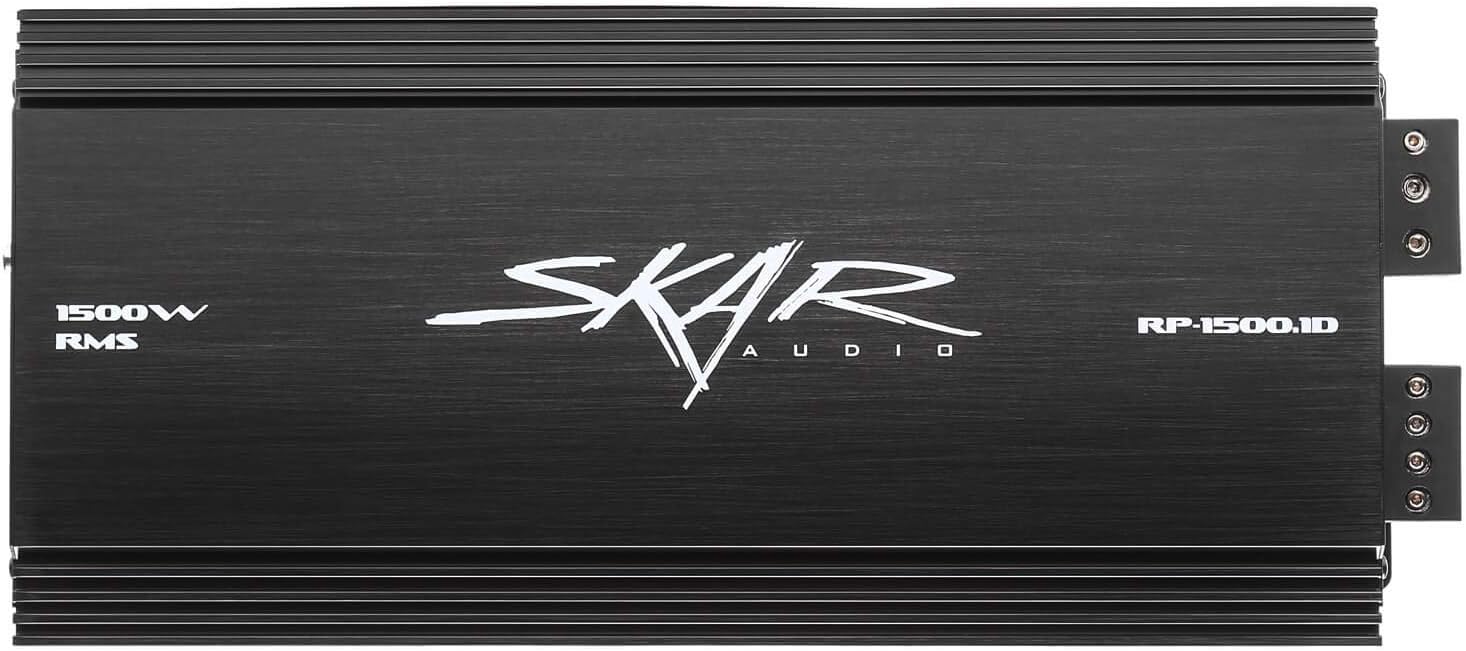
The Skar Audio RP-1500.1D is the amp that keeps coming up in budget bass builds. This review covers why that reputation holds up, where it falls short, and what the install actually requires to get the most from it. Specifically, this is a Class D monoblock designed for 1-ohm stability. That places it squarely in the daily driver bass category rather than show car territory. For clean, heavy bass from a single sub or dual-sub parallel setup without premium brand pricing, the RP-1500.1D belongs on your shortlist.
Affiliate Disclosure: AmplifierZone is reader-supported. As an Amazon Associate, we may earn commissions from qualifying purchases at no extra cost to you.
Skar Audio RP-1500.1D — Key Specifications
- Class: Class D monoblock
- Power (1Ω RMS): 1,500W
- Power (2Ω RMS): 750W
- Power (4Ω RMS): 400W
- Minimum impedance: 1Ω stable
- Topology: MOSFET
- Filters: Subsonic filter + variable low-pass filter
- Remote: Bass remote level control included
- Recommended wire gauge: 4-gauge OFC minimum
- Amazon rating: 4.6 stars / 675 reviews — view on Amazon
Understanding the wattage figures requires separating rated peak from real-world RMS output. For a full breakdown of how manufacturers rate amplifier power, the amplifier wattage guide covers the distinction in detail. The RP-1500.1D’s 1,500W figure is its 1Ω RMS rating. That is the number that determines how hard it drives a subwoofer under real listening conditions.
Performance and Sound
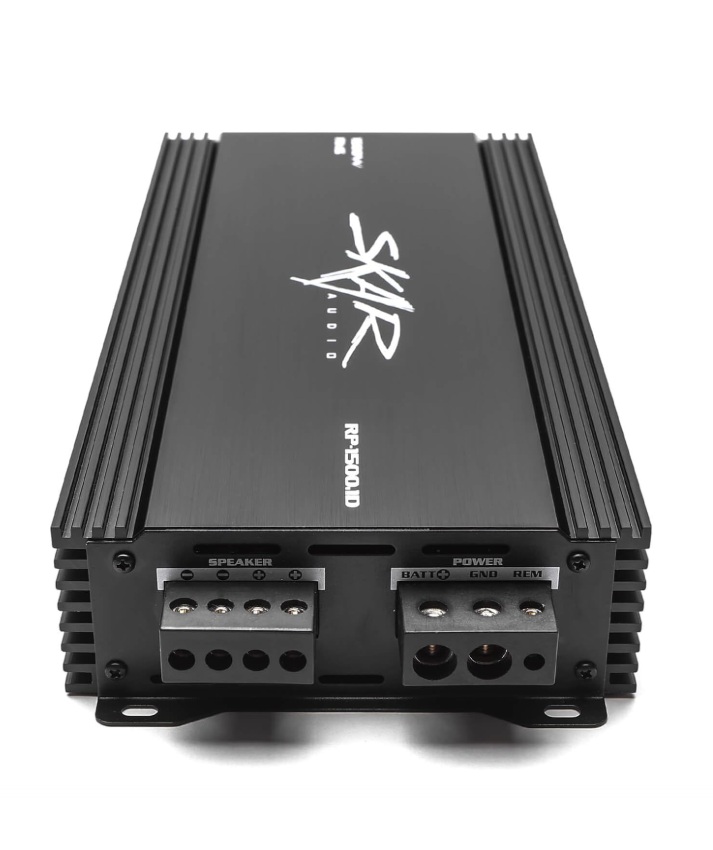
The RP-1500.1D delivers punchy, authoritative low-end that consistently outperforms expectations for its price class. Specifically, the Class D topology is efficient — it generates less heat per watt of output than Class AB designs. Consequently, a correctly installed RP-1500.1D stays cooler and pulls less current at equivalent listening levels. Furthermore, the MOSFET power supply is more tolerant of voltage fluctuation than cheaper bipolar designs. This matters practically when a car’s electrical system sags under load.
Sound character is best described as punchy and impactful rather than refined. Specifically, the RP-1500.1D excels at modern bass music — hip-hop, EDM, and bass-heavy playlists where sub impact and low-frequency authority are the primary goal. However, it is not an SQ amplifier in the audiophile sense. Consequently, listeners building a system around tonal accuracy and precise imaging are better served by higher-grade amplifiers at a corresponding price premium. For daily use where bass impact is the priority, the RP-1500.1D delivers the result its price point promises.
Thermal performance deserves specific mention. Most heat complaints in online reviews trace back to installation problems rather than the amplifier itself. Notably, a Class D amplifier at this wattage level needs unrestricted airflow. Installing it under a seat or face-down against carpet eliminates that airflow. Consequently, thermal throttling or shutdown follows. Given adequate ventilation and correct gain settings, the RP-1500.1D runs at a manageable temperature under sustained listening conditions.
Installation Requirements
The RP-1500.1D’s electrical demands are the most important factor to plan before purchasing. Specifically, a 1-ohm stable monoblock at this power level draws significant current — peak draw can exceed 100 amperes under full load. Consequently, factory wiring in most stock vehicles is not adequate. Proper installation requires attention to three specific areas before the amplifier goes in.
Wiring gauge
Specifically, 4-gauge OFC (oxygen-free copper) is the minimum recommended power and ground wire for this amplifier. Furthermore, true OFC copper matters. CCA (copper-clad aluminium) wire sold at the same gauge carries less current capacity and contributes to voltage sag and heat in the wiring run. Consequently, buying genuine OFC wire is not an upsell; it directly affects amplifier performance and thermal behaviour.
Grounding
The ground connection is where most installation problems originate. Specifically, the ground wire must connect directly to bare metal chassis. Not a bolt through carpet or a painted body panel — and the run must be as short as possible. A long or high-resistance ground creates a voltage differential that manifests as amplifier noise, heat, and reduced output. For persistent thermal issues after correct installation, the amplifier overheating guide covers diagnosis and fixes in detail.
Big 3 upgrade
Visible voltage drop or dimming headlights at bass peaks are the signals to do a Big 3 upgrade first. That is the correct step before any other electrical modification. Specifically, this involves upgrading three factory wiring runs: the alternator-to-battery wire, the battery-to-chassis ground, and the engine block-to-chassis ground. An alternator upgrade becomes relevant only if voltage still sags after a correct Big 3 installation and healthy battery. Most daily driver installs with the RP-1500.1D do not require an alternator upgrade with the Big 3 in place.
Incorrect impedance configuration is one of the most common installation errors. Wiring subs in the wrong configuration presents the wrong load to the amplifier and limits output. For the detail on how parallel and series wiring affect the impedance the amplifier sees, the amplifier impedance guide covers the calculation thoroughly.
Gain Setup and Tuning
Incorrect gain setting is the other major source of RP-1500.1D problems reported online. Specifically, gain is not a volume control — it sets the sensitivity of the amplifier’s input relative to the head unit’s output signal. Setting it too high causes clipping — a harsh, distorted signal that damages voice coils. It also sounds objectively worse than a correctly set lower gain. Consequently, taking 10 minutes to set gain correctly protects the subwoofer and produces noticeably better sound.
Basic gain setup for the RP-1500.1D:
- Set the head unit to approximately 75% of max volume with EQ flat and bass boost off.
- Set the amplifier gain fully down, subsonic filter just below the subwoofer enclosure’s tuning frequency, and low-pass filter to approximately 80Hz.
- Play a 40Hz test tone and slowly raise gain until distortion is audible — then back off slightly.
- Use the included bass remote for small day-to-day trims, not to compensate for incorrect gain setting.
For a full walkthrough of monoblock tuning with specific multimeter-based gain matching, the monoblock amp tuning guide covers the precise method. Notably, using a multimeter to set gain by voltage measurement produces a more accurate result than the by-ear method above. This is particularly important when pairing the amp with subwoofers close to their maximum RMS rating.
Who It’s For — and Who It’s Not
Buy the RP-1500.1D if:
- You want serious bass impact from a daily driver build without a premium brand price tag.
- Your subwoofer or sub setup can genuinely use 1,200–1,500W RMS at 1Ω.
- You are prepared to install a proper 4-gauge OFC wiring kit and set gain correctly.
- Bass impact and output level are the primary goal — not audiophile tonal accuracy.
Look elsewhere if:
- You want a low-noise-floor amplifier for a sound quality competition build.
- Your vehicle’s electrical system cannot support sustained current draw at 1Ω.
- You need a tight install with restricted airflow — thermal throttling becomes a real risk.
- Your subwoofer is only rated for 400–600W RMS — the RP-1500.1D is overpowered at 4Ω for that use case; the RP-1200.1D is the more sensible choice.
Competitor Alternatives
Three amplifiers are frequently cross-shopped against the RP-1500.1D in this power and price range:
| Amplifier | Class | Best for |
|---|---|---|
| CT Sounds AT-1400.1D | Class D mono | Similar RMS output, cleaner signal path — better for SQ-leaning builds |
| Rockville Krypton K1 | Class D mono | Lower price entry point, 1-ohm stable — runs hotter under load |
| Skar Audio RP-2000.1D | Class D mono | Same lineup, higher wattage — correct if planning a subwoofer upgrade later |
Within the Skar lineup itself, the step-down option is also worth considering. Specifically, if the subwoofer is rated for 600–1,200W RMS, the Skar RP-1200.1D is the better-matched amplifier. Running an amp at 4Ω for a lower-rated sub wastes the RP-1500.1D’s 1Ω capability and pays for power that never gets used.
Pros and Cons
- 1-ohm stable — correct amp for dual-sub parallel wiring or single DVC sub wired to 1Ω
- Class D efficiency — less heat and current draw than Class AB at equivalent output
- MOSFET power supply — more tolerant of voltage fluctuation than budget bipolar designs
- Subsonic and low-pass filters included — basic tuning tools built in
- Bass remote included — convenient daily volume trim without touching the head unit
- Compact chassis — fits in tighter install spaces than equivalent Class AB monoblocks
- Demands a proper install — weak wiring, poor grounds, or restricted airflow produce the heat and noise complaints common in online reviews
- Not an SQ amplifier — noise floor and tonal character fall short of higher-grade alternatives
- Overpowered at 4Ω for lower-rated subwoofers — choose the RP-1200.1D if subs are rated below 1,000W RMS
Skar Audio RP-1500.1D — Class D mono, 1-ohm stable, 1,500W RMS, MOSFET, includes bass remote. 4.6★ / 675 reviews.
Final Verdict
The Skar Audio RP-1500.1D earns its reputation in the budget bass category for a straightforward reason. Specifically, it delivers 1-ohm stable Class D power at a price point where most alternatives compromise on build quality, electrical tolerance, or actual output. Specifically, it is not the most refined amplifier available at any price. The noise floor, thermal behaviour under stress, and tonal character all reflect its price tier honestly. However, for daily driver bass where impact and output level are the goal, few amplifiers at this price deliver as consistently.
Most negative reviews trace to installation problems. Specifically, inadequate wiring, poor grounding, or restricted airflow are the common causes — not product failure. Consequently, the installation quality determines the result. A correct install produces a noticeably different outcome. Quality 4-gauge OFC wiring, a direct chassis ground, and adequate ventilation make the difference. The same amplifier bolted under a seat with CCA wire and no airflow produces a completely different result. For a full comparison at every budget, the best car amplifiers for bass guide covers the full range from entry to premium.
Frequently Asked Questions
Is the Skar Audio RP-1500.1D genuinely stable at 1 ohm for daily use?
Yes — with adequate wiring, proper airflow, and correctly set gains, the RP-1500.1D is stable at 1 ohm for daily listening. The heat and shutdown issues reported online consistently trace to installation problems — typically undersized wire, poor grounding, or restricted airflow — rather than the amplifier failing at 1 ohm by design. Install it correctly and it handles daily 1-ohm operation reliably.
Do I need to upgrade my alternator to run this amp?
Start with the Big 3 wiring upgrade and confirm you have a healthy battery. Most daily driver installs with the RP-1500.1D do not require an alternator upgrade after a correct Big 3 installation. If voltage still dips noticeably after the Big 3, an alternator upgrade becomes relevant — but that is the exception, not the rule, at this power level for a single-amp daily build.
What subwoofer power rating does the RP-1500.1D suit?
The RP-1500.1D is best matched to subwoofers rated for 1,200–1,500W RMS at 1 ohm. Specifically, this means a single subwoofer with dual voice coils wired in parallel to 1 ohm, or two subwoofers wired in parallel to present a 1-ohm combined load. If your subwoofer is only rated for 400–600W RMS, the RP-1200.1D is a better-sized match at 2 ohms — the RP-1500.1D running at 4 ohms (400W) on a lower-rated sub wastes the amplifier’s 1-ohm capability entirely.
Can I run the RP-1500.1D at 2 ohms instead of 1 ohm?
Yes — the RP-1500.1D is stable at 2 ohms and delivers approximately 750W RMS at that load. Running at 2 ohms draws less current, produces less heat, and runs the amplifier more conservatively. It is a valid choice if the subwoofer is rated for 600–900W RMS or if the vehicle’s electrical system cannot comfortably support sustained 1-ohm current draw.
Is the bass remote a gain control?
No — the bass remote is a level trim, not a gain control. It adjusts the output level within a pre-set range after gain is correctly configured at the amplifier. Setting gain too low and compensating with the bass remote at maximum defeats its purpose and produces a worse result than a correctly set gain with the remote at a mid position. Set gain correctly first, then use the remote for day-to-day adjustments.