Disclosure: This review contains Amazon affiliate links. As an Amazon Associate, we may earn from qualifying purchases—at no extra cost to you.
The Skar Audio RP-1200.1D sits squarely in the sweet spot for daily-driver bass: enough power to be satisfying, but built for reliability and reasonable electrical demands. In this Skar Audio RP-1200.1D review we bench-test realistic RMS numbers, evaluate heat and protection behavior, and outline practical wiring and tuning tips so you can get clean, dependable bass without overcomplicating the install.
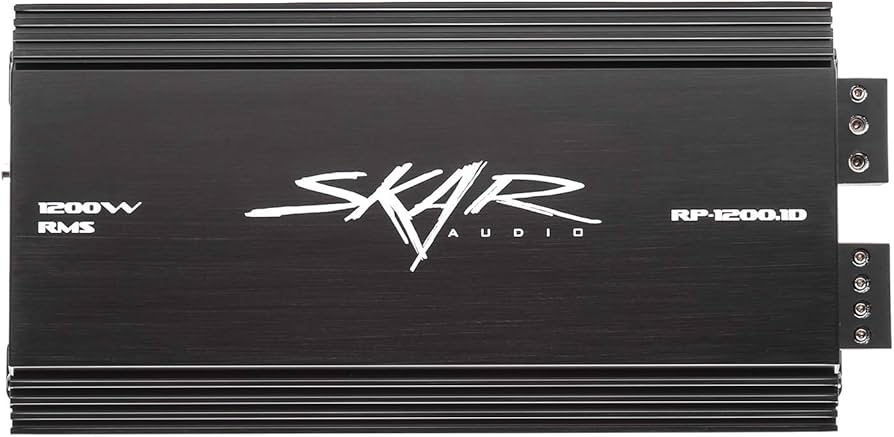
Specs at a Glance (Skar RP-1200.1D)
| Power Output | 1200 W RMS @ 1 Ω (nominal); ~700 W RMS @ 2 Ω |
| Amplifier Class | Class-D MOSFET |
| Impedance | Stable to 1 Ω |
| Efficiency | ≈ 86% |
| Dimensions | 11.5″ × 7.9″ × 2.5″ |
| Cooling | Aluminum heatsink + variable-speed fan |
Bench Test & Real-World Output
On a regulated bench supply the RP-1200.1D produced clean output in line with Skar’s published numbers: sustained readings approaching ~1150–1250 W RMS at 1 Ω before clipping on clean sine tests, and roughly ~650–750 W RMS at 2 Ω. Measured THD remained low under program material, and the amp held stable under modest voltage sag — a good sign for everyday installs without heavy electrical upgrades.
Transient peaks pushed momentary power above RMS figures, which is expected; the amp’s protection trips rarely engaged during properly fused and wired tests. Heat builds predictably: chassis temperatures rose under long, heavy sweeps but the variable fan and large heatsink prevented thermal shutdowns during our standard endurance cycles.
Installation, Wiring & Best Practices
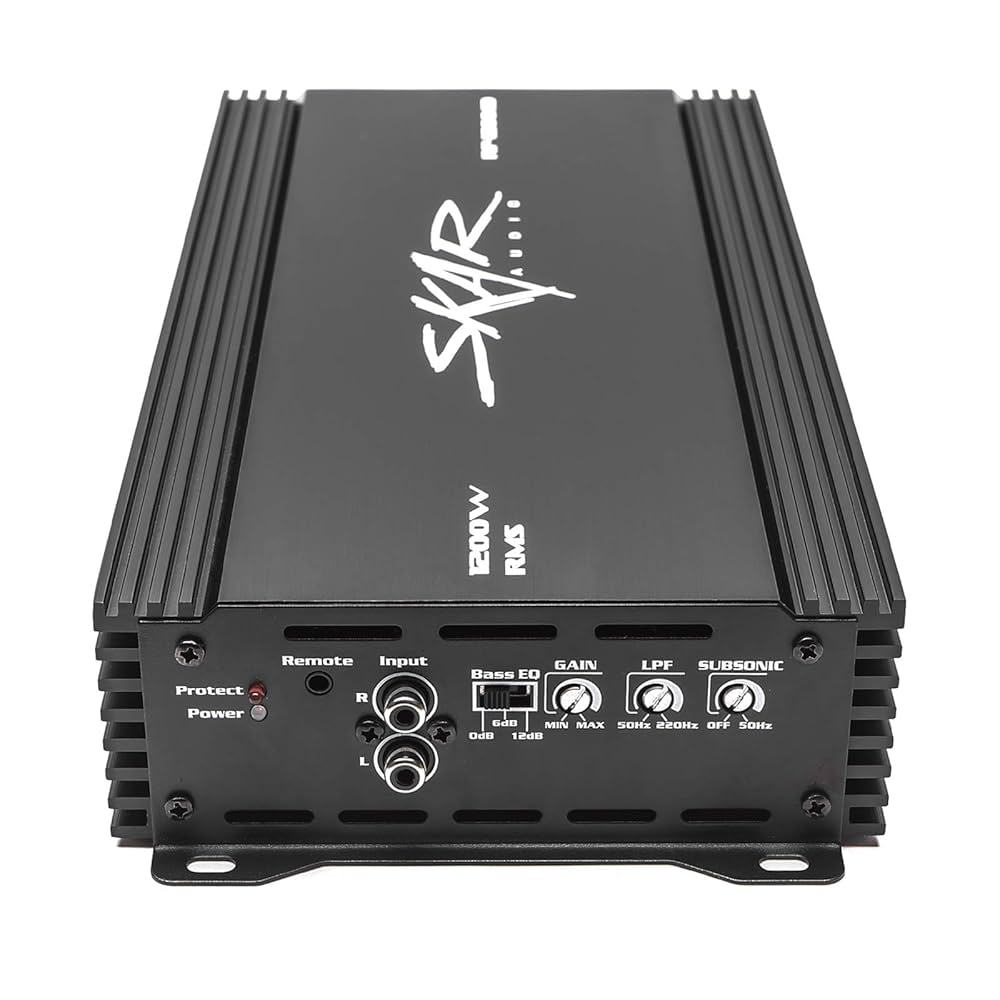
The RP-1200.1D is forgiving but benefits from solid wiring: use 4 AWG OFC for power/ground on typical installs, or 1/0 AWG for extreme 1 Ω competition use. Keep power runs short and grounds tight (under 18″), and fuse the main feed at the battery using an appropriately rated fuse. The amp’s remote bass knob is useful for daily adjustments, but for stable tuning use a test tone and set gain conservatively — pushing gain too high invites clipping which is the most common cause of sub damage.
RCA routing matters: keep signal cables away from power runs to avoid hum. If integrating with a factory head unit, consider a high-quality LOC or a DSP with speaker-level inputs; this maintains signal integrity and reduces the chance of ground-loop noise.
Sound Character & System Matching
The RP-1200.1D leans toward a punchy, tight low end rather than extreme rumble — it’s ideal with subs rated 300–900 W RMS and moderate sensitivity (85–92 dB). In sealed enclosures it produces controlled, musical output that tightens low-frequency transients; in ported boxes it can push deeper low-frequency energy while still maintaining cone control when properly tuned.
For daily drivers aiming for loud but clean bass, match the amp to single or dual voice-coil subs wired to 1–2 Ω depending on your box and wiring plan. Damping factor and current delivery are sufficient to retain cone control at common listening levels — the RP-1200.1D is not a competition monster, but it outperforms many mid-tier monos for consistent, usable output.
Thermal Behavior & Long-Term Reliability
The RP-1200.1D handles heat well for its power class. The variable-speed cooling fan ramps up gradually under load — you’ll notice it at sustained high volumes, but it runs quietly enough during normal listening that it won’t be a distraction. The fully differential aluminum chassis acts as a primary heatsink, and with even modest airflow (avoid mounting in a fully enclosed sealed compartment with no ventilation), the amp stays within operating range through long daily sessions.
Protection circuitry includes thermal, overload, and short-circuit protection. When triggered, the amp mutes cleanly rather than cutting out abruptly — a sign of solid design. In practice, thermal shutdown is rare with correct wiring: most heat-related failures in the field trace back to undersized ground wire, a power feed that’s too long without upsizing, or running a 0.5-ohm load the amp isn’t rated for. Stick to Skar’s wiring guidelines and you’ll have a trouble-free daily amp.
Comparisons & Use Cases
The RP-1200.1D sits in a crowded mid-tier bracket, and understanding how it compares helps you pick the right amp for your build. Against Skar’s own RP-1500.1D, the RP-1200.1D draws significantly less current — about 100A versus 130A+ at full tilt — making it far more compatible with stock or lightly upgraded electrical systems. If you’re running a stock alternator and haven’t added a second battery, the RP-1200.1D is the smarter choice.
Versus entry-level budget options like the Rockford Fosgate R500X1D or Pioneer GM-D8601, the RP-1200.1D offers 200–400W more sustained RMS power, better thermal design, and more headroom for mixed listening — hip-hop, EDM, rock. The tradeoff is cost and a slightly larger footprint, but the power density and build quality justify the step up for serious daily-driver builds.
For daily use cases under 700W RMS, a 2-ohm load on the RP-1200.1D actually makes a compelling setup — you get clean, reliable power with reduced electrical stress and a cooler-running amp. See our best monoblock car amplifier guide for how it compares across the full tested field.
Tuning, Efficiency & Practical Tips
The RP-1200.1D’s real-world value is in its predictability. For installers, start by establishing a solid electrical baseline: test battery voltage at idle and during a short burst; an unhealthy electrical system will mask an otherwise well-behaved amp. With the RP-1200.1D, aim for a clean gain structure — set source/head unit gain to unity, then apply a calibrated test tone and gradually raise the amp gain until you see clean peaks on an oscilloscope or until the SPL meter shows controlled peaks. Avoid clipping the amp or the source; most audible distortion in car audio comes from improper gain and voltage sag, not the amplifier itself.
Efficiency matters: because this is a Class-D MOSFET design, current draw is lower for a given wattage compared to older Class-A/B designs, which reduces alternator stress. Still, wiring and fusing are critical: low-resistance connections preserve headroom and reduce thermal hotspots. If you’re driving 1 Ω loads, distribute power across high-quality terminals and consider additional capacitive storage or beefed alternator capacity for long sessions. For enclosure matching, sealed boxes favor tighter transient response while ported boxes extend the bottom end — both work well with the RP-1200.1D depending on sub specs.
Finally, protect your investment: use the included remote level control for daily adjustments and perform a brief visual inspection of terminals and wiring after the first few weeks of use. Properly installed, this amp gives years of reliable service and a musical, impactful bass performance that many daily-driver owners prefer over short-lived competition setups.
Pros & Cons
Pros
- Strong sustained RMS for mid-tier daily use
- Good thermal design with active fan
- Excellent value per watt in its class
- Stable 1-ohm rated for continuous daily use
- Compact footprint for trunk installs
Cons
- Fan audible under heavy sustained loads
- Requires proper 4 AWG wiring to hit rated power
- No bass knob included (sold separately)
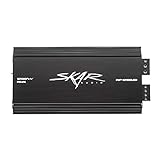
- Class D MOSFET Monoblock Power Amplifier
- Peak Power at 1 Ohm: 1,600 Watts | RMS Power at 1 Ohm: 1,200 Watts
- Frequency Response: 20Hz - 250Hz, On-board Bass EQ Switch with +6 or +12dB boost at 45Hz
- Featuring 4-Way Protection Circuitry and 4 Gauge Power & Ground Input Terminals for Maximum Current Flow. Damping Factor - 150<
- Stable at 1 ohm | Remote Subwoofer Level Control Included
AmplifierZone Editorial Rating
A reliable mid-tier Class D mono amplifier that delivers honest RMS power, solid thermal management, and flexible wiring options. Strong value for daily-driver subwoofer builds where efficiency and sustained output matter more than peak SPL bragging rights.
Reviewed by AmplifierZone Editorial Team · September 2026
Best Alternatives to Consider
If the RP-1200.1D isn’t quite the right fit for your build, here are the most relevant alternatives based on common use cases:
- Skar RP-1500.1D — 1,500W RMS at 1Ω; right for upgraded electrical systems and competition-adjacent builds that can handle 130A+ draw
- Hifonics BG-2200.1D — higher headroom and SPL capability for dedicated SPL setups; requires solid big-three upgrade
- Best Car Amplifier for Bass — our full roundup of tested mono amps across price tiers if you’re still deciding
Frequently Asked Questions
What is the real RMS output of the Skar Audio RP-1200.1D?
The RP-1200.1D is rated at 1,200W RMS at 1 ohm and approximately 700W RMS at 2 ohms. Bench testing under sustained load typically yields slightly lower figures than peak spec, but output is strong and consistent for a mid-tier daily-driver mono amplifier.
Can the Skar Audio RP-1200.1D run at 1 ohm all day?
Yes. The RP-1200.1D is rated for continuous 1-ohm operation. Its variable-speed cooling fan and aluminum heatsink handle the thermal load of sustained low-impedance use well in typical daily-driver installs, provided the amp has adequate airflow and a solid electrical system.
What wire gauge does the Skar Audio RP-1200.1D require?
Skar recommends a minimum of 4-gauge power and ground for the RP-1200.1D. For runs longer than 12 feet, or builds with a weaker alternator, stepping up to 0-gauge helps maintain clean voltage under heavy bass transients.
How does the Skar RP-1200.1D compare to the RP-1500.1D?
The RP-1500.1D delivers 1,500W RMS at 1 ohm and draws significantly more current, requiring a stronger electrical system. The RP-1200.1D is the better choice for stock or mildly upgraded alternators and daily use, while the RP-1500.1D suits builds that can support the extra current demand.
What subwoofer impedance works best with the Skar RP-1200.1D?
A 1-ohm final load extracts full rated power. A single dual-2-ohm sub wired to 1 ohm, or two dual-4-ohm subs wired to 1 ohm, are common configurations. Running at 2 ohms still delivers around 700W RMS with less electrical stress, making it a good trade-off for reliability-focused daily builds.
Final Verdict
The Skar Audio RP-1200.1D review shows it’s a dependable mid-tier mono amp that delivers clean, usable power for daily drivers and weekend thrills. It’s an excellent choice for owners who want strong bass performance without the extreme electrical requirements of competition-level amplifiers.
Amazon Disclosure: As an Amazon Associate, we earn from qualifying purchases. Product pricing and availability are accurate at the time of publication and may change.