
This Marantz PM6007 review covers the integrated amplifier that most clearly embodies what Marantz has been doing since the 1950s: making music sound involving, warm, and genuinely pleasurable to listen to. At around $600 it sits in direct competition with the Denon PMA-600NE and Yamaha A-S501, but takes a different position from both — more musical and characterful than the Yamaha, smoother and more refined than the Denon, and uniquely equipped with a dedicated discrete headphone amplifier stage that neither of its direct competitors includes.
It appears in our roundup of the best integrated amplifiers with phono input as the best choice for musical vinyl warmth. This review examines exactly what that means in practice — how the PM6007’s phono stage sounds across different cartridges, what the dedicated headphone amp adds, and precisely which listeners will find this the most satisfying amplifier in the cluster.
Quick Answer: The Marantz PM6007 is the most musically engaging integrated amplifier under $700 for vinyl listeners who prioritise a warm, relaxed, non-fatiguing presentation. Its MM phono stage has the Marantz house sound at its most accessible — smooth, full-bodied, and suited to extended listening sessions on acoustic, vocal, and classical recordings. The dedicated discrete headphone amp is a genuine differentiator. At 45W per channel it suits efficient bookshelf speakers in small to medium rooms — listeners needing more power should look at the Yamaha A-S501 or A-S801.
This article contains affiliate links. If you purchase through them, we may earn a commission at no extra cost to you. This helps support AmplifierZone and allows us to keep creating in-depth, unbiased audio guides.
Who Is the Marantz PM6007 For?
The listener it was designed for
The PM6007 is built for the listener who treats their hi-fi system as a place to relax with music rather than a tool for evaluating recordings. Marantz’s house sound has always prioritised long-session comfort over analytical precision — warmth, smoothness, and a musical coherence that makes you want to keep listening rather than keep adjusting. The PM6007 delivers that character at its most accessible price point.
Practically, it suits three profiles. First, vinyl listeners who primarily play acoustic music — jazz, classical, folk, vocal recordings — where the PM6007’s warm midrange and smooth top end provide exactly the right tonal balance. Second, anyone who regularly listens through headphones and wants a genuinely good headphone output rather than the basic tap-from-speaker-output that most integrated amplifiers at this price provide. Third, listeners who have found previous amplifiers slightly harsh or tiring over extended sessions and want an amplifier that specifically addresses that.
When to look elsewhere
The PM6007 is the wrong choice for listeners whose room or speakers already lean warm — the Marantz character will compound rather than balance. It’s also not the right tool for listeners who need Bluetooth integration, more than 45W per channel, or two speaker pair outputs. For any of those requirements, the Yamaha A-S501 or Denon PMA-900HNE serve better. And for listeners who want maximum neutrality and accuracy from their amplifier, Yamaha’s house sound is the more appropriate choice. Matching the PM6007’s 45W to your specific speakers is covered in the speaker matching guide.
Quick check: Do you primarily listen to acoustic, vocal, classical, or jazz recordings? Do you value long-session comfort over analytical detail? Do you use headphones regularly alongside speakers? If all three apply, the PM6007 is almost certainly the right amplifier in this cluster for you.
Marantz PM6007 — Key Specifications
Marantz PM6007 Integrated Amplifier
- Type: Integrated stereo amplifier with MM phono stage
- Power output: 45W × 2 (8Ω)
- Phono stage: MM (moving magnet) — Marantz musical house character
- Inputs: Phono (MM), 4× RCA stereo line, optical digital (Toslink)
- Speaker outputs: 1 pair
- Headphone output: Dedicated discrete headphone amplifier — front panel
- Source Direct: Yes — bypasses tone, balance, and filter circuits
- Tone controls: Yes — bass, treble, balance
- Bluetooth: No
- Dimensions: 440 × 105 × 378mm
- Weight: 7.8kg
- Marantz house sound — warm, smooth, and musically engaging for long sessions
- Dedicated discrete headphone amplifier — significantly better than speaker-tap alternatives
- Source Direct mode — full signal path bypass for critical listening
- Optical digital input — direct TV or CD player connection
- Premium finish — Marantz’s signature aesthetic at its most accessible
- Proven reliability — PM6007 series has a strong long-term track record
- 45W per channel — limited for less sensitive speakers or larger rooms
- No Bluetooth or wireless streaming
- Warm character can compound with warm speakers or cartridges
- No MC phono support
- One speaker pair output only
Approx. price: $500–$700. Best for musical vinyl warmth — and the dedicated headphone amp stage is genuinely good.
The 45W per channel rating is Marantz’s honest continuous figure into 8Ω. For speakers above 87dB sensitivity in small to medium rooms, 45W provides comfortable headroom at normal listening levels. Below that sensitivity threshold or in rooms larger than roughly 20 square metres, it starts to feel limited — particularly at higher volumes where the warmth-forward character of the PM6007 benefits from the headroom to express itself properly. The full explanation of how watts and sensitivity translate to practical performance is in this amplifier wattage guide.
Design and Build Quality
Marantz signature aesthetic
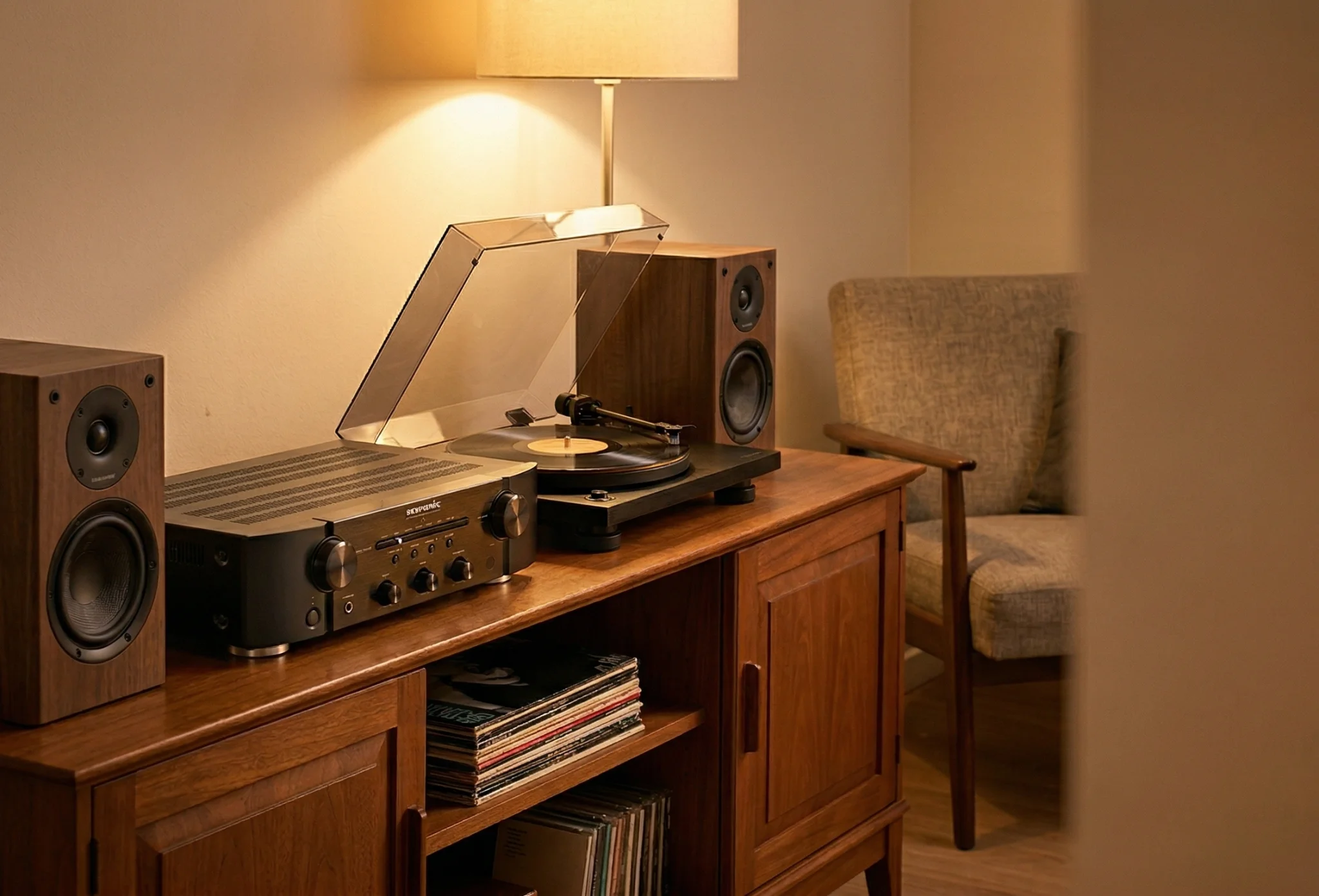
The PM6007 looks like a Marantz amplifier — and that’s not a small thing. Marantz’s signature aesthetic, with its champagne-gold finish, porthole-style power meter window, and distinctive circular dial layout, is one of the most recognisable in hi-fi. The PM6007 carries this design language at an entry point that makes it accessible alongside its sonic character. On a listening shelf alongside a quality turntable, it makes a visual statement that Yamaha’s functional industrial design and Denon’s more conservative appearance don’t attempt.
Build quality and materials
Marantz builds the PM6007 in their current standard — solid chassis, quality front panel components, and internal construction that reflects proper engineering rather than cost minimisation. At 7.8kg it’s well-weighted for its size. The volume knob is smooth and precise. Source Direct engages with a satisfying click. Build quality is consistent with the PM6007’s reputation for long-term reliable service — user reports of PM6007 and earlier PM6006 series units operating without fault after five or more years of daily use are common.
The headphone amplifier
The dedicated discrete headphone amp is worth specific attention because it’s unusual at this price. Most integrated amplifiers — including the Denon PMA-600NE and Yamaha A-S501 — tap the speaker output stage for headphone use, which produces lower noise performance than a dedicated circuit. Marantz provides a separate headphone amplifier circuit in the PM6007, which produces lower crosstalk, better channel separation, and a more controlled presentation for dynamic headphones. For listeners who split their time between speakers and headphones, this is a genuine practical advantage.
Sound Quality
The phono stage character
Marantz’s MM phono stage in the PM6007 is the smoothest-sounding in this cluster. Where Denon’s PMA-600NE phono stage is warm and rhythmically forward, the PM6007’s is warmer still but in a more relaxed direction — the upper midrange is less prominent, the top end is more rolled-off, and the overall presentation prioritises fatigue reduction over energy. On acoustic guitar, piano recordings, and female vocals particularly, the PM6007 produces a listening experience that most listeners describe as immediately comfortable and involving.
The limitation is at the boundaries of that comfort zone. Electronic music, modern pop production, and detail-heavy recordings that benefit from a more forward and analytical presentation lose some of their crispness through the PM6007’s phono stage. The warmth that makes acoustic recordings so enjoyable slightly softens the definition that makes electronic music satisfying. Source Direct helps — bypassing the tone circuits tightens the presentation somewhat — but the core character of the Marantz phono stage is set at the circuit level.
As a line amplifier
Via the RCA line inputs and the optical digital input, the PM6007’s amplifier stage maintains its musical character. Bass is well-controlled and tuneful without the last degree of tightness that Yamaha’s high-current design provides. Midrange is the standout quality — rich, present, and textured in a way that makes voices and acoustic instruments sound genuinely real. The top end is smooth and non-fatiguing; it never becomes harsh or sibilant even at higher volumes over long sessions.
Headphone listening
The dedicated headphone amplifier produces results clearly above what speaker-tap alternatives provide at this price. With mid-impedance dynamic headphones — Beyerdynamic DT 770 Pro, Sennheiser HD 560S, Audio-Technica ATH-M50x — it delivers Marantz’s warm character directly: controlled bass, textured midrange, and a smooth top end that suits extended listening. For high-impedance headphones above 250Ω, the dedicated stage is still limited compared to a dedicated headphone amplifier — the PM6007 is not a substitute for a proper headphone amp — but it is the strongest headphone output available in an integrated amplifier at this price point.
Marantz PM6007 review — where its character adds the most value
- Acoustic, vocal, jazz, classical: Marantz warmth and smoothness are directly suited to these genres
- Fatigue-prone listeners: Smooth top end and warm midrange reduce long-session listening fatigue
- Headphone users: Dedicated discrete headphone amp is the best in class at this price
- Neutral or slightly analytical speakers: Marantz warmth balances without over-colouring
- Electronic and modern pop: Warmth softens definition — Cambridge AXA35 or Yamaha A-S501 serve this better
Connectivity and Compatibility
Inputs and source options
The rear panel carries the MM phono input with ground terminal, four RCA stereo line inputs, and a Toslink optical digital input. Four line inputs handle a CD player, streaming device, TV via analogue stereo, and one spare — all selected from the front panel. The optical input connects a TV or CD player with digital output without consuming an RCA slot, which is practically useful for listeners who want vinyl and TV audio from the same amplifier without a complicated switching setup.
Source Direct and tone controls
Source Direct bypasses all tone control, balance, and filter circuitry simultaneously — a more complete signal path bypass than a simple tone defeat switch. With Source Direct engaged, the signal travels from the source selector directly to the power amplifier stage via the volume pot only. The audible difference is subtle on most recordings but consistently noticeable on well-recorded vinyl: slightly lower noise, more precise image placement, and a cleaner top end. Most PM6007 owners end up using Source Direct for critical vinyl listening and engage tone controls for digital sources or TV audio where a small boost is useful. The role of source direct and signal path purity within a broader system is covered in this explainer on what a preamp does.
What’s absent
No Bluetooth, no Wi-Fi, no USB input, no coaxial digital input, and no preamp output. The PM6007 is a traditional integrated amplifier in a modern chassis — analogue and optical in, speakers and headphones out. Listeners who need Bluetooth must connect a separate wireless receiver to one of the four RCA line inputs. The omission of a coaxial digital input means CD players and streamers without optical output need an external converter or must use an analogue RCA connection.
How the Marantz PM6007 Compares
Marantz PM6007 vs Denon PMA-600NE
Both are warm integrated amplifiers at similar prices targeting vinyl listeners. Character differs in a meaningful way: Denon’s warmth is rhythmically forward and punchy — energetic, dynamic, suited to rock and electronic music alongside vinyl. Marantz’s warmth is smoother and more relaxed — better suited to acoustic, jazz, and classical recordings where long-session comfort matters more than forward energy. Denon’s PMA-600NE includes an optical input and is marginally more powerful. Marantz’s PM6007 counters with the dedicated discrete headphone amp and a Source Direct mode that the PMA-600NE lacks. Ultimately, the choice comes down to listening style and music preference.
Marantz PM6007 vs Yamaha A-S501
Character versus capability. Yamaha’s A-S501 delivers 85W of neutral, accurate amplification with two speaker pairs and both optical and coaxial digital inputs. Marantz’s PM6007 delivers 45W of warm, musical amplification with a dedicated headphone amp and Source Direct. For listeners whose priority is power, speaker flexibility, and accuracy, the A-S501 wins. For listeners whose priority is musical character, headphone performance, and relaxed long-session listening, the PM6007 is considerably more satisfying.
Marantz PM6007 vs Marantz PM6006
The PM6007 succeeds the PM6006 — same house sound, refined internal components, and improved phono stage performance. Current market availability favours the PM6007, with the PM6006 available at discounted prices where stock remains. Both are excellent amplifiers. For a new purchase the PM6007 is the natural choice. Where a well-priced PM6006 is available, its sonic character is close enough to its successor that the choice becomes a pure pricing decision.
Best Speaker Pairings
The PM6007’s warm character pairs best with neutral to analytical speakers where it adds balance rather than compounds existing warmth:
| Speaker | Sensitivity | Character | Result |
|---|---|---|---|
| KEF Q150 | 86dB | Neutral, detailed | Excellent — PM6007 warmth complements KEF’s analytical precision |
| Elac Debut 2.0 B5.2 | 86dB | Neutral, slightly lean | Very good — Marantz adds body to the Debut’s lean presentation |
| Monitor Audio Bronze 100 | 88dB | Clean, detailed | Excellent — Monitor Audio neutrality suits PM6007’s musical character |
| Klipsch R-51M | 93dB | Forward, lively | Good — PM6007 smooths Klipsch’s forward energy; high sensitivity helps |
| Wharfedale Diamond 12.2 | 86dB | Warm, rounded | Caution — compounding warmth; use Source Direct and check in room |
| Dali Oberon 1 | 84dB | Warm, smooth | Caution — both warm; 45W may feel limited below 84dB sensitivity |
Is the Marantz PM6007 Worth It?
For the right listener — yes
For the vinyl listener who values musical character, long-session comfort, and a genuinely good headphone output alongside their speakers, the PM6007 is difficult to better under $700. Its Marantz house sound is the most refined and musically satisfying presentation available in this cluster at this price. The dedicated discrete headphone amp is a practical differentiator that adds real daily-use value. Source Direct ensures signal purity is available when you want it. Build quality and the Marantz reliability record make it a confident long-term purchase.
When the PM6007 is not the answer
Warm character, moderate power, and a single speaker pair output define its limitations. A listener with large floorstanders, a big room, or speakers below 85dB sensitivity will find 45W running short of headroom. A listener who primarily plays electronic, modern pop, or detail-heavy recordings will find the PM6007’s smooth character slightly softens what those recordings need to be satisfying. For those use cases, the Yamaha A-S501 or the Denon PMA-900HNE serve the listener more directly.
Speaker sensitivity matters more here than anywhere in this cluster: At 45W, the PM6007 is more sensitive to speaker efficiency than the higher-powered alternatives. Run it with 87dB+ speakers in a room up to roughly 20 square metres and it performs confidently. Push below that sensitivity or above that room size and the warmth that makes it special can start to feel thick rather than rich — the amplifier needs to run at a comfortable volume level to sound its best.
Marantz PM6007 Review — Final Verdict
What makes it special
The Marantz PM6007 earns its position by being the most musically enjoyable amplifier in this cluster for the listener it was designed for. Its phono stage makes acoustic and vocal recordings sound warm, present, and involving. Its dedicated headphone amp performs above anything else available at this price in an integrated amplifier. Source Direct and four line inputs give it flexibility beyond its modest power rating suggests. Marantz’s premium finish and proven reliability make it a component worth owning for years.
What comes next
If you need vinyl and streaming in one box — Bluetooth, AirPlay, and a phono input together — without the complexity of separate components, the Denon PMA-900HNE review covers exactly that combination at a higher price. For the full picture across all eight integrated amplifiers with phono input, the complete roundup maps every use case clearly.
Approx. price: $500–$700. Best for musical vinyl warmth — and the dedicated headphone amp stage is genuinely good.
Frequently Asked Questions
Does the Marantz PM6007 have a phono input for a turntable?
Yes. The PM6007 has a dedicated MM phono input with ground terminal on the rear panel. It supports moving magnet cartridges — the most common type used with consumer turntables. MC (moving coil) cartridges are not supported directly and require an external step-up transformer or phono preamp. Turntables with a built-in phono preamp should be connected via line output to one of the four RCA line inputs rather than the phono input.
What makes the Marantz PM6007 headphone output different from other amps?
Most integrated amplifiers at this price route the headphone output from the speaker amplifier stage via a resistor network — a simple and inexpensive approach that produces adequate but not exceptional headphone performance. The PM6007 includes a dedicated discrete headphone amplifier circuit that is independent of the speaker output stage. This produces lower noise, better channel separation, and a more controlled presentation for dynamic headphones. For listeners who regularly use headphones alongside speakers, the PM6007’s headphone stage is meaningfully better than alternatives in this price range.
What does Source Direct mode do on the Marantz PM6007?
Source Direct bypasses all tone control, balance, and filter circuits in the signal path simultaneously. With Source Direct active, the signal travels directly from the input selector through the volume pot to the power amplifier stage without any further processing. This produces the lowest possible noise floor and most transparent presentation the PM6007 can provide. Tone controls and balance are unavailable while Source Direct is engaged. For critical vinyl listening with a well-matched cartridge, Source Direct is the recommended setting.
How does the Marantz PM6007 compare to the Denon PMA-600NE?
Both are warm integrated amplifiers with MM phono stages at similar prices. Denon’s PMA-600NE is warmer in a rhythmically forward, punchy way that suits rock and electronic music. Marantz’s PM6007 is smoother and more relaxed — better for acoustic, jazz, and classical recordings over long sessions. The PM6007 adds a dedicated discrete headphone amp and Source Direct that the PMA-600NE lacks. The Denon is marginally more powerful at 45W vs 45W, but includes both optical and more power headroom through its 4Ω rating. Choose based on listening style and music preference.
Is the Marantz PM6007 good for electronic music?
It works but it’s not the strongest choice. The PM6007’s warm, smooth character softens the definition and top-end clarity that makes electronic music satisfying — the precision and forward energy that well-produced electronic tracks benefit from is partially absorbed by the Marantz warmth. For electronic music as a primary genre, the Yamaha A-S501’s neutral character or the Cambridge Audio AXA35’s clean signal path serve those recordings more accurately. The PM6007 is at its best on acoustic, vocal, jazz, and classical material.