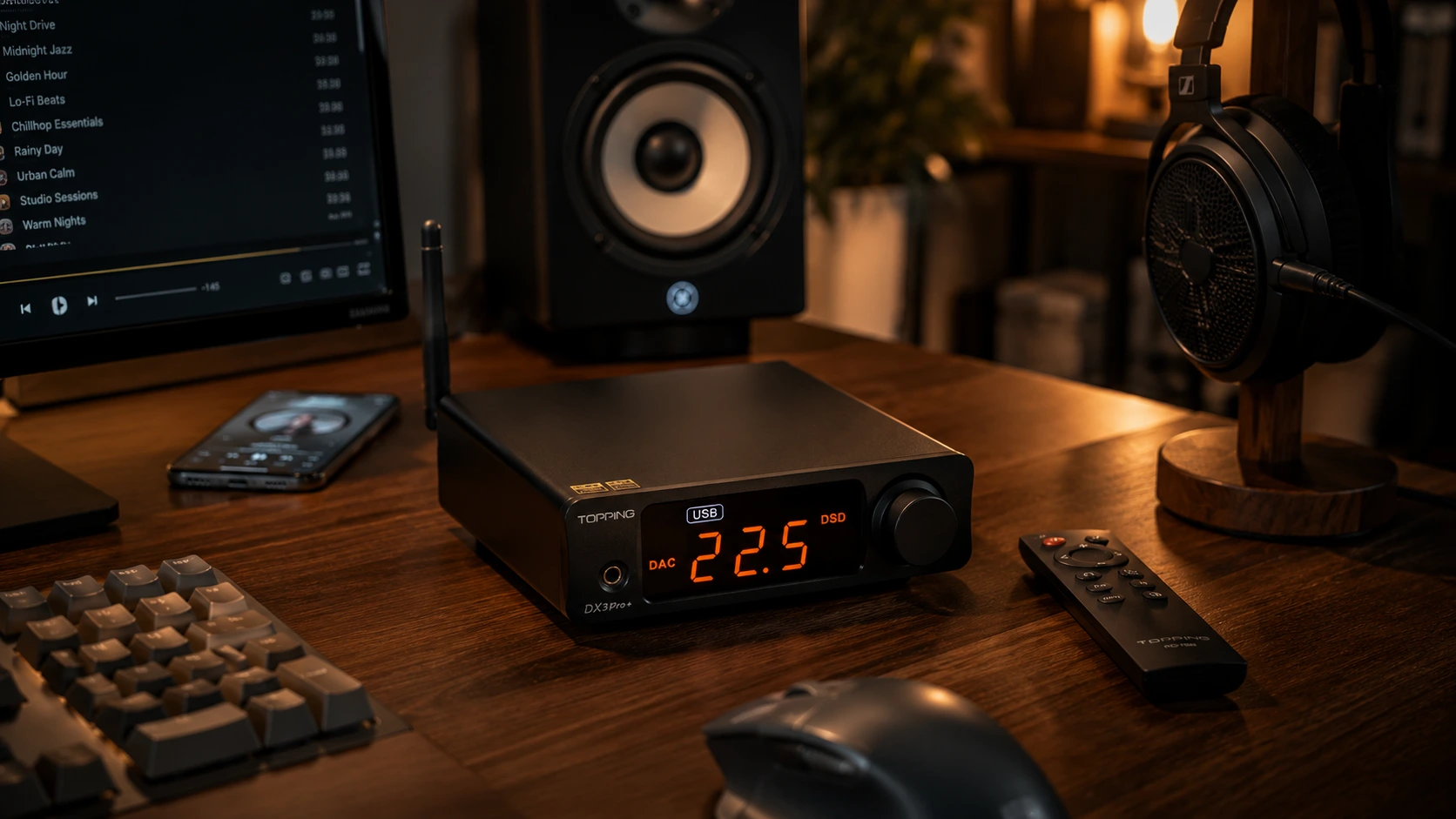
Most desktop DAC/amp units require a cable between the source and the unit — and for many desk setups that is perfectly fine. But for listeners who primarily stream from a phone, a tablet, or a sofa-distance laptop, a wired USB connection is an inconvenience that quietly discourages using the better audio chain. The Topping DX3 Pro+ solves that problem with LDAC Bluetooth 5.0 — the only unit in the under-$250 desktop category that accepts high-resolution wireless audio without compromising the DAC quality. It was the wireless pick in the best DAC/amp combo under $250 roundup, and this review explains in full why that is and whether it is the right choice for your setup.
This review covers who genuinely benefits from LDAC wireless, what the ES9038Q2M DAC chip delivers, where the DX3 Pro+ is the stronger choice versus wired alternatives, and where its power limitations become relevant. If your primary use case is wired desktop listening with demanding headphones, the answer may point elsewhere before you finish reading.
Quick Answer: The Topping DX3 Pro+ is the right choice for listeners who stream wirelessly from a phone and want LDAC-quality Bluetooth — not standard Bluetooth. The ES9038Q2M chip, NFCA amplifier, remote control, and pre-amp function for active speakers make it the most versatile desktop unit in this price range. The limitation is power: at ~1,000mW into 32Ω it handles easy-to-drive and mid-impedance headphones well, but falls short of the FiiO K5 Pro ESS on demanding 300Ω dynamics and planars.
This article contains affiliate links. If you purchase through them, we may earn a commission at no extra cost to you. This helps support AmplifierZone and allows us to keep creating in-depth, unbiased audio guides.
Who Is the Topping DX3 Pro+ For?
Specifically, the DX3 Pro+ is built for listeners whose primary audio source is a phone or tablet, and who want the quality of a dedicated desktop DAC/amp without running a cable across their desk each time. Indeed, that is a specific and common scenario — and it is the only scenario in this price range where the DX3 Pro+ is the obvious correct answer. For any other use case, the decision is less clear-cut.
Furthermore, beyond wireless users, two further profiles suit it well. Listeners who want a single desktop hub that controls both headphones and powered speakers from one remote — the variable RCA pre-amp output with volume control makes the DX3 Pro+ genuinely useful as a system controller in a way no other unit at this price can match. And listeners who prefer the ESS sound signature — precise, detailed, and analytically transparent — over the warmer AKM character of the FiiO units. Specifically, for listeners still deciding whether a dedicated unit makes any difference, the headphone amp guide covers that question directly before the DX3 Pro+ becomes relevant.
The wireless test: Do you primarily stream music from a phone? Is your phone LDAC-capable (most Android phones since 2018, Sony devices specifically)? If yes to both, the DX3 Pro+ delivers a meaningfully better wireless experience than any alternative at this price. If you primarily listen from a desktop computer via USB, the wireless advantage disappears and a wired unit offers better value.
Topping DX3 Pro+ — Key Specifications
Topping DX3 Pro+ LDAC DAC and Headphone Amplifier
- DAC chip: ESS ES9038Q2M
- Amplifier circuit: NFCA (Nested Feedback Composite Amplifier)
- Headphone output power: ~1,000mW into 32Ω
- Headphone output jack: 3.5mm single-ended
- Bluetooth: Bluetooth 5.0 — LDAC (990kbps), aptX, aptX HD, AAC, SBC
- Digital inputs: USB, Optical Toslink, Coaxial, Bluetooth
- Line output: RCA — fixed and variable (pre-amp mode)
- Pre-amp function: Yes — variable RCA output with volume control
- Remote control: Yes — included
- Balanced output: No
- Resolution: Up to 32-bit/768kHz PCM, DSD256
- Display: Small OLED screen — shows input source and volume level
- Seller note: Listed via KGUSS Store on Amazon — verify listing before purchase
- LDAC Bluetooth 5.0 — highest-quality wireless audio codec, up to 990kbps
- ESS ES9038Q2M — flagship-tier DAC chip, precise and detailed
- Remote control — only unit in this category with one included
- Variable RCA pre-amp output — volume-controlled speaker feed from one device
- OLED display — shows input and volume at a glance
- USB/optical/coaxial/Bluetooth — all four input types covered
- No balanced headphone output — 3.5mm single-ended only
- Lower output power than FiiO K5 Pro ESS — not ideal for 250Ω+ dynamics or planars
- Third-party Amazon listing — sold via KGUSS Store, not Topping directly
- LDAC benefit requires LDAC-capable source device
- No analogue line-in — cannot be used as a pure headphone amp with external DAC
Approx. price: $199.00. Best wireless pick — LDAC Bluetooth 990kbps, ES9038Q2M, remote control, pre-amp function. Listed via KGUSS Store on Amazon.
Design and Build Quality
The DX3 Pro+ is compact and well-finished — the aluminium chassis is solid, the volume knob has a smooth, well-damped feel, and the small OLED display on the front panel shows the current input source and volume level clearly. The overall size is closer to the Fosi Audio Q4 than to the larger FiiO K5 Pro ESS, which makes it a practical fit on a desk with limited real estate.
Specifically, the remote control is a genuine convenience rather than a gimmick. For a desk setup with powered speakers where the DX3 Pro+ is acting as the system preamplifier, being able to control volume, mute, and input selection from across the room is legitimately useful. The remote is small, plastic, and functional — nothing premium about it, but it works correctly.
However, the 3.5mm headphone output on the front panel is a design choice worth noting. Specifically, most over-ear headphones use a 6.35mm jack — a 3.5mm-to-6.35mm adapter is needed for those headphones, which is a minor friction point. The 3.5mm choice is consistent with the DX3 Pro+’s positioning as a compact desktop unit rather than a dedicated high-power amplifier chassis.
Additionally, one practical note: the Amazon listing for the DX3 Pro+ at B09JC3TCJF is sold by KGUSS Store, a third-party reseller, rather than a Topping-authorised storefront. The product is genuine but buyer service experience may differ from a manufacturer-direct purchase. Verify the listing and seller details before ordering.
LDAC Bluetooth — What It Actually Delivers
LDAC is Sony’s high-resolution Bluetooth codec, and understanding what it means in practice determines whether the DX3 Pro+ makes sense for your setup. Specifically, standard SBC Bluetooth — the fallback codec on all Bluetooth devices — transmits audio at approximately 328kbps. LDAC at its highest quality setting transmits at 990kbps — roughly three times the data rate. Consequently, in practice, this means wireless audio through the DX3 Pro+ at LDAC quality is audibly closer to wired quality than standard Bluetooth by a meaningful margin.
Specifically, streaming Tidal HiFi, Apple Music lossless, or Qobuz from a phone via LDAC to the DX3 Pro+ produces a result where the wireless step in the chain contributes less audible degradation than it does with standard Bluetooth. Specifically, bass definition is tighter, high-frequency detail is more resolved, and the sense of spatial information in the recording is better preserved. However, it is not identical to a wired USB connection — some compression artefacts remain at 990kbps — but the difference between LDAC and wired is smaller than most listeners notice in normal use.
However, LDAC only works when both devices support it. Android phones from most major manufacturers since 2018 support LDAC. Sony devices support LDAC natively. iPhones do not support LDAC — Apple devices use AAC Bluetooth, which the DX3 Pro+ also supports. AAC at 256kbps is significantly better than SBC but does not approach LDAC quality. Consequently, iPhone users considering the DX3 Pro+ for its wireless advantage should understand that the full LDAC benefit is not available on iOS. For a broader comparison of how Bluetooth DAC/amps differ in practice, the Bluetooth DAC/amp guide covers every relevant option.
Sound Quality
The DX3 Pro+ sounds precise, detailed, and analytically transparent — the ES9038Q2M chip’s character. Specifically, compared to AKM-based units like the FiiO K5 Pro ESS, the ESS signature is slightly cooler and more neutral in the midrange, with sharper transient definition and a more analytical presentation of high-frequency detail. Specifically, whether this is preferable is a matter of taste and headphone pairing — ESS chips suit headphones with a warm or dark tonal character, where their precision adds balance. AKM chips suit headphones with a bright or analytical character, where their smoothness provides balance.
Via wired USB
Specifically, through a USB connection, the DX3 Pro+ performs at its best. The NFCA amplifier circuit is quiet, controlled, and transparent. Specifically, on headphones in the 32–150Ω range — which covers most consumer headphones — the combination of the ES9038Q2M DAC and the NFCA amp produces a clean, detailed, and well-controlled sound. The noise floor is very low. The imaging is precise. For casual and critical listening within this headphone impedance range, the wired DX3 Pro+ is a capable and satisfying unit.
Via LDAC Bluetooth
Specifically, at LDAC 990kbps with a compatible source, the wireless performance approaches the wired result closely enough that most listeners will not identify the difference in a blind test. Specifically, the bass retains its weight and definition, the midrange is natural and present, and the high-frequency detail is well-resolved. Indeed, this is the use case the DX3 Pro+ was designed for, and it delivers it correctly.
With demanding headphones
The DX3 Pro+’s approximately 1,000mW into 32Ω is adequate for headphones up to around 150–200Ω but starts to show limitations with 300Ω dynamics and planar magnetics. Sennheiser HD 600 at 300Ω can be driven to comfortable volume levels, but the bass lacks the authority and the dynamic headroom lacks the depth that the FiiO K5 Pro ESS delivers at the same impedance. Consequently, for listeners whose primary headphones are 250Ω or above, or planar magnetic, the FiiO K5 Pro ESS is the stronger wired choice at $30 less.
Connectivity and Features
Specifically, the DX3 Pro+ covers four input types: USB, optical Toslink, coaxial, and Bluetooth. USB works immediately on macOS and Linux without drivers. Windows users can also install Topping’s optional XMOS driver for ASIO support and advanced playback settings. Optical supports up to 24-bit/192kHz, covering every TV and console source. Coaxial adds CD transport and streamer compatibility. Bluetooth handles wireless from any LDAC, aptX, aptX HD, AAC, or SBC device.
Specifically, the pre-amp function is one of the DX3 Pro+’s most practically useful features. Specifically, the variable RCA output means the DX3 Pro+’s volume control adjusts the signal level sent to connected powered speakers — making it a true volume-controlled preamplifier for a combined headphone and speaker desk setup. Indeed, no other unit in this category provides this capability with a remote control included. The result is a complete desktop system controller: Bluetooth from the phone, USB from the computer, volume from the remote, headphone or speaker output selected without touching the unit.
However, one connectivity limitation: there is no analogue line-in. The DX3 Pro+ cannot be used as a pure headphone amplifier with an external DAC connected via RCA — all inputs are digital. This limits upgrade flexibility compared to the FiiO K5 Pro ESS, which accepts analogue RCA input. For listeners who want to upgrade the DAC component separately in the future, this is a relevant constraint.
How the Topping DX3 Pro+ Compares
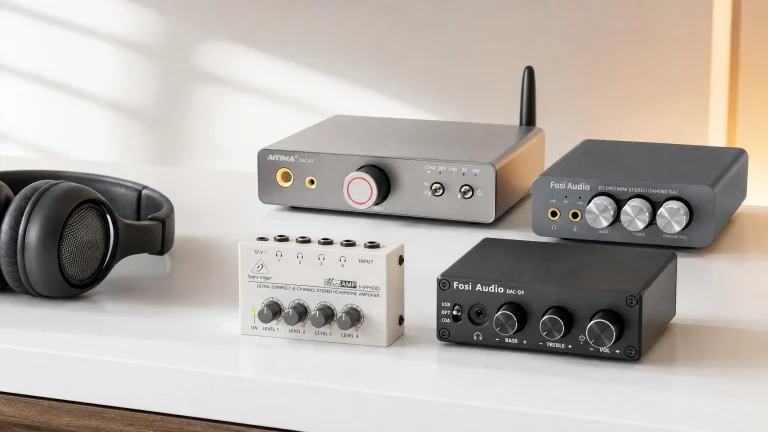
Topping DX3 Pro+ vs Fosi Audio Q4
The Q4 is the entry point for wired desktop listening. The DX3 Pro+ costs $130 more and adds LDAC Bluetooth, an ESS DAC chip, a remote control, and a pre-amp function. Specifically, for a listener who streams from a phone, that price difference represents genuine, functional value. However, for a listener who only uses USB from a desktop computer, the extra spend is harder to justify — the Q4’s USB performance is adequate for easy-to-drive headphones and the wireless capability adds nothing. Choose by use case, not by specs.
Topping DX3 Pro+ vs FiiO K5 Pro ESS
Specifically, the K5 Pro ESS is $30 less and delivers 50% more headphone output power — 1,500mW versus ~1,000mW. For listeners with demanding headphones, the K5 Pro ESS is the stronger tool. However, for listeners with easy-to-drive headphones who want wireless, the DX3 Pro+ provides the wireless capability the K5 Pro ESS completely lacks. Consequently, these two units do not directly compete for the same listener — they serve different primary needs.
Topping DX3 Pro+ vs FiiO K7
The K7 at $220 adds balanced output (2W via 4.4mm) and uses dual AK4493S chips. It has no Bluetooth. Consequently, the choice between these two is straightforward: wireless streaming matters → DX3 Pro+; balanced headphone output matters → K7. Indeed, there is no scenario where both matter equally at this price point.
Best Headphone Pairings
The DX3 Pro+ performs best with headphones in the 16–150Ω range. Here is a practical guide by headphone type:
| Headphone | Impedance | Type | Result with DX3 Pro+ | Wireless Benefit? |
|---|---|---|---|---|
| Sony WH-1000XM5 (wired) | 48Ω | Dynamic, closed-back | Clean, detailed, immediate improvement over laptop | Yes — LDAC from Android is ideal |
| Audio-Technica ATH-M50x | 38Ω | Dynamic, closed-back | Precise, controlled, low noise floor | Moderate — primarily USB users |
| Beyerdynamic DT 770 Pro 80Ω | 80Ω | Dynamic, closed-back | Well-driven, good balance, ESS pairs naturally with DT 770’s brightness | No — primarily wired studio use |
| Sennheiser HD 560S | 120Ω | Dynamic, open-back | Clean, adequate — approaching power limits at high volume | Yes — Bluetooth streaming ideal |
| Sennheiser HD 600 | 300Ω | Dynamic, open-back | Adequate volume — lacks bass weight vs K5 Pro ESS | Limited — needs more power |
| Sensitive IEMs | 16–32Ω | IEM | Low noise, fine control, excellent wireless use case | Yes — LDAC ideal for wireless IEM use |
Is the Topping DX3 Pro+ Worth It?
Specifically, the DX3 Pro+ is worth buying if wireless streaming from an LDAC-capable Android phone is part of your regular listening routine. Consequently, no alternative in this price range offers the same combination — LDAC quality, a flagship ESS DAC chip, remote control, and pre-amp functionality in a single compact unit. For that specific listener profile, the $199 price represents genuine value.
However, the case weakens outside that profile. For a listener who exclusively uses USB from a desktop computer, the $130 premium over the Fosi Audio Q4 buys features that contribute nothing to the use case. For a listener with 250Ω or higher headphones, the K5 Pro ESS is the correct answer at $30 less. Specifically, the DX3 Pro+ is an excellent unit in the scenario it was designed for — and a less obvious choice in every other scenario.
Check your phone before buying. The LDAC advantage only works with LDAC-capable source devices. iPhone users receive AAC Bluetooth (better than SBC, but not LDAC-quality). If wireless is the primary reason you are considering the DX3 Pro+ and your phone is an iPhone, the wireless benefit you are expecting is not fully available.
Final Verdict
The Topping DX3 Pro+ is the correct desktop DAC/amp for one specific listener: someone who streams from an LDAC-capable phone and wants wireless audio quality that actually approaches wired performance. For that listener, the ES9038Q2M DAC chip, NFCA amplifier, remote control, and pre-amp function combine to make it the most complete and versatile single-unit desktop solution at $199.
However, outside that profile, the trade-offs matter. Power-limited relative to the FiiO K5 Pro ESS for demanding headphones. No balanced output for listeners who want it. No analogue input for listeners who want upgrade flexibility. No iOS LDAC for iPhone users. Indeed, each limitation is real — but none of them affect the listener the DX3 Pro+ was designed for. Buy it for the wireless use case; consider the alternatives for everything else.
The complete comparison of every unit in this price range, including how the DX3 Pro+ fits relative to the entry tier and the balanced tier, is in the best headphone amplifier under $200 guide.
Approx. price: $199.00. Best wireless pick — LDAC Bluetooth 990kbps, ES9038Q2M DAC, remote control, and pre-amp function. Listed via KGUSS Store on Amazon.
Frequently Asked Questions
Does the Topping DX3 Pro+ work with iPhone?
Yes — via USB or Bluetooth AAC. iPhones do not support LDAC Bluetooth, so the wireless performance through an iPhone uses AAC codec at up to 256kbps rather than LDAC’s 990kbps. AAC is meaningfully better than standard SBC Bluetooth but does not deliver the near-wired quality that LDAC provides. For iPhone users, the USB connection from a computer or wired optical/coaxial input delivers the full DAC performance. The wireless LDAC advantage is specifically an Android feature.
What is LDAC and why does it matter?
LDAC is Sony’s high-resolution Bluetooth codec, transmitting audio at up to 990kbps — approximately three times the data rate of standard SBC Bluetooth and significantly above aptX HD’s 576kbps ceiling. At 990kbps, the compression artefacts that make standard Bluetooth audibly inferior to wired audio are substantially reduced. Streaming lossless audio via LDAC produces a result that most listeners cannot reliably distinguish from a wired USB connection in normal listening conditions.
Can I use the Topping DX3 Pro+ with powered speakers?
Yes — and this is one of its most useful features. The variable RCA output functions as a preamplifier output: the DX3 Pro+’s volume control (including via the remote) adjusts the signal level sent to powered speakers. Specifically, connect powered monitors or active bookshelf speakers to the RCA output, and the DX3 Pro+ becomes the system volume controller for both headphones and speakers. No separate preamp or mixer is needed.
Is the Topping DX3 Pro+ better than the FiiO K5 Pro ESS?
For different use cases. The DX3 Pro+ is better for wireless streaming (LDAC) and as a system preamplifier with remote control. The FiiO K5 Pro ESS is better for driving demanding headphones — it delivers 1,500mW versus the DX3 Pro+’s ~1,000mW, and adds an analogue RCA input the DX3 Pro+ lacks. If your headphones are under 150Ω and you stream from a phone, choose the DX3 Pro+. If your headphones are 250Ω or above, choose the K5 Pro ESS.
Does the Topping DX3 Pro+ need drivers?
No. The DX3 Pro+ connects via USB as a standard USB audio device on Windows 10/11, macOS, and Linux without any driver installation. On Windows, set it as the default audio output device in Sound settings after connecting. Bluetooth pairing uses the standard Bluetooth settings on any device — no additional software is required.