This Topping L30II review covers one of the more focused products in the sub-$150 headphone amp market. Most amplifiers in this range are marketed on output power — milliwatts into 32Ω, a figure that sounds impressive but tells you almost nothing about driving a 300Ω dynamic or a demanding planar magnetic. The Topping L30II NFCA leads with a different specification: 37 volts peak-to-peak output voltage. That number tells you exactly who this amp was built for and why it outperforms much of its competition in one very specific scenario.
This is a pure headphone amplifier — no DAC, no Bluetooth, no tone controls. It accepts an analogue signal from an existing DAC or source and amplifies it with Topping’s NFCA topology, which prioritises low distortion and high voltage swing over everything else. It sits in our roundup of the best headphone amplifiers under $200 as the specialist recommendation for high-impedance and planar headphone owners. This Topping L30II review unpacks exactly why — and where its precise, clinical character becomes a limitation rather than an asset.
Quick Answer: The Topping L30II NFCA is the best pure headphone amplifier under $150 for high-impedance dynamics (150Ω and above) and planar magnetics. Its 37Vpp output voltage is the highest in this price class, and its NFCA topology delivers low distortion with the voltage headroom that demanding headphones actually need. It does not include a DAC and has a clinically precise character — not warm. If your headphones are below 80Ω and already perform well from a clean source, a different amp is more appropriate.
This article contains affiliate links. If you purchase through them, we may earn a commission at no extra cost to you. This helps support AmplifierZone and allows us to keep creating in-depth, unbiased audio guides.
Who Is the Topping L30II For?
Who the Topping L30II is designed for
The L30II is built for one scenario more clearly than any other amp at this price: you own high-impedance or planar magnetic headphones, you already have a DAC, and you want an amp that gives those headphones exactly what they were designed to run on.
High-impedance dynamics — Sennheiser HD 6XX, HD 600, HD 650, HD 800, Beyerdynamic DT 880 250Ω and 600Ω, AKG K702 — need amplifiers that deliver meaningful voltage swing. Most budget amps deliver milliwatts but not volts. The L30II specifically addresses the voltage side. Planar magnetics from Hifiman and Audeze follow the same logic. They need consistent current delivery across their full frequency range — something the L30II’s NFCA topology handles well.
Where it’s the wrong tool
It’s a poor fit for listeners whose source is a computer or phone with no external DAC. The L30II accepts analogue input only, so a DAC is required upstream. It’s also less suited to efficient headphones under 80Ω — the voltage advantage is irrelevant there, and other amps at this price perform just as well. Whether the L30II is the right fit for your specific headphones is exactly what this guide to whether you need a headphone amp helps determine.
The one-line test: If your headphones are 150Ω or above — or planar magnetic at any impedance — the L30II is built for them. If they’re under 80Ω and sensitive, the voltage headroom is wasted and other amps serve you equally well for less money.
Topping L30II — Key Specifications
Topping L30II NFCA Linear Headphone Amp
- Type: Pure linear headphone amplifier — no DAC
- Amplification topology: NFCA (Nested Feedback Composite Amplifier)
- Max output voltage: 37Vpp — highest in class under $150
- Headphone outputs: 6.35mm (front) | 3.5mm adapter included
- Inputs: RCA stereo analogue (rear)
- Preamp output: RCA stereo (rear) — fixed passthrough
- Balanced output: No
- Gain: Low / Mid / High (three-position switch)
- Power supply: External DC adapter (included)
- Chassis: Compact metal enclosure
- 37Vpp output voltage — best high-impedance performance in the pure amp category at this price
- NFCA topology — low distortion, high bandwidth, technically one of the cleanest amps here
- Three-position gain switch — Low, Mid, High covers the full headphone range precisely
- RCA passthrough output — integrates cleanly into existing signal chains
- Both 6.35mm and 3.5mm outputs included
- Compact footprint — takes up minimal desk space
- No DAC — requires an existing analogue source
- No balanced headphone output
- Clinical, precise character — not suited for listeners wanting tonal warmth
- Passthrough output is fixed level — not volume-controlled like the Magni Unity’s preamp out
- Less field history than longer-established alternatives
Approx. price: $140–$160. Best for high-impedance headphones — the 37Vpp voltage swing is what demanding dynamics actually need.
The three-position gain switch deserves specific attention. Most amps at this price offer Low and High only. The L30II adds a Mid position. In practice, this means the volume knob sits at a more comfortable position for 80–150Ω headphones rather than jumping between two extremes. How output voltage interacts with impedance is explained in this guide to amplifier impedance.
Design and Build Quality
Chassis and footprint
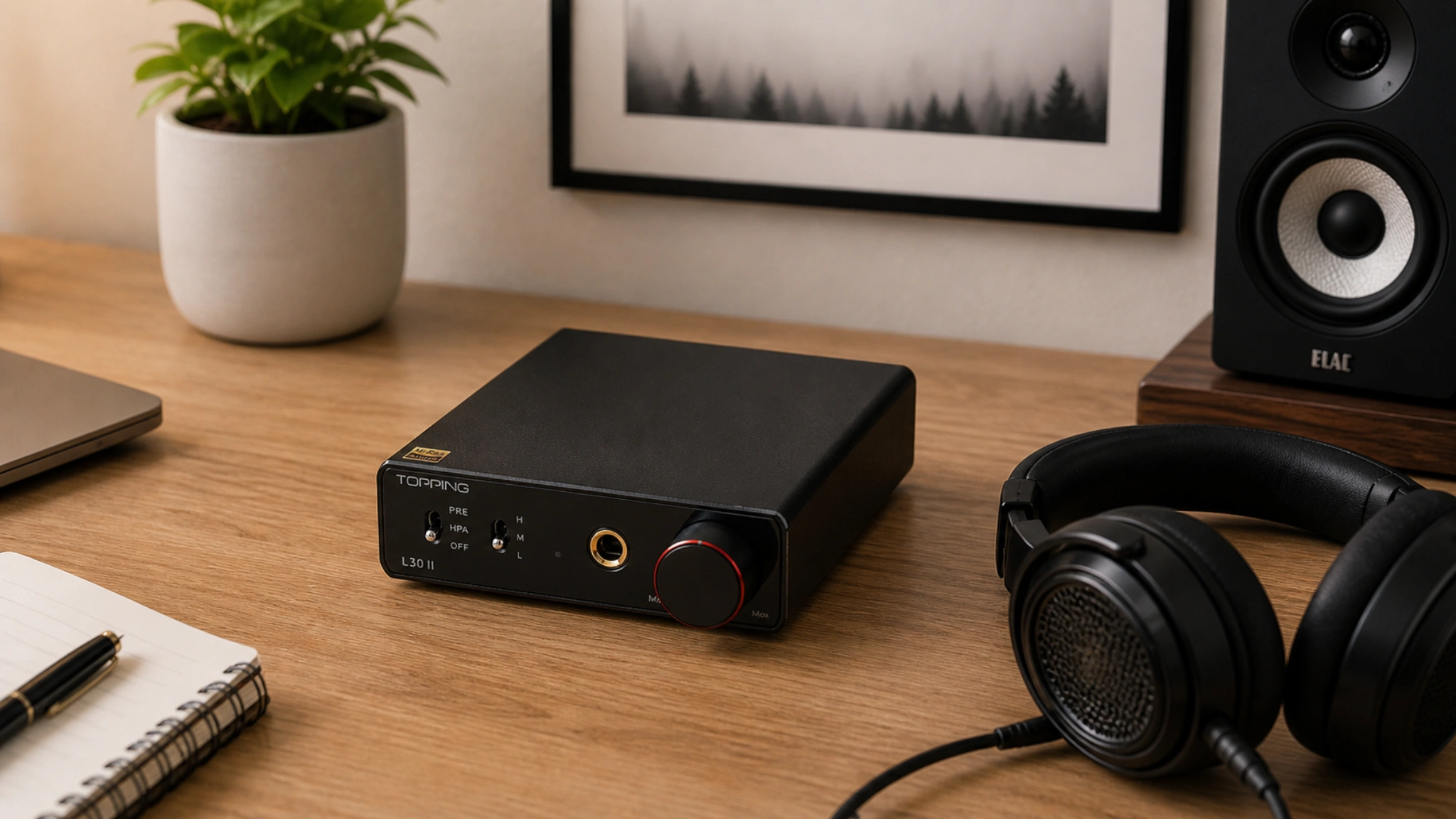
The L30II is compact — noticeably smaller than the Schiit Magni Unity and roughly the size of a thick hardback book stood on its side. The metal chassis is solid and well-finished with no flex or rattle. Topping’s industrial design tends toward clean, minimal lines and the L30II is no exception: a black or silver rectangular box with a front panel that fits everything it needs to without crowding.
Front panel layout
The front panel has the 6.35mm headphone jack on the left, a three-position gain switch in the centre, and the volume knob on the right. The volume pot has a smooth rotation with good channel balance at low positions — important for high-impedance headphones where listening levels in High gain can be lower than expected. The gain switch clicks cleanly between positions with no scratching or resistance.
Rear panel and build notes
The rear panel carries the RCA input pair, the RCA passthrough output, and the DC power input. Build quality is consistent with what Topping delivers across their product line — precise, clean, and functional without the analogue warmth of Schiit’s physical presentation. It runs cool under normal operating conditions, even in High gain with 300Ω headphones, which reflects the efficiency of the NFCA topology.
Sound Quality
Overall character
In this Topping L30II review, sound character is the defining discussion. The L30II sounds precise. It is technically one of the lowest-distortion amplifiers available under $150, and that measurement accuracy translates to a listening character that prioritises transparency and detail retrieval above everything else. What you feed it is what you hear — amplified cleanly, without added warmth, texture, or tonal shaping.
With high-impedance dynamics
This is where the L30II makes its strongest case. Sennheiser HD 6XX, HD 600, HD 650 — all 300Ω headphones that are consistently underpowered from budget amps — open up fully on the L30II in High gain. Bass gains weight and definition. Soundstage expands in a way simply not available from a phone or laptop output. Transients sharpen. That famous midrange clarity the HD series is known for comes through with presence and air that makes clear why these headphones have the reputation they do. At 37Vpp, the L30II has the voltage headroom to drive them as their designers intended.
With planar magnetics
Hifiman HE-400se, Hifiman Sundara, and similar entry-to-mid planars respond to the L30II’s consistent current delivery with tighter bass and better control through the midrange. Planar magnetics maintain stable impedance across frequency — which means the amp’s ability to deliver consistent power across the whole range matters more than peak wattage. The NFCA topology handles this well. The L30II’s clinical character also pairs naturally with planars, which are already detailed and fast-sounding headphones.
With mid-impedance headphones
In Mid gain, headphones in the 80–150Ω range — Beyerdynamic DT 770 Pro 80Ω, AKG K240, Audio-Technica ATH-R70x — are driven cleanly and quietly. The improvement over a laptop output is consistent: lower noise floor, tighter bass, and better control at moderate listening levels. The three-position gain switch is genuinely useful here — Mid gain provides better volume control resolution for this impedance range than High gain would.
With sensitive IEMs
Low gain is the correct setting for sensitive IEMs. In Low gain, the noise floor is low enough for most IEMs without audible background hiss. The volume knob sits at a higher position in Low gain, which improves control resolution and reduces channel imbalance at quiet listening levels. That said, the L30II’s voltage headroom is largely wasted on IEMs — if sensitive earphones are your primary use case, a less powerful amp is a more appropriate tool.
Topping L30II NFCA — what does the voltage advantage actually mean?
- 300Ω dynamics: Full voltage swing — bass, dynamics, and soundstage perform as designed
- 250Ω dynamics: Clean authority with no compression at any listening level
- Planar magnetics: Consistent current across the full frequency range — tighter bass, better control
- 80–150Ω headphones: Real improvement over underpowered sources, though other amps are equally capable
- Under 80Ω / sensitive IEMs: The voltage advantage is irrelevant — any clean amp at this price performs comparably
Connectivity and Compatibility
The L30II’s connectivity is deliberately minimal. One RCA stereo input on the rear, one RCA stereo passthrough output, and two headphone outputs on the front. The passthrough sends the input signal to another destination — a second amp, a powered speaker, or a recording interface — at fixed level. Volume control is not included on that output. That’s a meaningful distinction from the Schiit Magni Unity’s variable preamp, which is volume-controlled from the front knob.
DAC pairing
Because the L30II is a pure amp with RCA input only, choosing the right DAC upstream matters. Topping’s own E30II is the natural pairing — same form factor, same aesthetic, and designed to sit stacked with the L30II as a matched system. Any DAC with RCA outputs works equally well: SMSL, Cambridge Audio, and other standalone DACs all connect cleanly via a standard RCA cable. For listeners building a Bluetooth-capable desk setup with a pure amp at the centre, the options and trade-offs are covered in this comparison of Bluetooth DAC/amp combinations.
Source requirements
The L30II requires an analogue source. Computers and phones need a DAC first. CD players, streaming players with analogue outputs, and external DACs connect directly. There is no USB input, no optical input, and no Bluetooth — the L30II is purely an amplification stage in a larger chain, not a standalone system.
How the Topping L30II Compares
Topping L30II review vs Schiit Magni Unity
This is the most direct comparison in the pure amp category at this price. Both accept RCA input, both cost around $150, and both target serious headphone listeners. On raw voltage output, the L30II leads — 37Vpp versus the Magni Unity’s lower figure — giving it the technical edge for 600Ω headphones and demanding planars. Tonal character is a different story. The Magni Unity’s fully discrete circuit has a more natural, analogue-feeling presentation compared to the L30II’s clinical precision. Its variable preamp output also makes it more useful in mixed headphone-and-speaker setups. At HD 6XX and HD 650 impedances, both amps drive them well. Push to Beyerdynamic DT 990 600Ω, and the L30II’s voltage headroom is the deciding factor.
Topping L30II vs Topping A30 Pro
The Topping A30 Pro is the step up from the L30II in Topping’s own lineup — adding balanced XLR and 4.4mm outputs at a higher price. For listeners whose headphones have balanced cables or who specifically want the noise floor reduction that balanced operation provides, the A30 Pro is worth considering. The L30II is the right starting point for listeners who don’t yet own balanced cables or whose headphones don’t support them.
Topping L30II vs FiiO K11 ESS
A category comparison rather than a direct one. The FiiO K11 ESS includes a DAC, balanced output, and 1,400mW output power — making it the better choice for listeners who don’t yet have a DAC. The L30II’s 37Vpp voltage advantage matters most at very high impedances where the K11 ESS’s milliwatt figure doesn’t tell the complete story. For 300Ω headphones with a DAC already in the chain, the L30II is the more focused tool. For starting from scratch, the K11 ESS handles both conversion and amplification in one step.
Best Headphone Pairings
The L30II performs across all impedance ranges, but delivers its most distinctive advantage with high-impedance and planar headphones that other amps in this price range struggle to drive correctly:
| Headphone | Impedance | Type | Gain Setting | Result |
|---|---|---|---|---|
| Sennheiser HD 6XX / HD 650 | 300Ω | Dynamic, open-back | High | Full authority — bass, dynamics, soundstage all perform correctly |
| Beyerdynamic DT 990 Pro 600Ω | 600Ω | Dynamic, open-back | High | 37Vpp handles 600Ω cleanly — one of the few amps at this price that does |
| Hifiman HE-400se | 25Ω | Planar magnetic | High | Consistent current delivery — tighter bass, better control than budget alternatives |
| Hifiman Sundara | 37Ω | Planar magnetic | High | Strong pairing — Sundara opens up with proper current delivery |
| Beyerdynamic DT 880 250Ω | 250Ω | Dynamic, semi-open | High | Clean and controlled — DT 880’s analytical character suits the L30II’s precision |
| Audio-Technica ATH-M50x | 38Ω | Dynamic, closed-back | Low or Mid | Works well but voltage advantage is irrelevant — any clean amp performs similarly |
Is the Topping L30II Worth It?
For the right buyer
For the listener this Topping L30II review is written for — someone with high-impedance or planar headphones and an existing DAC — the L30II is difficult to beat at this price. The 37Vpp voltage output is the highest available under $150 in the pure amp category. It makes a clear, audible difference with headphones that genuinely need it. The NFCA topology delivers low distortion and a clean signal path that doesn’t editorialize on what you feed it.
For everyone else
The value proposition is less clear outside that core use case. Listeners with efficient headphones under 80Ω won’t hear the voltage advantage. Those without an existing DAC are paying for amplification without the conversion stage they need. And anyone who wants warmth or tonal character will find the L30II’s clinical precision works against them rather than for them.
Before you buy: The L30II’s advantage is specifically voltage swing at high impedance. Check your headphone’s rated impedance before purchasing. If it’s under 80Ω, the L30II’s headline specification is irrelevant to your setup and the Schiit Magni Unity or FiiO K11 ESS is the better-matched tool.
Topping L30II Review — Final Verdict
The Topping L30II NFCA earns its place by doing one thing better than anything else at this price: driving high-impedance and planar magnetic headphones with the voltage they actually need. Owners of Sennheiser HD 6XX, HD 650, Beyerdynamic DT 990 600Ω, or any Hifiman or Audeze planar will find it the most technically appropriate pure amp under $150.
Limitations to consider
Its clinical character is an asset for listeners who want accuracy and a limitation for those who want warmth. Its fixed passthrough output is less useful than the Magni Unity’s variable preamp for speaker integration. And like all pure amps, it needs a DAC upstream to function. Within those parameters, it performs exactly as its specification suggests — precisely, quietly, and with enough voltage headroom to let demanding headphones do what they were designed to do.
Against the full range in our complete headphone amplifier roundup, the L30II sits clearly in the specialist category. For a completely different approach — one box handling Bluetooth streaming, powered speakers, and headphones simultaneously — the LOXJIE A30 review covers that trade-off in full detail.
Approx. price: $140–$160. Best for high-impedance headphones — the 37Vpp voltage swing is what demanding dynamics actually need.
Frequently Asked Questions
Does the Topping L30II include a DAC?
No. As covered in this Topping L30II review, the L30II is a pure headphone amplifier that accepts analogue input via its rear RCA jacks only. It does not convert digital signals. If your source is a computer, phone, or streaming device, you need a standalone DAC between your source and the L30II. Topping’s own E30II is the natural pairing, though any DAC with RCA outputs works equally well.
What does NFCA topology mean and why does it matter?
NFCA stands for Nested Feedback Composite Amplifier. It’s Topping’s proprietary architecture combining multiple amplifier stages with nested feedback loops. The goal is very low distortion and high bandwidth at the same time. In practical terms, it produces one of the lowest measured distortion figures available under $150 — while maintaining the 37Vpp output voltage that makes the L30II suitable for high-impedance headphones. Whether the distortion difference is audible versus a well-implemented op-amp design depends on the listener. The voltage headroom advantage, however, is measurable and clearly audible at high impedances.
Can the Topping L30II drive Sennheiser HD 6XX or HD 650?
Yes — and this is one of its best use cases. Both the HD 6XX and HD 650 are 300Ω headphones that need meaningful voltage swing to perform at their designed level. The L30II’s 37Vpp output drives them with full authority in High gain. The bass gains weight and definition, the soundstage expands, and the midrange clarity these headphones are known for becomes clearly audible in a way it isn’t from underpowered sources.
What is the difference between the Topping L30II and the Schiit Magni Unity?
Both are pure headphone amplifiers without a built-in DAC, priced around $150. The L30II’s NFCA topology delivers 37Vpp — the technical edge for very high-impedance headphones and demanding planars. The Magni Unity uses a fully discrete circuit with a more natural character. It also adds a variable preamp output that controls powered speakers from the same knob as headphones. At 300Ω, both amps perform well. Push to 600Ω or maximum voltage swing and the L30II has a clear advantage. In mixed headphone-and-speaker setups, the Magni Unity’s preamp output is the more useful feature.
Is the Topping L30II good for IEMs?
It works with IEMs in Low gain — the noise floor is adequately quiet for most sensitive earphones and channel balance is clean at low volume positions. However, the L30II’s 37Vpp voltage advantage is entirely wasted on IEMs, which typically need very little power to reach listening volume. If sensitive IEMs are your primary use case, a simpler and less expensive amp serves you equally well and the L30II’s specialist capability goes unused.