Affiliate disclosure: AmplifierZone is reader-supported. As an Amazon Associate, we may earn commissions from qualifying purchases at no extra cost to you. Our recommendations are based on product fit, published specifications, installation practicality, and system-matching considerations.
A good four-channel amplifier can make a factory or aftermarket system sound more controlled without forcing you to rebuild the entire audio chain. The important question is not simply which amplifier has the biggest headline number. For mids and highs, the right choice is the model that supplies clean power at the impedance your speakers actually present, fits the available space, and gives you enough filter and gain control to integrate it without distortion.
For most daily-driver systems, the Alpine MRV-F300 is the most balanced starting point: it combines a compact Class D chassis with 50 watts RMS per channel at 4 ohms, 75 watts RMS per channel at 2 ohms, and a 150-watt-per-channel bridged option. The Pioneer, Kenwood, and Skar alternatives below make more sense when your priorities are different, such as Class AB voicing, an exceptionally small installation footprint, or more output density.
Quick answer: Choose the Alpine MRV-F300 for the best all-around compact system upgrade, the Pioneer GM-A6704 when factory-source integration and Class AB operation matter most, the Kenwood KAC-M3004 for tight or marine-oriented installations, and the Skar SK-M4004D when you need a very small amplifier with a higher published output target. Always confirm the amplifier’s load limits against your speakers before wiring it.
At-a-glance comparison
The table is intentionally limited to stable product characteristics rather than prices, ratings, or temporary offers. RMS output is the useful figure for matching an amplifier to speakers; maximum or peak numbers are not a reliable substitute for it.
| Amplifier | Design | Published four-channel power | Best fit |
|---|---|---|---|
| Alpine MRV-F300 | Class D | 50W × 4 at 4Ω; 75W × 4 at 2Ω | Compact daily-driver systems and clean mids/highs |
| Pioneer GM-A6704 | Class AB | 60W × 4 at 4Ω; 95W × 4 at 2Ω | Factory-source integration and traditional AB architecture |
| Kenwood KAC-M3004 | Class D | 50W × 4 at 4Ω | Very small installations, boats, and powersports systems |
| Skar SK-M4004D | Class D | Higher published output target; verify current documentation | Output-focused compact builds that need careful matching |
Alpine MRV-F300: best overall for a compact mids-and-highs upgrade
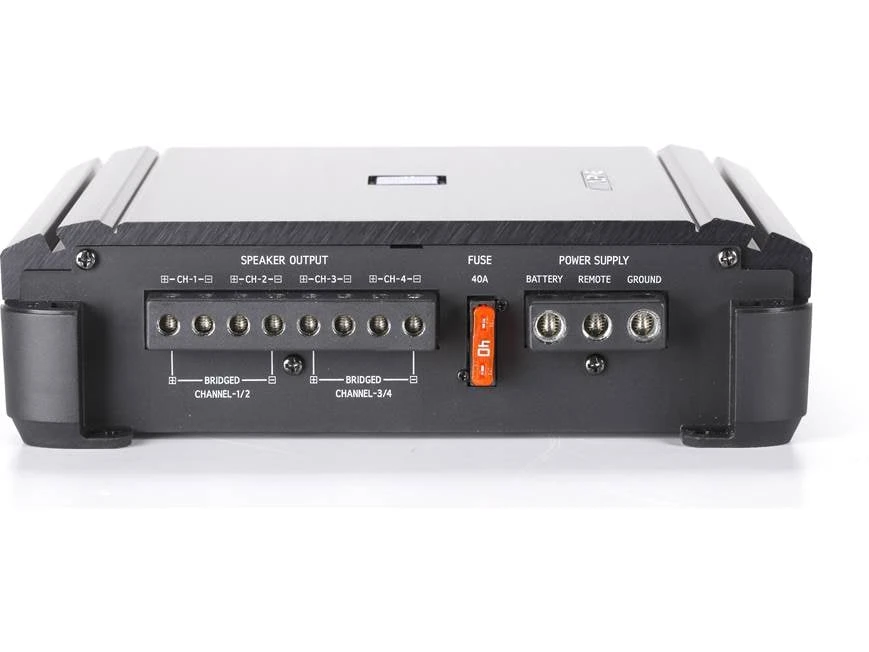
- Class D four-channel architecture.
- 50 watts RMS × 4 at 4 ohms.
- 75 watts RMS × 4 at 2 ohms.
- 150 watts RMS × 2 when bridged.
- Compact chassis with RCA and speaker-level input support.
The MRV-F300 is the easiest recommendation when the goal is to improve front and rear speaker control without giving up much cabin or cargo space. Its 4-ohm rating is a sensible match for many aftermarket coaxial and component speakers, while the 2-ohm capability gives you more flexibility when a speaker set or wiring arrangement presents a lower load. The Class D design also helps keep heat and current demand manageable in installations where a larger amplifier would be difficult to ventilate.
For mids and highs, the practical advantage is balance rather than brute force. Fifty clean watts per channel is enough to give many speakers more headroom than a factory radio, provided the speakers are not being asked to reproduce bass below their useful range. Use the high-pass filter to remove unnecessary low-frequency work, then set the gain so the amplifier reaches the desired output without clipping.
Our dedicated Alpine MRV-F300 review goes deeper into its installation footprint and system-matching behavior.
Check the Alpine MRV-F300 on Amazon
Pioneer GM-A6704: the Class AB choice for factory-source systems
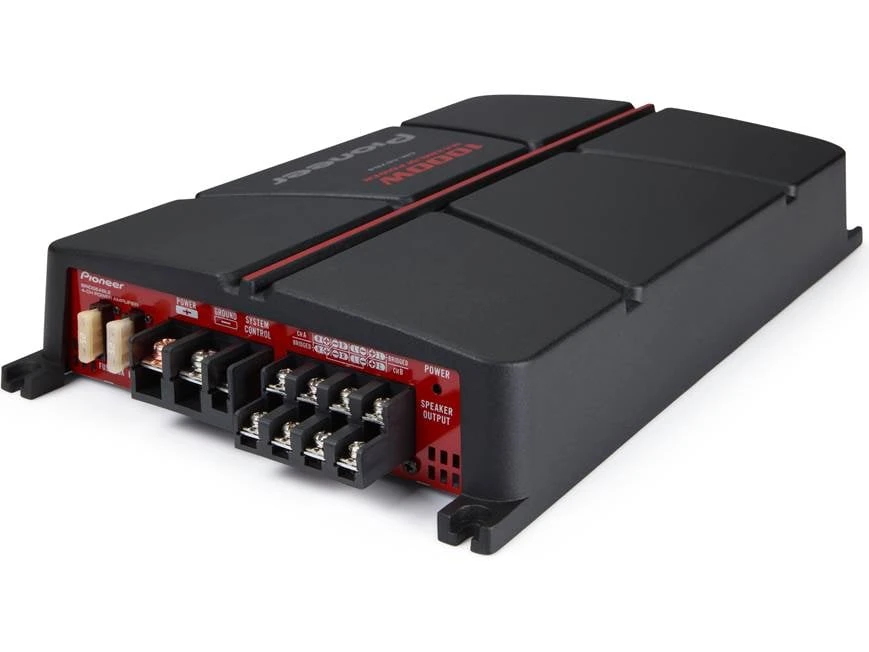
- Class AB four-channel architecture.
- 60 watts RMS × 4 at 4 ohms.
- 95 watts RMS × 4 at 2 ohms.
- 190 watts RMS × 2 when two channels are bridged at 4 ohms.
- Speaker-level inputs, automatic signal sensing, adjustable filters, and bass boost.
The GM-A6704 is a strong fit when you want to keep the factory radio but add a conventional full-range amplifier behind it. Its speaker-level inputs can accept signal from a factory source without requiring preamp outputs, and automatic signal sensing can simplify turn-on wiring in compatible installations. The amplifier also provides the filter controls needed to keep low bass away from small midrange and tweeter systems.
Class AB amplifiers generally trade some efficiency for a familiar analog output stage. That does not automatically make one sound better than a Class D model, but it can be the right design preference for a straightforward four-channel system where installation space and heat are not as restrictive. The Pioneer also gives you more rated power per channel than the Alpine at 4 ohms, which can be useful with speakers whose RMS rating is closer to 60 watts.
Read our Pioneer GM-A6704 review for a closer look at factory integration, filters, and bridged operation.
Check the Pioneer GM-A6704 on Amazon
Kenwood KAC-M3004: the smallest-installation specialist
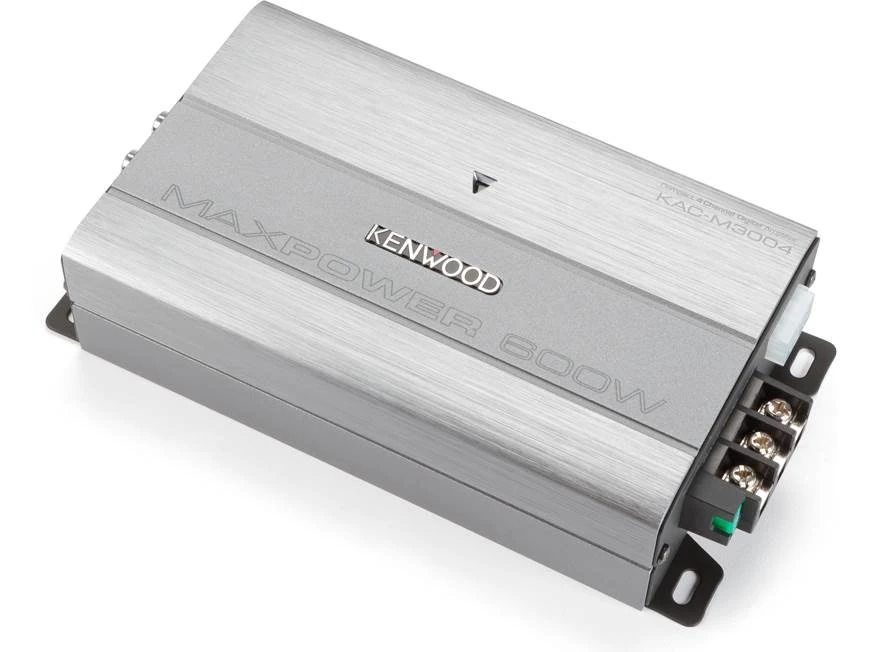
- Compact Class D four-channel design.
- 50 watts RMS × 4 at 4 ohms.
- 2-ohm load capability for compatible system layouts.
- Variable high-pass and low-pass filtering in the approximately 50–200 Hz range.
- RCA and speaker-level inputs with signal-sensing turn-on.
- Approximate dimensions: 6.5 × 1.75 × 3.875 inches.
The KAC-M3004 is the practical answer when the amplifier must fit somewhere other four-channel models will not. Its low-profile enclosure can work under a seat, behind an interior panel, or in a compact boat or powersports installation, subject to ventilation and water-exposure precautions. Kenwood’s signal-sensing turn-on and dual input options also make it easier to adapt to different source units.
Its 50-watt-per-channel 4-ohm rating puts it in the same general power class as the Alpine for a conventional mids-and-highs upgrade. The deciding factor is the enclosure and the installation environment. Do not treat a marine- or powersports-oriented construction description as permission to mount any amplifier where it will be continuously soaked; protect connections, provide airflow, and follow the installation manual.
The upcoming Kenwood KAC-M3004 review covers its compact chassis, input flexibility, and vehicle or powersports use in more detail.
Check the Kenwood KAC-M3004 on Amazon
Skar SK-M4004D: compact output for carefully matched speakers
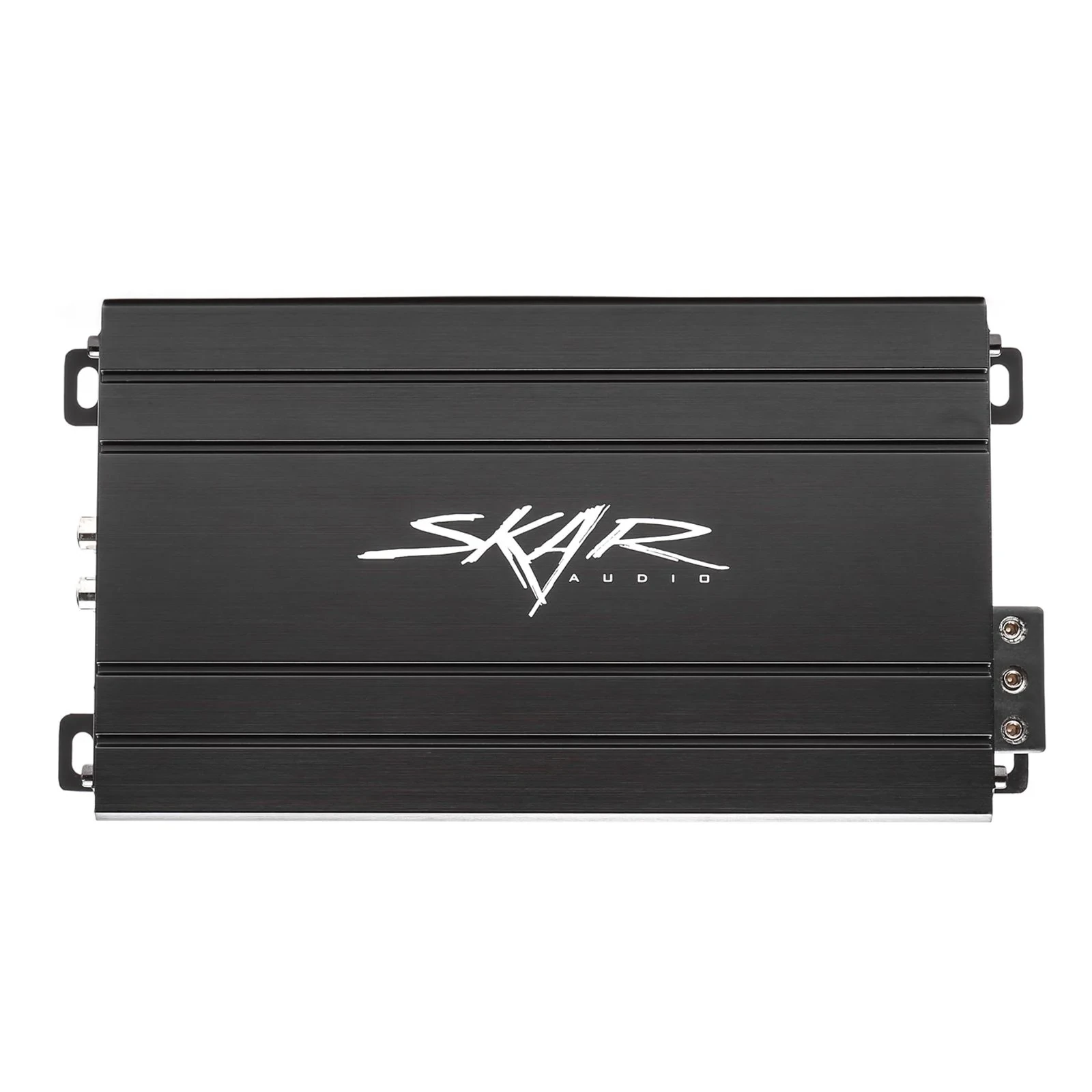
- Compact Class D four-channel design.
- Higher published output target than the 50–60 watt-per-channel alternatives; verify the current manual before wiring.
- Designed for output-focused builds where chassis size matters.
- Requires careful confirmation of speaker impedance, wiring, and ventilation before installation.
The SK-M4004D is the option to investigate when you want a compact four-channel chassis with a more ambitious published output target than the Alpine or Kenwood. That extra headroom can be useful for efficient component speakers or a front-stage system that needs to stay composed at higher listening levels, but it also makes matching more important. A speaker’s RMS rating, the amplifier’s load limit, and the vehicle’s charging system all need to be considered together.
Because product listings and regional specifications can vary, verify the current manual and final wiring requirements before installation. In particular, do not assume that a small chassis can be wired to any low-impedance load or mounted in a sealed space. The amplifier should be treated as an output-focused choice, not as a reason to ignore speaker ratings or thermal management.
See the scheduled Skar Audio SK-M4004D review for a dedicated examination of its compact design and system-matching considerations.
Check the Skar SK-M4004D on Amazon
Why use a dedicated four-channel amplifier for mids and highs?
A four-channel amplifier gives each left and right front speaker and each left and right rear speaker its own output channel. That separation makes level setting and filtering more predictable than asking a head unit to drive every speaker at its limit. It also leaves room for a deliberate upgrade path: you can run four full-range channels today and later reserve a separate mono amplifier for a subwoofer.
The amplifier will not repair a poor speaker location, a damaged driver, an incorrect polarity connection, or a noisy signal source. It can, however, provide more voltage swing and current reserve so the speakers remain cleaner when music becomes dense. That is particularly noticeable in the midrange, where vocals, guitars, keyboards, and much of the perceived detail compete for headroom.
For a front-stage-focused system, another option is to bridge two channels for the front speakers and leave the remaining pair for rear fill, but bridging changes the load each channel sees. It should only be used when the manual and speaker impedance support that configuration. If your primary goal is a clean four-speaker upgrade, running the amp in its normal four-channel mode is usually the simplest and safest starting point.
Power matching and speaker compatibility
Start with the speaker’s continuous or RMS power rating and nominal impedance, not the largest number printed on the amplifier box. An amplifier rated near the speaker’s RMS range can be a good match when the gain is set correctly. A higher-rated amplifier is not automatically unsafe, but it leaves less room for careless gain settings, bass-heavy content, or an impedance mismatch.
Impedance warning: A 2-ohm rating in four-channel mode does not automatically mean the amplifier is safe to run at 2 ohms per channel when bridged. Bridging combines channels and changes the electrical load each output stage sees. Confirm the manual’s bridged impedance requirement before connecting speakers.
Use the high-pass filter to keep deep bass away from mids and tweeters that are not designed to reproduce it. A starting point around 80–100 Hz is common for small full-range speakers, but the correct setting depends on the speaker’s enclosure, location, and response. Raise the crossover if the speaker sounds strained; lower it only when the driver and enclosure can handle the additional low-frequency energy cleanly.
If you are building a larger system with a subwoofer, the guide to choosing a monoblock car amplifier explains why low-frequency duties are usually better handled by a dedicated channel rather than by forcing a four-channel amp to do everything.
Installation and gain setting
Good wiring and ventilation matter as much as the amplifier model. Run the main power cable from the battery through an appropriately sized fuse placed close to the battery, protect it where it passes through metal, and use a solid chassis ground of suitable gauge. Keep signal cables away from major power runs where practical, and verify speaker polarity before finalizing the trim panels.
Our car amplifier installation guide walks through the broader wiring sequence, while the car amplifier wiring kit guide covers the components that are commonly needed before installation day. If you are replacing a factory radio, check whether the amplifier expects RCA-level or speaker-level input and whether the source provides a dependable remote-turn-on signal.
A practical gain-setting method
- Set the head unit’s tone controls, loudness, bass boost, and equalizer to a neutral starting position. Turn the amplifier gain all the way down.
- Use a clean test track or an appropriate test tone and set the head unit to the highest volume that remains clean. Do not use a clipped source signal as the reference.
- If you are using a multimeter, calculate the target AC voltage with voltage = square root of (target watts × speaker ohms). For example, 50 watts into 4 ohms is approximately 14.1 volts AC.
- Raise the gain slowly until the target is reached or the system begins to sound strained, then back it down slightly. Gain is input sensitivity, not a second volume control.
- Reconnect the speakers, listen at several normal levels, and revisit the crossover and gain if vocals become harsh or the speakers show audible distress.
Never use a gain setting to compensate for a weak source, and never keep increasing it because the system seems quiet at one song’s mastering level. The goal is clean headroom, not maximum knob position.
Final verdict
The Alpine MRV-F300 is the best all-around choice for most mids-and-highs upgrades because its power, compact Class D design, and flexible load support are easy to integrate. The Pioneer GM-A6704 is the better fit when you want Class AB architecture, speaker-level inputs, and a straightforward factory-source installation. The Kenwood KAC-M3004 wins when the amplifier must fit into a very small or powersports-oriented space. The Skar SK-M4004D is the output-focused alternative, but it deserves the most careful attention to current specifications, speaker matching, and cooling.
Whichever model you choose, treat the amplifier as one part of the signal chain. Confirm the speaker impedance, use the correct crossover, fuse the power cable correctly, set the gain methodically, and leave enough ventilation around the chassis. Those decisions will have a larger effect on reliable, clean mids and highs than chasing an inflated peak-power number.
If you want another comparison point before buying, see our guide to four-channel car amplifiers in a budget-focused comparison. Use the stable specifications and installation requirements as your decision framework, then check the current Amazon listing for each model’s present availability and terms.
Frequently asked questions
What is the best four-channel amplifier for mids and highs?
The Alpine MRV-F300 is the best overall starting point for many systems because it combines compact Class D efficiency with 50 watts RMS per channel at 4 ohms, 75 watts at 2 ohms, and a bridged option. The Pioneer GM-A6704 is a strong alternative for factory-source integration, while the Kenwood and Skar make more sense when installation size or output density is the priority.
How many watts do mids and highs need?
There is no universal wattage target. Many aftermarket coaxial and component speakers work well with roughly 50–100 watts RMS per channel when the impedance and gain are correct. Match the amplifier to the speaker’s continuous rating, use a high-pass filter, and avoid using power numbers as a substitute for correct installation.
Should I run a four-channel amp at 2 ohms?
Only when the amplifier is explicitly rated for that load in the exact configuration you plan to use. A four-channel 2-ohm rating usually refers to normal four-channel operation. Bridged operation can require a higher minimum impedance, so check the manual before wiring two speakers together or bridging channels.
Do I need a separate amplifier for a subwoofer?
Not always, but a separate mono amplifier is usually the cleaner choice when the system includes a dedicated subwoofer. It lets the four-channel amplifier concentrate on mids and highs while the mono amplifier supplies the current and filtering needed for low frequencies.
How do I set the gain on a four-channel amplifier?
Start with the gain low, neutralize the source controls, set the head unit to a clean reference volume, and raise the gain gradually. If you know the target power and speaker impedance, use the square-root voltage formula with a multimeter, then back the gain down slightly if the system shows audible strain. Gain is input sensitivity, not a volume boost.
Specification references
Stable specifications were checked against the manufacturers’ published information and the site’s verified model reviews. Product links in this guide are Amazon-only purchase links; the reference links below are informational and are not purchase CTAs.
Affiliate disclosure: AmplifierZone is reader-supported. As an Amazon Associate, we may earn commissions from qualifying purchases at no extra cost to you. We do not publish static prices, ratings, or offer claims because those details can change; check the linked Amazon listing for current information.
Leave a Reply
You must be logged in to post a comment.