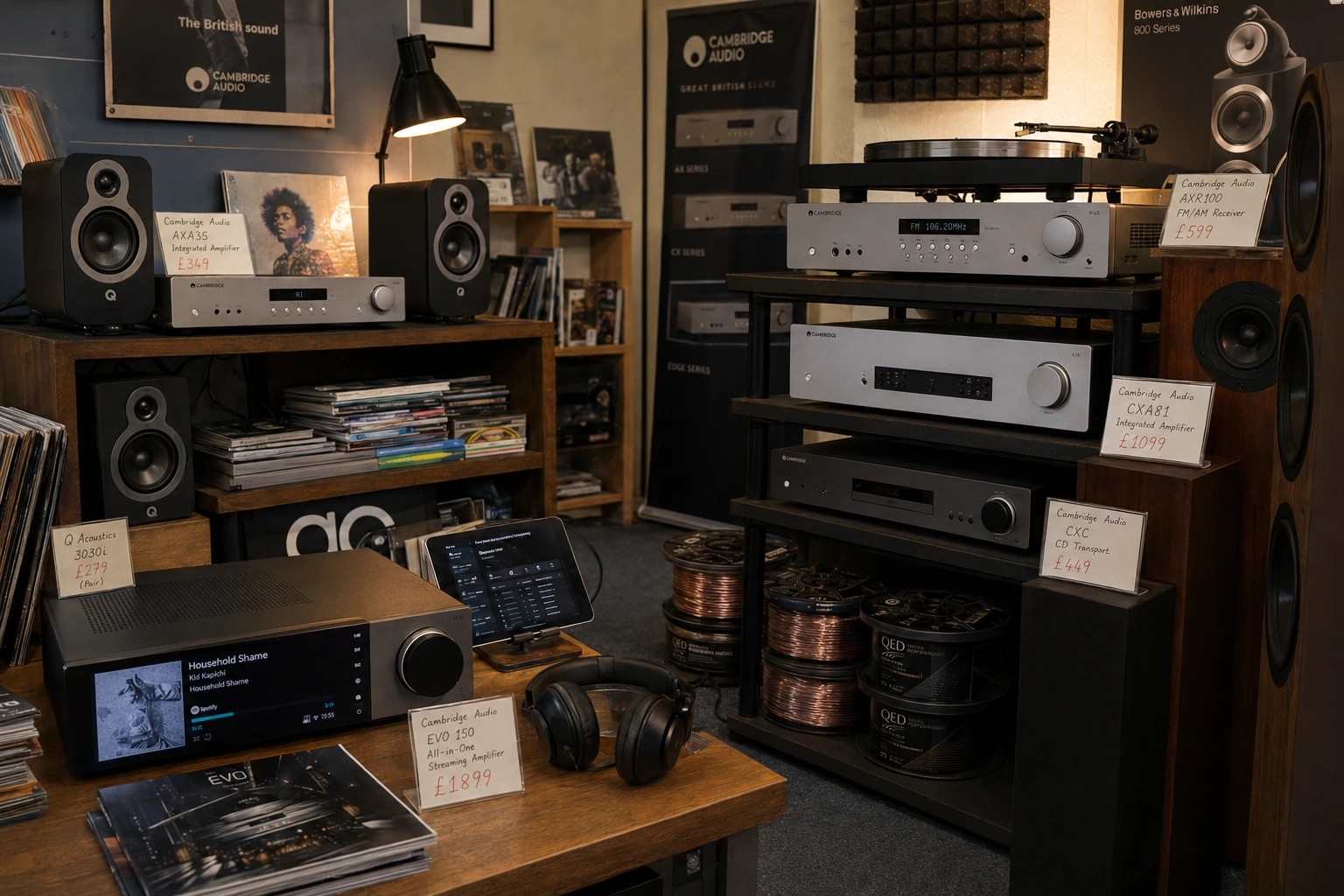
Cambridge Audio makes amplifiers across three series — AX entry integrated, CX mid-range integrated, and EVO all-in-one streaming — plus the AXR100 stereo receiver. Specifically, each series targets a different listener profile. The price difference between an AXA25 and an EVO 150 reflects genuinely different capabilities, not specification inflation. This guide explains what each series does and who each model suits. The goal is to help you choose without overspending on features that do not match the intended use. For listeners who have already identified a bookshelf speaker, our best amplifiers for bookshelf speakers guide maps specific amplifier pairings at each budget.
- Entry integrated — wired sources: AXA25 or AXA35 — phono stage, clean circuit, no streaming
- Mid-range integrated — DAC + Bluetooth: CXA61 or CXA81 MkII — ESS Sabre DAC, apt-X HD, balanced outputs on CXA81
- All-in-one streaming: EVO 75 or EVO 150 — AirPlay 2, Chromecast, HDMI ARC, no separate components needed
- Receiver with tuner: AXR100 — FM/AM, Bluetooth, phono, 100W, Amazon’s Overall Pick
This article contains affiliate links. If you purchase through them, we may earn a commission at no extra cost to you. This helps support AmplifierZone and allows us to keep creating in-depth, unbiased audio guides.
What Cambridge Audio Gets Right
Cambridge Audio has held the same position since the 1960s — transparent, accurate amplification that undercuts the audiophile establishment without compromising circuit engineering. Specifically, their amplifiers are not designed to flatter recordings or add warmth. Instead, they are designed to communicate what is on the recording as accurately as the price point allows. Consequently, they suit listeners who value hearing the recording rather than hearing the amplifier.
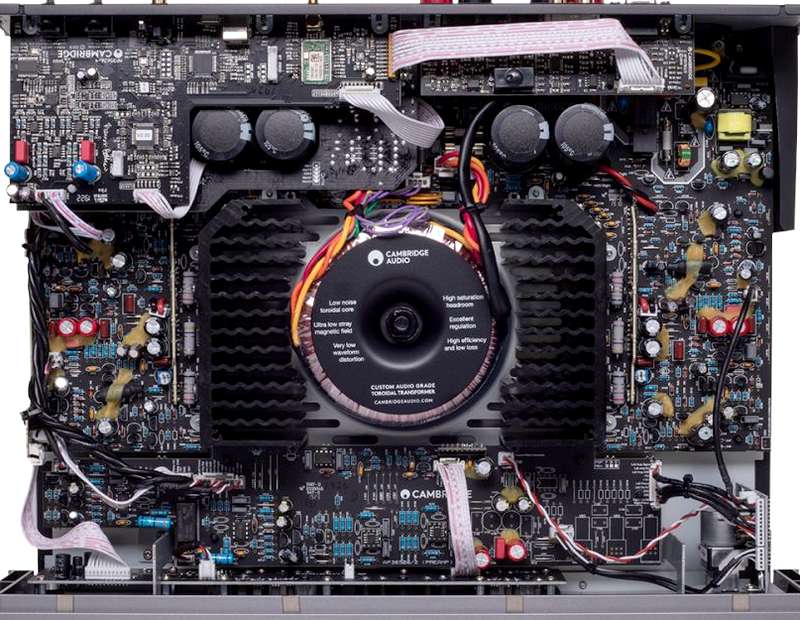
Class XD — the CX series circuit
Cambridge Audio’s Class XD is a proprietary amplifier topology used in the CX series. Specifically, it works by displacing the crossover point away from zero — where class-A/B amplifiers transition between positive and negative output transistors. This crossover transition is where conventional class-A/B designs introduce a small but measurable distortion. Class XD moves this transition into a region where the output transistors are already conducting. This reduces crossover distortion and produces a cleaner, more linear transfer characteristic than standard class-A/B.
In practice, Class XD gives the CX series a slightly warmer, more musical character than the AX series’ conventional class-A/B design. The difference is subtle — more apparent on acoustic recordings and vocals than on electronic music. However, it is one of the reasons the CXA61 and CXA81 justify their premium over the AXA35 beyond just the added DAC and Bluetooth features.
ESS Sabre DAC — the CX and EVO advantage
Specifically, both the CX series and EVO series use ESS Sabre DAC chips for their digital inputs. Specifically, ESS Sabre DACs are known for a low noise floor and high channel separation. These contribute to the precise, detailed sound Cambridge Audio’s mid-range and flagship models are known for. Consequently, the AX series uses no digital inputs and no DAC — it is a purely analog amplifier.
The Cambridge Audio Range at a Glance
| Model | Power | Phono | DAC | Bluetooth | Streaming | Type |
|---|---|---|---|---|---|---|
| AXA25 | 25W × 2 | Yes (MM) | No | No | No | Integrated |
| AXA35 | 35W × 2 | Yes (MM) | No | No | No | Integrated |
| CXA61 | 60W × 2 | No | Yes (ESS Sabre) | Yes (apt-X) | No | Integrated |
| CXA81 MkII | 80W × 2 | No | Yes (ESS Sabre) | Yes (apt-X HD) | No | Integrated |
| EVO 75 | 75W × 2 | Yes (MM) | Yes (ESS Sabre Ref) | Yes (apt-X HD) | AirPlay 2, Chromecast | All-in-One |
| EVO 150 | 150W × 2 | Yes (MM) | Yes (ESS Sabre Ref) | Yes (apt-X HD) | AirPlay 2, Chromecast, HDMI ARC | All-in-One |
| AXR100 | 100W × 2 | Yes (MM) | No | Yes | No | Receiver |
AX Series — Entry Integrated Amplifiers
The AX series is Cambridge Audio’s entry into integrated amplifiers — purely analog, no digital inputs, no Bluetooth, no streaming. Specifically, this is a deliberate choice rather than a cost-cutting measure. The AXA25 and AXA35 are built for listeners whose sources are all wired — turntable, CD player, streaming box via RCA. They deliver the cleanest possible signal path without digital conversion stages.
AXA25

- Power: 25W × 2 (8Ω)
- Inputs: 4 × RCA stereo, MM phono
- Phono stage: Yes — MM cartridge
- Bluetooth: No
- DAC: No
- Amplifier class: Class A/B
The AXA25 is the entry point — 25W into 8Ω, MM phono stage, four RCA inputs, compact silver chassis. Specifically, 25W is adequate for efficient speakers (88dB+) in small rooms at moderate listening levels. However, it sits at the lower edge for less efficient 6Ω speakers. For the Q Acoustics 3020c (25W minimum, 75W maximum), the AXA25 is technically within the correct window — but leaves no headroom for dynamic transients. The AXA35 is the safer pairing for most bookshelf speakers.
AXA35
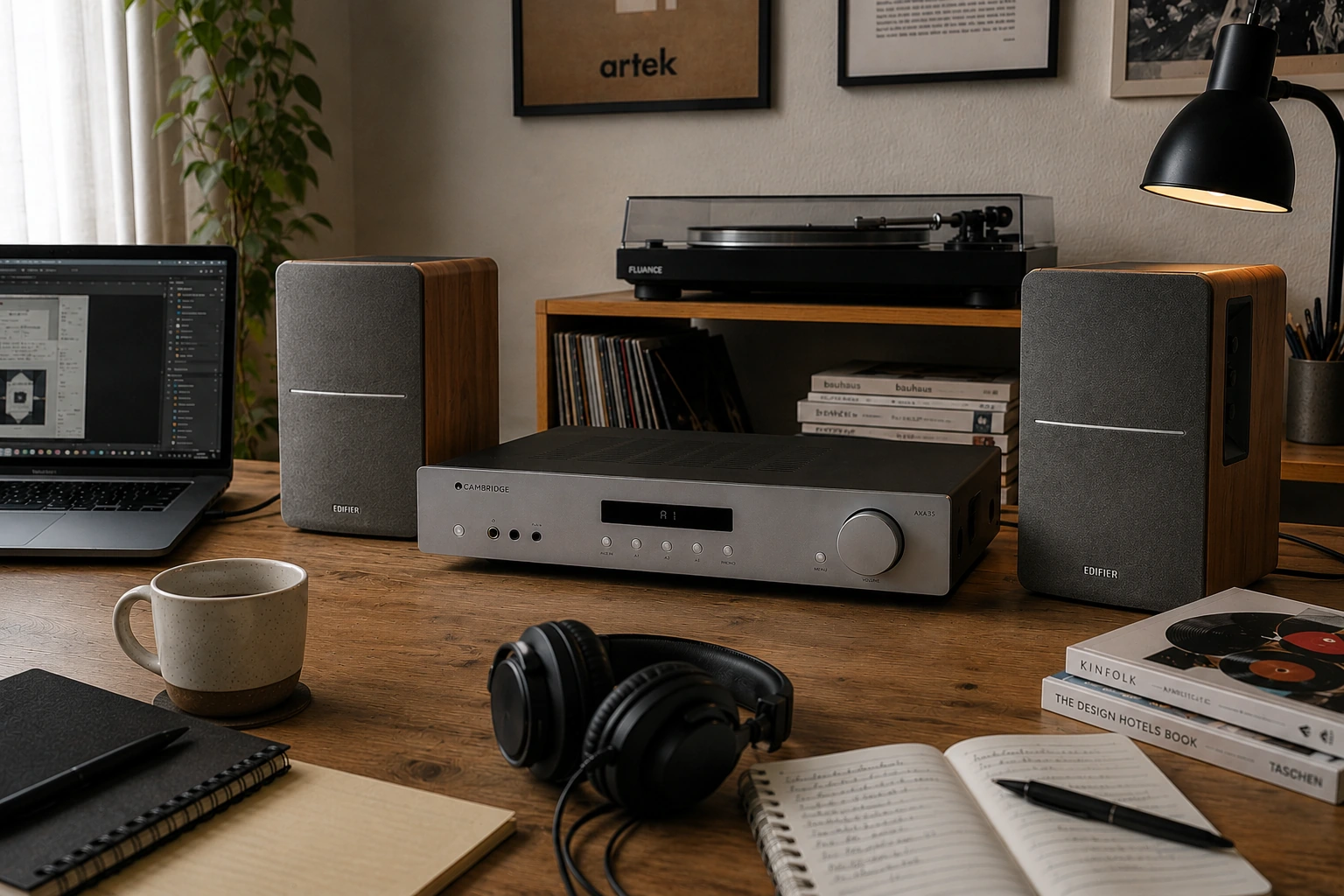
- Power: 35W × 2 (8Ω)
- Inputs: 4 × RCA stereo, MM phono
- Phono stage: Yes — MM cartridge
- Bluetooth: No
- DAC: No
- Amplifier class: Class A/B
The AXA35 adds 10W over the AXA25 — which is more significant than it sounds. Specifically, 35W into 8Ω provides comfortable headroom for 88dB speakers in small to medium rooms, and sits cleanly within the Q Acoustics 3020c’s strict 25–75W window. Specifically, the AXA35 is the correct pairing for the Q Acoustics 3020c, Polk ES20, and Sony SSCS5. For detailed performance analysis and listening impressions, the full Cambridge Audio AXA35 review covers the AXA35 comprehensively. The AXA35 has no Bluetooth and no digital inputs — for listeners who need wireless connectivity, the AXR100 or CXA61 are the correct alternatives.

AX Series is correct for: Listeners with wired sources only (turntable, CD, streaming box via RCA) who want Cambridge Audio’s transparent class-A/B amplification without paying for unused digital features. Not correct for listeners who need Bluetooth, digital inputs, or more than 35W.
CX Series — Mid-Range Integrated Amplifiers
Specifically, Cambridge Audio’s mid-range integrated range — the CX series — uses Class XD topology, ESS Sabre DAC, and Bluetooth apt-X. The CXA81 MkII upgrades to apt-X HD and adds significantly more power than the AX series. Specifically, the AX-to-CX step up buys three things: Class XD circuit, digital source connectivity, and enough power for demanding 6Ω speakers in medium rooms. The trade-off is no phono stage on either CX model — turntable users need a separate phono preamp.
CXA61

- Power: 60W × 2 (8Ω)
- Amplifier class: Class XD
- DAC: Yes — ESS Sabre
- Digital inputs: Optical, coaxial, USB
- Bluetooth: Yes — apt-X
- Phono stage: No
- Balanced output: No
The CXA61 delivers 60W of Class XD amplification alongside a full digital input complement — optical, coaxial, USB, and Bluetooth apt-X. Specifically, 60W into 8Ω is the correct power level for the ELAC B6.2 (87dB/6Ω, minimum 50W) in small to medium rooms. The AXA35 cannot deliver this with adequate woofer control. Consequently, the CXA61 opens the ELAC B6.2 pairing that the AX series cannot correctly serve. For listeners who want Class XD character, a DAC, Bluetooth, and adequate power for the ELAC — the CXA61 is the correct choice. The trade-off is no phono stage and no balanced XLR outputs.
CXA81 MkII
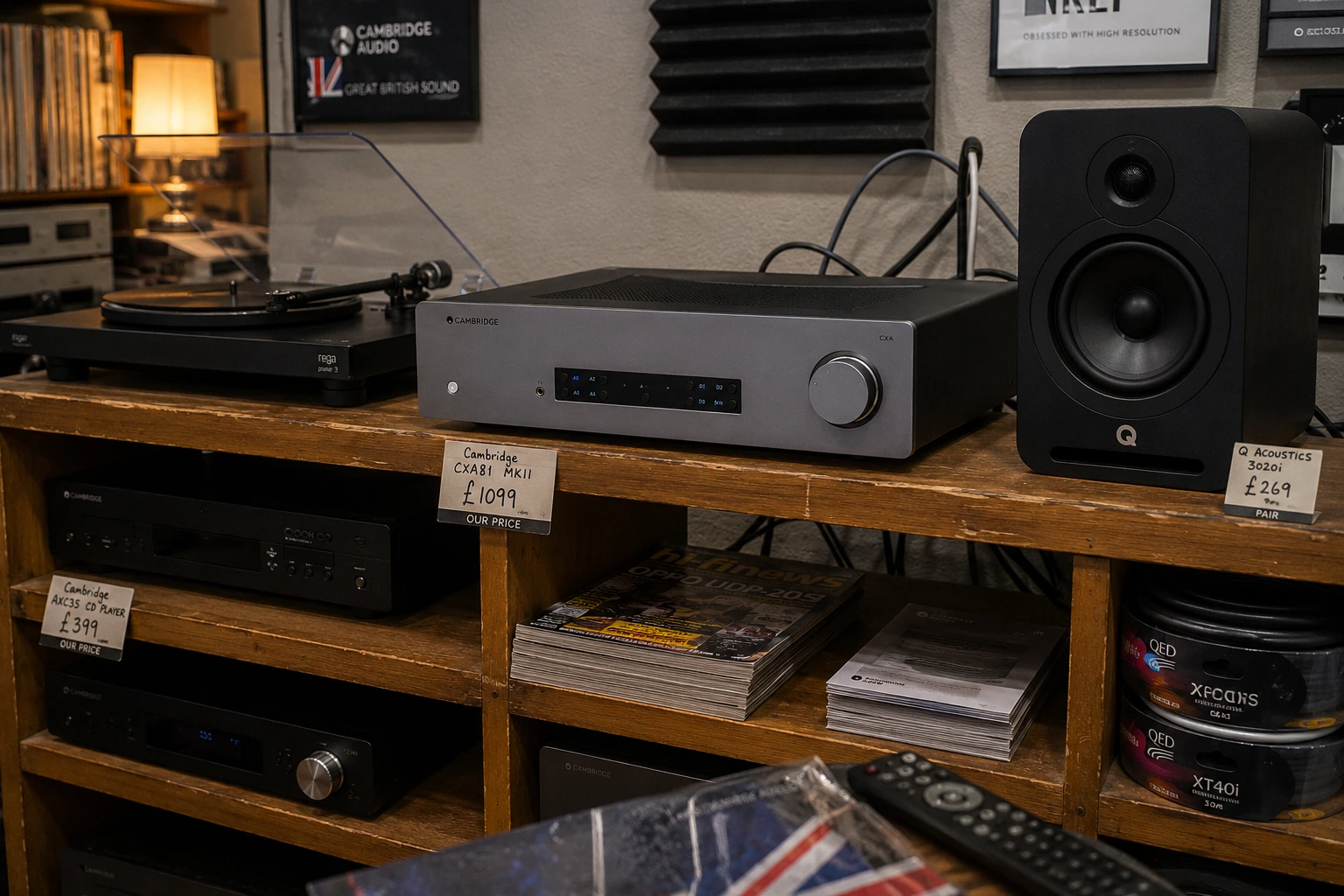
- Power: 80W × 2 (8Ω)
- Amplifier class: Class XD
- DAC: Yes — ESS Sabre
- Digital inputs: Optical, coaxial, USB
- Bluetooth: Yes — apt-X HD
- Phono stage: No
- Balanced output: Yes — XLR
The CXA81 MkII steps up from the CXA61 with 80W, Bluetooth apt-X HD, and balanced XLR outputs. Specifically, apt-X HD supports 24-bit audio over Bluetooth — meaningful for listeners who use Bluetooth from a phone or tablet as a primary source. The balanced XLR outputs allow connection to studio monitors or a power amplifier. Unbalanced connections introduce noise floor increases over longer cable runs that XLR avoids. Furthermore, 80W into 8Ω provides headroom for virtually any passive bookshelf speaker. This includes the ELAC B6.2 in medium rooms and the Q Acoustics 3020c within its 75W maximum.
CX Series is correct for: Listeners who want Class XD character, digital source connectivity, and adequate power for demanding 6Ω speakers. Not correct for turntable users who need a phono stage (add a separate phono preamp) or listeners who need network streaming (step to the EVO series).
EVO Series — All-in-One Streaming Amplifiers
The EVO series represents a fundamentally different product category from the AX and CX series. Specifically, AX and CX require a separate streaming device. The EVO units include the streaming layer — AirPlay 2, Chromecast, HDMI ARC — built directly into the amplifier. For listeners who want amplification and network audio in one box, the EVO series eliminates the need for an external streaming device. For the full distinction between active and passive source configurations that applies here, the passive vs active speakers guide covers the relevant concepts.
EVO 75

- Power: 75W × 2 (8Ω)
- Streaming: AirPlay 2, Chromecast built-in
- DAC: Yes — ESS Sabre Reference
- Bluetooth: Yes — apt-X HD
- Phono stage: Yes — MM cartridge
- HDMI ARC: No (EVO 150 only)
The EVO 75 combines 75W of amplification with AirPlay 2, Chromecast, Bluetooth apt-X HD, an ESS Sabre Reference DAC, and a built-in MM phono stage. This eliminates the need for a separate streamer, DAC, or phono preamp. Specifically, this simplifies a system that currently runs a separate streamer, amplifier, and phono preamp. The EVO 75 replaces all three. However, it has no HDMI ARC. TV-connected setups that need HDMI audio should step to the EVO 150.
EVO 150

- Power: 150W × 2 (8Ω)
- Streaming: AirPlay 2, Chromecast built-in
- DAC: Yes — ESS Sabre Reference
- Bluetooth: Yes — apt-X HD
- Phono stage: Yes — MM cartridge
- HDMI ARC: Yes
The EVO 150 adds 150W, HDMI ARC, and additional power supply headroom over the EVO 75. Specifically, HDMI ARC allows a TV to pass audio to the EVO 150 over the HDMI cable. This eliminates a separate optical connection and enables TV remote volume control via HDMI CEC. The 150W output has headroom for any passive bookshelf speaker. It also scales into larger floor-standing speakers the AX and CX series cannot drive correctly. Consequently, the EVO 150 suits listeners building a TV-integrated system. It also suits those who want EVO convenience features alongside power reserves for larger speaker loads.
EVO Series is correct for: Listeners who want network streaming (AirPlay 2, Chromecast) built into the amplifier — eliminating a separate streamer. The EVO 75 suits music-first setups without a TV connection. The EVO 150 adds HDMI ARC for TV-integrated systems and more power headroom.
AXR100 — Stereo Receiver

- Power: 100W × 2 (8Ω)
- Tuner: FM/AM stereo
- Phono stage: Yes — MM cartridge
- Bluetooth: Yes
- DAC: No digital inputs
- Amplifier class: Class A/B
The AXR100 is the only Cambridge Audio product with an FM/AM tuner. It is the correct choice for listeners who still use broadcast radio alongside Bluetooth and a turntable. Specifically, 100W into 8Ω drives any passive bookshelf speaker correctly, including the ELAC B6.2 in medium rooms. Amazon’s Overall Pick status confirms consistent purchase validation at this price. However, 100W into 6Ω exceeds the Q Acoustics 3020c’s 75W maximum — use the AXA35 for that specific pairing rather than the AXR100.
Additionally, the AXR100 has no digital inputs — no optical, coaxial, or USB. For listeners who want to connect a computer or TV digitally, a separate DAC is needed between the source and the AXR100’s RCA inputs. Furthermore, it has no network streaming capability — the EVO series addresses that need. The AXR100 occupies a specific niche — Cambridge Audio’s circuit standards at 100W, with Bluetooth and phono, for listeners who value FM/AM broadcast reception.
AX vs CX vs EVO vs AXR100 — How to Choose
The correct model depends on four questions: sources, power requirement, streaming need, and room size. For the power calculation, the amplifier to speaker matching guide covers sensitivity, impedance, and power in detail.
Decision framework:
- Wired sources only, no streaming needed: AXA25 (small room, efficient speakers) or AXA35 (most bookshelf speakers, most rooms)
- Digital sources or Bluetooth needed, no streaming: CXA61 (60W, apt-X) or CXA81 MkII (80W, apt-X HD, balanced XLR)
- Network streaming built in (AirPlay 2 / Chromecast): EVO 75 (no HDMI ARC) or EVO 150 (with HDMI ARC, 150W)
- FM/AM tuner needed alongside Bluetooth and phono: AXR100 (100W, receiver)
- Turntable without built-in preamp: AXA25, AXA35, EVO 75, EVO 150, or AXR100 — all include MM phono. The CXA61 and CXA81 MkII do not.
When to step from AX to CX
The AX-to-CX step is worth making when two or more of these apply. First, the speaker is a 6Ω design that needs 50W+ for correct woofer control. Second, a digital input is needed — optical from a TV or USB from a computer. Third, Bluetooth is a primary source. Finally, the listener wants Class XD’s sonic character over standard class-A/B. However, if only one of these applies, the AXA35 with an external Bluetooth receiver or DAC often represents better value than the CXA61.
When to choose EVO over CX
The EVO series costs more than the CX series for one primary reason — the built-in network streaming layer. Specifically, AirPlay 2 and Chromecast allow playback from any Apple device, Android device, or Chromecast-compatible streaming service — without pairing delays or audio quality limitations. If a separate streamer is already in the system and working correctly, the CX series delivers comparable audio quality at a lower price. However, if eliminating components and simplifying the signal chain is the priority, the EVO’s integration has genuine system-level value beyond the price difference.
Speaker Pairing Recommendations
Cambridge Audio amplifiers pair well with the passive bookshelf speakers in our listening room tests. Specifically, the following pairings represent the correct match by power, impedance, and sonic character. For the full speaker guide, the best bookshelf speakers for home audio guide covers five picks with pairing notes.
Cambridge Audio amplifier × speaker pairing:
- AXA25 or AXA35 + Q Acoustics 3020c: Correct — 25–35W within the 3020c’s strict 25–75W window. Transparent character matches the 3020c’s neutral presentation.
- AXA35 + Polk Audio ES20 (88dB/8Ω): Correct — 35W delivers full capability in small to medium rooms. Warmest pairing available in the AX range.
- AXA35 + Sony SSCS5 (87dB/6Ω): Correct for small rooms — adequate at moderate listening levels. Step to CXA61 for medium rooms.
- CXA61 or CXA81 + ELAC Debut 2.0 B6.2 (87dB/6Ω): Correct — 60–80W delivers adequate current for the B6.2’s 6.5″ woofer. This is the entry to the ELAC’s full capability.
- EVO 75 or EVO 150 + any passive bookshelf speaker: Correct — 75–150W drives all bookshelf speakers correctly with ample headroom. Adds streaming without a separate source component.
- AXR100 + most bookshelf speakers: Correct — 100W suits all except Q Acoustics 3020c (75W max). Use AXA35 for the 3020c specifically.
One pairing to avoid: the AXR100 or CXA81 at high volumes with the Q Acoustics 3020c. Specifically, both exceed the 3020c’s 75W maximum power handling when driven hard — and sustained overdriving at high volumes risks tweeter damage. The AXA35 is the correct Cambridge Audio pairing for the Q Acoustics 3020c. For any other bookshelf speaker, any Cambridge Audio model from the AXA35 upward pairs correctly when room size and listening level are appropriate. For the complete amplifier recommendation guide matched to specific bookshelf speakers at each budget, the best amplifiers for bookshelf speakers guide covers specific model recommendations.
Frequently Asked Questions
What is the difference between the AXA25 and AXA35?
Ten watts — the AXA25 delivers 25W into 8Ω and the AXA35 delivers 35W. Both use the same class-A/B circuit, the same MM phono stage, and the same four RCA input layout. The AXA35 is the correct choice for most bookshelf speakers because it provides more headroom above the minimum power threshold. The AXA25 suits very efficient speakers (88dB+) in small rooms at moderate listening levels, or the Q Acoustics 3020c where 25W is the stated minimum. For most listeners, the AXA35 is the safer and more useful purchase.
Does the Cambridge Audio CXA61 or CXA81 have a phono stage?
No — neither the CXA61 nor the CXA81 MkII includes a phono stage. Both are designed for digital-first setups. Turntable users who want a CX series amplifier need a separate external MM phono preamp between the turntable and the CXA61 or CXA81’s RCA input. Alternatively, choose the AXA35, EVO 75, EVO 150, or AXR100 — all include a built-in MM phono stage.
What is Class XD and which Cambridge Audio models use it?
Class XD is Cambridge Audio’s proprietary amplifier topology that displaces the crossover point of the output stage away from zero — reducing the crossover distortion that standard class-A/B designs introduce at the transition between positive and negative output transistors. In practice, it produces a slightly warmer, more linear character than standard class-A/B. The CXA61 and CXA81 MkII both use Class XD. The AX series, EVO series, and AXR100 use conventional class-A/B.
Is the EVO 150 worth the premium over the CXA81 MkII?
Only if network streaming is a priority. The CXA81 MkII delivers comparable audio quality through Class XD amplification and ESS Sabre DAC — the EVO 150 adds AirPlay 2, Chromecast, HDMI ARC, a built-in phono stage, and 150W. For listeners who already have a separate streamer they are satisfied with, the CXA81 MkII is the better value. For listeners who want to eliminate the separate streamer and simplify to a single component, the EVO 150’s integration justifies the premium.
Can I use the Cambridge Audio AXR100 with the Q Acoustics 3020c?
Yes, but with care. The AXR100 delivers 100W into 8Ω — above the Q Acoustics 3020c’s 75W maximum power handling. At moderate listening levels this is not a problem, but driving the AXR100 toward high output risks exceeding the 3020c’s power limit. The Cambridge Audio AXA35 at 35W is the safer and more correctly matched pairing for the Q Acoustics 3020c specifically.