Specifically, most desktop amplifiers make you choose. Either you get Bluetooth or you get a USB DAC. Either you get subwoofer output or you get adequate power. The SMSL AD18 does not force that choice. USB DAC at 24-bit/96kHz, Bluetooth apt-X, optical, subwoofer output, DSP EQ, and class-D amplification are all present in a single compact unit that fits beside a monitor. It earned the desktop all-in-one recommendation in the best amplifiers for bookshelf speakers guide — no other compact amplifier at its price matches its feature set for PC-based listening. This review covers what those features actually deliver in daily use, where the class-D design has real limitations, and who should step up to a class-A/B integrated instead.
Quick Answer: The SMSL AD18 is the correct desktop amplifier for PC listeners who want USB DAC, Bluetooth apt-X, and subwoofer output in a single compact unit. Its class-D design delivers adequate power for all passive bookshelf speakers at this price. The limitation is sonic character — class-D is precise rather than warm, and critical listeners who prioritise tonal character over convenience features will find the Cambridge Audio AXA35 or Denon PMA-600NE more rewarding.
This article contains affiliate links. If you purchase through them, we may earn a commission at no extra cost to you. This helps support AmplifierZone and allows us to keep creating in-depth, unbiased audio guides.
Who Is the SMSL AD18 For?
The AD18 is built for the PC listener — someone who wants USB audio, wireless streaming, and passive speaker amplification without a stack of separate components. Specifically, this profile includes three types. First, listeners who use a desktop computer as their main source and want bit-perfect USB audio. Second, listeners who also want Bluetooth for phone or tablet streaming. Third, listeners who want to add a powered subwoofer without a separate crossover unit.
Furthermore, the AD18 suits listeners entering the passive speaker world from an all-in-one Bluetooth background. The subwoofer output means the system can expand to 2.1 without replacing the amplifier. For the full range of passive bookshelf speaker options that pair with the AD18, the best bookshelf speakers for home audio guide covers compatible picks at each budget.
Who should look elsewhere
The AD18 is less suited to listeners who prioritise sonic character over convenience. Its class-D full-digital topology is precise and clean — but it lacks the warmth and midrange density that class-A/B amplifiers deliver. For turntable listeners, there is no phono stage — a separate phono preamp is needed. Additionally, listeners in larger rooms who need more than 40W into 8Ω for correct speaker control at higher volumes should consider the Sony STR-DH190 or Denon PMA-600NE instead. For more context on the active vs passive distinction for bookshelf setups, the passive vs active speakers guide covers both paths.
Speaker pairing at a glance: The AD18 at approximately 40W into 8Ω drives all five passive bookshelf speakers in the home audio roundup correctly in small to medium rooms. The Polk ES20 (88dB/8Ω) and Sony SSCS5 (87dB/6Ω) pair naturally. The ELAC B6.2 (87dB/6Ω) works but benefits from higher current — step up to the Denon PMA-600NE for the ELAC in medium rooms. The Q Acoustics 3020c (25–75W max) is within the AD18’s correct power window.
SMSL AD18 — Key Specifications
SMSL AD18 HiFi Stereo Amplifier with Bluetooth and USB DAC
- Power output: 80W × 2 (4Ω), approximately 40W × 2 (8Ω)
- Amplifier class: Class D — full digital
- Inputs: USB DAC (24-bit/96kHz), Bluetooth 4.2 apt-X, optical, RCA
- Subwoofer output: Yes — line-level RCA
- Phono stage: No
- DSP: Yes — bass, treble, balance, EQ modes via front panel
- Display: Front OLED — input, volume, DSP settings
- Impedance: 4–8Ω
- Remote control: Yes — included
- USB DAC at 24-bit/96kHz — bit-perfect computer audio without a separate DAC
- Bluetooth apt-X — higher quality wireless than standard SBC Bluetooth
- Subwoofer line output — 2.1 system without a separate crossover
- DSP EQ — bass, treble, and balance adjustment on-unit
- Optical input — connects TV, game console, or CD player digitally
- Remote control included — volume and input switching from the listening position
- Compact footprint — sits beside a monitor without occupying significant desk space
- No phono stage — separate phono preamp required for turntable connection
- Class-D character — precise rather than warm; less suited to critical long-session listening
- Bluetooth 4.2 — older specification than Bluetooth 5.0 on the Fosi BT20A
- ~40W into 8Ω — adequate but not ideal for demanding 6Ω speakers in larger rooms
- Lower purchase validation than Fosi BT20A and Sony STR-DH190
Best desktop all-in-one — USB DAC, Bluetooth apt-X, subwoofer output, class-D. Most feature-complete compact amplifier at this price.
Design and Build Quality
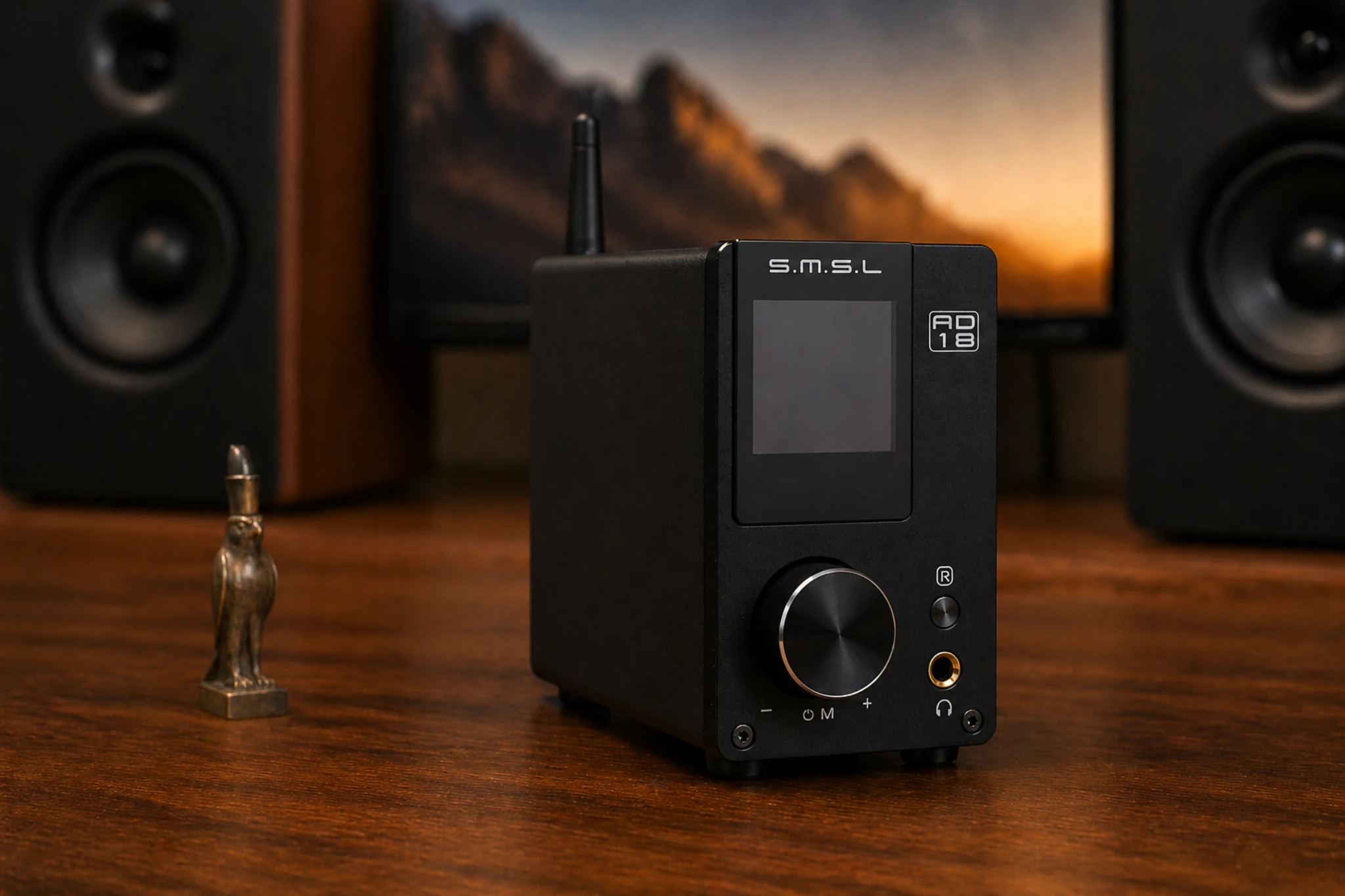
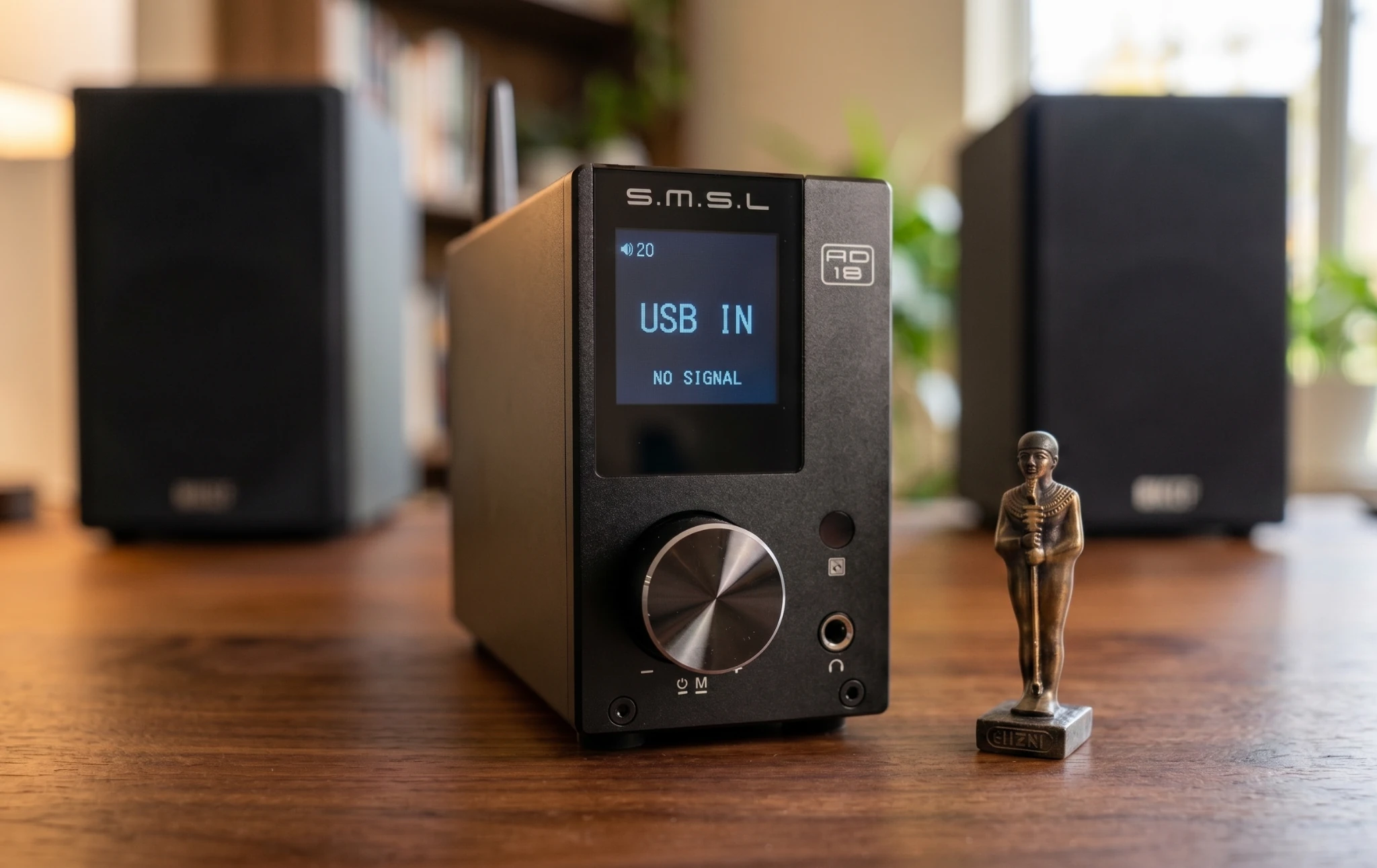
The AD18 is compact by any standard — smaller than most integrated amplifiers and small enough to sit beside a monitor without consuming visible desk real estate. Specifically, the aluminium enclosure feels solid for the price. The OLED display is clear at desk distance and the volume rotary encoder has smooth, well-damped action. Overall build quality communicates honest construction rather than premium finish — appropriate for a product whose value is in its feature set rather than its aesthetics.
The front panel houses the OLED display, volume rotary encoder, and input selector. The rear panel provides all connections — USB type B for computer audio, optical input, RCA stereo input, speaker terminals, and the subwoofer RCA output. Specifically, the speaker terminals are compact screw-type rather than the binding posts found on full-size integrated amplifiers. They accept bare wire and small spade connectors but not banana plugs — a practical limitation for listeners who use terminated speaker cables. Additionally, a remote control is included, which handles volume, input switching, and DSP adjustments from the listening position.
USB DAC and Digital Inputs
Specifically, the USB DAC is the AD18’s most practically useful feature for its target audience. Specifically, connecting a USB cable presents the AD18 as a USB audio device. The computer routes audio directly to the AD18’s internal DAC at up to 24-bit/96kHz, bypassing the computer’s internal audio chip. The result is cleaner, lower-noise audio delivery than the headphone output of most laptops and desktop computers provides.
In practice, this matters most for listeners who use their system for critical listening alongside daily work. Specifically, the computer’s internal audio chip often shares a circuit board with components that generate electrical interference — fan controllers, USB controllers, power regulation circuits. The AD18’s USB DAC isolates audio processing from these noise sources. The result is a lower noise floor and cleaner high-frequency reproduction than a 3.5mm-to-RCA cable from the headphone output. For a full explanation of how DACs integrate into source chains and when a standalone DAC adds value, the DAC and amplifier integration guide covers every scenario.
Optical input
Specifically, the optical input accepts digital audio from a TV, game console, Blu-ray player, or CD transport. Specifically, it handles PCM stereo at up to 24-bit/96kHz — sufficient for all standard broadcast and streaming audio. The optical input does not accept Dolby Digital or DTS surround — it decodes stereo PCM only. For TV audio specifically, set the TV’s audio output to PCM stereo rather than Dolby Digital before connecting to the AD18.
Power Output and Speaker Pairing
Specifically, the AD18’s rated 80W into 4Ω translates to approximately 40W into 8Ω in real-world use — class-D amplifiers typically halve their output as impedance doubles. Specifically, 40W into 8Ω is adequate for the Polk ES20 (88dB/8Ω), Sony SSCS5 (87dB/6Ω, small room), and Q Acoustics 3020c (25–75W, within the window) in small to medium rooms. For the ELAC B6.2 at 6Ω, the AD18 delivers adequate volume but sits at the lower edge of what the woofer needs for full damping. The Denon PMA-600NE is the stronger pairing for the ELAC specifically.
For detailed guidance on calculating the correct power for any specific speaker sensitivity and impedance, the amplifier to speaker matching guide covers the calculation. One practical note: the AD18’s class-D output stage is stable into 4Ω loads. Listeners who wire a second speaker pair in parallel — dropping impedance to approximately 4Ω — remain within the AD18’s operating range. Not all compact amplifiers at this price handle this safely.
Sound Quality
The AD18 sounds clean, detailed, and precise — characteristics that suit analytical listening and background music well. Specifically, its full-digital class-D topology produces a low noise floor and clear high-frequency resolution that makes detail in well-recorded music clearly audible. There is no added warmth, no low-frequency emphasis, and no midrange coloration — the AD18 presents audio accurately rather than flatteringly.
Compared to class-A/B amplifiers
Specifically, the distinction between the AD18 and a class-A/B amplifier like the Cambridge Audio AXA35 is most apparent on vocals and acoustic instruments at moderate listening levels. Specifically, the AXA35’s class-A/B circuit adds a subtle midrange density and tonal weight that makes voices and acoustic instruments feel more physically present. However, the AD18 does not do this — instruments are accurately positioned in the stereo field but without the organic warmth that class-A/B amplification contributes. Consequently, the AD18 is more rewarding for electronic music, pop, and casual background listening than for extended critical sessions with acoustic and vocal recordings.
Bass performance
Overall, bass through the AD18 is tight and controlled rather than warm and full. Specifically, the class-D output stage has a high damping factor — controlling cone movement precisely. The result is defined, well-timed bass rather than the slightly rounded character lower-damping amplifiers introduce. For bookshelf speakers with smaller woofers, this tightness is an asset. Combined with the subwoofer output, the AD18’s tight bass integrates cleanly with a powered subwoofer. The amplifier adds no low-frequency character that would disrupt the hand-off.
DSP, Subwoofer Output, and Controls
DSP equalisation
The AD18 includes a front-panel DSP with bass and treble adjustment, balance control, and several EQ presets accessible via the rotary encoder and remote. Specifically, the bass and treble controls operate at the DSP stage — before the amplifier output. They adjust the signal cleanly, without the noise or drift that analog tone control circuits introduce over time. In practice, the DSP adjusts tonal balance for speakers that run bright (treble reduction) or adds warmth to speakers with limited bass extension.
Subwoofer output
Specifically, the subwoofer output is a line-level RCA connection that carries the full-frequency signal — it does not apply a low-pass filter on the AD18 side. Consequently, the crossover point is set at the powered subwoofer itself rather than in the AD18. Specifically, this is the correct approach for most powered subwoofers, which include their own adjustable crossover and volume controls. Connect the subwoofer RCA input to the AD18’s subwoofer output, set the subwoofer’s crossover to approximately 80Hz, and adjust the subwoofer volume to blend with the bookshelf speakers at the listening position.
Connectivity and Setup
Overall, setup is straightforward for a multi-input desktop amplifier. Connect the USB cable from the computer first — the AD18 appears as a USB audio device in the computer’s sound settings within seconds of connection. Set it as the default audio output device. Next, connect speaker cables from the AD18’s rear speaker terminals to the bookshelf speakers, observing polarity. Finally, connect any additional sources — optical from a TV, RCA from a CD player, or pair via Bluetooth for mobile devices.
Specifically, the USB input takes priority when a USB source is active. Switching between inputs is done via the front-panel selector or remote. The Bluetooth pairing process is standard: hold the input selector until the OLED shows pairing mode, then connect from the phone or tablet’s Bluetooth settings. Additionally, the optical input requires PCM stereo output from the source device. Set the TV’s audio output to PCM if the AD18 produces no sound from optical. For a complete guide to connecting sources including turntables, computers, and streaming devices, the DAC connection guide covers each scenario.
No banana plug support on speaker terminals. The AD18’s compact screw-type speaker terminals do not accept banana plugs — bare wire or small spade connectors only. If existing speaker cables are terminated with banana plugs, remove the plugs and connect bare wire, or use a spade adapter. This is a practical limitation not visible in product photos — check before purchasing if termination type matters.
How the SMSL AD18 Compares
SMSL AD18 vs Fosi Audio BT20A
Specifically, the Fosi BT20A is smaller, less expensive, and has Bluetooth 5.0 versus the AD18’s 4.2. The AD18 counters with USB DAC input, optical input, subwoofer output, DSP EQ, and a remote control. Specifically, for listeners whose primary source is a computer and who want USB audio quality, the AD18’s feature advantage justifies the higher price. For listeners who primarily use Bluetooth and RCA only, the Fosi BT20A is the simpler and lower-cost correct choice.
SMSL AD18 vs Cambridge Audio AXA35
Specifically, the Cambridge AXA35 is a class-A/B integrated amplifier with a phono stage and 35W of analog amplification — no USB DAC, no Bluetooth, no subwoofer output. Specifically, the AXA35 delivers a warmer, more organic sonic character that suits critical listening better than the AD18. The AD18 delivers more source flexibility and convenience features at a lower price. For listeners who want the best-sounding amplifier for bookshelf speakers and sources are wired, the AXA35 is the correct choice. For listeners who want PC audio, wireless streaming, and subwoofer integration, the AD18 is the correct choice.
SMSL AD18 vs Sony STR-DH190
Specifically, the Sony STR-DH190 is a full-size stereo receiver with phono input, Bluetooth, 100W, and A/B speaker switching — but no USB DAC and no subwoofer output. It costs more than the AD18. For desktop use where the AD18’s compact footprint matters, the STR-DH190 is not a practical alternative. For larger room setups where 100W and phono input are priorities, the Sony is the more complete solution.
Is the SMSL AD18 Worth It?
Overall, the AD18 is worth buying for PC listeners who want USB DAC, Bluetooth, and subwoofer output in one unit. No other amplifier at its price matches this combination. The USB DAC eliminates a separate DAC purchase. The subwoofer output enables 2.1 expansion without replacing the amplifier. Class-D power is adequate for all standard passive bookshelf speakers in small to medium rooms.
However, it is not the correct choice for listeners who prioritise tonal character. The class-D precision is an asset for analytical and background listening. It is a limitation for extended critical sessions where class-A/B warmth is the distinguishing factor. Furthermore, turntable listeners need a separate phono preamp, which adds cost and reduces the AD18’s convenience advantage over the Sony STR-DH190 at a higher price.
Final Verdict
The SMSL AD18 is correct for the PC listener who wants everything in one box — USB DAC, Bluetooth apt-X, optical, subwoofer, DSP EQ, and class-D power. At its price, no competing unit matches this feature combination. For that listener it delivers exactly what it promises. The compact footprint fits naturally into a desk setup without the size penalty of a full-size integrated.
Specifically, the trade-off is sonic character. Class-D precision suits the AD18’s intended use case well — PC audio, Bluetooth streaming, and background listening reward its clean, detailed presentation. For listeners who have identified that class-A/B warmth is the priority and convenience features are secondary, the Cambridge Audio AXA35 or Denon PMA-600NE are the correct next steps. For the PC listener who wants the most capable compact all-in-one, the AD18 stands without a direct competitor at its price.
Best desktop all-in-one — USB DAC, Bluetooth apt-X, subwoofer output, class-D. Most feature-complete compact amplifier at this price.
Frequently Asked Questions
What speakers work best with the SMSL AD18?
Any passive bookshelf speaker at 87–88dB sensitivity works correctly with the AD18 in small to medium rooms. The Polk Audio ES20 (88dB/8Ω), Sony SSCS5 (87dB/6Ω), and Q Acoustics 3020c (88dB/6Ω, within the 25–75W window) all pair naturally. The ELAC Debut 2.0 B6.2 (87dB/6Ω) works but benefits from more current than the AD18 delivers optimally — the Denon PMA-600NE is a stronger match for the ELAC specifically.
Does the SMSL AD18 work as a USB DAC with a computer?
Yes — connect a USB type B cable from the computer to the AD18 and it appears as a USB audio device in the operating system’s sound settings. Set it as the default output device and audio plays through the AD18’s internal DAC at up to 24-bit/96kHz. No drivers are required on macOS; Windows may download a driver automatically. This bypasses the computer’s internal audio chip, which typically reduces noise and improves clarity compared to the headphone output.
Can I connect a turntable to the SMSL AD18?
Only if the turntable has a built-in phono preamp. The AD18 has no internal phono stage — its RCA input accepts line-level signals only. Turntables with a built-in preamp (most modern entry models include one — check for a line/phono switch set to line) connect directly via RCA. Turntables without a built-in preamp require a separate external phono preamp between the turntable and the AD18’s RCA input. Connecting a raw phono signal directly produces very quiet, tonally incorrect audio.
How does the SMSL AD18 subwoofer output work?
The subwoofer output is a line-level RCA connection that carries the full-frequency signal — no low-pass filter is applied by the AD18. The crossover point is set at the powered subwoofer itself. Connect the subwoofer’s RCA input to the AD18’s subwoofer output, set the subwoofer’s crossover to approximately 80Hz, and adjust the subwoofer volume to blend with the bookshelf speakers at the listening position. The subwoofer output is always active when the AD18 is powered on — it cannot be disabled independently.
Is the SMSL AD18 better than the Fosi Audio BT20A?
Different rather than better — they serve different listener profiles. The Fosi BT20A is smaller, less expensive, and has Bluetooth 5.0. The AD18 adds USB DAC input, optical input, subwoofer output, DSP EQ, and remote control. For PC listeners who want USB audio quality and subwoofer integration, the AD18 is the correct choice. For listeners who primarily use Bluetooth and RCA only and want the smallest possible footprint at the lowest price, the Fosi BT20A is the simpler correct choice.