The Edifier R1280T solves a problem most bookshelf speaker guides ignore: not everyone wants to buy a separate amplifier. At its price point, it delivers 42W RMS of built-in amplification, a wooden enclosure, dual RCA inputs, and front-panel bass and treble controls in a single compact unit that connects directly to a source and plays music without any additional hardware. It is Amazon’s Choice with over 1,000 monthly purchases — the most validated powered bookshelf speaker in its price range. Specifically, it earned the budget active pick position in the best bookshelf speakers for home audio roundup for exactly that reason. This review covers what the R1280T actually delivers in daily use, where its active design creates a ceiling on long-term performance, and who should choose it versus a passive speaker instead.
Quick Answer: The Edifier R1280T is the correct choice for listeners who want a complete desktop speaker system without buying a separate amplifier — wooden enclosure, dual RCA inputs, tone controls, and Amazon’s Choice validation in a single unit. The limitation is its active design: performance cannot be improved by upgrading to a better amplifier. Listeners who plan to build or upgrade a system over time need a passive speaker instead.
This article contains affiliate links. If you purchase through them, we may earn a commission at no extra cost to you. This helps support AmplifierZone and allows us to keep creating in-depth, unbiased audio guides.
Who Is the Edifier R1280T For?
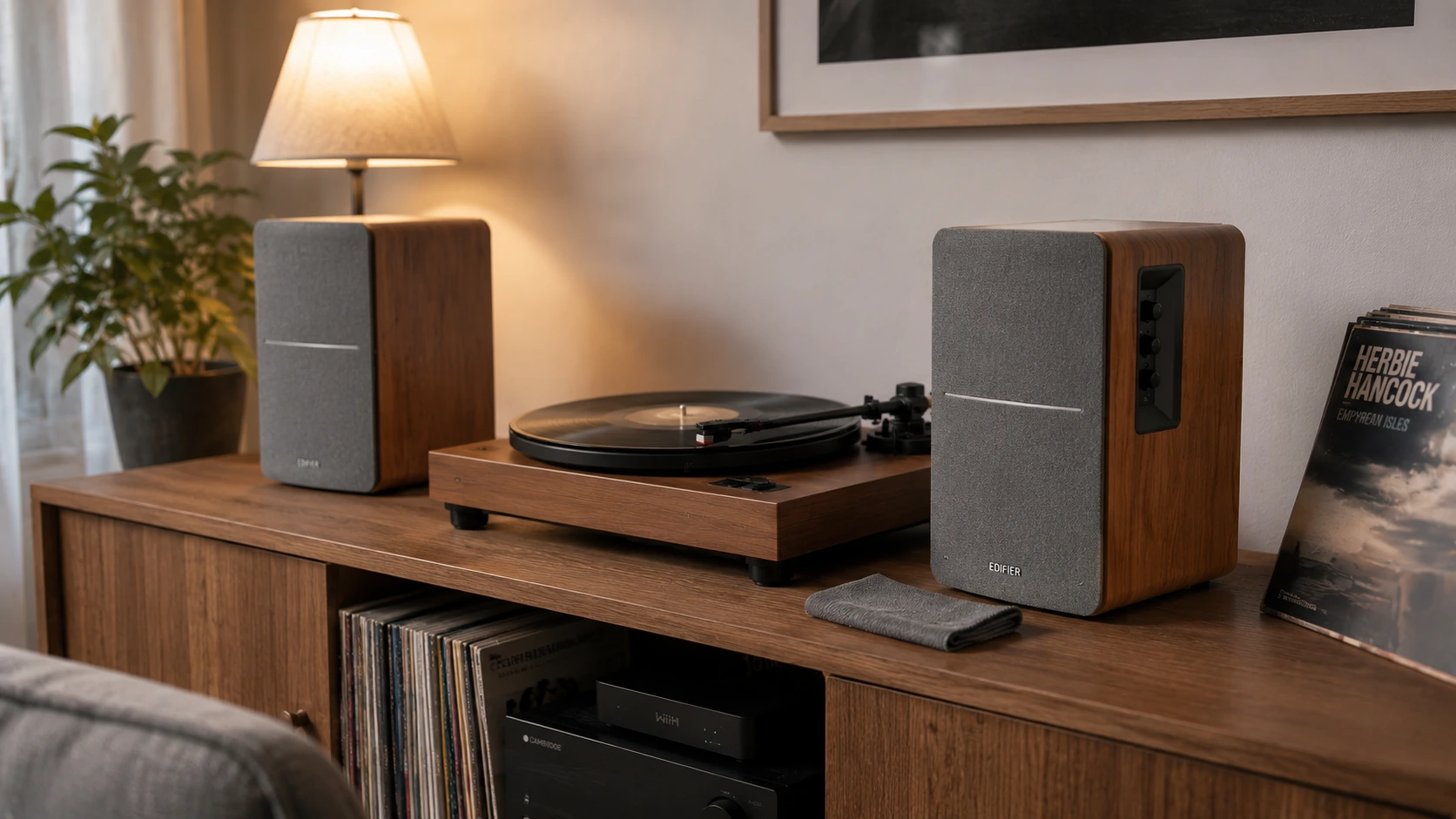
The R1280T is built for three specific listener profiles. First, anyone setting up a desktop audio system for the first time who wants music playing without researching amplifiers, speaker cables, and impedance matching — the R1280T connects to a source and works immediately. Second, listeners with a turntable that already has a built-in phono preamp who want to connect it directly to powered speakers without any additional components in the signal chain. Third, anyone in a small room or at a desk where the 42W total output is sufficient for near-field listening and a compact footprint matters more than long-term upgradeability.
The R1280T is less suited to listeners who are thinking ahead. Specifically, if the plan is to upgrade the sound quality by pairing better amplification at a later stage — that upgrade path does not exist with an active speaker. The built-in amplifier is permanently part of the unit. For listeners who want a passive speaker they can pair with progressively better amplifiers over time, the passive vs active speakers guide maps that decision with specific recommendations at each budget level.
Check your turntable first: If your turntable has a built-in phono preamp with a line output, it connects directly to the R1280T’s RCA inputs. If your turntable outputs a raw phono signal (no built-in preamp), you need a separate phono preamp between the turntable and the R1280T. Check for a line/phono switch on the back of your turntable — if it exists and is set to line, direct connection works.
Edifier R1280T — Key Specifications
Edifier R1280T Powered Bookshelf Speakers
- Type: Active — built-in amplifier, no external amp required
- Power output: 42W RMS total (21W per channel)
- Driver configuration: 2-way — 4″ woofer, 13mm silk dome tweeter
- Inputs: Dual RCA (two source inputs, front-panel selector)
- Controls: Front-panel volume, bass, treble knobs
- Enclosure: Wooden — reduces resonance vs plastic alternatives
- Frequency response: 55Hz–20kHz
- Connectivity: Wired RCA only — no Bluetooth
- Dimensions: 150 × 235 × 195mm per speaker
- Complete system — no separate amplifier, cables, or impedance matching required
- Amazon’s Choice — 1,000+ monthly purchases confirming consistent real-world satisfaction
- Wooden enclosure — lower cabinet resonance than plastic alternatives at this price
- Dual RCA inputs — connect two sources simultaneously with front-panel switching
- Front-panel tone controls — bass and treble adjustment without touching the source device
- Compact desktop footprint — fits beside a monitor or on a bookshelf
- Active design — cannot be upgraded by pairing with a better amplifier
- No Bluetooth — wired RCA connection only on the standard R1280T
- 4″ woofer — bass rolls off below 55Hz, limited extension for bass-heavy listening
- 42W total — designed for near-field desktop use, not suitable for larger rooms
- No phono input — turntables without built-in preamps need a separate phono stage
Budget active pick — built-in 42W amplifier, wooden enclosure, dual RCA inputs. Amazon’s Choice. No external amp required.
Design and Build Quality
Specifically, the R1280T uses a wooden enclosure — specifically medium-density fibreboard with a wood-grain vinyl wrap — rather than the injection-moulded plastic used by most powered speakers at this price. Specifically, wooden enclosures have higher density and lower internal resonance than plastic, which reduces cabinet colouration and contributes to a cleaner mid-bass response. The difference is audible compared to plastic-enclosure competitors in the same price range, particularly on acoustic guitar and piano recordings where cabinet colouration is most apparent.
The active speaker (left channel) houses all the amplifier electronics and the control interface. Its passive speaker (right channel) connects via a speaker-level cable included in the box. Consequently, the setup involves connecting the two speakers together first, then running a single RCA source cable to the active unit. Front-panel controls — volume, bass, treble, and input selector — are on the active speaker’s left side panel, accessible without reaching behind the unit.
Build quality is appropriate for the price — the cabinets feel solid, the knobs have smooth action, and the RCA sockets grip plugs firmly. Overall the R1280T communicates honest construction rather than premium finish, which is the correct expectation at this price point.
Active Design — The Key Trade-off
Specifically, the R1280T’s active design is both its primary appeal and its fundamental limitation. Specifically, the appeal is simplicity — no amplifier to choose, no speaker cables to terminate, no impedance matching to understand. The limitation is that the built-in amplifier defines the performance ceiling permanently. Specifically, every component improvement that a passive speaker listener makes — better amplifier, better speaker cables, better source — passes through the passive speaker and delivers audible improvement. With the R1280T, none of those upgrades are possible.
Furthermore, when the R1280T’s amplifier eventually fails or becomes inadequate for the listener’s evolving standards, the entire unit requires replacement — not just the amplifier section. However, for the listener whose standards are well-served by a near-field desktop system and who has no intention of upgrading components individually, this trade-off is entirely irrelevant. The R1280T’s active design is not a compromise — it is a correct solution for a specific listener. For listeners who are uncertain which path suits them, the best amplifiers for bookshelf speakers guide clarifies what the passive route involves at each budget level.
Sound Quality
Overall, the R1280T sounds clean and balanced for a powered speaker in its price range — the wooden enclosure contributes to a more controlled mid-bass than plastic alternatives, and the 13mm silk dome tweeter avoids the harsh, fatiguing quality of cheaper metal dome alternatives. Specifically, vocals and acoustic instruments are presented with reasonable clarity and tonal density, and the stereo image is well-defined for near-field listening at a desk.
Bass performance
Specifically, the 4″ woofer rolls off below approximately 55Hz — which means bass-heavy electronic music, hip-hop, and film soundtracks will feel thin without a subwoofer. Specifically, the R1280T is not designed to reproduce deep bass, and the bass tone control adds warmth rather than genuine low-frequency extension. For acoustic music, jazz, podcasts, and casual listening, the bass performance is adequate and pleasant. However, for bass-critical listening, a subwoofer is a practical addition — the R1280T includes a subwoofer output specifically for this purpose.
Volume and room suitability
Specifically, at 42W total, the R1280T is designed for near-field use — optimally at distances of 0.5–2 metres from the listener. Consequently, it performs best as a desktop or shelf speaker in a small room. In a larger living room at distances above 3 metres, it will reach adequate but not comfortable listening levels before the amplifier begins to clip. For listeners in larger rooms, a passive speaker paired with a dedicated amplifier is the more appropriate solution.
Tone Controls and Inputs
Bass and treble controls
Specifically, the front-panel bass and treble knobs adjust tonal balance at the amplifier stage. Specifically, the bass control adds warmth and body to recordings that sound thin on small speakers, and the treble control manages brightness for recordings or cartridges that run slightly forward in the upper frequencies. Both controls have a centre-detent flat position — start here and adjust only if the tonal balance through the specific source and recording warrants it. Additionally, both controls are subtle in range — they provide compensation rather than dramatic re-equalisation, which is the correct approach for desktop speakers.
Dual RCA inputs
Specifically, two sets of RCA inputs allow two sources to be connected simultaneously — typically a turntable and a computer, or a TV and a phone via RCA adapter. The front-panel input selector switches between them without disconnecting either source. Specifically, this is a genuinely practical feature for desktop setups where two sources are in regular use — it eliminates the cable-swapping that single-input powered speakers require.
Connectivity and Setup
Setup is the simplest of any speaker on this list. Connect the passive speaker to the active unit via the included speaker cable, run an RCA cable from the source to one of the two input pairs, and power on. Total setup time is under five minutes with no configuration decisions required. For turntable connections specifically, verify whether the turntable has a built-in preamp before connecting — the R1280T’s RCA inputs accept line-level signals only. Additionally, for a full walkthrough of source connections including turntables, computers, and TVs, the DAC and source connection guide covers each scenario.
The R1280T has no Bluetooth. Connection is wired RCA only on the standard model — Edifier offers the R1280DB variant with Bluetooth and optical input for listeners who need wireless connectivity. For desk setups where the source is a computer, a standard 3.5mm-to-RCA cable from the computer’s headphone output to the R1280T’s RCA input provides a clean, direct connection.
How the Edifier R1280T Compares
Edifier R1280T vs Edifier R1280DB
The R1280DB adds Bluetooth 5.0 and optical/coaxial digital inputs at a higher price. For listeners who need wireless connectivity from a phone or tablet, the DB variant is the correct choice. Listeners whose sources are all wired — computer via RCA, turntable via RCA — the standard R1280T delivers the same core sound quality at a lower price without unused features.
Edifier R1280T vs Sony SSCS5
The Sony SSCS5 is a passive speaker requiring a separate integrated amplifier. Consequently, the total system cost is higher than the R1280T alone. However, the Sony’s passive design allows amplifier upgrades over time, its 3-way driver configuration extends high-frequency response to 50kHz, and its 10–145W power handling range scales to much larger rooms. For listeners who want a long-term, upgradeable system, the Sony with a budget amplifier is the correct direction despite the higher initial cost. Listeners who want a single-purchase desktop solution will find the R1280T the simpler and lower-cost answer.
Edifier R1280T vs budget passive speakers with an entry amplifier
Specifically, an entry passive bookshelf speaker paired with a budget class-D amplifier can match or exceed the R1280T’s sound quality at a competitive total cost — and it delivers the upgrade path the R1280T cannot. Specifically, the Fosi Audio BT20A or similar class-D amplifiers paired with the Sony SSCS5 represent a passive entry system at a comparable total investment. However, the advantage of the R1280T in this comparison is simplicity — fewer components, less setup, and a smaller footprint on the desk.
Is the Edifier R1280T Worth It?
Overall, the R1280T is worth buying for any listener who wants a complete, immediate desktop speaker system with no additional purchases required. Amazon’s Choice status and 1,000+ monthly purchases confirm that real-world buyers find it delivers on its promises at this price. The wooden enclosure, dual inputs, and tone controls represent genuine value that most plastic-bodied alternatives at the same price do not offer.
However, it is not worth buying as an entry point into building a home audio system with upgrade intentions. The active design means every future upgrade involves replacing the entire unit rather than improving individual components. For listeners who see this as the starting point of a growing system, a passive speaker and a separate entry amplifier is the correct foundation from day one — even if the initial outlay is slightly higher.
Turntable users — check your output type before connecting. The R1280T’s RCA inputs accept line-level signals only. Turntables with a built-in phono preamp (look for a line/phono switch set to line) connect directly. Without a built-in preamp, a raw phono signal requires a separate phono preamp before the R1280T. Connecting a raw phono signal without a preamp produces very quiet, bass-heavy, distorted audio.
Final Verdict
The Edifier R1280T is the most validated powered bookshelf speaker at its price — Amazon’s Choice with 1,000+ monthly purchases, a wooden enclosure that outperforms plastic alternatives, dual RCA inputs for two sources, and front-panel tone controls in a compact desktop unit. For the listener it is designed for — someone who wants music on a desk or shelf without the complexity of a separate amplifier and speaker cable setup — it delivers exactly what is promised.
Specifically, the active design is a permanent limitation, not a flaw. Indeed, it is the correct trade for listeners who value simplicity and a fixed system over upgradeability. For listeners who value the upgrade path, the passive speaker route is the correct starting point regardless of the initial cost difference. Both are valid answers to different questions — the R1280T answers the right question for its audience clearly and well.
Budget active pick — built-in 42W amplifier, wooden enclosure, dual RCA inputs. Amazon’s Choice. No external amp required.
Frequently Asked Questions
Does the Edifier R1280T need an amplifier?
No — the R1280T includes its own built-in amplifier delivering 42W RMS total. It connects directly to a source via RCA cable and does not require a separate amplifier or receiver. This makes it a complete self-contained speaker system. If you want a speaker that can be upgraded by pairing with a better amplifier in future, choose a passive speaker instead — the R1280T’s performance ceiling is set by its built-in amplifier.
Can I connect a turntable directly to the Edifier R1280T?
Only if the turntable has a built-in phono preamp. Most modern entry turntables — Audio-Technica AT-LP60, AT-LP120, Pro-Ject Debut Carbon — include a switchable built-in preamp. Set the turntable’s line/phono switch to line and connect via RCA cable to the R1280T. If the turntable has no built-in preamp (check the manual), a separate external phono preamp is needed between the turntable and the R1280T. Connecting a raw phono signal directly produces very quiet, tonally incorrect audio.
Does the Edifier R1280T have Bluetooth?
No — the standard R1280T is wired RCA only. For Bluetooth connectivity, Edifier makes the R1280DB variant which adds Bluetooth 5.0 and optical/coaxial digital inputs. If wireless connection from a phone, tablet, or laptop is important, the R1280DB is the correct model. For setups where all sources are wired, the standard R1280T delivers the same core sound quality without the higher price of unused wireless features.
Can I add a subwoofer to the Edifier R1280T?
Yes — the R1280T includes a subwoofer output on the rear of the active speaker. Connect an active subwoofer with an RCA input to this output. The subwoofer output is always active when the unit is powered on, so the subwoofer volume is controlled independently at the subwoofer itself. Adding a subwoofer addresses the R1280T’s primary acoustic limitation — bass extension below 55Hz — and is particularly worthwhile for listeners who play bass-heavy music or use the speakers for film audio.
What is the difference between the Edifier R1280T and R1280TF?
The R1280TF adds a built-in phono preamp, allowing direct turntable connection without a separate phono stage. For vinyl listeners who do not have a turntable with a built-in preamp, the R1280TF eliminates the need for an external phono preamp purchase. The standard R1280T is the correct choice if your turntable already has a built-in preamp or if your sources are all line-level. Both models deliver identical sound quality through the same amplifier and driver configuration.