The tube vs solid state guitar amp debate has been running since transistor-based amplifiers first appeared in the 1960s — and it generates more heat than most discussions in the guitar world because both camps are partly right. Indeed, tube amps sound different from solid state amps. The difference is real, measurable, and audible to most players who have experienced both. However, the significance of that difference depends almost entirely on how, where, and at what volume a player actually plays — and at bedroom volumes through headphones, the gap narrows considerably. This guide explains what each circuit type actually does, how the difference manifests in a real room, and which type makes more practical sense for different playing situations.
Quick answer: Tube amps use vacuum valves to amplify the guitar signal, producing harmonic distortion and dynamic compression that most players describe as warm, responsive, and musical. Solid state amps use transistors, producing a cleaner, more consistent signal that is more reliable, more affordable, and more practical for home use. Neither is objectively better — the correct choice depends on volume, budget, portability needs, and whether the specific character of valve distortion matters to you.
This article contains affiliate links. If you purchase through them, we may earn a commission at no extra cost to you. This helps support AmplifierZone and allows us to keep creating in-depth, unbiased audio guides.
How Tube Amps Work
The vacuum valve circuit
A tube guitar amp uses vacuum valves — also called valves in British English or tubes in American English — to amplify the guitar signal. A vacuum valve is a glass envelope containing metal electrodes in a near-vacuum environment. When the guitar signal is fed into the valve’s input electrode (the grid), it modulates the flow of electrons from the cathode to the plate, producing an amplified version of the input signal at the output.
Specifically, most guitar tube amps use two stages of valve amplification. The preamp stage — typically using 12AX7 or ECC83 valves — amplifies the guitar signal to a usable level and shapes the initial tone and gain character. The power amp stage — using EL34, 6L6, EL84, or other power valves — amplifies the preamp signal to speaker-driving levels. Additionally, the output transformer converts the power valve’s high-impedance output to the speaker’s low-impedance requirement.

Why tubes distort the way they do
The defining characteristic of valve amplification is what happens when the valve approaches its operating limits. Unlike a transistor, which clips the signal abruptly when overdriven, a valve clips gradually — the signal compresses progressively and adds harmonic overtones (primarily even-order harmonics: the 2nd, 4th, and 6th harmonics of the fundamental note) as it approaches saturation. Notably, these even-order harmonics are mathematically related to the original note in ways that the human auditory system perceives as musical and harmonically rich. This gradual saturation is what most players describe as valve warmth, bloom, and responsiveness — the way the amp seems to breathe with the playing rather than simply amplifying it.
Furthermore, the interaction between the power valves, the output transformer, and the speaker creates a feedback loop that responds dynamically to playing dynamics. For instance, strike a chord hard and the amp compresses slightly, rounding the attack and adding sustain. Play softly and the amp opens up, producing a cleaner, more defined response. This dynamic interaction is what players mean when they say a tube amp responds to the player — it is not a marketing description but a measurable physical property of the circuit.
How Solid State Amps Work
The transistor circuit
A solid state guitar amp uses transistors — semiconductor devices — to amplify the guitar signal. Transistors perform the same fundamental function as valves (controlling a larger current with a smaller input signal) but do so through the properties of semiconductor materials rather than electron flow in a vacuum. The result is an amplifier that is smaller, lighter, more reliable, more efficient, and significantly cheaper to manufacture than its valve equivalent.
Solid state amplifiers in their pure form amplify the guitar signal with very low distortion — the transistor circuit is more linear than a valve circuit, meaning it reproduces the input signal more accurately. Specifically, this accuracy is valuable in audio contexts where fidelity is the goal (hi-fi amplifiers, professional PA systems), but it creates a specific challenge for guitar amplification: an accurate, low-distortion amplifier produces the clean tone a guitarist wants at low gain, but when the signal clips (as it does in overdrive and distortion), it clips hard rather than gradually. Consequently, the resulting odd-order harmonic content (3rd, 5th, 7th harmonics) is what most players describe as harsh, buzzy, or transistor-like — less musically satisfying than valve saturation to many ears.
Modern solid state — closing the gap
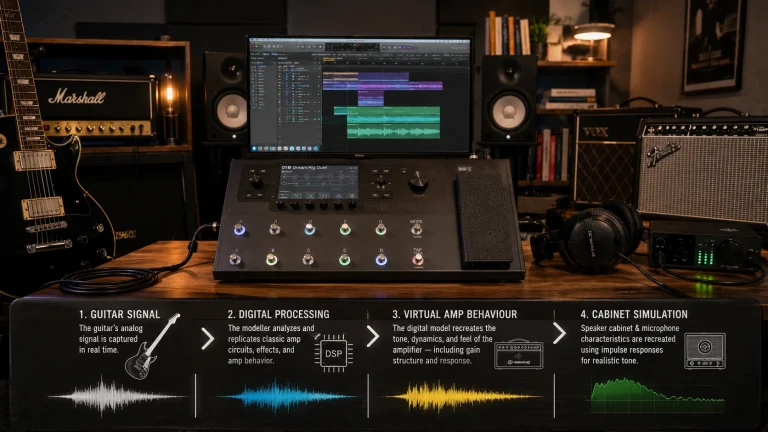
The solid state amps that matter at this budget in 2026 are not pure transistor amplifiers — they are sophisticated digital signal processing platforms that model the behaviour of valve circuits in software. Boss’s Tube Logic circuit, used in the Katana range, specifically models the valve response curve to introduce the gradual saturation and dynamic compression that a pure transistor circuit lacks. Consequently, the result is a solid state amp that produces a significantly more convincing valve-like response than a conventional transistor design. Read the full Boss Katana-50 Gen 3 review to understand how Tube Logic performs in practice.

Additionally, digital modelling platforms like the Positive Grid Spark and the Fender Mustang range go further — modelling not just the valve response but the specific character of individual amplifier circuits, speaker cabinets, and microphone placements. What began as a solid state circuit has become a platform capable of reproducing the behaviour of dozens of different valve amps within a single unit. What amp modelling does and how the technology works is explained in depth in the amp modelling guide.
The Real Difference in Practice
Dynamic response — the most important distinction
The practical difference between a tube amp and a solid state amp is most apparent in how each responds to changes in playing dynamics. Specifically, with a tube amp set to a moderate overdrive level, the difference between picking lightly and digging in hard is significant — a soft touch produces a clean or near-clean tone, while a harder attack drives the valves into saturation and produces the characteristic breakup. Indeed, this single-amp dynamic range is one of the most musically useful properties a guitar amplifier can have. Players can control their clean/dirt balance with pick attack and guitar volume rather than switching channels or adjusting controls.
Solid state amps — even well-designed ones — typically have a sharper transition between clean and overdriven states. The dynamic range exists, but the response curve is steeper. However, this is not necessarily a disadvantage: for players who want consistent, predictable distortion at all dynamics, a more linear response is actually preferable. Metal and high-gain playing often benefits from solid state’s tight, consistent response — particularly in the low frequencies, where valve amps can sound loose or undefined at high gain.
Tube vs solid state — key practical differences at a glance:
- Distortion character: Tube — gradual, even-order harmonics; Solid state — abrupt, odd-order harmonics
- Dynamic response: Tube — responsive to pick attack; Solid state — more consistent across dynamics
- Low frequency: Tube — warm, sometimes loose at high gain; Solid state — tight, controlled
- Reliability: Tube — requires valve replacement over time; Solid state — no consumable components
- Weight and cost: Tube — heavier, more expensive; Solid state — lighter, more affordable
- Volume requirements: Tube — often sounds best at higher volumes; Solid state — consistent at any volume
The volume dependency of tube tone
Tube amps are volume-dependent in a way that solid state amps are not. Specifically, the power valve saturation that produces the most desirable valve tone — the dynamic compression, the bloom, the harmonic richness — occurs when the power stage is pushed into its operating range. Specifically, in a 50-watt valve amp, this typically means fairly loud volumes. At low volumes, the power valves are running well within their linear range and the amp sounds more like a high-quality preamp into a relatively clean power stage — pleasant, but without the full character of the driven power stage.
This volume dependency is one of the most practically significant differences between tube and solid state amps for home players. A 50-watt solid state amp sounds essentially the same at 0.5 watts as it does at 50 watts — the character is set by the preamp and modelling stage rather than the power stage. A 50-watt tube amp at 0.5 watts lacks the power stage saturation that defines its character at higher volumes. Why wattage interacts differently with tube and solid state designs is explained fully in the guitar amp wattage guide.
Tube vs Solid State at Bedroom Volumes
The attenuator solution
The guitar industry has developed several solutions to the tube amp’s volume problem. Power attenuation — built into amps like the Blackstar HT-1R MkIII at 1W and 0.1W settings — reduces the output power while keeping the full amp circuit active. Consequently, at 0.1W, a tube amp produces approximately the volume of a quiet conversation while the valves continue to operate in their characteristic saturation zone. The tone at 0.1W is not identical to the same amp at full power — the speaker’s behaviour changes at different drive levels — but it is genuinely a valve amp producing valve character at bedroom volume rather than a loud amp turned down.
The Blackstar HT-1R MkIII review covers this in detail — specifically how 1W tube amplification handles bedroom volume constraints versus what is lost compared to the same circuit at higher power. For players who specifically want tube tone at home, the HT-1R MkIII represents the most practical solution available at this price.
Where solid state wins at home
For home players, solid state and digital modelling amps have a structural advantage that tube amps cannot overcome at low volumes: their character is independent of output level. Specifically, a Boss Katana-50 Gen 3 at 0.5W through a 12-inch speaker sounds like a Boss Katana-50 — the Tube Logic circuit, the amp character, and the effects all behave identically at bedroom volume as they do at rehearsal volume. Power attenuation on solid state amps does not involve any tone compromise because the tone is set before the output stage rather than by the interaction of valves and transformer at a specific drive level.
Furthermore, headphone outputs on solid state amps provide completely silent practice with cabinet simulation — an option that tube amps cannot provide without additional hardware, because the speaker cabinet’s interaction with the power stage is part of what produces the tone. At bedroom volumes with headphones, the solid state amp’s advantages are substantial and the tube amp’s advantages largely disappear.

Tube vs Solid State for Home Recording
Recording a tube amp
Recording a tube amp at the volume where it sounds best — typically fairly loud — requires either a microphone in front of the speaker, a load box that attenuates the output before recording, or an amp with a built-in line out with speaker emulation. Microphone recording in a home environment introduces room acoustics, placement sensitivity, and volume levels that most domestic situations cannot accommodate consistently. Consequently, many home players who own tube amps record them through load boxes or attenuation setups that are separate purchases on top of the amp cost.
However, tube amps with built-in line outs — like the Blackstar HT-1R MkIII’s emulated line output — capture the valve circuit’s character in a direct signal without requiring a microphone. The quality of this captured signal depends on the quality of the speaker emulation in the amp’s output stage. For players who want genuine valve character in a home recording without microphone setup, this is the most practical approach.
Recording a solid state or modelling amp
Solid state and modelling amps with USB audio output are significantly more straightforward for home recording — connect via USB, select the amp as the audio input in the DAW, and the full processed signal is captured. Specifically, no microphone, no room acoustics, no load box. The Boss Katana-50 Gen 3 additionally captures a dry re-amp channel alongside the processed signal, enabling post-session tone changes without replaying the part. For players whose primary goal is capturing guitar tracks at home, the solid state recording workflow is substantially less friction than a microphone-based tube amp setup.
Which Type Is Right for You?
Choose a tube amp if:
You play regularly at volumes that allow the power stage to operate in its characteristic range — rehearsal rooms, small venues, or a home environment that tolerates meaningful speaker volume. Furthermore, you specifically value the dynamic response and harmonic character of valve amplification and have experienced it enough to know it matters to you. You are prepared for the maintenance requirements: valve replacement typically every few years depending on use, and occasional biasing. Additionally, your playing style benefits from the natural compression and pick-attack sensitivity that valve circuits provide — blues, classic rock, country, and jazz players most commonly describe this as essential to their tone.
Choose a solid state or modelling amp if:
You primarily practice at home at low or bedroom volumes. Specifically, you want consistent, reliable tone at any volume without maintenance. You need headphone output for silent practice or USB recording for DAW capture. You want to cover multiple amp characters — clean, crunch, British, American, high-gain — without owning multiple amps. Your budget is a practical constraint, since a solid state amp at any given price point will outperform a tube amp in features, though not necessarily in pure valve character. You gig at venues where the amp needs to be reliable every night without the risk of a valve failing mid-set.
The honest practical assessment
For most home players in 2026, a well-designed solid state or modelling amp is the more practical choice — specifically because the volume dependency of tube tone makes the valve advantage largely inaccessible at the volumes most domestic players actually use. However, the exception is players who have specifically experienced real tube tone at appropriate volumes, know they value it, and are prepared to build their practice setup around making it work at home — whether through power attenuation, a low-wattage tube amp, or a hybrid arrangement. For anyone else, the modelling amps covered in the best guitar amp for home use roundup provide excellent tone, more features, and significantly greater practical flexibility at any given price point.
Frequently Asked Questions
Tube vs solid state basics
Do tube amps really sound better than solid state amps?
Not objectively — the two types sound different, and whether “better” applies depends entirely on the player and the context. Tube amps produce harmonic distortion and dynamic compression that most players who play at appropriate volumes describe as warmer, more responsive, and more musical. At bedroom volumes and through headphones, the difference narrows considerably. Many professional players use solid state and modelling amps live and in the studio without tonal compromise. The honest answer is: tube amps sound better to players who specifically value what valve circuits produce, at the volumes where those circuits operate as intended.
Are tube amps worth it for bedroom players?
Generally not, unless the player specifically buys a low-wattage tube amp designed for bedroom use. A high-wattage tube amp at bedroom volumes cannot reach the power stage saturation that defines its character — it effectively operates as an expensive preamp into a clean power stage. Low-wattage tube amps like the Blackstar HT-1R MkIII at 1W address this specifically, but they sacrifice output power and tonal flexibility in exchange. Consequently, for most bedroom players, a solid state or modelling amp with power attenuation provides more practical daily value at equivalent cost.
Practical differences
How long do tubes last in a guitar amp?
Preamp valves (12AX7, ECC83) typically last 10,000 hours or more under normal use — often a decade of regular playing before replacement is needed. Power valves (EL34, 6L6, EL84) last approximately 1,000–3,000 hours depending on how hard they are driven, typically requiring replacement every two to five years for regular players. Rectifier valves, where present, last similarly to power valves. Valve replacement is not complex — most guitar amp valves can be swapped without specialist tools — but it is an ongoing maintenance cost that solid state amps do not have.
Can a solid state amp sound like a tube amp?
Modern modelling amps can closely approximate the behaviour of tube amps, particularly at bedroom volumes and in recordings. The Boss Katana’s Tube Logic circuit specifically models the valve response curve, producing gradual saturation and dynamic response that is closer to valve behaviour than conventional solid state. At stage volumes through a real speaker cabinet, experienced players can generally identify the difference between even the best modelling and a real valve amp. At home volumes through headphones or direct recording, the difference is much less apparent to most listeners. The modelling technology continues to improve — the gap is narrowing every hardware generation.
More questions
Is a hybrid amp (tube preamp, solid state power) a good compromise?
Hybrid amps use valve preamp stages for tone shaping and transistor power stages for amplification. They capture some of the preamp valve character — the touch sensitivity and harmonic response of the input stage — while avoiding the volume dependency and maintenance of an all-valve power stage. The result is closer to valve character than a pure solid state design but stops short of the full power stage valve response that defines the tube sound at high volumes. For home players who want some valve character without the cost and complexity of an all-valve amp, a hybrid design is a reasonable middle ground. However, a well-designed modelling amp at the same price often provides more tonal versatility with comparable character.