This Boss Katana-50 Gen 3 review covers the amp that sits at the top of the most recommended home guitar amp list for good reason. The MkII was already the go-to recommendation for home players. The Gen 3 rethinks the character system entirely — moving from five channels to twelve distinct amp voices, upgrading the Tube Logic circuit, and adding a custom 12-inch speaker. At around $350 it earns its Overall Pick designation from Amazon’s algorithm through real sustained purchasing volume rather than a promotional spike.
It sits as the best overall pick in our best guitar amp for home use roundup. This review goes deeper. It examines the Gen 3’s changes over its predecessor, how the amp characters perform at home, and which buyers get the most value.
Quick Answer: The Boss Katana-50 Gen 3 is the best all-round home guitar amp in its price range. Twelve amp characters cover every major tone from clean to high gain. Power attenuation at 0.5W/25W/50W enables true bedroom operation. The custom 12-inch speaker delivers the physical feel that smaller alternatives cannot match, and USB recording captures the processed tone directly to a DAW. The evolved Tube Logic circuit is warmer and more dynamic than the MkII. Trade-offs: no AI backing tracks, app editing requires a computer rather than a smartphone, and it is the most expensive solid-state option in this group.

This article contains affiliate links. If you purchase through them, we may earn a commission at no extra cost to you. This helps support AmplifierZone and allows us to keep creating in-depth, unbiased audio guides.
Who Is the Boss Katana-50 Gen 3 For?
The player it was designed for
The Katana-50 Gen 3 is built for the serious home player who wants one amp that handles everything. Bedroom practice at whisper volumes, home recording without a microphone, the occasional small gig, and a breadth of tones across multiple genres — all without a pedalboard. The power attenuation system is what makes it work across all these contexts. At 0.5W it runs at genuine bedroom volumes through the 12-inch speaker, 25W covers rehearsals and small rooms, and 50W handles pub gigs and small venues. All three settings run the full amp circuit correctly. You are reducing actual output wattage — not simply turning down the master volume — so the amp’s character and response remain intact.
The Gen 3 suits players who have outgrown entry-level amps and want a long-term platform — not a stepping stone. The Tone Studio librarian, twelve amp characters, and Boss effects integration give it a ceiling that practice amps simply don’t have. It also suits players who have been through the modelling amp learning curve. For many, the Katana’s physical controls and immediate response are more satisfying than navigating menu-driven app interfaces.
When to consider something else
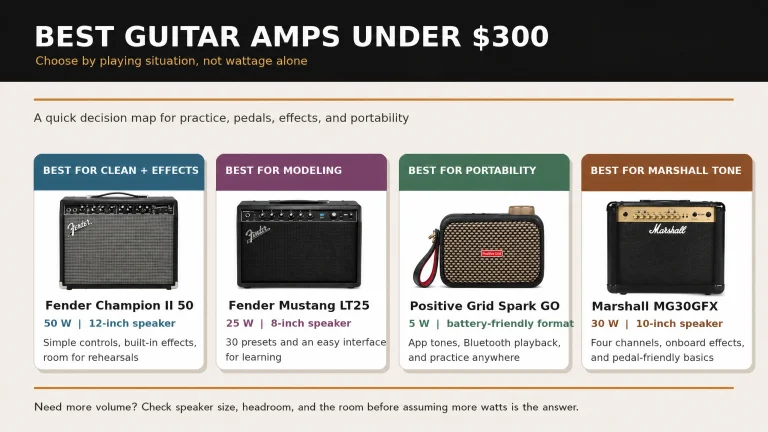
The Katana-50 Gen 3 is not the right choice for players who want AI-generated backing tracks for solo practice — that feature belongs to the Positive Grid Spark 40. For players who need primarily a headphone amp for completely silent practice, the Fender Mustang Micro serves that use case at a fraction of the price. For players who specifically want genuine tube tone with valve harmonic response, the Blackstar HT-1R MkIII is the only option in this price range.
Gen 3 vs MkII: If you already own a Katana MkII, the upgrade to Gen 3 is not automatic. The twelve amp characters are new and the Tube Logic revision is genuine, but the fundamental platform is evolved rather than replaced. For new buyers, the Gen 3 is unambiguously the better purchase at its current price. For existing MkII owners, assess whether the additional amp characters and circuit refinement justify the cost.
Boss Katana-50 Gen 3 — Key Specifications
Boss Katana-50 Gen 3 50-Watt Combo Amplifier
- Power output: 50W (selectable: 0.5W / 25W / 50W)
- Speaker: Custom 12-inch Boss
- Amp characters: 12 — Acoustic, Clean, Crunch, Lead, Brown, and more
- Effects: Onboard Boss effects — delay, reverb, chorus, modulation, and more
- Power attenuation: 0.5W / 25W / 50W selectable
- USB: Audio interface — stereo recording direct to DAW
- Headphone output: Yes — with speaker cabinet simulation
- Amp character system: Evolved Tube Logic solid-state modelling
- Tone Studio app: Deep editing via computer (Mac/PC)
- Effects loop: Send/return for external pedals
- Footswitch: GA-FC compatible for live channel switching
Pros and cons
- 12 amp characters — the broadest tonal range of any amp in this price range
- Power attenuation — genuine 0.5W bedroom operation without losing amp character
- Custom 12-inch speaker — physical amp feel that smaller speakers cannot replicate
- Evolved Tube Logic — warmer, more dynamic response than standard solid-state
- Onboard Boss effects — delay, reverb, chorus, modulation without additional pedals
- USB recording — direct stereo capture to any DAW without a microphone
- Effects loop — integrates professional pedal chains for advanced setups
- No AI backing tracks — practice platform features require a separate device
- Tone Studio requires a computer — no smartphone app for preset editing
- 267 reviews — newer Gen 3 has less real-world validation than the MkII had
- Weight — heavier than the Spark 40 and Mustang LT25 for transport
Best overall home guitar amp — 12 amp characters, power attenuation, 12-inch speaker, and USB recording. Amazon Overall Pick.
The power attenuation system deserves a specific explanation — it is what makes the Katana-50 Gen 3 genuinely practical for home use. At 50W, the amp is too loud for any normal home environment at anything above a whisper on the volume knob. At 0.5W through the 12-inch speaker, the amp fills a bedroom at a genuinely comfortable volume — no ear fatigue, no neighbour complaints. The 12-inch speaker still moves enough air to produce the physical sensation of playing through a real guitar amplifier. This is a meaningfully different experience from playing through a headphone output or a 3-inch speaker at the same volume level. How wattage ratings translate to real-world loudness is covered in the guitar amp wattage guide.
Design and Build Quality
Chassis and front panel
The Gen 3 retains the Katana’s established visual identity — a clean black panel with the distinctive Katana logo, five channel buttons corresponding to five of the twelve amp characters on the front panel, a three-band EQ, master volume, and the power level selector. The Gen 3 adds a more refined front panel layout that makes navigating the amp characters more intuitive than the MkII’s channel system. Build quality reflects Boss’s reputation for long-term reliability. The chassis is solid, the baffle is well-braced, and the controls have the firm, confident action Boss maintains across its product line.
The twelve amp characters explained
Shifting from five channels to twelve amp characters is the Gen 3’s most significant structural change. Each character models a specific amp type or era — from sparkly clean through British crunch, American lead, and high-gain modern voicings. Five front-panel buttons access five characters directly. The remaining seven are accessible through Tone Studio or via panel combinations. In practice, the five front-panel characters cover the most common home playing scenarios without needing to open the computer, and the deeper library rewards players who want to explore specific amp references.
The custom 12-inch speaker
Boss fitted the Gen 3 with a custom 12-inch speaker designed specifically for the Tube Logic circuit’s frequency response. A 12-inch driver moves substantially more air than the 8-inch and 4-inch alternatives in the Mustang LT25 and Spark 40. Bass extension is fuller, midrange projection is stronger, and the physical sensation of amplified guitar is more convincing at equivalent volume settings. This is not merely a specification advantage. Experienced players immediately identify the difference between a 3-inch driver and a 12-inch driver in a room, even at low volumes.
Sound Quality
The Tube Logic difference
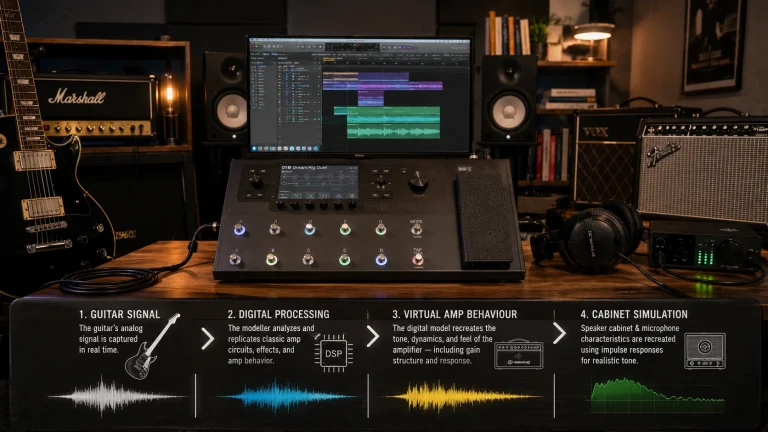
Boss’s Tube Logic is a solid-state design philosophy aimed at replicating the non-linear behaviour of tube amplifiers. It models how a tube amp’s response changes as the power stage is pushed, the preamp-to-power-amp interaction, and the harmonic content an output transformer adds. The Gen 3’s evolved Tube Logic circuit produces a noticeably warmer and more responsive feel than standard digital modelling at equivalent output. Notes decay more naturally, clean tones have dimensionality rather than flatness, and crunch tones compress in a way that rewards playing technique. Understanding what amp modelling does and how different implementations compare is covered in the amp modelling guide.
Clean and crunch tones
The clean characters are the Katana Gen 3’s strongest suit — particularly the Fender-influenced voicings that produce that characteristic bell-like chime on single-coil pickups and warm fullness on humbuckers. Picking dynamics translate clearly: light picking gives glassy clean tones, harder picking introduces gentle breakup rather than the binary clean-to-distorted switch of cheaper solid-state designs. The crunch characters span British-voiced breakup to classic American overdrive. All respond meaningfully to the guitar’s volume knob — rolling back produces cleaner tones, not just quieter ones.
Gain and high-gain characters
The lead and high-gain characters are convincing for home and rehearsal use. The Brown character produces tight, articulate distortion with good note separation even on fast passages. The lead voicings work well for blues lead, classic rock solo tones, and hard rock rhythm. For extreme metal applications — very high gain with very tight low-end — the Katana is good but not exceptional; dedicated modelling platforms like the Line 6 Helix or specialist pedals do that better. For most home players across mainstream genres, the gain range is more than sufficient.
Boss Katana-50 Gen 3 review — amp character quick guide:
- Acoustic: Guitar-into-PA simulation — best with acoustic-electric guitars
- Clean: Fender-influenced sparkle and warmth — best clean character in this group
- Crunch: British-voiced medium gain — covers blues, classic rock, and indie
- Lead: American-voiced lead — sustain and singing overdrive for solos
- Brown: High-gain rhythm and lead — tight, articulate distortion
- Plus 7 more: Accessible via Tone Studio — covers additional specific amp references
Connectivity and Features
USB recording
The Katana-50 Gen 3’s USB connection presents itself as a stereo audio interface to any DAW — GarageBand, Logic, Reaper, Ableton, Pro Tools. The captured signal is the full processed tone — amp character and onboard effects included — exactly what you hear through the speaker. Additionally, a separate dry guitar signal is available on a second USB channel for re-amping — recording raw guitar and adding processing later in the DAW. This two-channel USB output is a practical advantage over simpler implementations that only capture the processed signal.
Onboard effects and effects loop
The onboard Boss effects cover the most used categories for home and rehearsal playing: digital reverb with multiple room types, delay with tap tempo, chorus, tremolo, phaser, and flanger. All are accessible via the front panel without opening software. The effects quality reflects Boss’s professional heritage. The delay and reverb in particular are genuinely usable — not the basic approximations found in typical practice amp effects sections. Furthermore, the effects loop allows professional-grade pedals post-preamp — maintaining the Katana’s preamp character while using a dedicated reverb or time-based unit at line level.
Headphone output and silent practice
The headphone output includes cabinet simulation processing. The signal is processed to sound as though captured by a microphone through a speaker cabinet — not the thin, direct sound of an unprocessed headphone out. At 0.5W the Katana is quiet enough for most home environments. However, the headphone output enables completely silent operation — useful for very late hours or thin-walled apartments.
How the Boss Katana-50 Gen 3 Compares
Boss Katana-50 Gen 3 vs Positive Grid Spark 40
The most direct competition in the smart amp category. Compared to the Spark 40 — which costs less and adds AI Smart Jam, a smartphone app, 10,000+ community presets, and stereo speakers — the Katana counters with its 12-inch speaker, power attenuation, effects loop, and Tube Logic warmth. The choice depends entirely on playing habits. App-comfortable players who practice alone get more daily value from the Spark 40’s practice features. Players who prioritise amp feel and the acoustic experience of a 12-inch speaker consistently prefer the Katana. Both handle USB recording and headphone practice.
Boss Katana-50 Gen 3 vs Fender Mustang LT25
Different price brackets and different use cases. The Mustang LT25 costs considerably less and provides 30 amp models with USB recording in a compact 8-inch speaker combo — an excellent home recording tool. The Katana-50 Gen 3 provides the 12-inch speaker, power attenuation, effects loop, and Tube Logic character that make it a more satisfying speaker amp experience. For players who primarily record direct and rarely play through the speaker, the Mustang LT25’s lower price reflects a genuinely sufficient spec. For daily speaker players who want the physical amp experience, the Katana’s premium is worthwhile.
Boss Katana-50 Gen 3 vs Boss Katana-100 Gen 3
The Katana-100 Gen 3 costs more and adds 100W maximum output with an expanded power attenuation range. For home use exclusively, 50W with 0.5W attenuation is more than sufficient — the additional wattage is only relevant for larger venues. Additionally, the Katana-100 offers a broader speaker cabinet option. For home-focused players, the 50 is the right choice. Gigging players who need one amp for home and moderate venues should consider the 100. Both share the same twelve amp character system and Tube Logic circuit. The full under-$500 comparison including both Katana models is in the best guitar amps under $500 roundup.
Best Guitar Pairings
The Katana-50 Gen 3’s Tube Logic circuit responds well to pickup type and guitar volume — these pairings bring out specific strengths:
Guitar and tone character pairings
| Guitar type | Best character | Why it works |
|---|---|---|
| Single-coil Stratocaster/Telecaster | Clean, Crunch | Tube Logic clean is at its best with single-coils — sparkle and dynamics without harshness |
| Humbucker Les Paul/SG | Crunch, Lead, Brown | Humbuckers warm up the crunch characters naturally — classic rock and blues territory |
| P90 pickups | Clean, Crunch | P90 midrange bite through the Crunch character produces excellent blues and indie tones |
| Acoustic-electric | Acoustic character | The Acoustic character with appropriate EQ is usable for acoustic performance practice |
| Active pickups (EMG, Fishman) | Lead, Brown | Active pickups pair well with the high-gain characters — tight, articulate metal tones |
Is the Boss Katana-50 Gen 3 Worth It?
For home players who want a serious amp — yes
The Katana-50 Gen 3 earns its best overall recommendation by solving every practical home guitar amp problem at once. The power attenuation makes it genuinely usable at bedroom volumes through a real 12-inch speaker. Not headphones or a tiny driver — an actual guitar amp speaker with the physical feel of amplified guitar. The twelve amp characters and onboard Boss effects eliminate the need for a pedalboard for most home practice applications. USB recording captures the processed tone directly without microphone placement. The Tube Logic circuit gives it warmth and dynamic response that cheaper solid-state designs lack.
When the price premium isn’t justified
If the primary use case is exclusively headphone practice with occasional USB recording — never playing through the speaker — the Fender Mustang LT25 handles that at a lower price. If AI backing tracks and the Spark app ecosystem are a priority, the Positive Grid Spark 40 provides those features at a lower cost. The Katana-50 Gen 3’s premium is justified when the 12-inch speaker experience, power attenuation, and Tube Logic warmth are all daily-use priorities rather than occasional features.
Tone Studio note: Boss’s Tone Studio software for deep preset editing requires a Mac or PC — it is not available as a smartphone app. For players who want to manage presets from a phone during practice, this is a meaningful limitation. The five front-panel amp characters are immediately accessible without software, but accessing all twelve characters and managing custom presets requires the computer application. If smartphone-based tone management is a priority, the Positive Grid Spark 40’s app-first design is more convenient.
Boss Katana-50 Gen 3 Review — Final Verdict
What it delivers for home players
The Boss Katana-50 Gen 3 earns its position as the best overall home guitar amp in its price range by being the most complete single solution available. Twelve amp characters, Tube Logic warmth, power attenuation, a 12-inch speaker, Boss effects, an effects loop, and USB recording — no other amp combines all of that without compromise. Amazon’s Overall Pick designation and the Katana line’s established reputation confirm that real players consistently reach this conclusion.
The natural next step
For players who want USB recording, 30 amp models, and home recording capability at a lower price and in a more compact form — the Fender Mustang LT25 review covers the most cost-effective recording-focused alternative. For the complete view of what is available at the next price step up, the best guitar amp for home use roundup maps every use case.
Best overall home guitar amp — 12 amp characters, power attenuation, 12-inch speaker, and USB recording. Amazon Overall Pick.
Frequently Asked Questions
Getting started with the Katana-50 Gen 3
Is the Boss Katana-50 Gen 3 good for beginners?
Yes — but it is more amp than a typical beginner needs immediately. The five front-panel amp characters are straightforward from day one, the EQ is intuitive, and power attenuation makes comfortable volumes easy to find. However, the full depth of twelve amp characters, Tone Studio preset editing, and effects loop integration rewards players who develop past the beginner stage. On a tighter budget, the Fender Frontman 10G or Fender Champion II 25 are more appropriate starting points. For a player who wants to buy one amp and not outgrow it for years, the Katana-50 Gen 3 is a sound investment from the start.
What is the difference between the Boss Katana-50 Gen 3 and the MkII?
The Gen 3 makes three meaningful changes over the MkII. First, the amp character system expands from five channels to twelve distinct voicings — more amp references and more tonal range. Second, the Tube Logic circuit is evolved for warmer, more dynamic response — experienced players notice the difference in feel and harmonic content. Third, the connectivity and speaker are refined. The fundamental platform — power attenuation, USB recording, Boss effects integration, Tone Studio — remains consistent. For new buyers, the Gen 3 is the clear choice. For MkII owners, the upgrade is genuine but not essential unless the additional amp characters or circuit refinement are specifically priorities.
Using the Katana-50 Gen 3 live
Can the Boss Katana-50 Gen 3 be used for gigging?
Yes — at 50W through a 12-inch speaker it handles pub gigs, small venues, and rehearsal rooms without difficulty. The power attenuation switches between 0.5W for home practice, 25W for rehearsal, and 50W for live use. A compatible footswitch enables live channel switching between amp characters. Many working guitarists use the Katana as their sole gigging amp. The effects loop allows a professional pedalboard to integrate cleanly for live use.
More questions about the Boss Katana-50 Gen 3
Does the Boss Katana-50 Gen 3 work as a USB audio interface?
Yes — it presents as a stereo USB audio interface to any DAW on Mac or PC. The primary channel captures the full processed signal including amp character and effects. A secondary channel captures the dry guitar signal for re-amping. No additional drivers are required on most systems — plug-and-play with GarageBand, Logic, Reaper, and Ableton. The recording quality is appropriate for home demos and high-quality practice recordings.
How many amp characters does the Boss Katana-50 Gen 3 have?
Twelve amp characters in total. Five are accessible directly from the front panel buttons — Acoustic, Clean, Crunch, Lead, and Brown. The remaining seven are accessible via the Tone Studio software on a computer. Each character is a distinct amp voicing, not just a gain adjustment. The clean characters model different amplifier types than the crunch and lead characters, and each responds differently to the guitar’s pickup type and volume control. The five front-panel characters cover the most common playing scenarios without needing the computer.