
Guitar amp wattage is one of the most consistently misunderstood specifications in music gear — and the confusion causes real purchasing mistakes. Indeed, more watts does not mean better tone. A 100-watt amp is not ten times louder than a 10-watt amp. A 1-watt tube amp can be uncomfortably loud in a bedroom. And the wattage that matters for home practice is often completely different from the wattage that matters for live performance. This guide explains what guitar amp wattage actually controls, why the relationship between watts and perceived volume is not linear, and how to match output power to your actual playing situation.
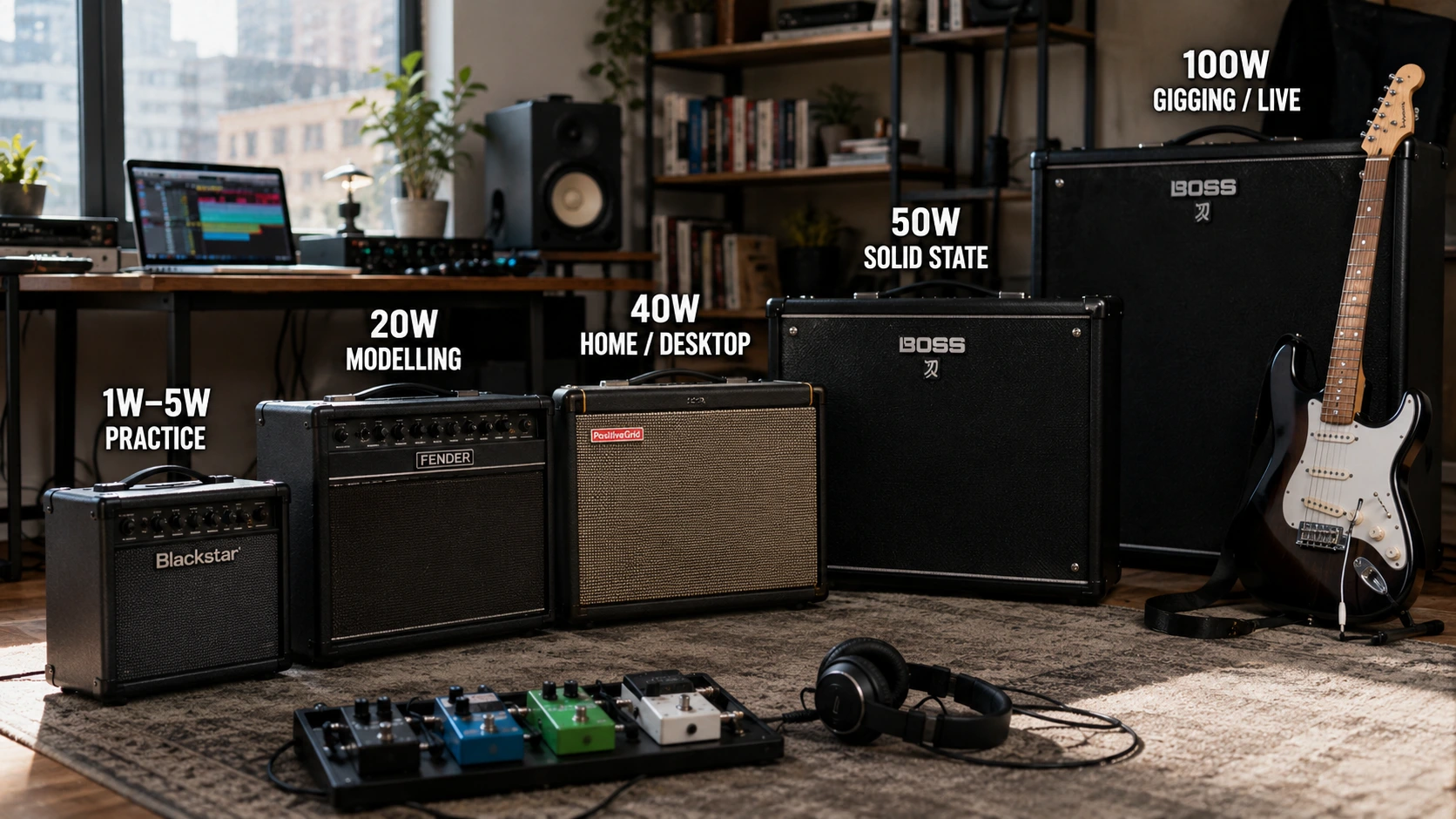
Quick answer: Guitar amp wattage controls headroom — the point at which the amp begins to distort naturally. More watts means more clean headroom before natural breakup. For home practice, 1–25W is generally sufficient. For live performance with drums, 40–100W is typically needed. Wattage does not directly determine tone quality — a 5W amp can sound better than a 100W amp for many home use cases.
This article contains affiliate links. If you purchase through them, we may earn a commission at no extra cost to you. This helps support AmplifierZone and allows us to keep creating in-depth, unbiased audio guides.
What Wattage Actually Controls
Headroom — not volume
The most important concept in understanding guitar amp wattage is headroom. Headroom is the amount of clean signal an amp can produce before the output stage begins to distort naturally. A 100-watt amp has significantly more headroom than a 10-watt amp — it can produce a clean, undistorted signal at much higher volumes before the amplifier circuit clips. This is why high-wattage amps are valued for clean playing and live performance: a 100-watt amp stays clean at volumes that would push a 10-watt amp into heavy distortion.
Conversely, low-wattage amps reach natural power stage distortion at lower volume levels. Specifically, for players who want the natural breakup that comes from pushing a valve output stage — the bloom, compression, and harmonic richness described in detail in the tube vs solid state guide — a lower-wattage amp achieves that character at more domestically practical volumes.
What wattage does not control
Wattage does not determine tone quality. A 5-watt amp is not inherently worse-sounding than a 50-watt amp — it simply has less headroom. In fact, some of the most celebrated guitar tones in recorded history came from small, low-wattage amplifiers. Furthermore, wattage does not determine the number of amp characters, effects, or features an amp provides — those are design decisions entirely separate from output power. A feature-rich modelling amp at 25 watts can outperform a basic 100-watt amp in every metric except maximum clean headroom.

The Non-Linear Relationship Between Watts and Volume
Why doubling watts does not double volume
Human perception of loudness does not follow a linear scale. Specifically, to double the perceived volume of a sound, the power output needs to increase by approximately ten times — a 10dB increase in sound pressure level. Consequently, the relationship between wattage and perceived loudness is logarithmic rather than linear: