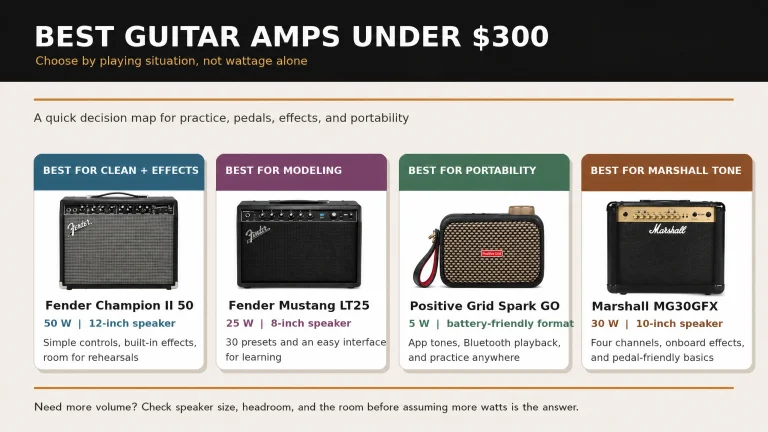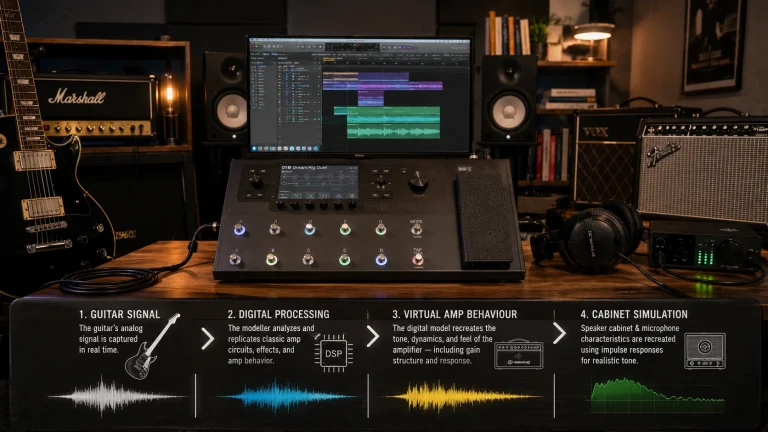
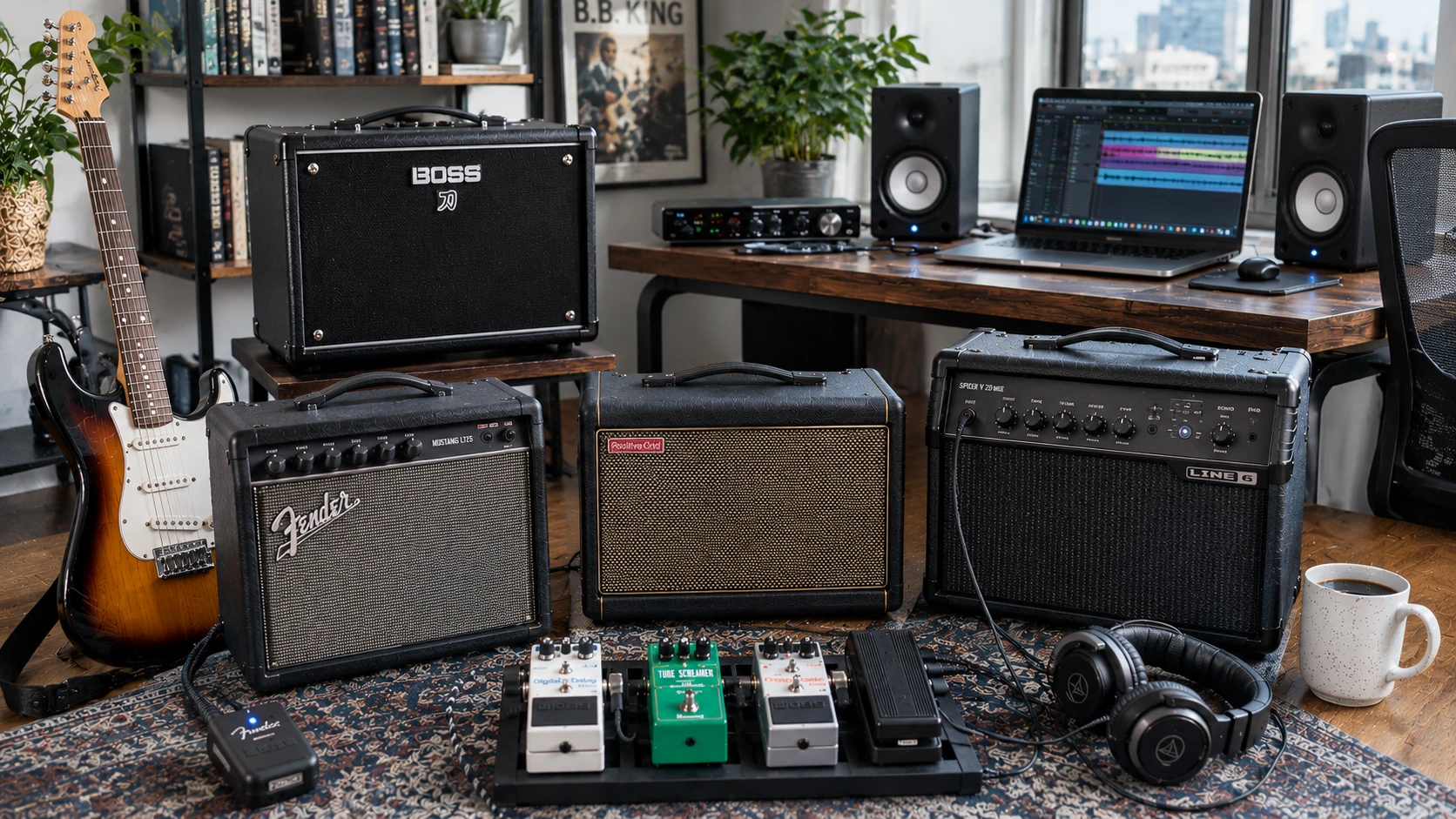
The best guitar amp for recording at home solves a specific problem: how do you capture convincing amp tone directly into a DAW without a microphone, without acoustic room treatment, and without the kind of volume that gets noise complaints at midnight? Every amp in this guide includes USB direct output, emulated line out, or headphone capture with cab simulation — meaning the processed guitar signal goes into the computer cleanly, at any hour, at any volume. For the complete picture of home amp options across all use cases, the best guitar amp for home use roundup covers every category. This guide covers only amps where recording capability is the primary consideration.
Specifically, each pick here targets a different recording scenario — from the most portable headphone-direct solution to a full 50-watt combo that also happens to be an excellent recording interface. The right choice depends on whether you need silence, portability, stereo capture, smart platform features, or physical amp feel alongside recording capability.
Quick Picks
- Best for silent recording: Fender Mustang Micro — plugs into the guitar, 12 amp models direct to headphones, no speaker needed
- Best entry recording combo: Fender Mustang LT25 — 30 amp models, USB direct recording, highest average buyer satisfaction in this group
- Best portable recording amp: Positive Grid Spark Mini — full Spark platform with USB recording in a battery-powered compact format
- Best stereo USB recording: Positive Grid Spark 40 — stereo USB capture at 24-bit, AI Smart Jam, 10,000+ ToneCloud presets, Amazon’s Choice
- Best amp feel + recording: Boss Katana-50 Gen 3 — 12-inch speaker, Tube Logic warmth, USB stereo recording with re-amp channel
This article contains affiliate links. If you purchase through them, we may earn a commission at no extra cost to you. This helps support AmplifierZone and allows us to keep creating in-depth, unbiased audio guides.
Best Guitar Amps for Recording — Comparison
Five picks mapped by recording output type, wattage, and standout feature so you can identify your recording scenario before reading the full reviews.
| Amp | Recording output | Power | Speaker | App | Best For |
|---|---|---|---|---|---|
| Fender Mustang Micro | Headphone / line | None (headphone only) | No speaker | Yes (Fender Tone) | Silent recording |
| Fender Mustang LT25 | USB mono | 25W | 8-inch | No | Entry combo recording |
| Positive Grid Spark Mini | USB | 10W | Stereo drivers | Yes (Spark) | Portable recording |
| Positive Grid Spark 40 | USB stereo 24-bit | 40W stereo | 2× 4-inch | Yes (Spark) | Stereo USB recording |
| Boss Katana-50 Gen 3 | USB stereo + dry re-amp | 50W | 12-inch | Tone Studio (PC) | Amp feel + recording |
Here is what each amp delivers for home recording — and the specific scenarios where each earns or loses its recommendation.
Best Guitar Amps for Recording — Top Picks Reviewed
1. Fender Mustang Micro Headphone Guitar Amplifier
Best for: Completely silent recording — plugs directly into the guitar, delivers 12 amp models with cab simulation to headphones, and outputs a recordable signal without a speaker or a DAW interface
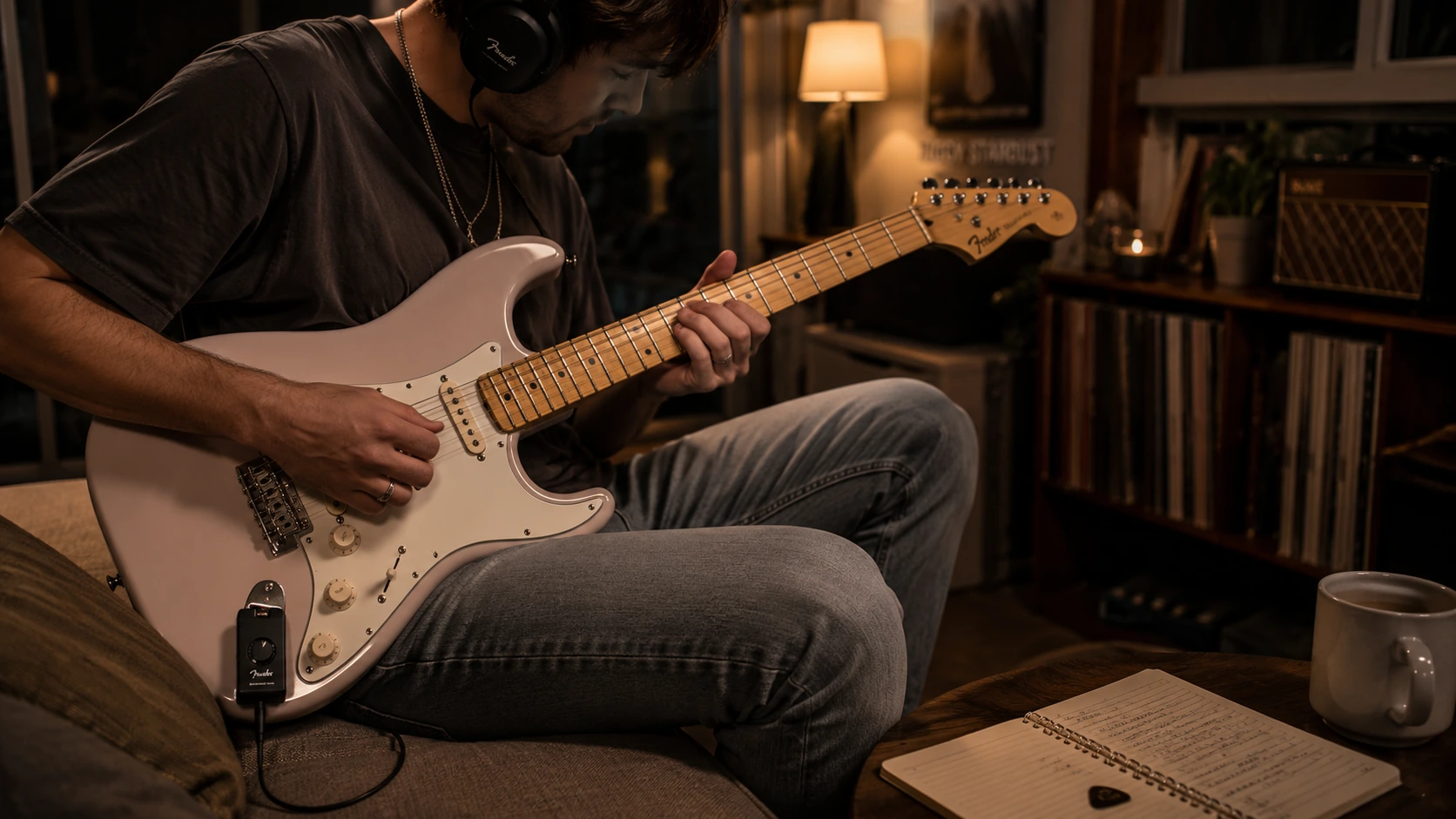
- Type: Headphone amplifier — no speaker
- Recording output: 3.5mm headphone with cab simulation — line out to interface
- Amp models: 12 — clean, crunch, lead, and fuzz
- Effects: 12 built-in effects — reverb, delay, chorus, and more
- Connectivity: Plugs directly into guitar output jack
- Bluetooth: Yes — streams backing tracks from phone to headphone mix
- App: Fender Tone app (iOS/Android) — editing and preset management
- USB: Charging and firmware updates only — not a USB audio interface
- Power: Rechargeable battery — up to 4 hours
The recording setup with no moving parts
The Mustang Micro represents the simplest possible best guitar amp for recording setup: plug it into the guitar’s output jack, connect the 3.5mm headphone output to an audio interface or directly to a laptop’s line input, and the processed signal — amp model plus active effects with cab simulation — is immediately recordable. Consequently, there is no speaker to mic, no room to treat acoustically, and no volume level to manage. Additionally, Bluetooth simultaneously streams a backing track from a phone into the headphone mix, so monitoring while recording requires no additional hardware. The Fender Tone app provides 12 amp models and 12 effects, with deep editing available via smartphone.
The limitation to understand before buying
The Mustang Micro’s 3.5mm headphone output is not a dedicated USB audio interface — it outputs an analogue signal that requires a separate interface to record at professional quality. However, connecting it to a standard audio interface’s line input captures the processed signal cleanly. Additionally, the 4-hour battery life limits extended recording sessions without USB charging access. Consequently, for players who want a single device that is both amp and USB interface, the Mustang LT25 or Katana-50 are the more complete solutions. For players who want absolute portability and silent operation above everything else, the Mustang Micro is the most practical recording solution at the lowest price.
- Plugs directly into guitar — no cables, no power outlet
- 12 amp models with cab simulation — recordable signal immediately available
- Bluetooth audio mixing — backing tracks in headphones while recording
- Fender Tone app — 12 amp models, 12 effects, full preset editing
- Most validated headphone recording solution at this price
- Completely silent — no speaker output at any point
- 3.5mm output only — requires a separate audio interface for best quality
- Not a USB audio interface — no direct DAW connection
- 4-hour battery life per charge
- 12 amp models — narrower selection than combo alternatives
Best silent recording pick — 12 amp models with cab simulation, Bluetooth backing track mixing, plugs directly into the guitar.
2. Fender Mustang LT25 25-Watt Modelling Amplifier
Best for: Players who want a true USB audio interface built into their practice amp — 30 amp models and effects captured directly into any DAW at the lowest price in this group
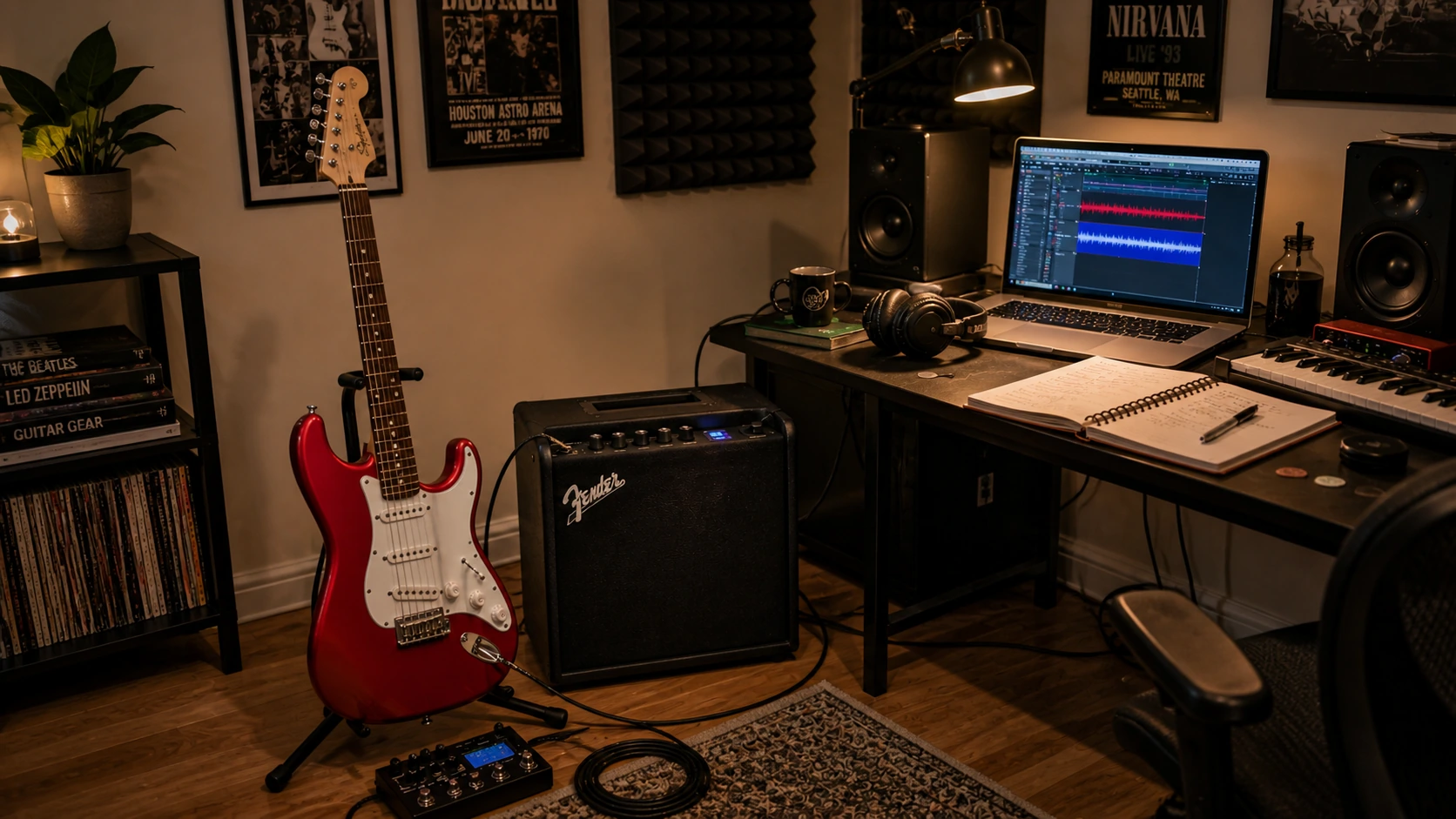
- Recording output: USB — audio interface, direct DAW recording
- Power output: 25W
- Speaker: 8-inch
- Amp models: 30 — clean, crunch, lead, British, acoustic simulation
- Effects: 30 built-in effects — reverb, delay, chorus, tremolo, and more
- Headphone output: Yes — with cabinet simulation
- Aux input: Yes — 3.5mm
- Preset storage: 20 user-programmable presets
- App: No — front panel only
- Warranty: 2 years (Fender)
USB recording without the separate interface
The Mustang LT25 is the best guitar amp for recording at entry price — specifically because USB connection makes it appear as a recognised audio interface in GarageBand, Logic, Reaper, Ableton, and any other DAW on Mac or PC. The full processed tone — amp model, active effects, and signal chain — is captured without a microphone, without room treatment considerations, and at any volume including silent headphone operation. Moreover, thirty amp models cover every foundational guitar tone: Fender clean, Vox-style chime, Marshall crunch, and high-gain lead. Furthermore, no additional interface purchase is required. The highest average buyer satisfaction score in this group confirms that real players find it does exactly what it promises.
Where the ceiling sits
The Mustang LT25 records in mono — the USB output is a single channel, which is correct for a guitar signal but means effects like stereo chorus and ping-pong delay collapse to mono on capture. Furthermore, there is no smartphone app and no re-amp channel — what goes in is what comes out. For players who want stereo USB capture, the Spark 40 provides it. For players who want a re-amp dry channel alongside the processed signal, the Katana-50 Gen 3 delivers both. However, for players whose primary goal is affordable, reliable USB guitar recording without any additional hardware, the Mustang LT25 is the correct starting point.
- USB direct recording — recognised audio interface in any DAW
- Highest average buyer satisfaction in this group
- Amazon Overall Pick — consistent purchasing volume
- 30 amp models and 30 effects — broadest model range at entry price
- Headphone output with cab simulation — silent recording option
- No separate interface needed — lowest total cost for USB recording
- Fender 2-year warranty
- Mono USB output — stereo effects collapse on capture
- No smartphone app — front panel editing only
- No re-amp dry channel
- 8-inch speaker — limited physical amp feel
Best entry recording combo — 30 amp models, USB direct recording, highest-rated in this group. Amazon Overall Pick.
3. Positive Grid Spark Mini Smart Guitar Amp
Best for: Players who need the full Spark recording platform in a battery-powered portable format — USB recording, AI Smart Jam, and ToneCloud presets without a fixed power outlet
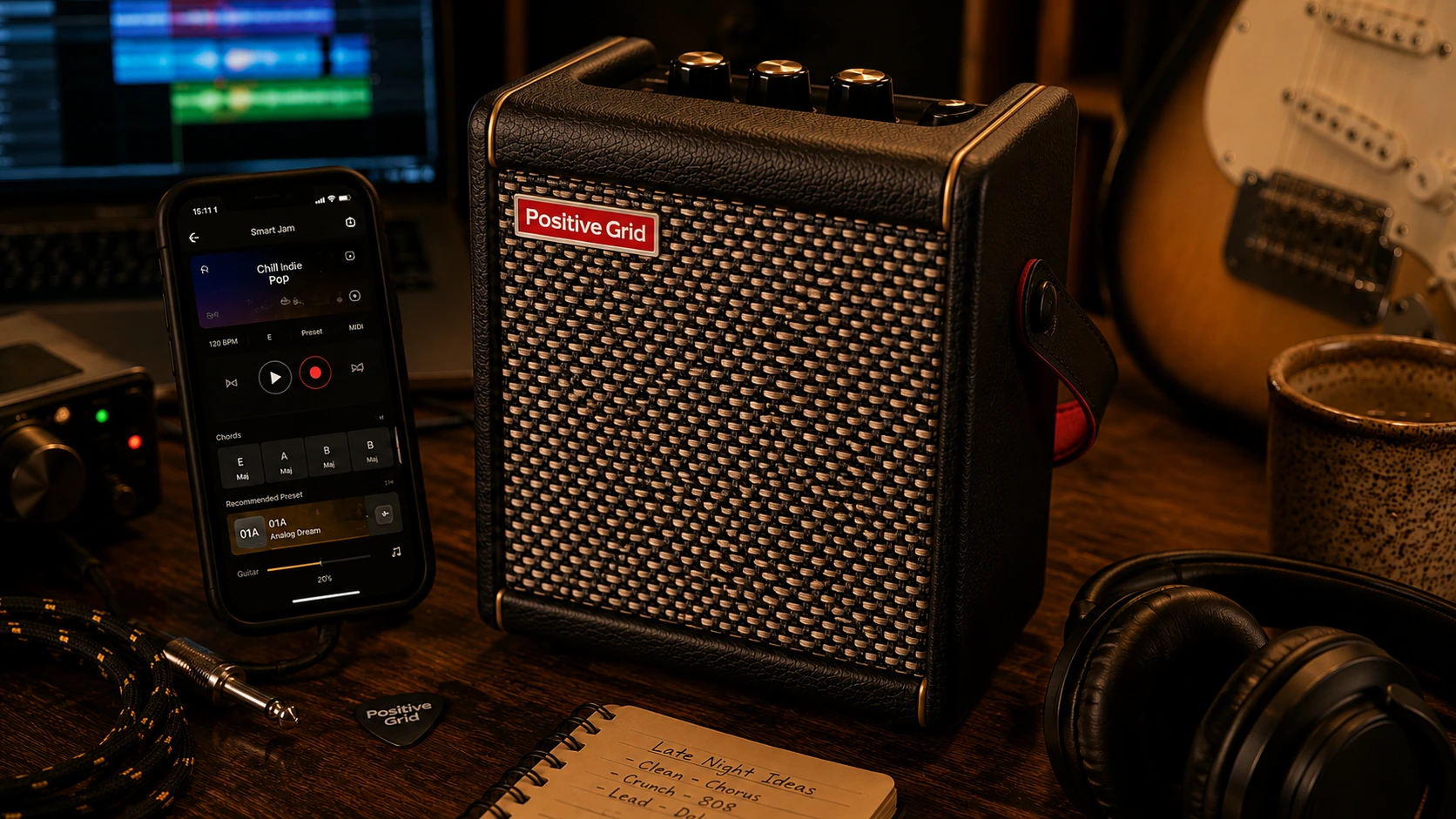
- Recording output: USB — audio interface for DAW recording
- Power output: 10W stereo
- Speakers: Dual full-range drivers (stereo)
- Amp models: 33 — electric, acoustic, and bass
- Effects: 43 effect types
- AI Smart Jam: Real-time backing track generation
- ToneCloud: 10,000+ community presets
- Battery: Built-in rechargeable — up to 5 hours
- Bluetooth: Yes — audio streaming
- Headphone output: Yes
Recording that travels
The Spark Mini’s specific advantage over every other best guitar amp for recording in this group is battery operation. USB recording capability and Smart Jam work whether the amp is plugged into a wall or running on its built-in rechargeable battery — meaning a complete recording setup is available in a hotel room, a tour bus, or anywhere a power outlet is unavailable. Furthermore, 33 amp models cover electric, acoustic-electric, and bass guitar, and 10,000+ ToneCloud community presets provide immediate access to artist and genre tones without any tone-building required. Accordingly, for players who record in multiple locations or want a single amp that handles both travel practice and home studio work, the Spark Mini is the only pick in this group that genuinely covers both.
The trade-off against the Spark 40
The Spark Mini and Spark 40 run the same platform — identical Smart Jam, identical ToneCloud access, and the same recording capability. Specifically, the meaningful differences are the Spark 40’s larger stereo speaker setup and its 40W output versus the Spark Mini’s 10W. Additionally, the Spark 40 specifically provides stereo USB recording where the Spark Mini records in mono. For players who primarily record at a fixed location and want the best audio quality from the Spark platform, the Spark 40 is the better choice. However, for players who need recording capability to travel, the Spark Mini’s battery operation makes it the correct pick.
- Battery powered — USB recording works without a power outlet
- Full Spark platform — Smart Jam, ToneCloud, 33 amp models
- USB recording — direct DAW capture included
- 33 amp models covering electric, acoustic, and bass
- Most portable recording amp in this group
- Headphone output and Bluetooth streaming
- Mono USB recording — stereo effects collapse on capture
- App dependency for Smart Jam and ToneCloud
- Higher price than the Mustang LT25 for similar recording capability
- 5-hour battery life per charge
Best portable recording pick — full Spark platform with USB recording in a battery-powered compact format.
4. Positive Grid Spark 40 Smart Guitar Amp
Best for: Players who want stereo USB recording with the full Spark platform — the only amp in this group that captures chorus, delay, and reverb at their full stereo width into any DAW at 24-bit quality
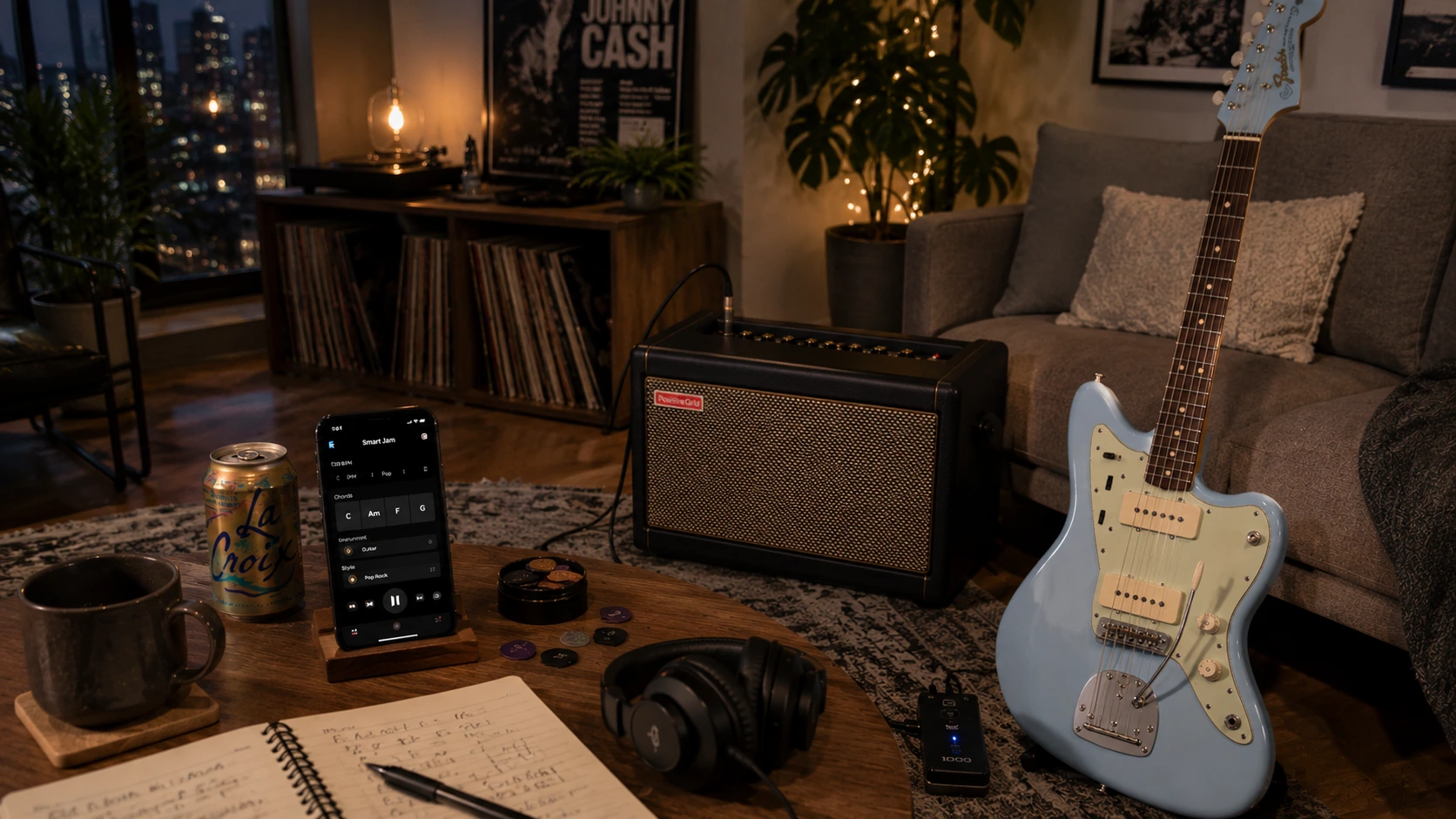
- Recording output: USB stereo 24-bit — full stereo signal to any DAW
- Power output: 40W stereo (2 × 20W)
- Speakers: 2× 4-inch full-range drivers (stereo)
- Amp models: 33 — electric, acoustic, and bass
- Effects: 43 effect types
- AI Smart Jam: Real-time backing track generation from chord input
- ToneCloud: 10,000+ community presets via Spark app
- Bluetooth: Yes — audio streaming from phone
- Headphone output: Yes — 3.5mm stereo
- Guitar types: Electric, acoustic-electric, bass
Why stereo USB recording matters
The Spark 40 is the only best guitar amp for recording in this group that captures guitar in true stereo. This is specifically meaningful for effects-heavy playing — a stereo chorus through the Spark 40 records with genuine left-right spatial separation; a ping-pong delay records with the ping-pong intact; stereo reverb records with its full width. In contrast, every other amp in this group that provides USB recording collapses the stereo field to mono on capture. For players whose recorded guitar parts rely on stereo effects as a core tonal element, the difference is audible and significant. Moreover, the 24-bit capture quality provides clean headroom for post-production processing without introducing noise. Amazon’s Choice status and sustained purchasing volume confirm real buyers find the complete platform — Smart Jam, ToneCloud, and stereo recording together — genuinely useful daily.
Recording and practice as one workflow
The Spark 40’s recording capability integrates naturally with its practice features. Specifically, Smart Jam generates a backing band from a chord progression in real time — recording the guitar part over that accompaniment, then capturing it via USB to a DAW, is a seamless workflow that practice-only amps cannot replicate. Furthermore, ToneCloud presets provide instant access to the exact tone needed for any part, eliminating tone-building time before a recording session. For players who record their own music consistently at home, the Spark 40 is the most workflow-complete recording amp in this group.
- Stereo USB recording at 24-bit — the only stereo capture in this group
- AI Smart Jam — reactive backing tracks for recording over
- 10,000+ ToneCloud presets — instant tone access for any session
- 33 amp models — electric, acoustic, and bass all supported
- 40W stereo — full playback monitoring through quality speakers
- Amazon’s Choice — most validated smart amp at this price
- App dependency — Smart Jam and ToneCloud require the Spark app
- No power attenuation, no effects loop
- 4-inch drivers — less physical amp feel than a 12-inch speaker
- Premium price over the Mustang LT25 for recording only
Best stereo USB recording pick — 24-bit stereo capture, AI Smart Jam, 10,000+ presets. Amazon’s Choice.
5. Boss Katana-50 Gen 3 50-Watt Combo Amplifier
Best for: Players who want genuine amp feel alongside recording capability — the 12-inch speaker, Tube Logic circuit, stereo USB recording, and dedicated re-amp dry channel make it the most complete recording amp in this group
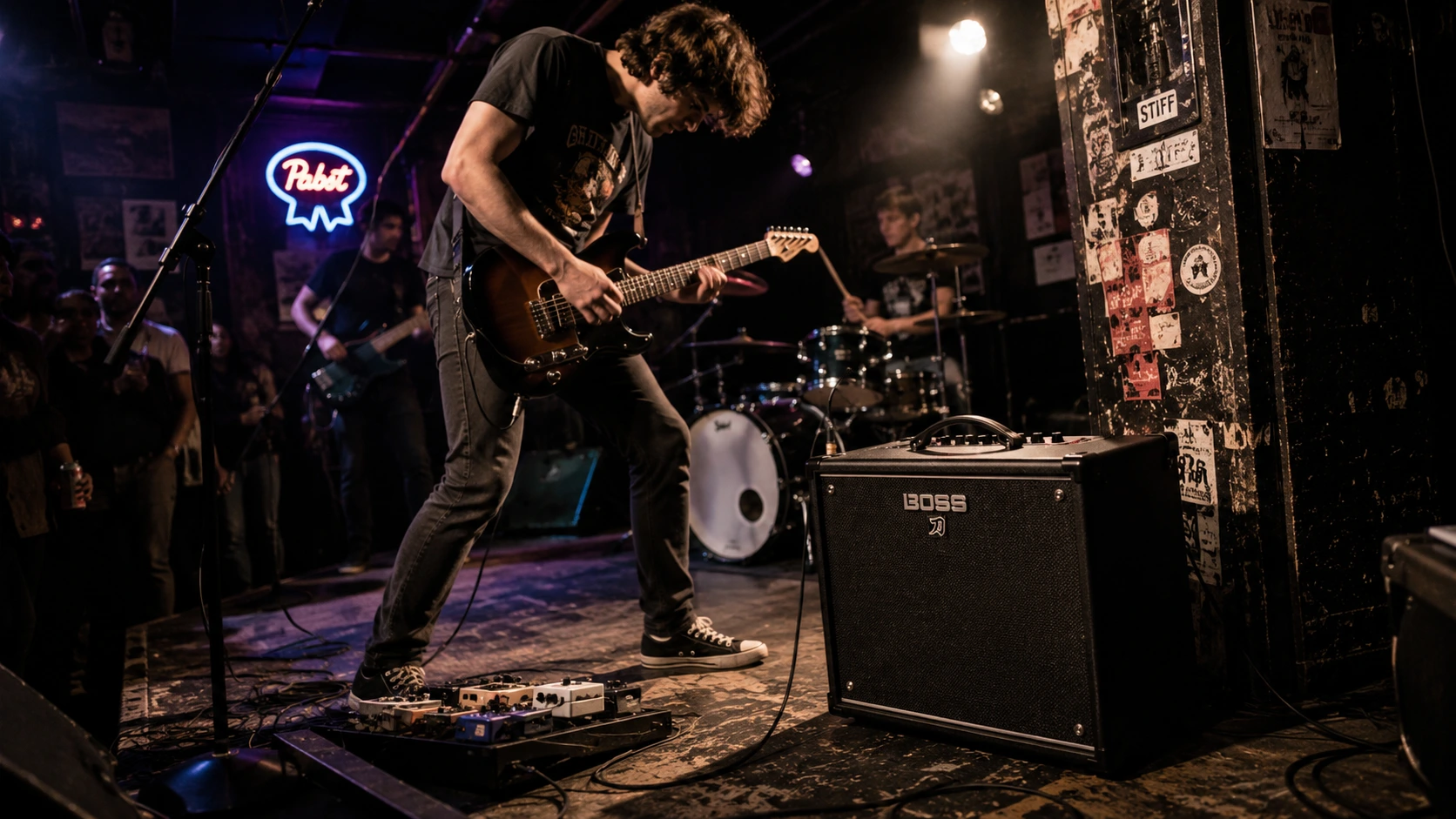
- Recording output: USB stereo — processed signal + dry re-amp channel
- Power output: 50W (selectable: 0.5W / 25W / 50W)
- Speaker: Custom 12-inch Boss
- Amp characters: 12 — Acoustic, Clean, Crunch, Lead, Brown + 7 via Tone Studio
- Effects: Onboard Boss effects — delay, reverb, chorus, modulation, and more
- Power attenuation: 0.5W / 25W / 50W selectable
- Headphone output: Yes — with speaker cabinet simulation
- Effects loop: Send/return for external pedals
- Tone Studio: Deep preset editing via Mac/PC software
The re-amp advantage
The Katana-50 Gen 3 provides a recording capability that no other amp in this group includes: a separate dry guitar channel alongside the processed USB output. Specifically, this means recording the raw, unprocessed guitar signal simultaneously with the amp-processed tone — consequently, if the recorded amp sound needs changing after the session, the dry track can be re-amped through any amp model or processed in the DAW without re-recording the performance. For players who record seriously at home, this re-amp workflow is a significant practical advantage. Furthermore, the stereo USB output captures the full processed signal at high quality, and power attenuation down to 0.5W means the recording setup works at genuine bedroom volumes through the 12-inch speaker — an experience none of the other amps in this group can replicate.
The full picture for recording players
The Katana-50 is specifically the best guitar amp for recording for players who want to hear what they are recording through a proper 12-inch speaker before the signal goes to the computer. Additionally, the Tube Logic circuit adds warmth and dynamic response that the recorded tone captures and carries. Furthermore, the effects loop integrates a professional pedalboard at line level — pedal tones record through USB alongside the Katana’s amp modelling. For the complete modelling context and how the Katana fits across the broader amp range, the best modelling guitar amps guide covers every category. At its price, the Katana-50 is the most capable recording tool in this group and additionally one of the best home practice amps available.
- USB stereo recording + dry re-amp channel — the most complete recording output here
- 12-inch speaker — hear the amp sound before recording it
- Tube Logic circuit — warmth and dynamics captured in the recording
- Power attenuation 0.5W–50W — recording at genuine bedroom volumes
- Effects loop — external pedals record through USB
- 12 amp characters — comprehensive tonal range for sessions
- No smartphone app — Tone Studio requires a computer
- No Smart Jam or AI practice features
- Highest price in this group
- Heavier than the other picks here
Best amp feel + recording pick — stereo USB with re-amp channel, 12-inch speaker, Tube Logic warmth, and power attenuation.
How We Chose the Best Guitar Amps for Recording
What qualifies as a recording amp
Every amp on this list provides a means of capturing the processed guitar signal without a microphone — either via USB audio interface output, emulated line out with cab simulation, or headphone output that can feed an external interface. Amps without any recording output were excluded regardless of their tonal quality. For a broader view of how recording amps fit within the full home amp market, the best modelling guitar amps guide covers the modelling platform landscape in full.
Recording output quality — what actually matters
Not all recording outputs are equal. USB audio interface output — used by the Mustang LT25, Spark Mini, Spark 40, and Katana-50 — provides a clean digital signal that requires no additional hardware. Specifically, the Spark 40’s stereo USB output captures stereo effects at full width, while mono outputs on other amps collapse stereo effects to a single channel. Moreover, the Katana-50’s additional dry re-amp channel provides the most recording flexibility. The Mustang Micro’s 3.5mm output requires a separate interface but provides maximum portability in return. Each output type represents a real trade-off — the right choice depends on recording workflow, not just whether a recording output exists.
What is not here and why
Several amps were considered and excluded. Specifically, the Line 6 Spider V 20 MkII lacks USB recording entirely — its app connectivity is strong, but without a USB output it does not qualify for this roundup. The Blackstar HT-1R MkIII includes a line out with speaker emulation for recording, but its headphone-only silent recording and tube-specific character places it more naturally in the tube amp category. Furthermore, the Boss Katana-100 Gen 3 was considered but its recording capability is identical to the Katana-50 — including the same re-amp channel — at higher cost and greater weight without a practical recording advantage.
Which guitar amp for recording is right for you?
- Maximum silence and portability: Fender Mustang Micro
- USB recording at entry combo price: Fender Mustang LT25
- Recording that works anywhere without power: Positive Grid Spark Mini
- Stereo USB capture with AI practice platform: Positive Grid Spark 40
- Re-amp channel and physical amp feel: Boss Katana-50 Gen 3
Best Guitar Amps for Recording — Final Verdict
Match the output to the workflow
The right best guitar amp for recording is determined by one practical question: what does your recording session actually look like? Specifically, each pick here answers a different version of that question, and choosing the wrong one means paying for recording features that don’t fit the workflow.
For silent and entry recording
Players who need absolute silence and maximum portability should start with the Fender Mustang Micro — it removes every cable and speaker from the equation and delivers 12 amp models with cab simulation to headphones, with the signal immediately routable to an interface for recording. For players who want a proper USB interface built into a combo at the lowest price, the Fender Mustang LT25 is the answer — no additional hardware required, 30 amp models, and the highest buyer satisfaction in this group. Read the full Fender Mustang LT25 review for the complete breakdown of what it does and does not capture.
For platform and stereo recording
Players who need recording capability to travel with them should choose the Positive Grid Spark Mini — the full Spark platform with USB recording in a battery-powered compact format that works anywhere. For players at a fixed home studio location who want stereo USB capture and the Smart Jam practice platform, the Positive Grid Spark 40 is the most workflow-complete recording amp in this group — stereo effects record at full width, AI backing tracks make session practice musically engaging, and ToneCloud presets eliminate tone-building time. Read the full Positive Grid Spark 40 review before deciding between the Spark 40 and the Katana-50.
For players who want to hear what they are recording through a 12-inch speaker before the signal hits the DAW, the Boss Katana-50 Gen 3 is the most complete recording tool in this group — stereo USB, a separate dry re-amp channel, Tube Logic warmth, and power attenuation for bedroom-level recording. It is additionally one of the best home practice amps available at any price, making it the strongest overall investment for players who record and practice from the same setup.
Frequently Asked Questions
Guitar amp recording basics
Can I record guitar directly from an amp without a microphone?
Yes — every amp in this roundup provides a direct recording output that bypasses the microphone entirely. USB audio interface output (Mustang LT25, Spark Mini, Spark 40, Katana-50) presents the amp as a recognised interface in any DAW. The Mustang Micro outputs via 3.5mm with cab simulation to a separate interface. Consequently, direct recording eliminates room acoustics, microphone placement, and volume concerns — the processed signal goes into the computer at any hour without disturbing anyone.
What is re-amping and which amp in this group supports it?
Re-amping means recording a dry, unprocessed guitar signal alongside the processed amp tone, then running that dry signal through an amp again later to apply a different sound without re-recording the performance. Specifically, only the Boss Katana-50 Gen 3 in this group provides a dedicated dry channel alongside its USB stereo output — consequently, it is the only amp here that genuinely supports a re-amp workflow. The other amps capture the processed signal only.
Choosing the right recording output
What is the difference between mono and stereo USB recording?
Mono USB recording captures the guitar signal on a single channel — stereo effects like chorus, ping-pong delay, and stereo reverb collapse to a single mono representation. Stereo USB recording captures left and right channels separately, preserving the full spatial character of stereo effects exactly as heard through the amp’s speakers. Furthermore, the Positive Grid Spark 40 is the only amp in this group with stereo USB output. For players whose recorded tone relies on stereo effects as a core element, the Spark 40 is the appropriate choice.
Do I still need an audio interface if I use a USB recording amp?
No — amps with USB audio interface output (Mustang LT25, Spark Mini, Spark 40, Katana-50) connect directly to a Mac or PC and are recognised as audio interfaces without any additional hardware. The amp itself handles the analogue-to-digital conversion. However, the Fender Mustang Micro is the exception — its 3.5mm headphone output is analogue and does require a separate interface for the best recording quality, though it can connect to a laptop’s line input in a pinch.
More questions about recording amps
Which amp in this group is best for recording acoustic guitar?
The Positive Grid Spark 40 and Spark Mini both support acoustic-electric guitars through dedicated acoustic amp models — the processing applies appropriate EQ and resonance simulation for acoustic reproduction. The Boss Katana-50 Gen 3 also includes an Acoustic character. All three capture the processed acoustic signal via USB. The Fender Mustang LT25 includes acoustic simulation models among its thirty options. The Fender Mustang Micro requires an acoustic-electric guitar with an onboard pickup to function — purely acoustic instruments without a pickup cannot connect.
Can the Boss Katana-50 Gen 3 record silently at night?
Yes — two ways. First, the headphone output with cab simulation allows completely silent monitoring while recording USB output to a DAW. Second, the 0.5W power attenuation setting reduces the 12-inch speaker to genuinely bedroom-quiet volumes while maintaining the full Tube Logic character — meaning the recorded USB signal carries the amp’s real tone at a volume that will not disturb neighbours. Additionally, both methods can be used simultaneously for silent monitoring while recording to the DAW at full quality.