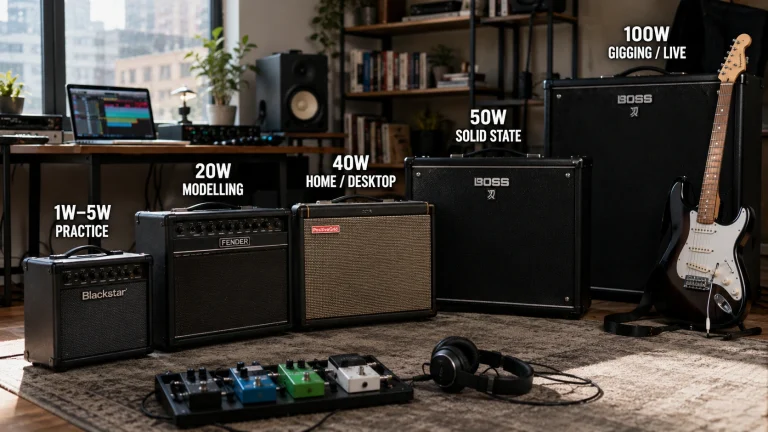
This Line 6 Spider V 20 MkII review covers the most connected practice amp at its price — a 20-watt modelling combo with Bluetooth app control, 16 amp models, 200+ presets, and Wi-Fi firmware updates, all for under $180. It sits in our best modelling guitar amps roundup as the most app-integrated option at the budget end of the modelling market. Where the Fender Mustang LT25 offers USB recording and the Fender Champion II 25 offers front-panel simplicity, the Spider V 20 MkII offers the deepest preset ecosystem of any amp at this price — 200+ factory presets spanning clean through high gain, accessible without buying a single pedal.
The honest framing: the Spider V line has a complicated reputation. Its earlier versions were criticised for digital-sounding tones and excessive gain presets aimed at beginners. The MkII addresses many of those concerns with revised amp models, improved cabinet simulation, and the Spider Remote app that provides deep editing and access to the Customtone preset community. Whether those improvements close the gap to the Fender and Boss alternatives at comparable prices is the question this review addresses directly.
Line 6 Spider V 20 MkII at a Glance
Quick Answer: The Line 6 Spider V 20 MkII is the best app-connected modelling amp under $200. Sixteen amp models, 200+ factory presets, Bluetooth app editing, headphone output, and USB recording in one unit. Its strengths are preset depth and app connectivity. Its weaknesses relative to competitors are tone quality at low gain settings and the learning curve of the Spider Remote app. For players who want maximum preset variety and app control at minimum cost, it delivers. For players who prioritise tone quality over preset breadth, the Fender Mustang LT25 or Boss Katana-50 Gen 3 are stronger choices.
This article contains affiliate links. If you purchase through them, we may earn a commission at no extra cost to you. This helps support AmplifierZone and allows us to keep creating in-depth, unbiased audio guides.
Who Is the Line 6 Spider V 20 MkII For?
The preset explorer
The Spider V 20 MkII is built for the player who wants to explore a wide range of tones immediately — without building a pedalboard, without learning deep amp editing, and without spending more than $180. Two hundred factory presets cover clean jazz through classic rock through metal, all accessible from a selector knob or the Spider Remote app. For a beginner who wants to hear what a Plexi crunch, a Fender clean, or a modern high-gain tone sounds like before developing their own preferences, the Spider V 20 MkII provides more instant sonic variety than any other amp at its price.
The Bluetooth app connection adds genuine practical value. The Spider Remote app on iOS or Android provides a visual interface for editing every parameter of every preset — something the limited front panel controls cannot do. Players who spend time shaping tones on a phone or tablet during practice sessions will find the app integration more useful than the front-panel-only approach of the Fender Champion II 25 or the computer-only approach of the Boss Katana’s Tone Studio.
When to look elsewhere
The Spider V 20 MkII is the wrong choice for players who prioritise tone quality over preset quantity. At comparable prices, the Fender Mustang LT25 produces more convincing clean and crunch tones through its more refined modelling engine. The Boss Katana-50 Gen 3 delivers significantly more realistic amp feel through its Tube Logic circuit. Players who have already developed tone preferences and know what they are looking for will find the Spider’s preset-heavy approach less useful than a smaller selection of better-sounding models. The Line 6 ecosystem rewards exploration; players who want a specific tone and want to dial it in precisely are better served elsewhere.
App requirement note: The Spider Remote app significantly expands the Spider V 20 MkII’s usability — without it, the front panel provides limited control over the 200+ presets and tone editing is restricted to four knobs. For players who are comfortable with smartphone apps during practice, this is a genuine advantage. For players who prefer not to use a phone during practice sessions, the front-panel-only experience is more limited than competing amps at the same price.
Line 6 Spider V 20 MkII — Key Specifications

Line 6 Spider V 20 MkII Guitar Amplifier
- Power output: 20W
- Speaker: 8-inch custom Line 6
- Amp models: 16 — clean through high gain across multiple amp voicings
- Factory presets: 200+
- Effects: Reverb, delay, modulation, pitch, and more — all included
- App control: Spider Remote app (iOS/Android) via Bluetooth
- USB: Yes — audio interface for computer recording
- Headphone output: Yes
- Aux input: Yes
- Customtone: Online preset community access via app
- Type: Digital modelling
Pros and cons
- 200+ factory presets — more instant tonal variety than any competitor at this price
- Spider Remote app — full Bluetooth editing from a smartphone
- 16 amp models — clean through high gain across multiple voicing families
- USB recording — direct DAW capture without a microphone
- Headphone output and aux input — silent practice and backing track use
- Customtone community — thousands of user-created presets downloadable via app
- 404 reviews at 4.6 stars — Amazon’s Choice
- Tone quality — clean and crunch models less refined than Fender Mustang LT25 at similar price
- App dependency — front panel alone is limited for deep editing
- Spider V reputation — earlier generations had tone quality issues that some players still associate with the brand
- Lower review count — 404 reviews versus 4,000+ for the Fender Mustang LT25
- 20W through 8-inch — similar headroom to Fender Mustang LT25 but with less tonal refinement
Most connected modelling amp under $200 — 16 amp models, 200+ presets, Bluetooth app control, and USB recording. Amazon’s Choice.
Design and Build Quality
Utilitarian design
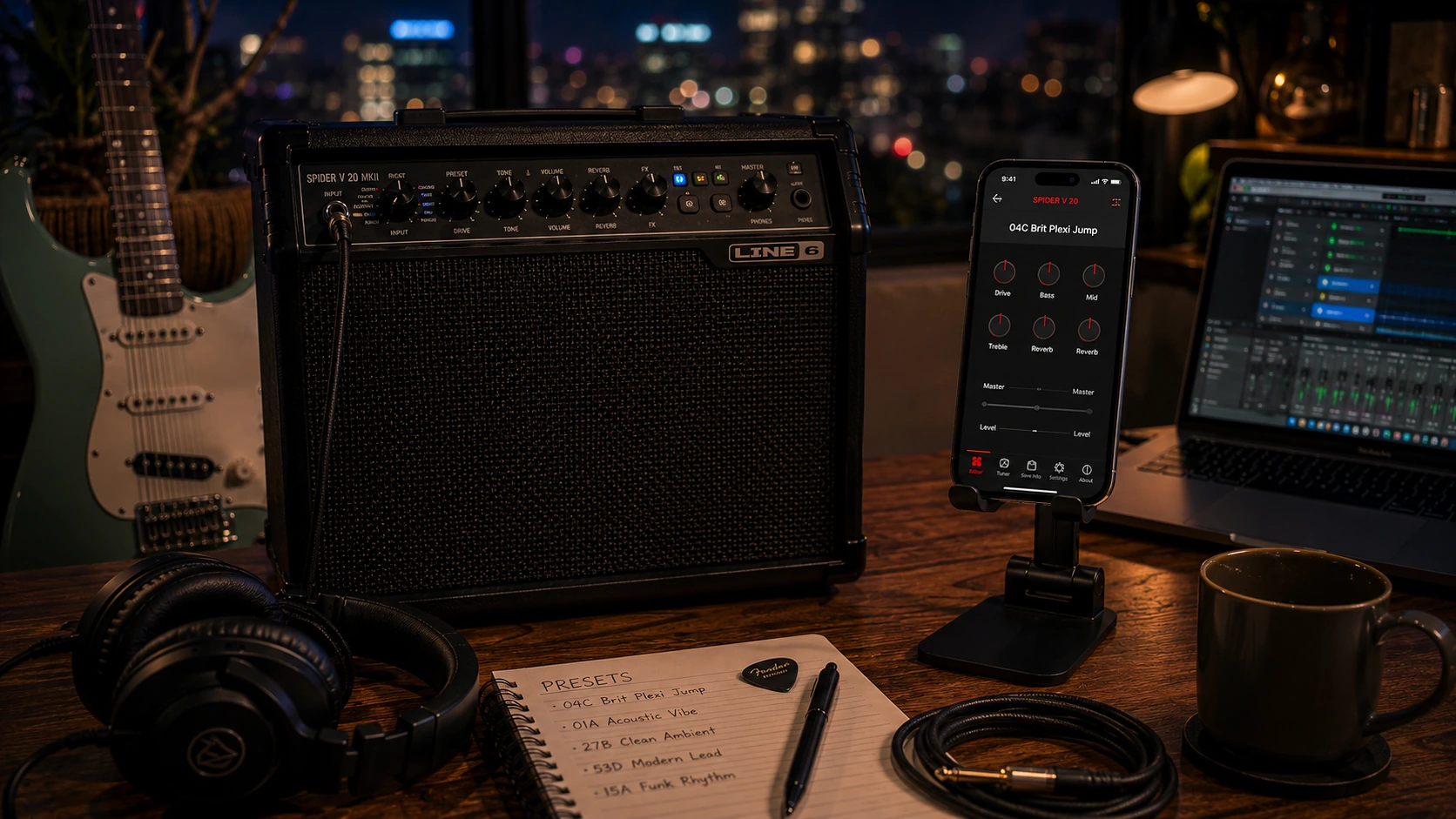
The Spider V 20 MkII uses a straightforward black vinyl cabinet with a black speaker grille — practical rather than distinctive. The front panel carries a channel selector, four tone knobs (Drive, Bass, Mid, Treble), a master volume, an effects knob, and a tap tempo button. Build quality is appropriate for the price: solid enough for daily home practice, lighter in feel than Fender’s practice amp construction. At practice volumes, the 8-inch speaker handles the 20W output cleanly.
The app interface
The Spider Remote app is the Spider V 20 MkII’s most important design element — more so than any physical control. Available free on iOS and Android, it connects via Bluetooth and provides a full graphical interface for every parameter of every preset: amp model selection, gain staging, individual effects parameters, signal chain order, and preset naming. The Customtone section of the app allows downloading user-created presets from Line 6’s online community — thousands of presets recreating specific guitar tones from recorded tracks. For players who enjoy exploring and customising tones, the app transforms what the front panel alone cannot provide.
USB connectivity
The USB port provides both audio interface functionality for computer recording and firmware update capability — Line 6 periodically releases firmware updates that improve the modelling engine and add preset content. This is a practical advantage over competitors that require hardware replacement for improvements: the Spider V 20 MkII can improve over time through software updates without additional cost.
Sound Quality
Where it sounds good
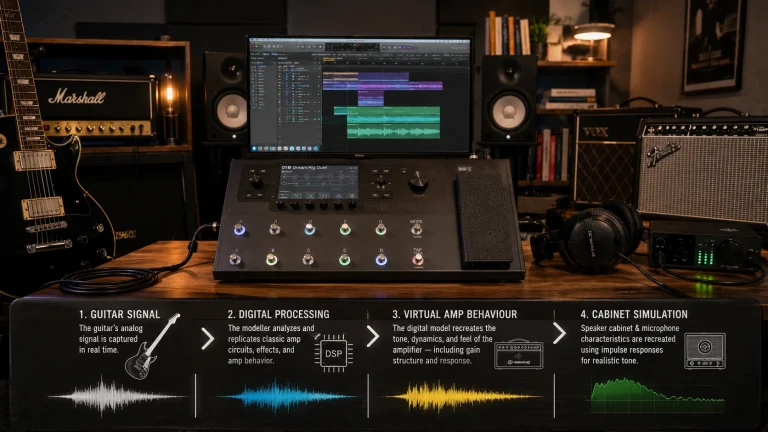
The Spider V 20 MkII’s strongest tonal territory is medium-to-high gain. Rock crunch, classic metal, and modern high-gain presets are convincing and immediately usable — the gain models benefit from Line 6’s long history in modelling high-gain American and British amp voicings. For players who primarily want to practice rock and metal tones, the Spider V 20 MkII delivers those convincingly at bedroom volumes. The 200+ presets include dedicated recreations of classic rock amp combinations that give a player immediate access to recognisable tones. What amp modelling actually does and how different implementations compare is explained in the amp modelling guide.
Where the limitations show
Clean tones are the Spider V 20 MkII’s weakest area relative to its competitors. The Fender Mustang LT25’s clean models are more refined and more convincingly Fender-like. The Boss Katana-50 Gen 3’s Tube Logic clean channel has warmth and dynamics that the Spider’s digital clean models lack. For players who primarily play clean or light crunch — jazz, blues, indie, country — the Spider V 20 MkII’s clean tones are functional but noticeably less polished than alternatives at similar prices. The gain presets excel where the clean models fall short, which defines the amp’s genuine audience.
Effects depth
The Spider V 20 MkII’s effects library is extensive — reverb, delay, chorus, flanger, phaser, tremolo, pitch shifting, wah, and more are all accessible. The Spider Remote app allows stacking and ordering effects in a signal chain, which single-preset amps with one active effect cannot do. For players who want to build complex effects setups at home practice volumes, the Spider’s effects depth is a genuine differentiator from simpler amps like the Fender Champion II 25.
Line 6 Spider V 20 MkII review — honest tone assessment by genre:
- Metal / high gain: Excellent — this is what the Spider does best at any price
- Classic rock: Very good — crunch models are convincing and plentiful
- Blues: Good — medium gain models work well, clean models less convincing
- Indie / pop: Adequate — functional but less characterful than Fender alternatives
- Jazz / clean: Weakest area — clean models lack warmth and definition
- Effects exploration: Excellent — the deepest effects library in this price range
How the Line 6 Spider V 20 MkII Compares
Line 6 Spider V 20 MkII vs Fender Mustang LT25
The most directly comparable modelling amp at this price. Both provide 20–25W through an 8-inch speaker with USB recording and headphone output. A significant validation gap exists: the Mustang LT25 has 4,088 reviews at 4.8 stars versus the Spider’s 404 at 4.6. Furthermore, the Mustang LT25 provides superior clean and crunch tones through Fender’s more refined modelling engine. By contrast, the Spider V 20 MkII provides more preset variety, Bluetooth app editing, and stronger high-gain performance. For players who primarily play clean and light crunch, the Mustang LT25 is the better amp. For players who primarily play rock and metal and want app-connected preset management, the Spider V 20 MkII is the more appropriate tool. The full under-$200 context is in the best guitar amps under $200 roundup.
Line 6 Spider V 20 MkII vs Fender Champion II 25
Different approaches to the same budget. The Fender Champion II 25 offers front-panel simplicity — 12 effects accessible without an app, straightforward two-channel operation, and Fender’s clean tone heritage. The Spider V 20 MkII offers app-connected depth — 200+ presets, 16 amp models, and Bluetooth editing from a phone. For players who want maximum simplicity and Fender’s clean tone without app interaction, the Champion II 25 is the better daily practice amp. For players who want app-connected preset exploration and stronger high-gain performance, the Spider V 20 MkII delivers it at a comparable price.
Line 6 Spider V 20 MkII vs Positive Grid Spark 40
A significant price difference separates these two. The Spark 40 costs considerably more and adds AI Smart Jam backing tracks, 10,000+ community presets, stereo speakers, and handles electric, bass, and acoustic guitar. Both provide app connectivity and modelling depth. For players whose budget extends to the Spark 40, it outperforms the Spider V 20 MkII across every relevant specification. The Spider V 20 MkII’s relevance is specifically for players who want app-connected modelling at the lowest possible price.
Is the Line 6 Spider V 20 MkII Worth It?
For app-connected rock and metal practice — yes
No other amp under $200 provides this combination of Bluetooth app editing, 200+ factory presets, 16 amp models, and USB recording. For players who primarily play rock through high gain and want to explore a wide preset library through a smartphone app, the Spider V 20 MkII provides more in those areas than any competitor at its price. The Customtone community adds ongoing value — new presets are continuously added, and popular song tones are typically available for download shortly after release.
The honest case against
For players who prioritise clean tone quality, the Fender Mustang LT25 at a comparable price is the better amp — full stop. The validation gap (4,088 reviews at 4.8 versus 404 at 4.6) reflects a real difference in real-world satisfaction across a broader range of playing styles. The Spider V 20 MkII is a specialist tool for players in specific genres. Outside those genres, the alternatives serve most players better.
Line 6 Spider V 20 MkII Review — Final Verdict
The connected modelling specialist under $200
The Line 6 Spider V 20 MkII earns its Amazon’s Choice status within a specific use case — app-connected modelling with extensive preset variety at the lowest possible price. Its 200+ factory presets, Bluetooth app editing, 16 amp models, and USB recording are genuine features that no comparable amp provides at this price. High-gain tones are its strongest suit; clean tones are its weakest. Players who know they primarily play rock and metal and want app-connected preset management will find it a capable and cost-effective practice tool. For the complete view of the modelling amp landscape at all prices, the best guitar amp for home use roundup covers every option.
Next in this review series
For the only all-tube amplifier in this cluster — genuine valve tone at 1 watt with CabRig speaker simulation for headphone and direct recording use — the Blackstar HT-1R MkIII review covers the most characterful amp at the top of this price range.
Most connected modelling amp under $200 — 16 amp models, 200+ presets, Bluetooth app control, and USB recording. Amazon’s Choice.
Frequently Asked Questions
Using the Line 6 Spider V 20 MkII
Does the Line 6 Spider V 20 MkII need the app to work?
No — the Spider V 20 MkII works without the app. The front panel provides access to amp models, basic tone controls (Drive, Bass, Mid, Treble), effects, and volume without any app connection. However, the Spider Remote app significantly expands the amp’s usability by providing full parameter editing, access to all 200+ factory presets by name, and connection to the Customtone community. Players who use only the front panel will access a fraction of what the amp provides.
Can the Line 6 Spider V 20 MkII record to a computer?
Yes — USB connection makes it appear as an audio interface in any DAW on Mac or PC. The full processed signal — amp model, effects, and cabinet simulation — is captured without a microphone. No additional drivers are required on most systems. It is compatible with GarageBand, Logic, Reaper, Ableton, and most recording software. The USB connection also enables firmware updates and Customtone preset downloads via the Line 6 Updater software.
Comparing the Spider V 20 MkII
Is the Line 6 Spider V 20 MkII good for beginners?
Yes — with a caveat. The 200+ factory presets and 16 amp models provide immediate tonal variety without any expertise. Beginners who primarily play rock and metal will find the Spider V 20 MkII’s gain presets immediately useful and engaging. The caveat is that the learning curve of the Spider Remote app adds complexity that simpler amps like the Fender Frontman 10G or Fender Champion II 25 avoid. For beginners who are not interested in app-based tone editing, a simpler amp at a lower price is a more appropriate starting point.
How does the Line 6 Spider V 20 MkII compare to the Fender Mustang LT25?
Both are 20–25W modelling amps with USB recording and headphone output at comparable prices. The Mustang LT25 has 4,088 reviews at 4.8 stars and produces superior clean and crunch tones through Fender’s more refined modelling engine. The Spider V 20 MkII has 404 reviews at 4.6 stars but provides more preset variety (200+ versus 30 models), Bluetooth app editing, and stronger high-gain performance. For clean and light crunch playing, the Mustang LT25 is better. For rock, metal, and app-connected preset exploration, the Spider V 20 MkII is the more relevant tool.
More questions about the Line 6 Spider V 20 MkII
What is Customtone on the Line 6 Spider V 20 MkII?
Customtone is Line 6’s online preset community where users share and download amp patches for Spider V amplifiers. It is accessible through the Spider Remote app or the Line 6 website. Thousands of user-created presets are available, many recreating specific guitar tones from famous recordings — a player can search for a particular artist or song and often find a preset that approximates that tone. Customtone presets are downloaded directly to the amp via the app and can be used alongside the factory presets.
What amp models does the Line 6 Spider V 20 MkII include?
Sixteen amp models spanning clean through extreme high gain. Categories include clean American and clean British voicings, crunch models based on classic British and American amp characters, lead models, and several high-gain modern amp voicings. The gain-focused models are the strongest — Line 6’s history in modelling high-gain amplifiers is reflected in the Spider V’s most convincing tones. Clean models are functional but less refined than Fender’s Mustang series at the same price.