
Pro-Ject Debut Carbon EVO Review — Carbon Fiber Tonearm Turntable

Disclosure: This review contains Amazon affiliate links. As an Amazon Associate, we may earn from qualifying purchases—at no extra cost to you.

Both turntables we’ve covered so far in this series — the AT-LP60X and the AT-LP120XBT-USB — include a built-in preamp, so you can plug either directly into a basic speaker setup. The Pro-Ject Debut Carbon EVO doesn’t. That’s not an oversight — it’s a deliberate decision aimed at a different kind of buyer, and this Pro-Ject Debut Carbon EVO review covers exactly what that tradeoff costs you, why the carbon fiber tonearm is the actual reason to pay significantly more, and whether that combination makes sense for where you are in this hobby.
Pro-Ject Debut Carbon EVO turntable with carbon fiber tonearm
Pro-Ject Debut Carbon EVO — a belt-drive turntable built around an 8.6″ one-piece carbon fiber tonearm and pre-mounted Sumiko Rainier cartridge.

Specs at a Glance

Spec Detail
Drive Type Belt-drive, non-suspended
Speeds 33 & 45 RPM electronic switching; 78 RPM via included belt change
Operation Fully manual
Tonearm 8.6″ one-piece carbon fiber, integrated headshell, sapphire bearings
Cartridge Sumiko Rainier moving magnet, pre-mounted, elliptical stylus (5.0mV output)
Platter 1.7kg steel, TPE-damped
Built-In Preamp None — requires external phono preamp or phono-input amp
Wow & Flutter ±0.16% (33 RPM), ±0.14% (45 RPM)

No Built-In Preamp — What That Actually Costs You

This is the single most important fact to know before buying, and it’s worth stating plainly: unlike both other turntables in this cluster, the Debut Carbon EVO has no built-in phono preamp at all. You cannot plug this directly into a pair of basic powered speakers or an AUX input the way you can with the LP60X or LP120XBT-USB. You need either an amplifier or receiver with a dedicated phono input, or a separate external phono preamp between the turntable and whatever you’re amplifying with.
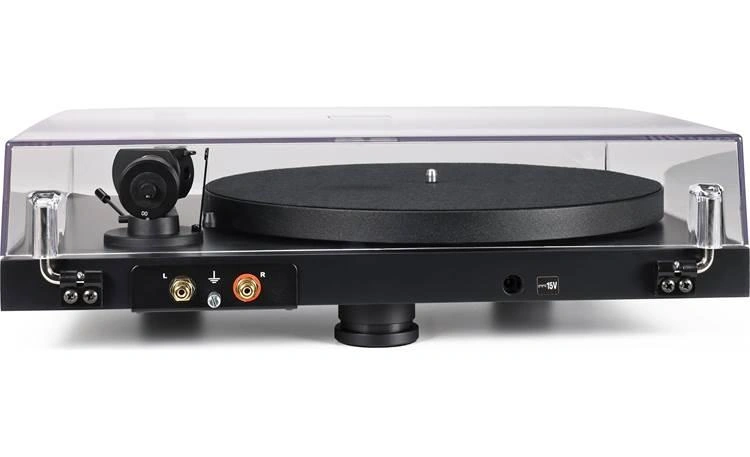
Pro-Ject Debut Carbon EVO RCA outputs no built-in preamp
The rear panel of the Pro-Ject Debut Carbon EVO features removable RCA output cables, a grounding terminal, and a DC power input. There is no built-in phono preamp or PHONO/LINE switch, so the turntable is designed to connect to an external phono stage or a receiver with a dedicated phono input.

That’s a real added cost and a real added step, so budget for it honestly — a decent external phono preamp typically adds $50 to $150 to the total cost of getting this turntable actually playing music, on top of the turntable’s own price. It’s not a flaw so much as a design philosophy: Pro-Ject is betting that anyone paying this much for a tonearm and cartridge already has, or is building, a proper amplification chain, and would rather choose their own preamp than be stuck with one soldered into the turntable. If you’re not sure what a phono preamp actually does or whether your current setup already has one, our what does a preamp do guide covers exactly this decision.

The Carbon Fiber Tonearm — Why It Actually Matters

“Carbon fiber tonearm” shows up on a lot of spec sheets as a bullet point without explanation, so here’s what it’s actually doing: a tonearm’s job is to hold the cartridge steady and let it track the record groove accurately, and that job gets harder the more the tonearm itself flexes or resonates under the tiny forces involved in tracking. Carbon fiber gives you an unusual combination — high rigidity so the arm doesn’t flex, and low mass so it doesn’t add unwanted inertia — that’s difficult to achieve with the aluminum tonearms found on cheaper turntables, including both others in this cluster.

Pro-Ject Debut Carbon EVO carbon fiber tonearm and Sumiko Rainier cartridge
The Pro-Ject Debut Carbon EVO features a one-piece carbon fiber tonearm paired with a pre-installed Sumiko Rainier moving magnet cartridge, combining low resonance with precise tracking for detailed, accurate vinyl playback.

Multiple independent reviewers testing this turntable against similarly priced competitors from Audio-Technica and Fluance have specifically pointed to this tonearm as the standout component at this price tier — not a marketing checkbox, but the actual mechanical reason the cartridge tracks more precisely and the resulting sound has more detail and a more convincing soundstage than cheaper alternatives.

The Sumiko Rainier Cartridge — And Its Upgrade Path

The pre-mounted Sumiko Rainier is a genuinely capable moving magnet cartridge for this price tier, with a frequency range of 15Hz–25kHz and 5.0mV output — sold on its own, it’s priced meaningfully higher than a typical entry-level cartridge, so its inclusion here is a real part of what you’re paying for. The real long-term advantage is what happens when you eventually want to upgrade: Sumiko’s Rainier, Olympia, and Moonstone cartridges share the same body, so moving up the line is a stylus swap, not a full cartridge replacement or a re-alignment project.

That’s a genuinely different ownership experience than either Audio-Technica turntable in this cluster. The LP60X’s cartridge isn’t upgradeable at all, and while the LP120XBT-USB’s is swappable via its detachable headshell, the Sumiko upgrade path here is simpler still — you’re not hunting for a compatible replacement cartridge, just moving up within one manufacturer’s own lineup.

What It Actually Sounds Like

Through a proper phono preamp into a real amplifier, the difference between this and the two Audio-Technica turntables in this cluster is genuinely audible, not marginal. Bass is tighter and better defined, imaging is more precise — instruments occupy distinct positions in the soundstage rather than blurring together — and the overall presentation has a sense of ease and detail retrieval that neither AT turntable quite matches. This is the carbon fiber tonearm and the Sumiko cartridge doing real work, not price-tag placebo.

The tradeoff, beyond the missing preamp, is that this is a fully manual turntable with no speed switching beyond the electronic 33/45 toggle — 78 RPM requires physically swapping the belt, and there’s no auto-return or auto-stop at all. This is a turntable for someone who wants to be hands-on with the listening ritual, not someone looking for the LP60X’s zero-friction convenience.

Pros & Cons

  • Carbon fiber tonearm delivers genuinely superior tracking and resonance control at this price
  • Pre-mounted Sumiko Rainier cartridge is a real value inclusion, not a budget afterthought
  • Simple, same-body cartridge upgrade path via Sumiko’s Rainier/Olympia/Moonstone line
  • Electronic 33/45 speed switching — no belt repositioning needed for standard speeds
  • No built-in preamp — requires an external preamp or phono-input amp, adding real cost
  • Fully manual with no auto-return or auto-stop
  • 78 RPM requires a physical belt swap, not electronic switching

View on Amazon

Final Verdict

The Pro-Ject Debut Carbon EVO is built for a specific buyer, and it’s honest about who that is: someone who already knows vinyl is a lasting hobby, is building or already has a proper amplification chain, and wants a tonearm and cartridge that meaningfully outperform entry-level gear. If that’s not where you are yet, the missing preamp and the added cost and complexity it introduces make this a harder sell than either Audio-Technica turntable in this cluster. If it is where you are, the carbon fiber tonearm alone justifies stepping up.

Still building the rest of your vinyl setup? Our vinyl setup for beginners guide covers everything beyond the turntable itself.

Frequently Asked Questions

Does the Pro-Ject Debut Carbon EVO have a built-in phono preamp?
No. Unlike many entry-level turntables, it has no built-in preamp at all. You need an amplifier or receiver with a dedicated phono input, or a separate external phono preamp, to use it.
Can I upgrade the cartridge on the Debut Carbon EVO?
Yes. The pre-mounted Sumiko Rainier shares its body with Sumiko’s higher-tier Olympia and Moonstone cartridges, so upgrading is a stylus swap rather than a full cartridge replacement or re-alignment.
Why does the carbon fiber tonearm matter?
Carbon fiber combines high rigidity with low mass, which lets the tonearm track the record groove more precisely with less flex and resonance than the aluminum tonearms found on cheaper turntables — this directly improves detail retrieval and soundstage accuracy.
Is the Debut Carbon EVO fully manual?
Yes. It has electronic switching between 33 and 45 RPM, but no auto-return or auto-stop, and 78 RPM playback requires physically swapping the included drive belt.
Amazon Disclosure: As an Amazon Associate, we earn from qualifying purchases. Product pricing and availability are accurate at the time of publication and may change.