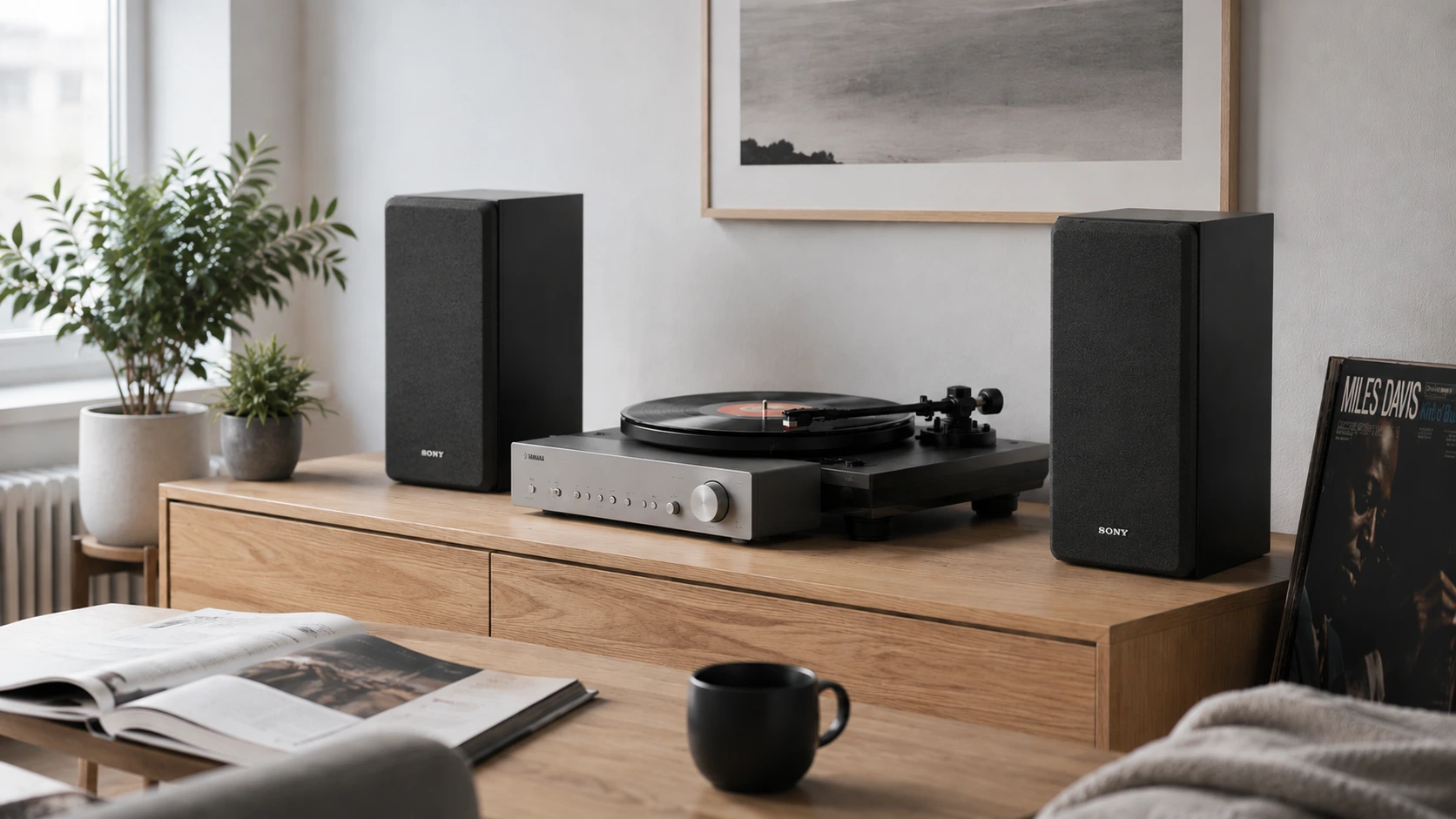
Specifically, most bookshelf speakers at the entry passive price point use a 2-way driver configuration — a woofer and a tweeter, dividing the frequency range between two drivers. The Sony SSCS5 uses three. Specifically, a dedicated super tweeter extends high-frequency response to 50kHz alongside the standard woofer and tweeter combination — a design choice that is unusual at this price and that makes the SSCS5 compatible with Hi-Res audio formats that encode content above the 20kHz threshold of human hearing. Combined with the broadest power handling range on the best bookshelf speakers for home audio list (10–145W) and Amazon’s Choice status, the SSCS5 is the most versatile entry passive bookshelf speaker available at this price. This review covers what that 3-way design actually delivers in listening, how the SSCS5 pairs with different amplifiers, and where its limitations become relevant.
Quick Answer: The Sony SSCS5 is the correct entry passive bookshelf speaker for any listener pairing with a budget to mid-range integrated amplifier. Its 3-way driver configuration, 10–145W power handling, and Amazon’s Choice validation make it the safest first passive speaker purchase at this price. The primary limitation is the plastic enclosure and 87dB sensitivity at 6Ω, which requires adequate amplifier current to reach full dynamic range in larger rooms.
This article contains affiliate links. If you purchase through them, we may earn a commission at no extra cost to you. This helps support AmplifierZone and allows us to keep creating in-depth, unbiased audio guides.
Who Is the Sony SSCS5 For?
Specifically, the SSCS5 is built for first-time passive speaker buyers who want a proven, validated entry point that works correctly with a wide range of amplifiers without requiring careful matching. Its 10–145W power handling makes it compatible with almost any integrated amplifier — from budget class-D units at 30–40W to mid-range integrated amplifiers at 80–100W — without the risk of underpowering or overpowering the speaker. Consequently, listeners who already own an amplifier and are unsure whether it will drive a given speaker correctly can pair it with the SSCS5 with confidence.
Furthermore, the SSCS5 suits listeners who want Hi-Res audio compatibility without paying a premium for it. The dedicated super tweeter extending response to 50kHz is unusual at this price point — most bookshelf speakers at entry passive prices roll off at 20–25kHz. For listeners who stream or play Hi-Res audio files (24-bit/96kHz or higher) and want a speaker that resolves the full encoded frequency range, the SSCS5 provides that capability at entry cost.
The SSCS5 is less suited to listeners who prioritise enclosure quality and bass definition above extended high-frequency response. Its plastic enclosure has higher internal resonance than the wooden cabinets of the ELAC B6.2 or Polk ES20, and bass definition at the lower end of its range is softer than the ELAC’s larger woofer delivers. For those priorities at a higher budget, the ELAC Debut 2.0 B6.2 is the correct step up.
Amplifier pairing at a glance: The SSCS5 at 87dB/6Ω works correctly with any integrated amplifier delivering 30W or more per channel into 6Ω. Budget class-D amplifiers (Fosi Audio BT20A, SMSL AD18) drive it adequately in small rooms. Mid-range integrated amplifiers (Yamaha A-S501, Denon PMA-600NE) reveal its full capability in medium rooms. Avoid amplifiers specified at 4Ω only — verify the 6Ω or 8Ω power rating before pairing.
Sony SSCS5 — Key Specifications
Sony SSCS5 3-Way 3-Driver Bookshelf Speaker System
- Type: Passive — requires external amplifier
- Driver configuration: 3-way — 5.12″ woofer, 0.98″ soft dome tweeter, 13/16″ super tweeter
- Sensitivity: 87 dB (1W/1m)
- Impedance: 6Ω nominal
- Power handling: 10–145W
- Frequency response: 53Hz–50kHz
- Enclosure: Bass reflex — rear port
- Enclosure material: Plastic
- Binding posts: Single pair — no bi-wire
- 3-way 3-driver configuration — dedicated super tweeter for 50kHz high-frequency response
- Amazon’s Choice — highest purchase validation at entry passive price
- 10–145W power handling — compatible with virtually any integrated amplifier
- Hi-Res audio compatible — 50kHz response covers full Hi-Res encoded range
- Rear bass reflex port — controlled low-frequency extension to 53Hz
- Plastic enclosure — higher internal resonance than wooden cabinet alternatives
- 87dB sensitivity at 6Ω — requires adequate current delivery from the amplifier
- Bass rolls off below 53Hz — subwoofer needed for deep bass listening
- Single binding post — no bi-wiring option
- Soft dome tweeter — less detailed upper-frequency resolution than dome tweeter alternatives at higher prices
Best entry passive pick — 3-way 3-driver, Amazon’s Choice, 10–145W power handling. Broadest amplifier compatibility at entry passive price.
Design and Build Quality
Overall, the SSCS5 uses a plastic enclosure in a rectangular cabinet design — functional, inoffensive, and less visually distinctive than wooden-cabinet alternatives at higher prices. Specifically, the plastic material introduces more internal cabinet resonance than the MDF or wooden enclosures used by the ELAC B6.2 and Polk ES20, which means the cabinet itself contributes slightly more colouration to the midrange than denser alternatives. In practice this manifests as a very slight boxiness on male vocals and piano — audible on careful comparison, not intrusive in normal listening.
The driver complement is the SSCS5’s primary physical differentiator. Specifically, three drivers are mounted on the front baffle: the 5.12″ woofer handling bass and lower midrange, the 0.98″ soft dome tweeter handling the midrange and lower treble, and the 13/16″ super tweeter handling the upper treble and ultra-high-frequency range. All three are housed behind a magnetic grille that attaches without pegs — the grille simply holds magnetically and can be removed cleanly. Additionally, the rear bass reflex port is positioned to allow wall clearance of at least 8–10 inches for the bass tuning to develop correctly.
The 3-Way Driver — What It Actually Delivers
Specifically, a 3-way speaker divides the audio spectrum between three drivers rather than two, which allows each driver to operate in a narrower frequency range and consequently within its optimal performance window. Specifically, the woofer handles only bass and lower midrange — it does not need to reproduce upper-midrange and treble frequencies where a large driver introduces beaming and coloration. The soft dome tweeter handles the midrange and lower treble where vocal clarity and instrument definition sit. Additionally, the super tweeter extends coverage to 50kHz.
In practice, the primary benefit of the 3-way configuration at this price is improved upper-frequency extension rather than a dramatic improvement in midrange clarity over a well-designed 2-way. Specifically, for standard 16-bit/44.1kHz CD-quality audio, the super tweeter adds nothing audible — all the content is below 22kHz. For Hi-Res audio encoded at 24-bit/96kHz or higher, the super tweeter covers the encoded range above 22kHz. Whether ultrasonic content above 20kHz is audibly meaningful is debated in audio engineering — however, the SSCS5’s 50kHz extension means the speaker is technically compliant with every Hi-Res audio certification standard currently in use.
Furthermore, the 3-way crossover design means the tweeter is relieved of lower-frequency duties, which typically results in a tweeter that runs cooler and with less distortion than in a 2-way design at equivalent listening levels. Consequently, the SSCS5 maintains clean high-frequency reproduction at higher volumes better than 2-way designs where the tweeter handles a wider frequency range.
Sound Quality
Overall, the SSCS5 sounds open, airy, and forward in the upper midrange and treble — the 3-way configuration and dedicated super tweeter contribute a sense of high-frequency extension and air around instruments that is uncommon at this price. Vocals are present and clear, and acoustic instruments — guitar, piano, strings — have a bright, detailed character that makes the SSCS5 immediately engaging on first listen.
High-frequency character
However, the brightness that makes the SSCS5 engaging on acoustic and vocal recordings can tip into hardness on recordings that are already bright or forward in the upper midrange. Specifically, guitar distortion, brass, and closely-miked vocals through the SSCS5 can feel slightly aggressive in a small reflective room. Consequently, the SSCS5 benefits from placement in a room with soft furnishings, or from pairing with a slightly warmer-sounding integrated amplifier (Denon, Marantz) rather than a bright or analytical one.
Bass performance
The 5.12″ woofer and rear bass reflex port produce controlled bass down to 53Hz — adequate for acoustic music, jazz, and most rock but insufficient for bass-heavy electronic music without a subwoofer. Overall, bass character is lean and defined rather than warm and full — the plastic enclosure contributes to this character by allowing more internal vibration than a wooden cabinet would. For listeners who want the SSCS5 specifically for its high-frequency extension but miss the bass weight, a compact subwoofer addresses this limitation directly.
Stereo imaging
Specifically, stereo imaging is wide and well-defined for a speaker at this price — the 3-way configuration contributes to a clean separation of high-frequency and mid-frequency content that helps the listener locate instruments in the stereo field accurately. Consequently, the SSCS5 performs particularly well on well-recorded jazz, classical, and acoustic music where instrument placement in the stereo field is an important part of the recording’s character.
Amplifier Pairing
The SSCS5’s 10–145W power handling range is its most practically useful specification for amplifier pairing. Specifically, the lower limit of 10W means even very low-powered amplifiers will drive it to audible levels — and the upper limit of 145W means mid-range integrated amplifiers have significant headroom before approaching damage territory. For guidance on matching amplifier power to speaker sensitivity and impedance, the amplifier to speaker matching guide covers the calculation in detail.
However, the 87dB sensitivity at 6Ω means the SSCS5 requires more current from the amplifier than a 90dB/8Ω speaker to reach the same listening level. Specifically, in a small room (up to 15 square metres), 30–40W per channel is adequate. In a medium room (15–25 square metres), 50–80W delivers the full dynamic range the speaker is capable of. Furthermore, the 6Ω impedance means the amplifier should be specified at 6Ω or have a stable output at 6Ω — amplifiers specified only at 8Ω will deliver less power into the SSCS5’s 6Ω load than their rated output suggests. For specific amplifier recommendations at each budget level, the best amplifiers for bookshelf speakers guide covers compatible picks.
Connectivity and Setup
Setup is standard for a passive bookshelf speaker — connect speaker cables from the amplifier’s speaker binding posts to the SSCS5’s single binding post pair per speaker, observing polarity (red positive, black negative). The rear bass reflex port requires the speakers to be positioned with at least 8–10 inches of clearance from the back wall for the bass tuning to develop correctly. Placing the SSCS5 flush against a wall compresses the bass reflex output and produces a boomy, poorly defined low-frequency character rather than the controlled extension the port is designed to produce.
Additionally, the SSCS5 benefits from slight toe-in toward the listening position — angling each speaker inward by approximately 15–20 degrees tightens the stereo image and brings the upper-midrange detail into better focus. At desk distance, toe-in of 10–15 degrees is adequate. For placement guidance covering stand height, toe-in angles, and wall clearance recommendations, the beginner amplifier guide covers the full system setup process including speaker positioning.
How the Sony SSCS5 Compares
Sony SSCS5 vs ELAC Debut 2.0 B6.2
The ELAC B6.2 is the natural step up from the SSCS5. Specifically, it replaces the SSCS5’s plastic cabinet with a driver-matched bass reflex enclosure, its 5.12″ woofer with a 6.5″ aramid fiber design extending bass to 44Hz, and its 2-way crossover (plus super tweeter) with Andrew Jones’ acclaimed 2-way design. The trade-off is a higher price and a narrower power handling range (30–120W vs 10–145W) that requires more careful amplifier matching. For listeners who want the best passive bookshelf speaker performance available in this roundup and can match it to a 50W+ amplifier, the ELAC is the correct upgrade. Listeners who want maximum amplifier flexibility at the entry passive price will find the SSCS5 the correct choice.
Sony SSCS5 vs Edifier R1280T
The Edifier R1280T is an active speaker requiring no amplifier — total system cost is lower but no amplifier upgrade path exists. The SSCS5 is passive and requires a separate amplifier, increasing initial cost but allowing performance improvement through amplifier upgrades over time. For listeners who want to build a system that improves with investment, the SSCS5 is the correct foundation. Listeners who want a complete desktop solution at the lowest cost will find the Edifier the simpler answer.
Sony SSCS5 vs Klipsch R-51M
The Klipsch R-51M uses a horn-loaded tweeter that delivers higher sensitivity (93dB) and a more forward, energetic sound character than the SSCS5. Specifically, the R-51M requires less amplifier power to reach listening levels and excels with rock and jazz where its forward presentation is an advantage. The SSCS5 counters with the 3-way configuration, Hi-Res compatibility, and broader amplifier compatibility. Neither is objectively better — the decision comes down to preferred sonic character and amplifier efficiency requirements.
Is the Sony SSCS5 Worth It?
Overall, the SSCS5 is worth buying as the entry passive bookshelf speaker for any listener pairing with an integrated amplifier. Its 3-way driver configuration, 10–145W power handling, Amazon’s Choice validation, and Hi-Res audio compatibility represent genuine value that most 2-way alternatives at this price cannot match. For first-time passive speaker buyers who want a proven, safe first purchase, the SSCS5 is the correct starting point.
However, it is not worth buying if bass weight and enclosure quality are the primary priorities — the plastic cabinet and 5.12″ woofer are real limitations that the ELAC B6.2 addresses with a wooden enclosure and larger driver at a higher price. Listeners willing to spend more for those improvements will find the ELAC the better long-term purchase. For listeners who want the broadest entry passive option at the lowest price with the widest amplifier compatibility, the SSCS5 delivers that combination clearly.
Wall clearance matters. The rear bass reflex port requires at least 8–10 inches of clearance from the back wall. Placing the SSCS5 close to a wall or in a shelf with limited rear clearance produces boomy, poorly defined bass. If shelf placement with limited rear clearance is unavoidable, consider a sealed-enclosure speaker instead — sealed designs are less sensitive to rear-wall proximity than bass reflex alternatives.
Final Verdict
Indeed, the Sony SSCS5 earns its Amazon’s Choice status through a combination of specifications that are unusual at entry passive prices — 3-way driver configuration, 50kHz high-frequency extension, and 10–145W power handling that accommodates virtually any integrated amplifier a buyer is likely to own or purchase. It is the most versatile entry passive bookshelf speaker available at this price, and the consistent purchasing volume confirms that real-world buyers find it delivers on that promise.
However, the plastic enclosure and softer bass definition are real trade-offs that the SSCS5’s price reflects honestly — they are not unexpected limitations but the correct compromises for a speaker at this price delivering a 3-way configuration and Hi-Res certification. For the listener who wants the broadest, safest first passive speaker purchase at entry price, the SSCS5 is the answer. Listeners ready to commit to a higher budget for better bass and enclosure quality will find the ELAC Debut 2.0 B6.2 the correct next step.
Best entry passive pick — 3-way 3-driver, Amazon’s Choice, 10–145W power handling. Broadest amplifier compatibility at entry passive price.
Frequently Asked Questions
What amplifier works best with the Sony SSCS5?
Any integrated amplifier delivering 30W or more per channel into 6Ω will drive the SSCS5 correctly in a small to medium room. Budget class-D amplifiers (30–40W) work adequately at desk distance and in small rooms. Mid-range integrated amplifiers (50–80W) reveal the full dynamic range of the speaker in medium-sized listening rooms. Avoid amplifiers specified only at 8Ω — verify the 6Ω power output before pairing, as some amplifiers deliver significantly less than rated power into 6Ω loads.
Does the Sony SSCS5 need a subwoofer?
For acoustic music, jazz, rock, and most genres — no. The SSCS5’s bass reflex extension to 53Hz covers the vast majority of musical content adequately. For bass-heavy electronic music, hip-hop, and film soundtracks where bass extension below 50Hz is part of the intended experience, a subwoofer significantly improves the low-frequency presentation. The SSCS5’s listening character is lean and open rather than bass-heavy, which suits acoustic and vocal music well but may feel thin for bass-critical listening without a subwoofer.
What is the super tweeter on the Sony SSCS5 and why does it matter?
The super tweeter is a third driver dedicated to reproducing frequencies above approximately 20kHz — the upper limit of human hearing. Its practical purpose is Hi-Res audio compatibility: audio formats encoded at 24-bit/96kHz or higher contain content above 20kHz, and the super tweeter ensures the SSCS5 reproduces the full encoded range. Whether ultrasonic content above 20kHz is audibly meaningful is debated, but the super tweeter gives the SSCS5 Sony’s Hi-Res Audio certification and the technical capability to reproduce any audio format at its encoded bandwidth.
How much clearance does the Sony SSCS5 need from the back wall?
At least 8–10 inches (20–25cm) of clearance from the rear port to the back wall. The rear bass reflex port needs space for the port output to develop correctly — placing the speaker close to a wall compresses the bass reflex output and produces boomy, poorly defined low-frequency character. If shelf placement with limited rear clearance is unavoidable, plug the port with foam to convert to approximate sealed-enclosure behaviour, which reduces bass output but improves bass definition in confined placements.
Is the Sony SSCS5 good for a home theater setup?
Yes — the SSCS5 connects to AV receivers as well as stereo integrated amplifiers. For a 2.0 or 2.1 home theater configuration, the SSCS5’s wide power handling range and high-frequency extension make it suitable as front left and right speakers. Its lean bass character benefits from a subwoofer in home theater use where film soundtracks rely on low-frequency content. The Sony SSCS5 and SSCSE center channel are designed as a matched system for those building a full Sony speaker array.