Guitar amp wattage is one of the most consistently misunderstood specifications in music gear — and the confusion causes real purchasing mistakes. Indeed, more watts does not mean better tone. A 100-watt amp is not ten times louder than a 10-watt amp. A 1-watt tube amp can be uncomfortably loud in a bedroom. And the wattage that matters for home practice is often completely different from the wattage that matters for live performance. This guide explains what guitar amp wattage actually controls, why the relationship between watts and perceived volume is not linear, and how to match output power to your actual playing situation.
Quick answer: Guitar amp wattage controls headroom — the point at which the amp begins to distort naturally. More watts means more clean headroom before natural breakup. For home practice, 1–25W is generally sufficient. For live performance with drums, 40–100W is typically needed. Wattage does not directly determine tone quality — a 5W amp can sound better than a 100W amp for many home use cases.
This article contains affiliate links. If you purchase through them, we may earn a commission at no extra cost to you. This helps support AmplifierZone and allows us to keep creating in-depth, unbiased audio guides.
What Wattage Actually Controls
Headroom — not volume
The most important concept in understanding guitar amp wattage is headroom. Headroom is the amount of clean signal an amp can produce before the output stage begins to distort naturally. A 100-watt amp has significantly more headroom than a 10-watt amp — it can produce a clean, undistorted signal at much higher volumes before the amplifier circuit clips. This is why high-wattage amps are valued for clean playing and live performance: a 100-watt amp stays clean at volumes that would push a 10-watt amp into heavy distortion.
Conversely, low-wattage amps reach natural power stage distortion at lower volume levels. Specifically, for players who want the natural breakup that comes from pushing a valve output stage — the bloom, compression, and harmonic richness described in detail in the tube vs solid state guide — a lower-wattage amp achieves that character at more domestically practical volumes.
What wattage does not control
Wattage does not determine tone quality. A 5-watt amp is not inherently worse-sounding than a 50-watt amp — it simply has less headroom. In fact, some of the most celebrated guitar tones in recorded history came from small, low-wattage amplifiers. Furthermore, wattage does not determine the number of amp characters, effects, or features an amp provides — those are design decisions entirely separate from output power. A feature-rich modelling amp at 25 watts can outperform a basic 100-watt amp in every metric except maximum clean headroom.

The Non-Linear Relationship Between Watts and Volume
Why doubling watts does not double volume
Human perception of loudness does not follow a linear scale. Specifically, to double the perceived volume of a sound, the power output needs to increase by approximately ten times — a 10dB increase in sound pressure level. Consequently, the relationship between wattage and perceived loudness is logarithmic rather than linear:
Wattage vs perceived volume — approximate relationships:
- 1W vs 2W: Barely perceptible difference — approximately 3dB increase
- 1W vs 10W: Noticeably louder — approximately 10dB increase
- 1W vs 100W: Significantly louder — approximately 20dB increase, perceived as roughly four times as loud
- 10W vs 100W: Noticeably louder — approximately 10dB increase
- 50W vs 100W: Marginally louder — approximately 3dB increase, barely perceptible
The practical implication
The practical consequence of this logarithmic relationship is significant. Consequently, going from a 50-watt amp to a 100-watt amp produces only a marginal increase in perceived loudness — approximately 3dB, which most listeners describe as barely noticeable. In contrast, going from a 1-watt amp to a 10-watt amp produces a much more significant perceived volume increase. This is why the wattage difference between a 50-watt and 100-watt amp matters far less in real use than the difference between a 1-watt and 10-watt amp. Accordingly, for live performance applications, the jump from 50W to 100W is primarily about additional headroom rather than meaningful volume increase.
Additionally, speaker efficiency — measured in decibels of sound pressure level per watt at one metre — affects perceived volume as much as wattage does. In fact, a highly efficient speaker (100dB/W/m) driven by a 10-watt amp can produce more acoustic output than a less efficient speaker (90dB/W/m) driven by a 100-watt amp. Accordingly, the combination of wattage and speaker efficiency determines real-world loudness, not wattage alone.
Tube vs Solid State Wattage — Why They Sound Different at the Same Power
Why a 30W tube amp sounds louder than a 30W solid state amp
A common observation among players who have owned both is that a 30-watt tube amp seems louder than a 30-watt solid state amp at equivalent volume control settings. This is real and measurable — but the explanation is not that tube amps produce more power. However, the explanation is not that tube amps produce more power — instead, the difference comes from how each circuit clips.
When a solid state amp clips, it clips hard — the waveform flattens abruptly at maximum amplitude. This hard clipping contains high levels of odd-order harmonics (3rd, 5th, 7th) that the human ear perceives as harsh and fatiguing. Consequently, listeners instinctively perceive hard-clipped solid state distortion as unpleasant and therefore “too loud” at lower volumes. In contrast, a tube amp clips gradually, producing primarily even-order harmonics that are more harmonically related to the original signal. The ear is less sensitive to this softer saturation, which means a tube amp at a given power level is subjectively more tolerable at equivalent acoustic levels — it sounds present and musical rather than harsh.
The rated wattage caveat
Manufacturer wattage ratings are not always measured consistently. Some manufacturers rate amplifier output at 1% total harmonic distortion (THD), others at 5% or 10%. An amp rated at 50W at 1% THD and another rated at 50W at 10% THD are producing meaningfully different amounts of clean power in real use. Furthermore, guitar amplifiers are rarely operated at their rated maximum output continuously — the wattage rating describes peak capability rather than typical operating level. Consequently, these factors mean manufacturer wattage ratings are a useful guideline but should not be treated as exact or comparable between different brands.
Wattage for Home Practice
How much power you actually need at home
For home practice at typical domestic volumes, 1–25 watts is sufficient for the vast majority of players. A 10-watt solid state amp at bedroom volume levels produces more than enough acoustic output for a single player in a normal room. In fact, the more relevant question for home players is not whether an amp has enough power but whether it has adequate volume control at low power levels — specifically whether it can be turned down to genuinely quiet levels without losing tone quality.
For players in the under-$200 range, a 10–25W solid state combo like those covered in the best guitar amps under $200 guide handles home practice without any wattage compromise. The headphone output on most modern practice amps eliminates the volume concern entirely for late-night sessions.
The bedroom volume problem with high-wattage amps
High-wattage amps — 50W and above — present a specific challenge for home use: the volume control range becomes difficult to manage precisely at very low levels. A 100-watt amp with its master volume at 1% may produce considerably more acoustic output than a 10-watt amp at the same control position. Moreover, for tube amp players specifically, the headroom advantage of high wattage works against home practice — a 100-watt tube amp at the volume levels where its power stage saturates musically is genuinely too loud for most domestic environments. This is precisely why low-wattage tube amps and power attenuation have become standard solutions for home valve amp players.
Wattage for Live Performance
Why live performance requires more power
Live performance alongside a drum kit, bass amp, and other instruments changes the volume requirements dramatically compared to home practice. A drummer playing moderately produces approximately 95–100dB of acoustic output at close range. To cut through this level acoustically — without a microphone — a guitar amp needs to produce comparable acoustic output from the stage position to the audience. In practice, 40–100 watts through a 12-inch speaker is the standard starting point for live performance with a band in a small-to-medium venue.
Specifically, 50 watts through a 12-inch speaker handles most pub gigs, small venue support slots, and band rehearsal rooms without microphone support. 100 watts provides additional headroom for louder stages, outdoor performances, or venues where the amp is not close-miked through the PA. Below 40 watts, most players find the amp is either not loud enough to hear themselves clearly on stage or is pushed into heavy distortion at the required volume — which may or may not be desirable depending on the genre.

DI and PA — when wattage matters less live
Many modern live setups use a direct injection (DI) box or amp modeller to feed the guitar signal directly into the PA system, with the stage amp serving as a monitor rather than the primary sound source. In this configuration, the amp’s wattage is less critical — it only needs to be loud enough for the player to hear themselves on stage, which 25–50 watts handles adequately in most cases. Accordingly, players who use in-ear monitors and DI their signal to the PA can use smaller, lighter amps on stage than players who rely on the amp for front-of-house sound.
Power Attenuation Explained
What a power attenuator does
A power attenuator reduces the output power of an amp after the output stage — between the amp and the speaker — allowing the amp to run its full circuit at a higher internal level while delivering less acoustic output to the speaker. Consequently, the practical result is that a 50-watt amp can be operated with its power stage running at conditions that produce the characteristic saturation and compression of a pushed output stage, while only delivering, say, 0.5 watts of actual audio power to the speaker. This enables the tonal character of a driven output stage at genuinely quiet volumes.
Modern amps increasingly include built-in power attenuation rather than requiring a separate device. The Boss Katana-50 Gen 3, for example, provides selectable power output at 0.5W, 25W, and 50W — the Boss Katana-50 Gen 3 review covers how this attenuation works in practice at bedroom volumes. Similarly, tube amps like the Blackstar HT-1R MkIII include 1W and 0.1W settings specifically for home use.
The limitations of attenuation
Power attenuation reduces acoustic output but does not perfectly replicate the full-power amp character. Specifically, a speaker behaves differently at low drive levels than at high drive levels — the speaker’s cone movement, suspension behaviour, and cabinet resonance all change with power input. Consequently, a 100-watt amp attenuated to 1 watt does not sound identical to a 1-watt amp designed from the ground up for that power level. Furthermore, the attenuation removes volume and modifies the speaker interaction; what remains is the preamp and power stage character without the full physical response of a driven speaker. Nevertheless, for home players who need the output stage tone of a higher-wattage amp at quiet volumes, attenuation is significantly more effective than simply turning the master volume down.
Choosing the Right Wattage
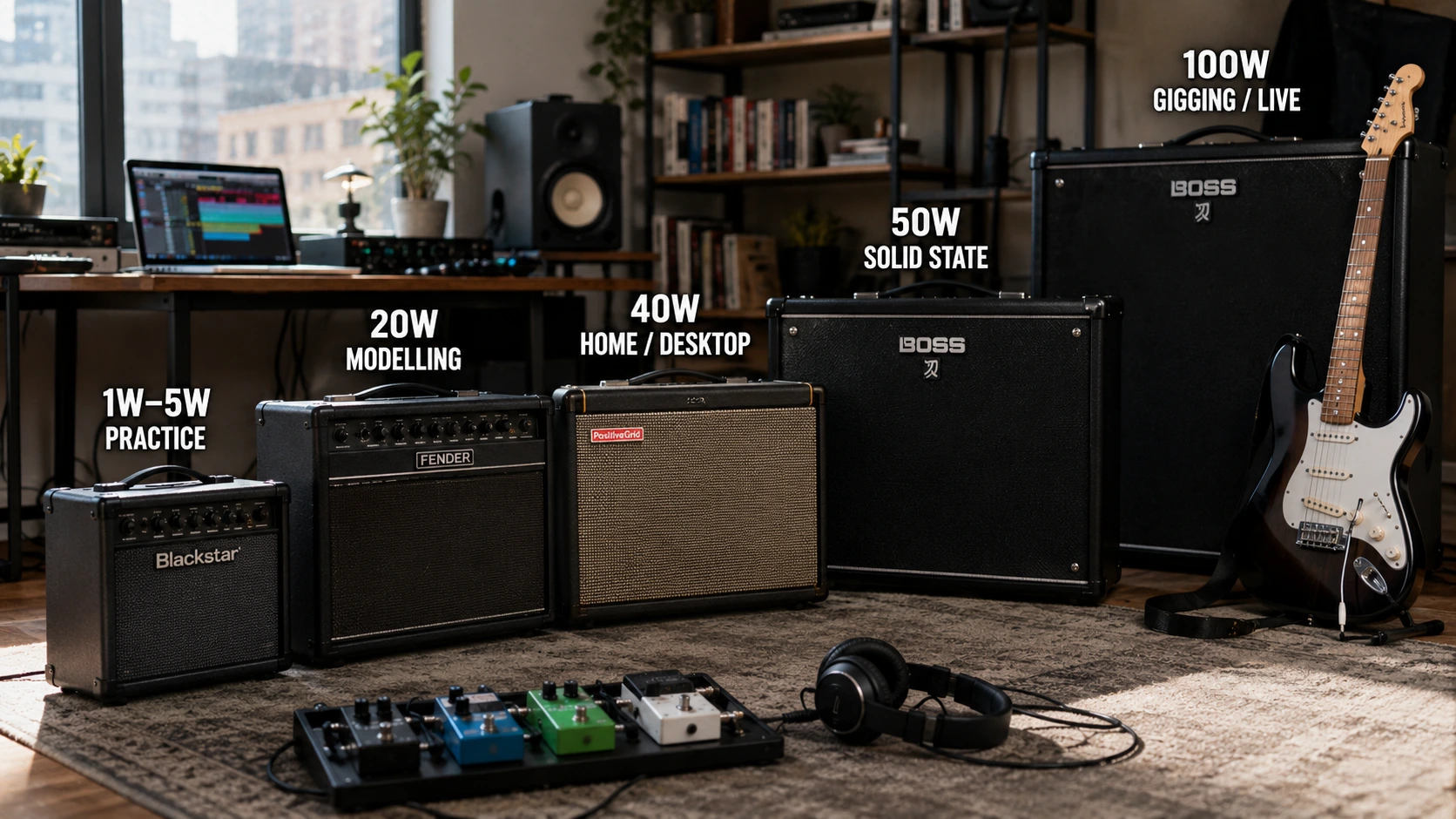
A practical wattage guide by use case
The following wattage ranges reflect real-world use cases rather than marketing categories. Individual situations vary — a particularly loud drummer, a very large living room, or a venue with PA support all shift these ranges. However, use them as a starting point rather than a definitive rule:
- Silent practice (headphones): Any wattage — headphone output bypasses the speaker entirely
- Bedroom / apartment practice: 1–15W is comfortable; 25W is workable but requires discipline with the volume control
- Home studio recording: Any wattage with USB or line output — wattage is irrelevant when recording direct
- Small rehearsal room (no drums): 10–25W is typically sufficient
- Band rehearsal with drums: 40–80W through a 12-inch speaker as a minimum
- Pub gig / small venue: 50W through a 12-inch speaker covers most scenarios
- Medium venue / outdoor performance: 80–100W provides comfortable headroom
The modelling amp exception
Modelling amps with built-in power attenuation change this calculation because their tonal character is largely independent of output power level. A 50-watt modelling amp at 0.5W sounds like the same 50-watt modelling amp — the preamp stage, amp characters, and effects all behave identically at any attenuation level. In contrast to tube amps, there is no power stage character to unlock at higher wattages, and consequently no tonal reason to push the volume. Consequently, for players primarily using modelling amps, the wattage question reduces to: how loud do you need it to go? The best modelling guitar amps guide covers how different wattage options within the modelling category compare in practice.
For the complete picture of which amp type and wattage range fits different home practice scenarios, the best guitar amp for home use roundup maps every category across every budget.
Frequently Asked Questions
Guitar amp wattage basics
How many watts do I need for home practice?
1–15 watts is comfortable for most home practice situations. A 10-watt solid state combo produces more than adequate volume for a single player in a normal room. The more important consideration is whether the amp can be turned down to genuinely quiet levels without losing tone quality — not whether it has enough maximum power. Most modern practice amps in the 10–25W range include headphone outputs that make the wattage question irrelevant for late-night sessions.
Is a 100W amp ten times louder than a 10W amp?
No. Human perception of loudness is logarithmic. A 100W amp produces approximately 10dB more sound pressure level than a 10W amp — which most listeners perceive as roughly twice as loud, not ten times. Going from 10W to 100W is a significant but not dramatic perceived volume increase. Going from 50W to 100W is barely perceptible — approximately 3dB, a marginal difference in real-world use. The primary advantage of 100W over 50W is additional headroom rather than meaningfully greater volume.
Wattage for specific situations
How many watts do I need to play with a drummer?
40–80 watts through a 12-inch speaker is a practical minimum for rehearsal with a drum kit without microphone support. Specifically, a moderate drummer produces approximately 95–100dB at close range; to hear your guitar clearly on stage without PA support requires comparable acoustic output from the amp. 50W through a 12-inch speaker handles most pub gig and small venue scenarios. 100W provides headroom for louder stages and outdoor performance. Amps below 40W typically cannot compete acoustically with a drum kit without PA assistance.
Why does my 1W tube amp seem louder than expected?
Indeed, several factors contribute. Specifically, tube amps clip gradually rather than hard, producing harmonic content that the ear perceives as louder at equivalent acoustic levels than solid state distortion. Additionally, many 1W ratings are measured at 5% or 10% total harmonic distortion rather than 1%, meaning the amp may produce more clean power than the rating implies. Furthermore, speaker efficiency varies significantly — a 1W amp into a 100dB-efficient speaker produces more acoustic output than a 10W amp into an 85dB-efficient speaker. A nominally 1W tube amp through an efficient speaker in a reflective room can be surprisingly loud.
More questions about amp wattage
Does a higher-wattage amp sound better than a lower-wattage amp?
No — wattage does not determine sound quality. A 5-watt amp with excellent circuitry, a quality speaker, and appropriate features can sound significantly better than a 100-watt amp with poor circuitry in any given playing context. Wattage determines headroom — the volume at which natural distortion begins. Indeed, for home practice, a lower-wattage amp often produces better tone at usable volumes because its output stage reaches the characteristic natural saturation zone without requiring damaging volume levels.
What is power attenuation and should I look for it?
Power attenuation reduces the output power of an amp without shutting down the full circuit — the amp runs internally at a higher level while delivering less acoustic power to the speaker. This enables valve amp tonal character at quieter volumes than the amp’s full power rating would normally produce. If you want a higher-wattage amp for occasional live use but need to practice at home at quiet volumes, built-in power attenuation is a valuable feature. Specifically, the Boss Katana range (0.5W / 25W / 50W / 100W selectable) and low-wattage tube amps like the Blackstar HT-1R MkIII (1W / 0.1W) are notable examples.