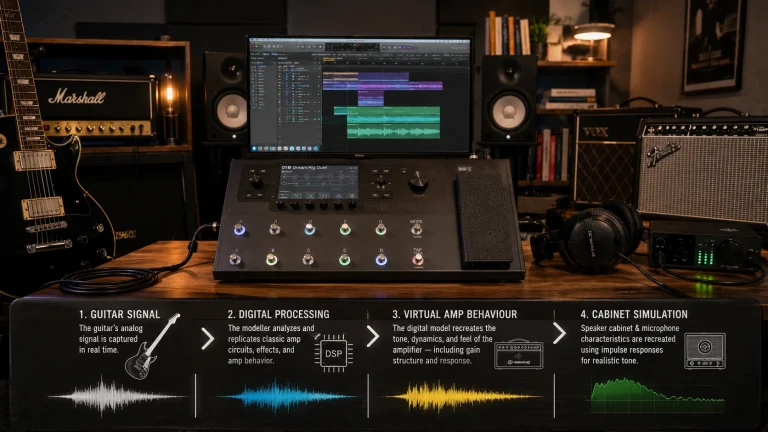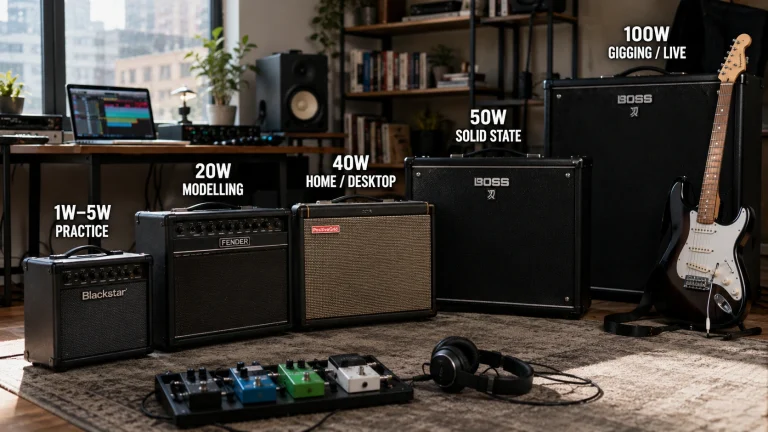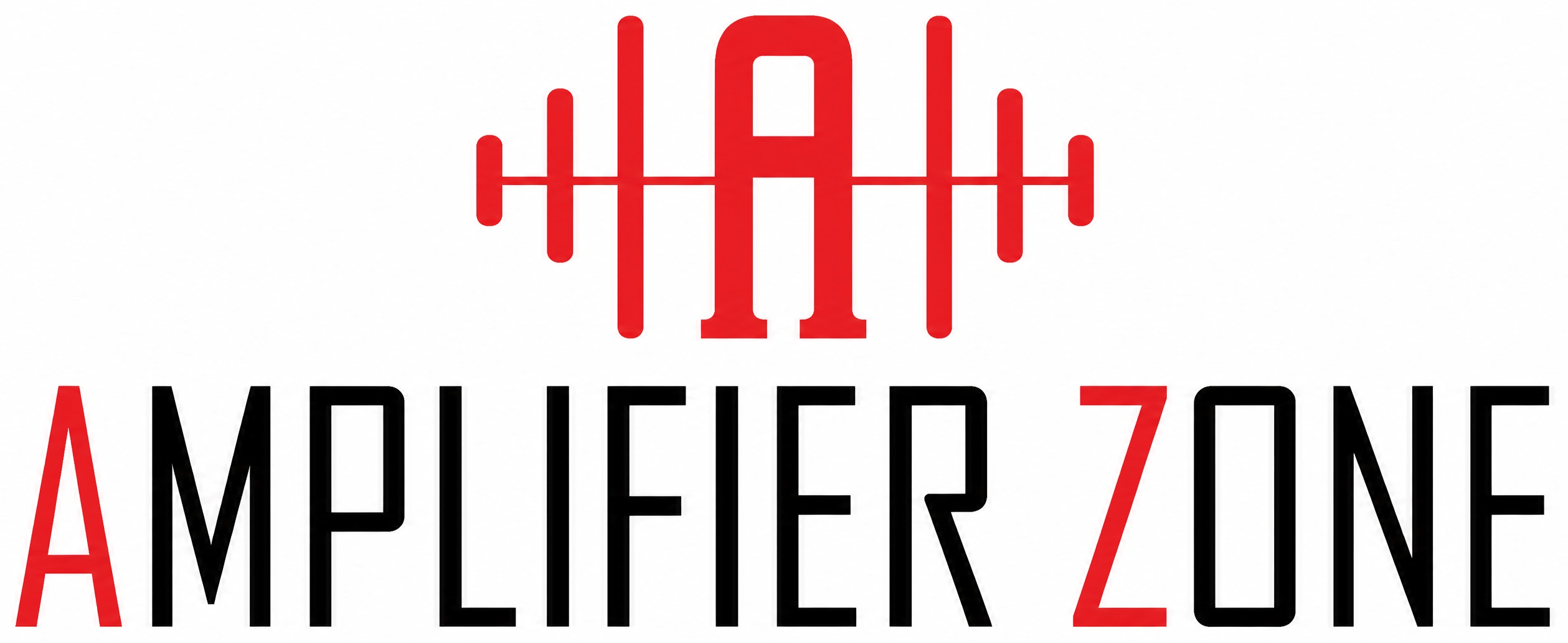
A modelling guitar amp solves a problem that took decades to figure out: how do you get the sound of a 100-watt Marshall stack, a Vox AC30, and a Fender Twin Reverb without owning three amplifiers, three speaker cabinets, and a house big enough to play them at volume? The answer is digital signal processing — and indeed, the best modelling guitar amps now do it convincingly enough that working musicians use them on tour. This guide covers five picks across the full price range, from the most accessible modelling platform with USB recording to the most powerful dual-purpose amp in the cluster. For players who want to understand how the technology actually works before choosing, the amp modelling guide explains digital amp simulation from the ground up.
Every amp here has been individually reviewed. Each one targets a different buyer — from the bedroom recorder who needs USB direct output to the gigging player who needs 100 watts on stage.
Quick Picks
- Best entry modelling amp / best for recording: Fender Mustang LT25 — 30 amp models, USB direct recording, highest average buyer satisfaction in this group
- Best app-connected modelling amp: Line 6 Spider V 20 MkII — 16 amp models, Bluetooth app control, Spider Remote ecosystem
- Best smart modelling amp: Positive Grid Spark 40 — AI Smart Jam, 10,000+ ToneCloud presets, 40W stereo, Amazon’s Choice
- Best for home use / amp feel: Boss Katana-50 Gen 3 — 12 amp characters, Tube Logic circuit, 12-inch speaker, power attenuation
- Best for home and gigging: Boss Katana-100 Gen 3 — 100W for venues, 0.5W for bedrooms, full Katana platform
This article contains affiliate links. If you purchase through them, we may earn a commission at no extra cost to you. This helps support AmplifierZone and allows us to keep creating in-depth, unbiased audio guides.
Best Modelling Guitar Amps — Comparison
Five picks mapped by amp models, wattage, speaker size, USB recording, and app connectivity so you can identify your use case before reading the full reviews.
| Amp | Models | Power | Speaker | USB rec. | App | Best For |
|---|---|---|---|---|---|---|
| Fender Mustang LT25 | 30 | 25W | 8-inch | Yes | No | Entry / recording |
| Line 6 Spider V 20 MkII | 16 | 20W | 8-inch | No | Yes (Spider Remote) | App / connected |
| Positive Grid Spark 40 | 33 | 40W stereo | 2× 4-inch | Yes — stereo | Yes (Spark) | Smart / AI platform |
| Boss Katana-50 Gen 3 | 12 characters | 50W | 12-inch | Yes — stereo | Tone Studio (PC) | Home use / amp feel |
| Boss Katana-100 Gen 3 | 12 characters | 100W | 12-inch | Yes — stereo | Tone Studio (PC) | Home and gigging |
Here is what each amp delivers in practice — and the specific situations where each earns or loses its recommendation.
Best Modelling Guitar Amps — Top Picks Reviewed
1. Fender Mustang LT25 25-Watt Modelling Amplifier
Best for: Players who want USB direct recording alongside 30 amp models — the only amp in this group under $200 that captures processed guitar tone straight into a DAW without a microphone
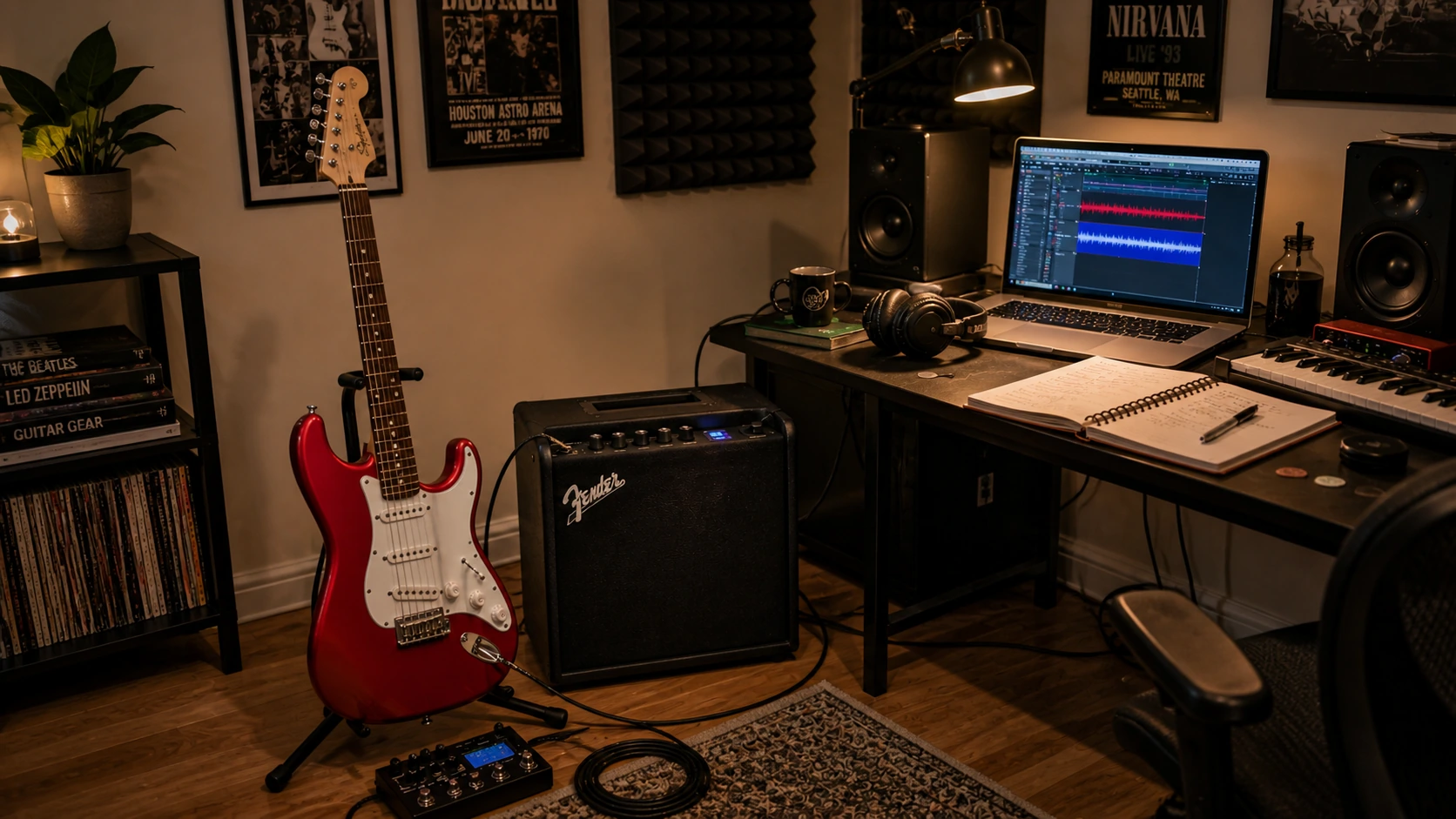
- Power output: 25W
- Speaker: 8-inch
- Amp models: 30 — clean, crunch, lead, British, acoustic simulation
- Effects: 30 built-in effects — reverb, delay, chorus, tremolo, and more
- USB: Yes — audio interface for direct DAW recording
- Headphone output: Yes — with cabinet simulation
- Aux input: Yes — 3.5mm
- Preset storage: 20 user-programmable presets
- App: No dedicated smartphone app — front panel only
- Warranty: 2 years (Fender)
The recording advantage at entry price
The Mustang LT25 is the most accessible entry point into this group — and specifically it earns that position through a feature that most practice amps at this price still do not include: USB direct recording. Connecting via USB makes the LT25 appear as an audio interface in GarageBand, Logic, Reaper, or Ableton — the full processed tone, including amp model and active effects, is captured without a microphone, without room treatment, and without volume concerns. Moreover, thirty amp models cover every foundational guitar tone: Fender clean, Vox-style chime, Marshall crunch, and high-gain lead. For the complete picture of what makes an amp suitable for home recording, the best guitar amps for recording guide covers every option across all budgets. Moreover, it holds the highest average buyer satisfaction score in this roundup — a meaningful signal given the review volume behind it.
Where it reaches its ceiling
The Mustang LT25 has no smartphone app — all preset editing happens from the front panel, which is functional but less convenient than app-based management. Additionally, the 8-inch speaker produces adequate bedroom volume but lacks the bass extension and physical presence of a 12-inch driver. Furthermore, twenty user presets cover most players’ needs, but deep modelling enthusiasts will find the ceiling relatively low. For players who prioritise recording capability at the lowest price in this group, however, nothing else here matches it.
- USB direct recording — no microphone or external interface needed
- Highest average buyer satisfaction in this roundup
- Amazon Overall Pick — consistent purchasing volume
- 30 amp models and 30 effects — broad tonal range at entry price
- Headphone output with cab simulation
- Lowest price in this group
- Fender 2-year warranty
- No smartphone app — front panel editing only
- 8-inch speaker — less bass extension than 12-inch alternatives
- 20 preset slots — limited storage for complex presets
- No power attenuation
Best entry modelling amp — 30 amp models, USB direct recording, highest-rated in this group. Amazon Overall Pick.
2. Line 6 Spider V 20 MkII 20-Watt Modelling Amplifier
Best for: Players who want Bluetooth app control and a connected modelling ecosystem — the Spider Remote app provides 200+ presets and wireless editing from a phone without plugging in

- Power output: 20W
- Speaker: 8-inch
- Amp models: 16 — clean, crunch, metal, and acoustic voicings
- Presets: 200+ factory presets + user storage
- Effects: Built-in effects — reverb, delay, modulation, and more
- App: Spider Remote (iOS/Android) — Bluetooth wireless editing
- Bluetooth: Yes — app control and audio streaming
- Headphone output: Yes — 3.5mm
- Aux input: Yes — 3.5mm
- USB: No direct recording
The connected modelling experience
Line 6 pioneered digital amp modelling, and the Spider V 20 MkII brings that heritage into a smartphone-connected package. The Spider Remote app connects via Bluetooth — consequently, preset browsing, tone editing, and effect adjustment all happen wirelessly from a phone without any cable connection to the amp. Furthermore, over 200 factory presets cover a broad range of tones, and the app’s interface makes navigating and customising them straightforward. Additionally, Bluetooth audio streaming allows backing tracks to play through the amp’s speaker alongside the guitar signal, creating a self-contained practice setup without additional hardware.
The trade-offs against the Mustang LT25
At a comparable price to the Mustang LT25, the Spider V 20 MkII offers a different set of strengths. Specifically, the app connectivity and 200+ preset library give it an immediate advantage for players who want wireless editing convenience. However, it does not include USB direct recording — players who want to capture guitar to a DAW need the Mustang LT25 or the Spark 40. Additionally, 16 amp models is a narrower selection than the Mustang LT25’s 30, though the quality and character of Line 6’s modelling remains genuinely strong at this price.
- Spider Remote app — Bluetooth wireless editing from phone
- 200+ factory presets — broad tonal library immediately available
- Bluetooth audio streaming — backing tracks through speaker
- Line 6 modelling heritage — proven amp simulation platform
- Headphone output and aux input
- Amazon’s Choice — consistent purchasing validation
- No USB direct recording — DAW capture requires external interface
- 16 amp models — narrower selection than Mustang LT25’s 30
- 8-inch speaker — limited bass extension
- No power attenuation
Best app-connected pick — Spider Remote Bluetooth editing, 200+ presets, and Line 6 modelling heritage. Amazon’s Choice.
3. Positive Grid Spark 40 Smart Guitar Amp
Best for: Players who want AI backing track generation and 10,000+ community presets — the Spark platform transforms solo practice by generating a reactive backing band from any chord progression in real time
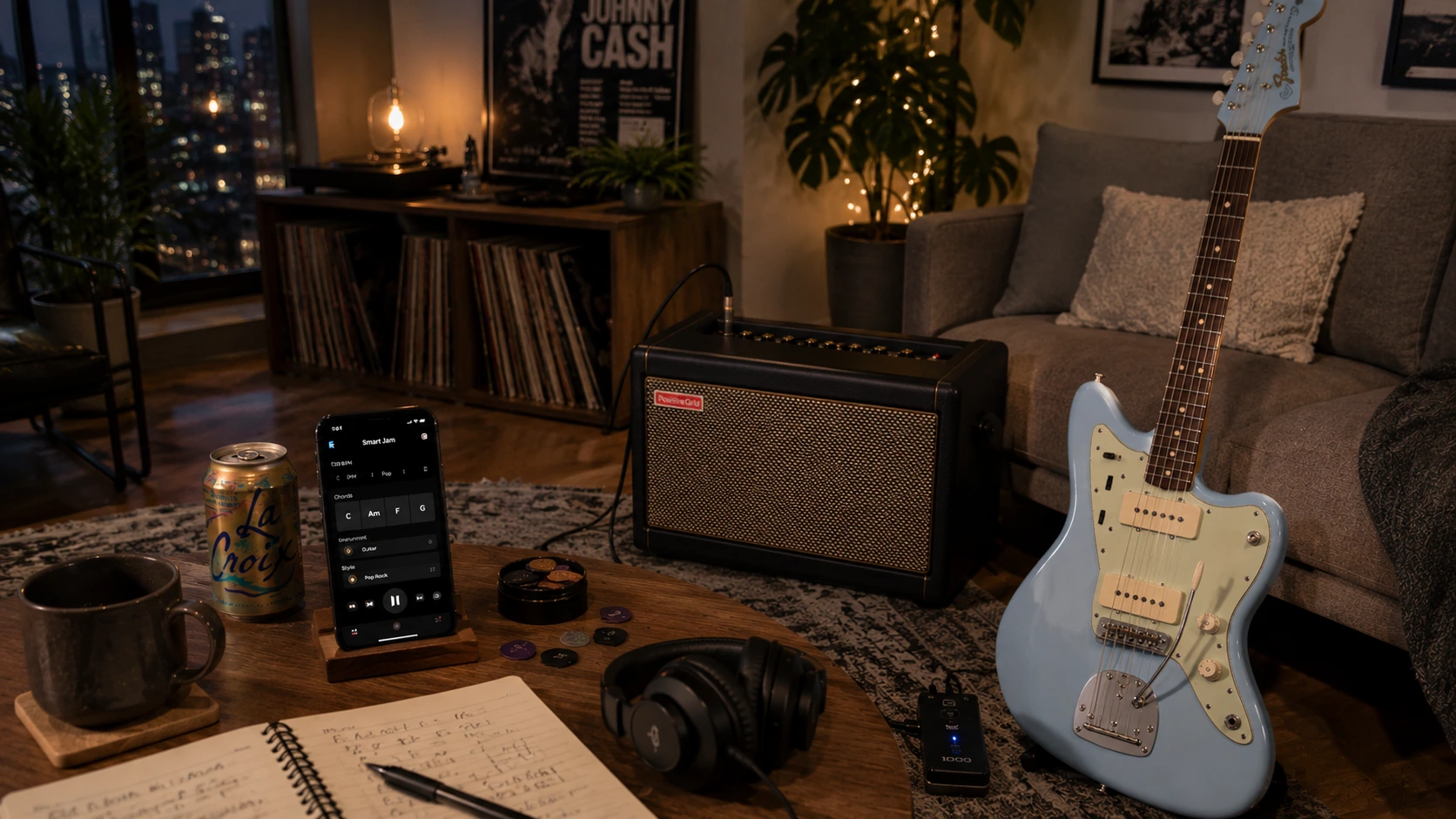
- Power output: 40W stereo (2 × 20W)
- Speakers: 2× 4-inch full-range drivers (stereo)
- Amp models: 33 — electric, acoustic, and bass
- Effects: 43 effect types
- AI Smart Jam: Real-time backing track generation from chord input
- ToneCloud: 10,000+ community presets via Spark app
- USB: Yes — stereo audio interface for DAW recording
- Bluetooth: Yes — audio streaming from phone
- Headphone output: Yes — 3.5mm stereo
- Aux input: Yes — 3.5mm
- Guitar types: Electric, acoustic-electric, bass
What Smart Jam actually does for practice
The Spark 40’s defining feature is Smart Jam — and specifically the difference it makes to daily practice is significant. Play a chord progression through the amp and the AI generates a full backing arrangement in real time: drums, bass, and accompaniment that follows the chord changes and matches the detected genre. Rock progressions generate rock backing; blues progressions generate blues-appropriate groove. In contrast to pre-recorded backing tracks that require selection and looping, Smart Jam responds dynamically to whatever is played. Furthermore, 10,000+ ToneCloud community presets provide instant access to artist and genre tones that would otherwise require hours of dialling in. Amazon’s Choice status and sustained purchasing volume confirm that real buyers find the platform genuinely useful.
Who should and should not buy it
The Spark 40’s premium over the Mustang LT25 and Spider V 20 MkII is justified specifically by the Smart Jam and ToneCloud platform. Specifically, for players who will engage with these features daily, the investment is well placed. However, for players who primarily want amp models and USB recording without platform engagement, the Mustang LT25 delivers the recording capability at considerably lower cost. Additionally, the 4-inch stereo drivers produce a different character from the 12-inch speakers in the Katana range — the stereo width is genuinely impressive, but the physical amp feel and bass punch of a single large driver are absent.
- AI Smart Jam — reactive backing track generation from chord input
- 10,000+ ToneCloud community presets — complete tonal library
- 40W stereo — wider, more dimensional sound than mono combos
- 33 amp models — electric, acoustic, and bass all supported
- USB stereo recording — direct DAW capture at high quality
- Amazon’s Choice — most validated smart amp at this price
- App dependency — Smart Jam and ToneCloud require the Spark app
- 4-inch stereo speakers — less physical amp feel than a 12-inch driver
- No power attenuation
- Premium price over the Mustang LT25 and Spider V 20 MkII
Best smart modelling amp — AI Smart Jam, 10,000+ community presets, 40W stereo, and USB recording. Amazon’s Choice.
4. Boss Katana-50 Gen 3 50-Watt Combo Amplifier
Best for: Home players who want the physical feel of a real guitar amp alongside modelling depth — the 12-inch speaker, Tube Logic circuit, and power attenuation deliver an amp experience the smaller combos in this group cannot match
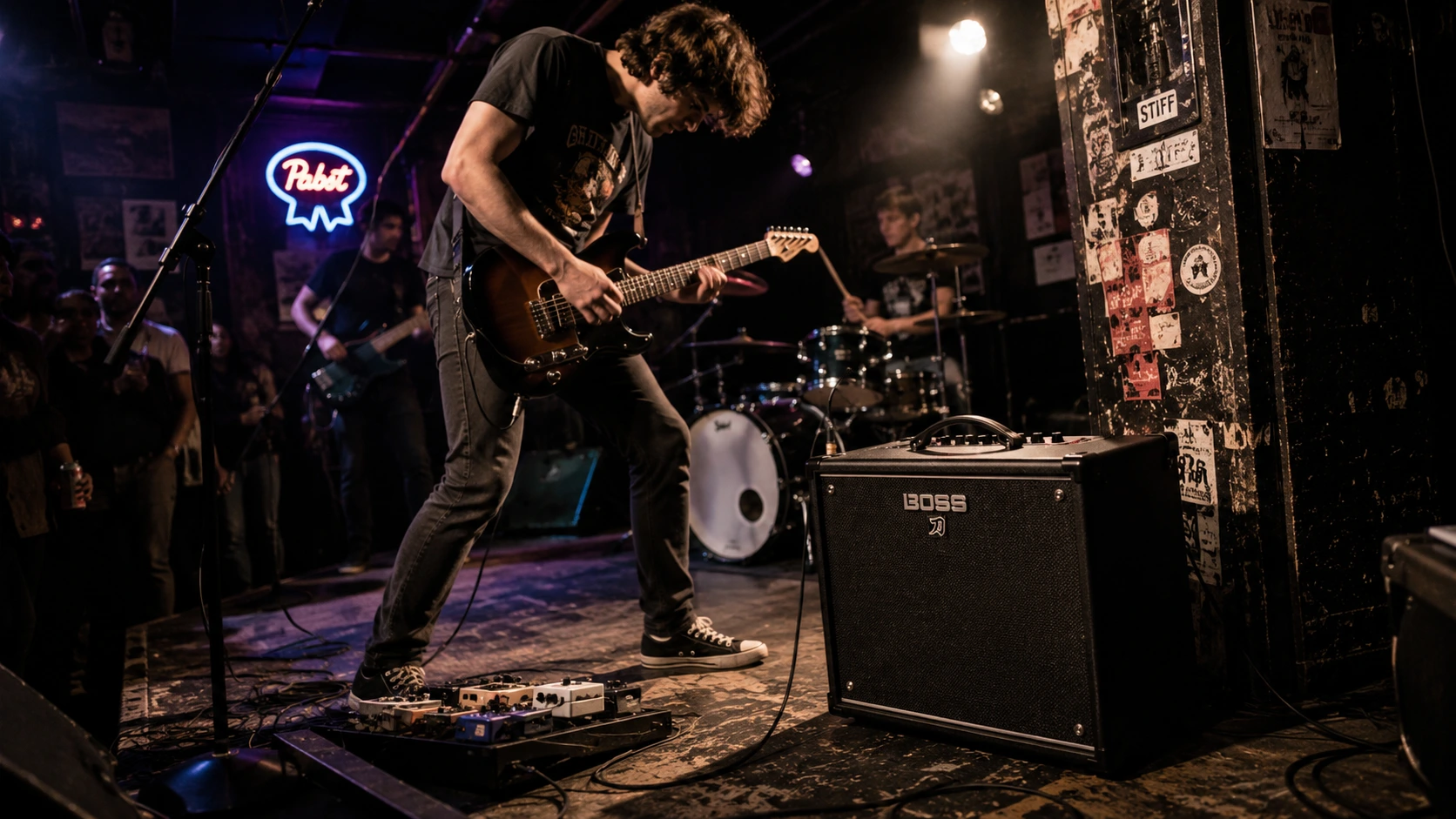
- Power output: 50W (selectable: 0.5W / 25W / 50W)
- Speaker: Custom 12-inch Boss
- Amp characters: 12 — Acoustic, Clean, Crunch, Lead, Brown + 7 via Tone Studio
- Effects: Onboard Boss effects — delay, reverb, chorus, modulation, and more
- Power attenuation: 0.5W / 25W / 50W selectable
- USB: Yes — stereo audio interface for direct DAW recording
- Headphone output: Yes — with speaker cabinet simulation
- Effects loop: Send/return for external pedals
- Tone Studio: Deep preset editing via Mac/PC software
- Footswitch: GA-FC compatible for live channel switching
Why the 12-inch speaker changes everything
The fundamental difference between the Katana-50 Gen 3 and every other amp in this group is physical: a 12-inch speaker in a properly sized cabinet produces bass extension, projection, and room presence that 8-inch and 4-inch drivers cannot replicate regardless of their digital processing. Specifically, the Katana’s Tube Logic circuit adds warmth and dynamic response that makes the amp feel more like a traditional valve amplifier than standard solid-state modelling. Furthermore, power attenuation from 50W down to 0.5W means the full amp character is accessible at genuine bedroom volumes — the Katana-50 sounds like itself at 0.5W in a way that many practice amps do not at any volume. Additionally, Tone Studio on Mac or PC unlocks seven additional amp characters beyond the five front-panel buttons, providing twelve distinct voicings in total.
The trade-offs vs the Spark 40
The Katana-50 Gen 3 costs more than the Spark 40 and delivers a fundamentally different value proposition. It has no Smart Jam, no ToneCloud, and no AI practice features. However, for players who prioritise physical amp feel, speaker quality, and the experience of playing through a proper 12-inch driver, it is the correct choice. Additionally, the effects loop allows a professional pedalboard to integrate at line level — a feature the Spark 40 lacks. For home-only players who never gig, the Katana-50 provides everything the Katana-100 does at a lower price.
- 12-inch speaker — genuine amp feel and bass extension
- Tube Logic circuit — warmer, more dynamic than standard solid-state
- Power attenuation 0.5W–50W — full character at bedroom volumes
- 12 amp characters — comprehensive tonal range
- USB stereo recording — direct DAW capture
- Effects loop — integrates professional pedalboards
- Tone Studio — deep preset editing on Mac/PC
- No Smart Jam or AI practice features
- No smartphone app — Tone Studio requires a computer
- Highest price of the home-only picks in this group
- Heavier than the smaller combos
Best home use pick — 12-inch speaker, Tube Logic warmth, power attenuation, and USB recording in the most physically convincing modelling combo here.
5. Boss Katana-100 Gen 3 100-Watt Combo Amplifier
Best for: Players who practice at home and gig live — 100W for venues, 0.5W for bedrooms, and the same twelve Katana amp characters across both environments without a second amp

- Power output: 100W (selectable: 0.5W / 25W / 50W / 100W)
- Speaker: Custom 12-inch Boss
- Amp characters: 12 — same system as Katana-50 Gen 3
- Effects: Onboard Boss effects — delay, reverb, chorus, modulation, and more
- Power attenuation: 0.5W / 25W / 50W / 100W selectable
- USB: Yes — stereo audio interface for direct DAW recording
- Headphone output: Yes — with speaker cabinet simulation
- Effects loop: Send/return for external pedals
- Speaker output: External cab connection available
- Footswitch: GA-FC compatible for live channel switching
- Tone Studio: Deep editing via Mac/PC
The one-amp solution for home and stage
The Katana-100 Gen 3 shares its entire amp character system and Tube Logic circuit with the Katana-50 — the tonal difference between them is minimal. However, what the Katana-100 adds is specifically relevant to live performance: 100W maximum output that handles medium-sized venues without microphone support, an additional 50W power attenuation step, and an external speaker output that connects to a larger cabinet for bigger stages. Accordingly, for players who practice at home daily and gig regularly, the Katana-100 eliminates the need for two separate amps. The 0.5W setting delivers the full Katana character at bedroom volumes; 100W delivers the same character at open-air stage levels.
When the Katana-50 is the better choice
For players who never gig, the Katana-50 Gen 3 provides identical tone at lower cost. The 100W output of the Katana-100 represents additional spending on a capability that home-only players will never use. Nevertheless, for gigging musicians at the early career stage — pub gigs, small venue support slots, regular rehearsals — the Katana-100 is the correct long-term investment. It is the most capable and versatile modelling amp in this group by a clear margin for players with live performance needs.
- 100W for live use — handles small-to-medium venues without microphone
- 0.5W attenuation — full amp character at genuine bedroom volumes
- 12 amp characters — same Tube Logic platform as Katana-50
- External speaker output — expandable to larger cab configurations
- USB stereo recording and effects loop
- GA-FC footswitch compatible for live channel switching
- Home-only players overpay — Katana-50 provides equal tone for less
- Heavier and larger than the Katana-50
- No Smart Jam or AI practice features
- Tone Studio requires a computer — no smartphone app
Best home and gig pick — 100W for venues, 0.5W for bedrooms, twelve Katana amp characters, and USB recording.
How We Chose the Best Modelling Guitar Amps
Selection criteria
Every amp here was evaluated against four criteria: tonal breadth and quality (how convincingly it covers the amp types it claims to model), practical home use capability (headphone output, power attenuation, USB recording, and volume management), feature value relative to price (what the platform offers beyond raw amp modelling), and real-world buyer validation. Specifically, amps were excluded if their modelling implementation was superficial — the market includes several products with large model counts that do not translate to usable tonal variety. For a broader picture of home amp options across all categories, the best guitar amp for home use roundup covers the full range including non-modelling alternatives.
Modelling depth vs model count
Model count is a marketing number — what matters is how well each model sounds and how distinct the voicings are from one another. Specifically, twelve convincing amp characters cover more practical musical ground than thirty models that share similar tone stacks. In particular, the Katana’s character system reflects this philosophy: five immediately accessible voicings on the front panel, seven more for players who want to explore further. In contrast, the Mustang LT25 and Spark 40 provide broader libraries with more variety across genre-specific tones. Neither approach is inherently superior — the right choice depends on how a player actually uses their amp day to day.
What is not on this list
Several amps were evaluated and excluded. For instance, the Fender Champion II 25 was excluded because its effect models do not constitute genuine amp modelling in the DSP sense — it is a two-channel amp with front-panel effects, not a modelling platform. Similarly, the NUX Mighty Plug Pro and Fender Mustang Micro are headphone-only devices covered in the mini amp roundup. The Line 6 Catalyst range was considered but its price positioning overlaps with the Katana-50 without a compelling advantage at this budget.
Which modelling guitar amp is right for you?
- USB recording at entry price: Fender Mustang LT25
- Wireless app editing and preset browsing: Line 6 Spider V 20 MkII
- AI backing tracks and ToneCloud presets: Positive Grid Spark 40
- Physical amp feel, 12-inch speaker, home use: Boss Katana-50 Gen 3
- One amp for home and live performance: Boss Katana-100 Gen 3
Best Modelling Guitar Amps — Final Verdict
The decision comes down to one question
Do you want a modelling amp that feels like a real amp — speaker, cabinet, physical response — or do you want a modelling platform that maximises tonal variety, practice features, and recording capability? That distinction separates this group cleanly into two camps, and the correct answer determines the purchase.
Platform-first picks
For players who prioritise recording capability at the lowest price in this group, the Fender Mustang LT25 is the answer — USB direct recording, 30 amp models, and the highest average buyer satisfaction here make it the default recommendation for home recorders on a budget. Read the full Fender Mustang LT25 review for the complete breakdown.
For players who specifically want Bluetooth app control and a large preset library without the Spark 40’s price premium, the Line 6 Spider V 20 MkII is the practical alternative — 200+ presets, wireless editing, and Line 6’s established modelling heritage in the same price bracket as the Mustang LT25.
For players who want the most complete practice platform in this group — AI backing track generation, 10,000+ community presets, stereo output, and USB recording — the Positive Grid Spark 40 is the correct choice. The premium over the entry picks is justified entirely by the Smart Jam and ToneCloud platform for players who will engage with it daily.
Amp-feel picks
For players who want the physical experience of a real guitar amp — 12-inch speaker, Tube Logic warmth, power attenuation, and an effects loop — the Boss Katana-50 Gen 3 delivers it more convincingly than anything else in this group. Read the full Boss Katana-50 Gen 3 review before deciding between the 50 and the 100. For players who additionally need live performance capability from the same amp, the Boss Katana-100 Gen 3 adds 100W output and external speaker connection — the only pick here that genuinely handles both environments without compromise.
Frequently Asked Questions
Choosing a modelling guitar amp
What is the best modelling guitar amp for beginners?
The Fender Mustang LT25 is the best entry point — 30 amp models cover every foundational guitar tone, USB direct recording is immediately useful for capturing practice, and the front panel controls require no app or software to start playing. For beginners who want immediate access to recognisable tones from specific artists and genres, the Positive Grid Spark 40’s ToneCloud preset library is additionally compelling, though its price is significantly higher. The Mustang LT25 handles the core modelling requirement at the lowest price in this group.
Is a modelling amp good enough for gigging?
Yes — specifically the Boss Katana-50 Gen 3 and Katana-100 Gen 3 are used by working musicians on stage regularly. The Katana-100 Gen 3 at 100W through a 12-inch speaker handles pub gigs, small venue headline slots, and medium-sized stages without microphone support. The Katana-50 Gen 3 at 50W covers most small venue and pub gig scenarios. The Fender Mustang LT25, Line 6 Spider V 20 MkII, and Positive Grid Spark 40 are practice-focused amps — they can be used live through a PA with a DI, but they are not stage monitors in the traditional sense.
Modelling amp features
Do modelling guitar amps sound as good as tube amps?
At bedroom practice volumes, the best modelling amps are indistinguishable from tube amps to most listeners — the Katana’s Tube Logic circuit in particular produces warmth and dynamic response that approaches valve character. At stage volumes through a 12-inch speaker, experienced players can generally identify the difference — tube amps have a physical response and harmonic complexity that digital processing has not fully replicated. However, for home practice, recording, and most practical use cases, a good modelling amp is genuinely sufficient. The practical advantages — power attenuation, silent practice, USB recording, and consistent tone at any volume — often outweigh the tonal difference at home.
Which modelling amp is best for home recording?
The Fender Mustang LT25 is the best for recording at entry price — USB direct output captures the full processed tone into any DAW without a microphone. The Positive Grid Spark 40 additionally provides USB stereo recording, capturing stereo effects at full width. The Boss Katana-50 Gen 3 and Katana-100 Gen 3 both provide USB stereo recording with a separate dry guitar channel for re-amping. However, the Line 6 Spider V 20 MkII does not include USB recording — players who need DAW capture should choose one of the other four.
More questions about modelling guitar amps
What is the difference between Boss Katana-50 Gen 3 and Katana-100 Gen 3?
Four differences: the Katana-100 provides 100W versus 50W maximum output, adds a 50W power attenuation step, includes an external speaker output for connecting additional cabinets, and uses a larger cabinet providing more low-frequency extension. However, the twelve amp character system, Tube Logic circuit, USB recording, effects loop, and Tone Studio software are identical. For home use only, the Katana-50 Gen 3 provides equal tone at lower cost. For gigging use, the Katana-100’s additional wattage and external speaker output make it the appropriate investment.
Does the Positive Grid Spark 40 work as a modelling amp without the app?
Yes — the Spark 40 functions as a standard 40W stereo guitar amp without the Spark app. The front panel controls access preset channels, volume, and basic tone settings. However, Smart Jam, ToneCloud preset access, and deep tone editing all require the Spark app. Without the app, the features that distinguish the Spark 40 from simpler alternatives are unavailable. For players who prefer to practice without a phone nearby, the Katana-50 Gen 3 provides equivalent modelling depth with no app dependency.