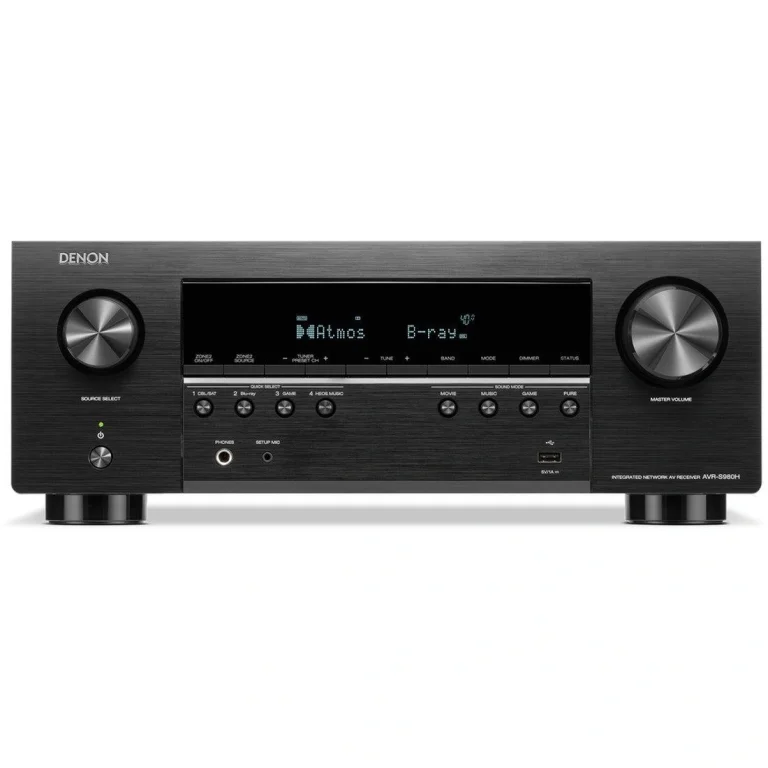
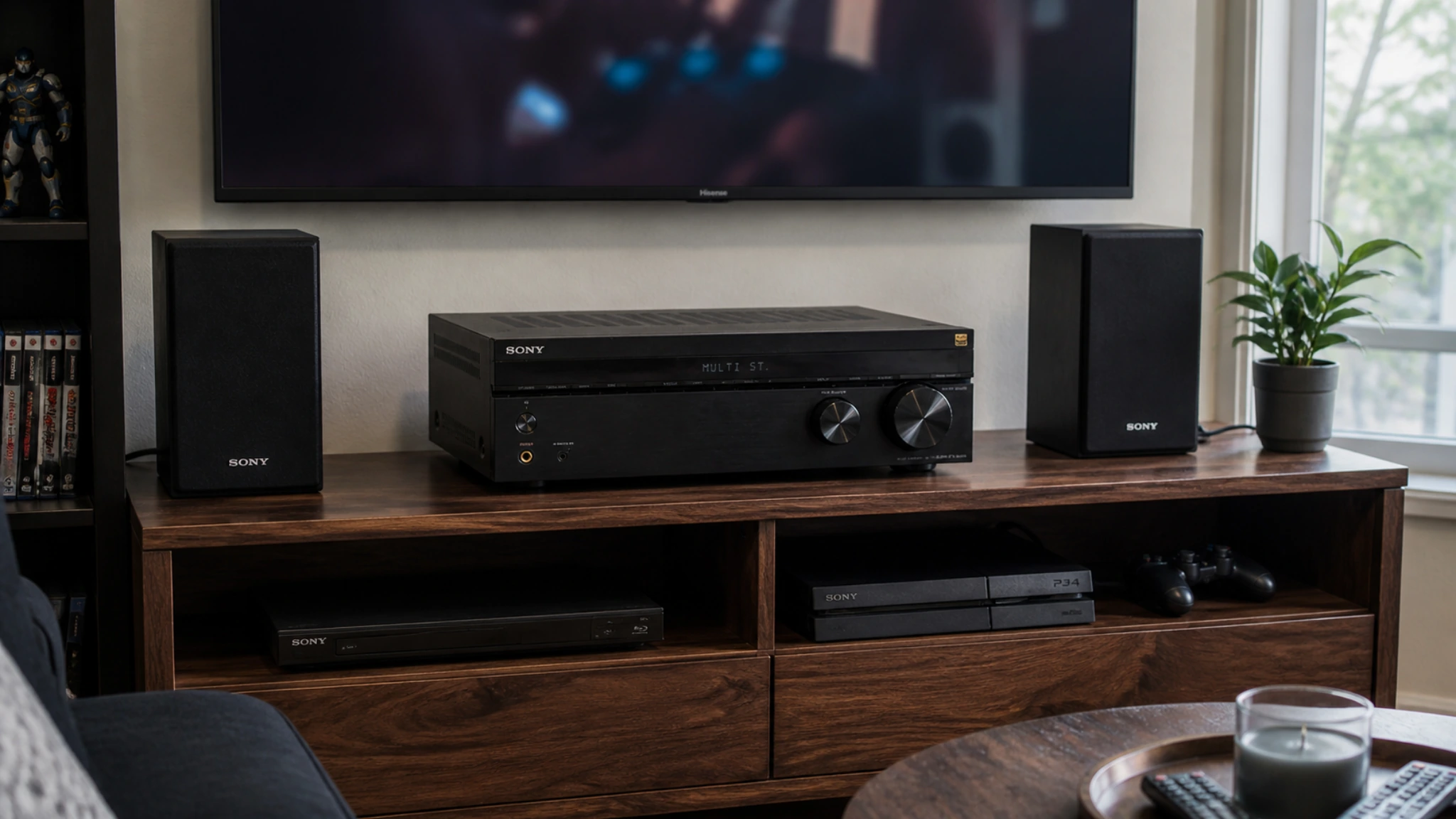
This Sony STRDH590 review covers the most extensively reviewed AV receiver in our under-500 group — 5,900+ Amazon ratings at 4.3 stars, Amazon’s Choice designation, and 100+ units bought per month reflect sustained real-world buyer satisfaction over multiple production years. Where every other receiver in this roundup has a more compelling specification in at least one dimension, the STRDH590’s most persuasive argument is simpler: more buyers have purchased it, lived with it, and returned to leave a positive review than any other option at this price.
It appears in our roundup of the best AV receivers under $500 as the proven track record pick. This review examines what that track record actually reflects — what the STRDH590 does consistently well across a range of real-world setups, where its specifications fall short of newer alternatives, and which buyers are best served by its combination of Sony reliability and accessible 5.1 performance.
Quick Answer: The Sony STRDH590 is the safest choice in this group for buyers who weigh track record and review volume as buying signals. Its 5,900+ Amazon reviews confirm consistent real-world satisfaction. Two optical inputs, 90W per channel (at 6Ω), 4K HDR passthrough, Dolby TrueHD, and Sony’s D.C.A.C. room calibration cover the core home theater use case reliably. The clear limitations are HDMI 2.0 only (no 4K/120Hz gaming), no Dolby Atmos, and Bluetooth-only streaming. For 4K/120Hz gaming, the Denon AVR-S570BT is the better tool at $49 less.
This article contains affiliate links. If you purchase through them, we may earn a commission at no extra cost to you. This helps support AmplifierZone and allows us to keep creating in-depth, unbiased audio guides.
Who Is the Sony STRDH590 For?
The buyer it was designed for
The STRDH590 is built for the buyer who values confidence over specification chasing — someone who wants to purchase a receiver from a globally trusted brand with a proven reliability record, confirmed by thousands of real-world buyers rather than a handful of professional reviews. Sony’s consumer electronics engineering heritage spans decades, and the STRDH590 reflects that: reliable 4K HDR passthrough, consistent Dolby TrueHD decoding, and a D.C.A.C. calibration system that handles speaker setup without drama.
In practical terms, it suits households watching movies and TV through streaming services and Blu-ray, with up to four HDMI sources connected simultaneously, who want Bluetooth for casual music streaming and two optical inputs for a TV audio return and a second digital source. Two optical inputs is a genuine practical advantage over all other receivers in this group, which provide one — allowing a TV and a second optical device to stay connected simultaneously without cable swapping. Whether a 5.1 surround configuration is right for your room or whether stereo makes more sense is worth considering — the stereo vs AV receiver guide covers that decision in practical terms.
When to look elsewhere
The STRDH590 is not the right choice for PS5 and Xbox Series X owners who game at 4K/120Hz — HDMI 2.0 caps the signal at 4K/60Hz, and the Denon AVR-S570BT handles that use case identically well at $49 less. It is also not suited to buyers who want Apple Music lossless or MusicCast whole-home audio — the Yamaha RX-V4A provides both at $38 more. And for any buyer who already knows Dolby Atmos with ceiling speakers is part of the plan, the Sony is not the correct foundation — the Denon AVR-X1700H Renewed is the only option in this group that supports it.
The track record question: The STRDH590’s 5,900+ reviews are a meaningful buying signal — but they reflect performance at a specification level that newer alternatives now exceed. A product with 114 reviews (JBL MA310) or 997 reviews (Denon AVR-S570BT) isn’t less reliable simply because fewer buyers have reviewed it. Consider whether you’re paying for confirmed history or accepting that newer hardware may be equally dependable with less evidence behind it.
Sony STRDH590 — Key Specifications
Sony STRDH590 5.2-Channel AV Receiver
- Channels: 5.2 (5 amplified + 2 subwoofer pre-outs)
- Power output: 90W × 5 (6Ω) — approximately 65W at 8Ω
- Dolby Atmos: No — Dolby TrueHD, DTS-HD Master Audio, Dolby Digital Plus
- HDMI: 4× in / 1× out — HDMI 2.0, 4K/60Hz, HDCP 2.2, ARC
- Video: 4K/60Hz passthrough, HDR10, HLG, Dolby Vision
- Room calibration: D.C.A.C. (Digital Cinema Auto Calibration)
- Streaming: Bluetooth 4.2
- Inputs: 4× HDMI, 2× optical, coaxial, 3× analogue stereo
- 5,900+ Amazon reviews at 4.3 stars — most validated receiver in this group by far
- Amazon’s Choice designation — sustained purchasing volume and positive feedback
- Two optical inputs — connects TV and a second optical source simultaneously
- Three analogue inputs — more than any other receiver in this group
- Sony build quality and long-term reliability track record
- Dolby TrueHD and DTS-HD Master Audio — full lossless decoding from Blu-ray
- 4K HDR passthrough — handles current streaming and TV content correctly
- No Dolby Atmos — no height channel support
- HDMI 2.0 only — 4K/60Hz ceiling, no 4K/120Hz, no VRR for gaming
- Bluetooth only — no Wi-Fi, no streaming ecosystem
- Highest price of the HDMI 2.0 receivers in this group
- D.C.A.C. room calibration — less sophisticated than YPAO or Audyssey
Approx. price: ~$498. Amazon’s Choice — the most reviewed AV receiver in this group, with Sony’s reliability record behind it.
The 90W power rating requires the same note as other receivers in this group: Sony quotes 90W into 6Ω, which drops to approximately 65W at the more representative 8Ω load that most bookshelf speakers present. At 65W into an 87–88dB speaker in a small to medium room there is comfortable headroom for normal listening levels. In larger rooms with less sensitive speakers, 65W runs closer to its limits than the RX-V4A’s 80W at 8Ω. How speaker sensitivity and room volume determine the power requirement is mapped in the speaker configuration guide.
Design and Build Quality
Sony’s established AV aesthetic
The STRDH590 uses Sony’s standard black AV receiver design — a clean front panel with a fluorescent display, source selector, volume knob, and input buttons. The aesthetic is conservative and functional rather than distinctive: it sits in an AV cabinet or on a shelf without drawing attention. Build quality reflects Sony’s consistent manufacturing standards — the chassis is solid, the binding posts are quality-grade, and the controls have the measured, confident feel of a product from a company that builds consumer electronics at scale and has refined the tolerances over many production cycles.
Rear panel input density
Two optical inputs and three analogue stereo inputs give the STRDH590 more legacy connectivity than any other receiver in this group. In practice, two optical inputs is the most practically useful differentiator: one connects the TV’s optical output for smart TV app audio, and the second handles a CD player, game console optical output, or set-top box without requiring a manual swap. Three analogue inputs cover a turntable with an external phono preamp, a CD player on analogue, and one spare. For households with multiple legacy sources that predate HDMI, the STRDH590’s rear panel is the most accommodating in this group.
The track record behind the design
What the review count reflects most directly is durability and consistency across a wide range of real-world setups. Buyers have purchased the STRDH590 in small apartments with compact bookshelf speakers, in households with larger floorstanders in medium-sized living rooms, and across setups ranging from basic 2.1 to full 5.1 arrays. A sustained 4.3-star average across that breadth confirms reliable performance across diverse conditions rather than excellence in just one specific configuration.
Sound Quality
Movie and surround performance
Dolby TrueHD and DTS-HD Master Audio decoding from Blu-ray sources is the STRDH590’s strongest audio performance context. Lossless surround tracks from well-mastered films — action sequences with significant surround and LFE content, atmospheric drama with subtle ambient effects — are reproduced cleanly with stable imaging and natural channel separation. Centre channel dialogue is consistently clear and well-positioned. Sony’s audio tuning in this receiver is neutral and unobtrusive — it neither adds warmth nor analytical brightness, presenting the source accurately without editorial character.
Streaming and Bluetooth audio
Bluetooth 4.2 with SBC codec handles casual music streaming from a phone or tablet within room range. Connection is stable and pairing is straightforward. SBC codec compresses the audio signal before transmission — this is standard for Bluetooth audio and audibly different from lossless AirPlay 2 on the Yamaha RX-V4A on high-quality recordings in a quiet room. For background music, playlist streaming, and casual listening, the quality difference is academic. For critical music listening, Bluetooth’s compression is a meaningful limitation that AirPlay 2 and Spotify Connect on the RX-V4A avoid entirely.
D.C.A.C. room calibration in practice
Sony’s D.C.A.C. (Digital Cinema Auto Calibration) measures speaker distances and levels automatically using an included microphone. The system is functional and produces a usable configuration — speakers are balanced, distances are set correctly, and the subwoofer crossover is applied. Its limitation relative to YPAO and Audyssey MultEQ XT is in frequency correction: D.C.A.C. applies less sophisticated equalisation than the parametric corrections in YPAO or the multi-position measurement of Audyssey MultEQ XT. In a well-treated room with well-matched speakers, the difference is modest. In a room with significant acoustic problems, more sophisticated calibration produces more noticeable improvements.
Sony STRDH590 review — what the review count actually tells you
- 5,900+ reviews confirm: The receiver performs reliably across a wide range of real-world setups and room sizes
- 4.3-star average confirms: The vast majority of buyers are satisfied — dissatisfied buyers leave reviews disproportionately, so sustained 4.3+ stars reflects genuine satisfaction
- What it doesn’t confirm: Whether the STRDH590 is better than newer alternatives — only that it is consistently good enough at what it does
- The honest trade-off: You pay ~$49 more than the Denon AVR-S570BT for an HDMI 2.0 receiver with a larger review base — the Denon provides HDMI 2.1 gaming features for less
Connectivity and Compatibility
HDMI inputs and video passthrough
Four HDMI 2.0 inputs handle 4K/60Hz passthrough with HDR10, HLG, and Dolby Vision — correctly processing current streaming content from Netflix, Disney+, Apple TV+, and all major 4K streaming sources. ARC on the HDMI output returns TV app audio to the receiver via a single HDMI cable. HDMI 2.0’s 4K/60Hz ceiling is not a limitation for streaming content — 4K/60Hz covers every current streaming format. It becomes a limitation specifically for gaming consoles running at 4K/120Hz, where HDMI 2.0’s bandwidth is insufficient to carry the signal without downsampling to 4K/60Hz.
Optical and analogue inputs
Two optical inputs and three analogue inputs provide the widest non-HDMI connectivity in this group. One optical handles a TV’s optical output — routing smart TV app audio through the surround system without requiring eARC. The second optical covers a CD player, a set-top box, or any source with Toslink output. Three analogue inputs accommodate a turntable with external phono preamp, a CD player on analogue, and one additional source — providing more source flexibility than any other receiver here. For help understanding how ceiling speakers and Atmos height channels integrate with receivers that support them, the ceiling speaker connection guide explains the configuration in practical terms.
What is absent
No HDMI 2.1 — so no 4K/120Hz, no VRR, no eARC (standard ARC only). No Wi-Fi — so no streaming apps, no AirPlay, no multi-room audio. No phono input — turntable users need an external preamp. No Dolby Atmos — ceiling speakers will not deliver height audio through this receiver. For buyers who need any of these features, a different receiver in this group handles them more appropriately.
How the Sony STRDH590 Compares
Sony STRDH590 vs Denon AVR-S570BT
The most direct challenge to the STRDH590’s position in this group. The Denon costs $49 less and adds HDMI 2.1 with VRR and ALLM for 4K/120Hz gaming, eARC, HDR10+, and 8K passthrough. Audio processing is comparable — both decode Dolby TrueHD and DTS-HD Master Audio, both lack physical Dolby Atmos, and both provide Bluetooth-only streaming. D.C.A.C. and basic Audyssey produce similar practical calibration results. The honest conclusion: for movie-watching households with no gaming use case, both receivers perform identically for that use case and the Sony’s larger review base is the differentiating factor. For gaming households, the Denon wins clearly at a lower price.
Sony STRDH590 vs JBL MA310
The STRDH590 costs $58 more than the MA310 and provides two optical inputs versus one, three analogue inputs versus two, and Sony’s review history versus JBL’s newer market presence. Both use HDMI 2.0, both lack Dolby Atmos, and both provide Bluetooth-only streaming. The JBL’s auto calibration and the Sony’s D.C.A.C. produce broadly comparable results. For buyers whose decision rests on brand confidence and input flexibility, the STRDH590’s premium is justifiable. For buyers focused purely on hardware capability at the lowest price, the MA310 delivers the same core home theater functionality at $58 less.
Sony STRDH590 vs Yamaha RX-V4A
A clear capability gap in the Yamaha’s favour at $38 more. The RX-V4A adds HDMI 2.1, VRR, ALLM, AirPlay 2, MusicCast, YPAO, and a phono input. The Sony counters with its 5,900+ review history. For buyers who want the reassurance of established reviews, the Sony is the emotional choice. For buyers focused on what the hardware delivers, the Yamaha wins on every specification. The $38 difference is the cost of that reassurance.
Best Speaker Pairings
At approximately 65W per channel (8Ω actual), the STRDH590 performs best with efficient bookshelf speakers in small to medium rooms:
| Speaker / Package | Sensitivity | Type | Room size | Result |
|---|---|---|---|---|
| Polk Audio T-Series 5.1 package | 89dB | Bookshelf + surrounds | Small–medium | Excellent — popular pairing, comfortable headroom |
| Klipsch R-51M (5-speaker array) | 93dB | Bookshelf | Small–large | Excellent — high sensitivity gives 65W significant headroom |
| Sony SS-CS Series 5.1 | 88dB | Bookshelf + surrounds | Small–medium | Very good — Sony-to-Sony pairing, natural tonal match |
| Q Acoustics 3010i array | 88dB | Compact bookshelf | Small–medium | Very good — Q Acoustics’ controlled dispersion suits Sony’s neutral character |
| Elac Debut 2.0 B5.2 array | 86dB | Bookshelf | Small | Good — works in small rooms, approaches limits in medium rooms at higher volumes |
| Low-sensitivity floor-standers (<85dB) | <85dB | Floorstanding | Medium–large | Not recommended — 65W at 8Ω will feel limited with demanding loads |
Is the Sony STRDH590 Worth It?
For the right buyer — yes
For a buyer who weighs brand track record and purchase volume as meaningful quality signals, and whose use case is movies and TV without 4K/120Hz gaming or Apple Music streaming, the STRDH590 delivers a reliable, well-calibrated 5.1 home theater experience from a globally trusted brand with thousands of satisfied buyers behind the product. Two optical inputs add genuine practical convenience. Sony’s build quality means it will run without drama for years. The 5,900+ reviews provide more real-world validation than any other receiver in this group by a significant margin.
When the honest answer is no
For 4K/120Hz gaming, the Denon AVR-S570BT provides HDMI 2.1 for $49 less — the STRDH590 is not the rational choice for that use case at any price, let alone at a premium. For music streaming, the Yamaha RX-V4A provides AirPlay 2 and MusicCast for $38 more — the gap is modest and the capability difference is significant. The STRDH590’s strongest position is for buyers for whom the review count is a decisive factor, and that is a legitimate reason to choose it.
The honest price comparison: At $498 the STRDH590 is $49 more than the Denon AVR-S570BT, which provides HDMI 2.1, VRR, 4K/120Hz, eARC, and HDR10+. For movie-only households with no gaming use case, the practical difference between the two receivers is the Sony’s larger review base and dual optical inputs. Both produce equivalent audio quality for that use case. Know what you’re paying for before committing.
Sony STRDH590 Review — Final Verdict
What its track record reflects
The Sony STRDH590 is the most validated choice in this group — not the most capable, but the most confirmed. Its 5,900+ Amazon reviews represent real buyers in real rooms who purchased, set up, and returned to verify their satisfaction. Sony’s reliability record, neutral audio character, two optical inputs, and consistent 4K HDR performance make it a genuinely good receiver for the use cases it was designed for. The honest caveat is that newer alternatives in this group provide better hardware at lower or comparable prices — the STRDH590’s premium is for the track record, and that track record has real value for the buyer who prioritises it.
The natural next step
For buyers ready to step up to genuine Dolby Atmos with physical height speakers, HEOS streaming, and Audyssey MultEQ XT room calibration at the ceiling of this budget — the Denon AVR-X1700H Renewed review covers the most capable hardware available under $500. For the complete comparison across all five receivers in this group, the complete roundup maps every use case.
Approx. price: ~$498. Amazon’s Choice — the most reviewed AV receiver in this group, with Sony’s reliability record behind it.
Frequently Asked Questions
Does the Sony STRDH590 support 4K video?
Yes — the STRDH590 passes 4K/60Hz video with HDR10, HLG, and Dolby Vision through its four HDMI 2.0 inputs. Current streaming content from Netflix, Disney+, Apple TV+, and all major 4K services passes through correctly. It does not support 4K/120Hz — HDMI 2.0’s bandwidth limits passthrough to 4K/60Hz. For 4K/120Hz gaming from PS5 or Xbox Series X, the Denon AVR-S570BT and Yamaha RX-V4A both provide HDMI 2.1 on all inputs.
Does the Sony STRDH590 support Dolby Atmos?
No. The STRDH590 is a 5.2-channel receiver and does not support Dolby Atmos in any form — physical or virtual. Dolby Atmos content from streaming services or Atmos-encoded Blu-rays plays in downmixed 5.1. It decodes Dolby TrueHD and DTS-HD Master Audio correctly for standard surround content. For Dolby Atmos with real ceiling or upward-firing speakers in this price range, the Denon AVR-X1700H Renewed is the only option.
Why does the Sony STRDH590 have two optical inputs?
Two optical Toslink inputs allow a TV and a second optical source to stay connected simultaneously without cable swapping. In a typical setup, one optical connects the TV’s optical audio output — routing smart TV app audio through the surround system — while the second handles a CD player, a set-top box, or any other device with optical output. No other receiver in this under-500 group provides two optical inputs; all others include one.
What does Amazon’s Choice mean for the Sony STRDH590?
Amazon’s Choice is an algorithmically assigned designation based on a combination of factors including review rating, purchase volume, price, availability, and shipping speed. It indicates that the product consistently meets Amazon’s threshold across those metrics over a sustained period — not that Amazon has editorially evaluated it against alternatives. For the STRDH590, the designation reflects its sustained high purchase volume, consistent 4.3-star average, and reliable availability at its listed price. It is a useful quality signal but not a guarantee of superiority over alternatives that don’t carry the badge.
Is the Sony STRDH590 good for gaming?
For gaming at 4K/60Hz — yes. The STRDH590 passes 4K/60Hz video and handles game audio through its surround system without issue. For gaming at 4K/120Hz with VRR — no. HDMI 2.0 cannot carry 4K/120Hz, and the STRDH590 will cap PS5 and Xbox Series X output at 4K/60Hz through the receiver. If 4K/120Hz gaming is a regular use case, the Denon AVR-S570BT provides HDMI 2.1 with VRR and ALLM for $49 less than the Sony’s current price.