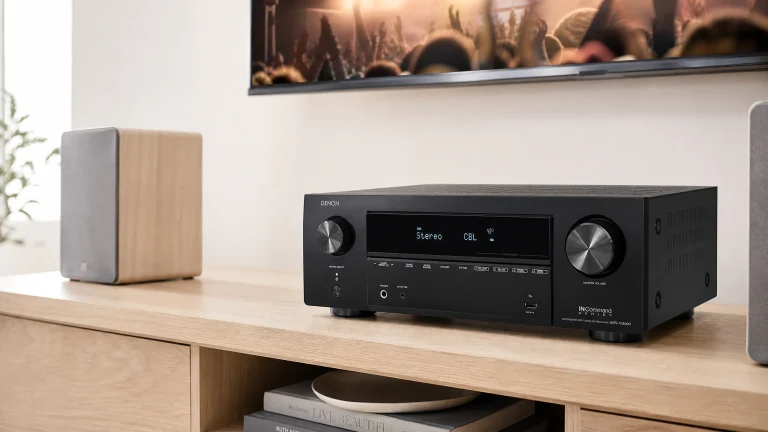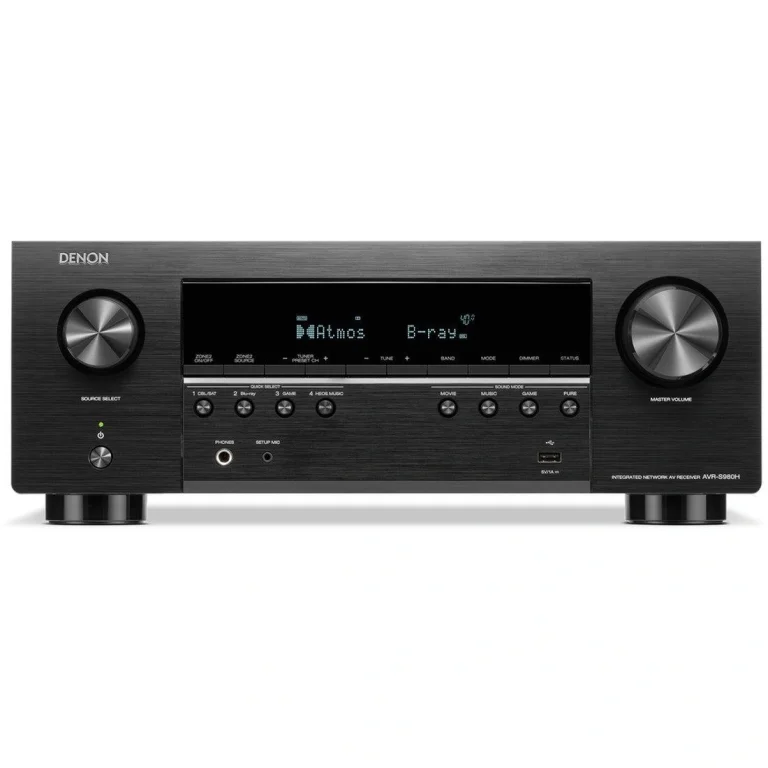
This Denon AVR-X1700H review covers the ceiling pick of our under-500 AV receiver group — the only receiver in the cluster with genuine Dolby Atmos support for physical height speakers, six HDMI 2.1 inputs, Audyssey MultEQ XT room calibration, and HEOS built-in streaming with Wi-Fi. At its new retail price of $599 it sits above this budget. However, the Amazon Certified Renewed listing brings it to approximately $499 — placing the most capable hardware in this group at the top of the budget for buyers comfortable with a certified refurbished unit.
It sits at the ceiling of our roundup of the best AV receivers under $500 as the recommendation for buyers who want Dolby Atmos with real ceiling speakers. This review examines what the certified renewed condition actually means in practice, why the Dolby Atmos capability matters specifically for home theater, and which buyers get genuine value from the X1700H’s premium over the simpler alternatives lower in this group.
Quick Answer: The Denon AVR-X1700H Renewed is the best ceiling pick under $500 for buyers comfortable with Amazon Certified Renewed electronics. It is the only receiver in this group with physical Dolby Atmos support for ceiling or upward-firing height speakers. Six HDMI 2.1 inputs, Audyssey MultEQ XT room calibration, HEOS streaming with Wi-Fi, and 80W per channel complete the picture. The important caveat is that this is a renewed unit — stock and pricing fluctuate. Verify the current listing price before purchasing. For buyers who need a new unit, the Yamaha RX-V4A or Denon AVR-S570BT are the strongest alternatives.
This article contains affiliate links. If you purchase through them, we may earn a commission at no extra cost to you. This helps support AmplifierZone and allows us to keep creating in-depth, unbiased audio guides.
Who Is the Denon AVR-X1700H For?
The buyer it was designed for
The AVR-X1700H is built for the home theater enthusiast who wants the full object-based surround sound experience — Dolby Atmos with real acoustic energy coming from above, not simulated from the sides by virtual processing. This means ceiling-mounted speakers, in-ceiling speakers installed in the ceiling plane, or upward-firing Atmos modules placed on top of the front speakers that reflect sound off the ceiling. The acoustic effect of physical height speakers is meaningfully more convincing than virtual height processing in a real room — overhead effects in film soundtracks and games genuinely originate from above rather than being suggested by psychoacoustic tricks from floor-level speakers.
Beyond Dolby Atmos, the X1700H suits buyers who need more than four HDMI inputs — a gaming household with PS5, Xbox Series X, Apple TV 4K, and a Blu-ray player benefits from the six-input capacity without introducing a separate HDMI switch. Additionally, HEOS streaming with Wi-Fi makes it the only receiver in this group that competes with the Yamaha RX-V4A’s streaming capability — Spotify, TIDAL, Amazon Music, and local NAS storage are all accessible directly. Whether the room layout supports ceiling speakers and how they connect to an AV receiver is explained in the stereo vs AV receiver guide alongside the broader question of surround configuration choice.
The renewed condition — who should proceed
Amazon Certified Renewed is a specific programme with defined standards: units are inspected by Amazon-qualified suppliers, tested against manufacturer specifications, and repackaged with a minimum 90-day warranty. Cosmetic imperfections may be present, but functional performance must meet new-unit standards. For buyers who regularly purchase certified refurbished electronics — laptops, phones, audio equipment — the category is familiar and the value proposition clear. For buyers who exclusively buy new and consider refurbished a meaningful risk, none of the trade-offs in this group justify that discomfort — the Yamaha RX-V4A or Denon AVR-S570BT are the correct new-unit alternatives.
Check the price before reading further: The Amazon Certified Renewed listing for the AVR-X1700H fluctuates in price and availability. Verify the current listing price before making a purchase decision based on this review. If the renewed listing is above $500 at the time of purchase, it falls outside the budget this guide is designed for and the comparison framework changes.
Denon AVR-X1700H — Key Specifications
Denon AVR-X1700H 7.2-Channel AV Receiver (Amazon Certified Renewed)
- Channels: 7.2 — supports 5.1.2 Dolby Atmos with ceiling or upward-firing speakers
- Power output: 80W × 7 (8Ω)
- Dolby Atmos: Yes — full support, physical height speakers in 5.1.2 configuration
- DTS:X: Yes — full object-based surround alongside Dolby Atmos
- HDMI: 6× in / 2× out — HDMI 2.1, 8K/60Hz, 4K/120Hz, HDCP 2.3, ARC/eARC
- Gaming features: VRR, ALLM
- Video: 8K/60Hz passthrough, 4K/120Hz, Dolby Vision, HDR10+, Dynamic HDR
- Room calibration: Audyssey MultEQ XT — multi-point measurement, parametric correction
- Streaming: HEOS built-in, Wi-Fi, Bluetooth, Spotify, TIDAL, Amazon Music
- Voice control: Alexa, Google Assistant
- Condition: Amazon Certified Renewed — inspected, tested, 90-day minimum warranty
- Physical Dolby Atmos — supports ceiling or upward-firing height speakers in 5.1.2
- DTS:X — both major object-based surround formats fully supported
- Six HDMI 2.1 inputs, two outputs — most connectivity in this group by two ports
- Audyssey MultEQ XT — most sophisticated room calibration in this roundup
- HEOS built-in with Wi-Fi — streaming without a separate device
- 80W × 7 channels — powers a full 7.1 or 5.1.2 speaker configuration
- Amazon Certified Renewed — inspected, tested, Amazon return policy applies
- Renewed unit — 90-day warranty vs full manufacturer warranty on new purchase
- Stock and pricing fluctuate — may not always be available at or under $500
- New retail price is $599 — verify current renewed price before purchasing
- No AirPlay 2 — HEOS does not support lossless Apple Music streaming
- HEOS app reliability can vary — occasional connectivity reports on older firmware
View on Amazon — Check Current Price
Approx. price: ~$499 (renewed). Best ceiling pick — Dolby Atmos, HEOS, and MultEQ XT at the top of this budget. Stock and pricing vary — verify before purchasing.
Understanding the 7.2-channel configuration precisely matters here. In a 5.1.2 Dolby Atmos setup, the AVR-X1700H amplifies seven channels simultaneously: front left, front right, centre, surround left, surround right, height left, and height right — plus two subwoofer pre-outs. Height left and height right power the ceiling or upward-firing speakers that deliver Dolby Atmos object audio from above. In a standard 7.1 configuration without Atmos, the two extra channels become dedicated rear surround channels for a full 7.1 surround layout. Both configurations are available from one receiver. How these configurations compare for different room sizes is mapped in the speaker configuration guide.
Design and Build Quality
Denon AVR-X series standard
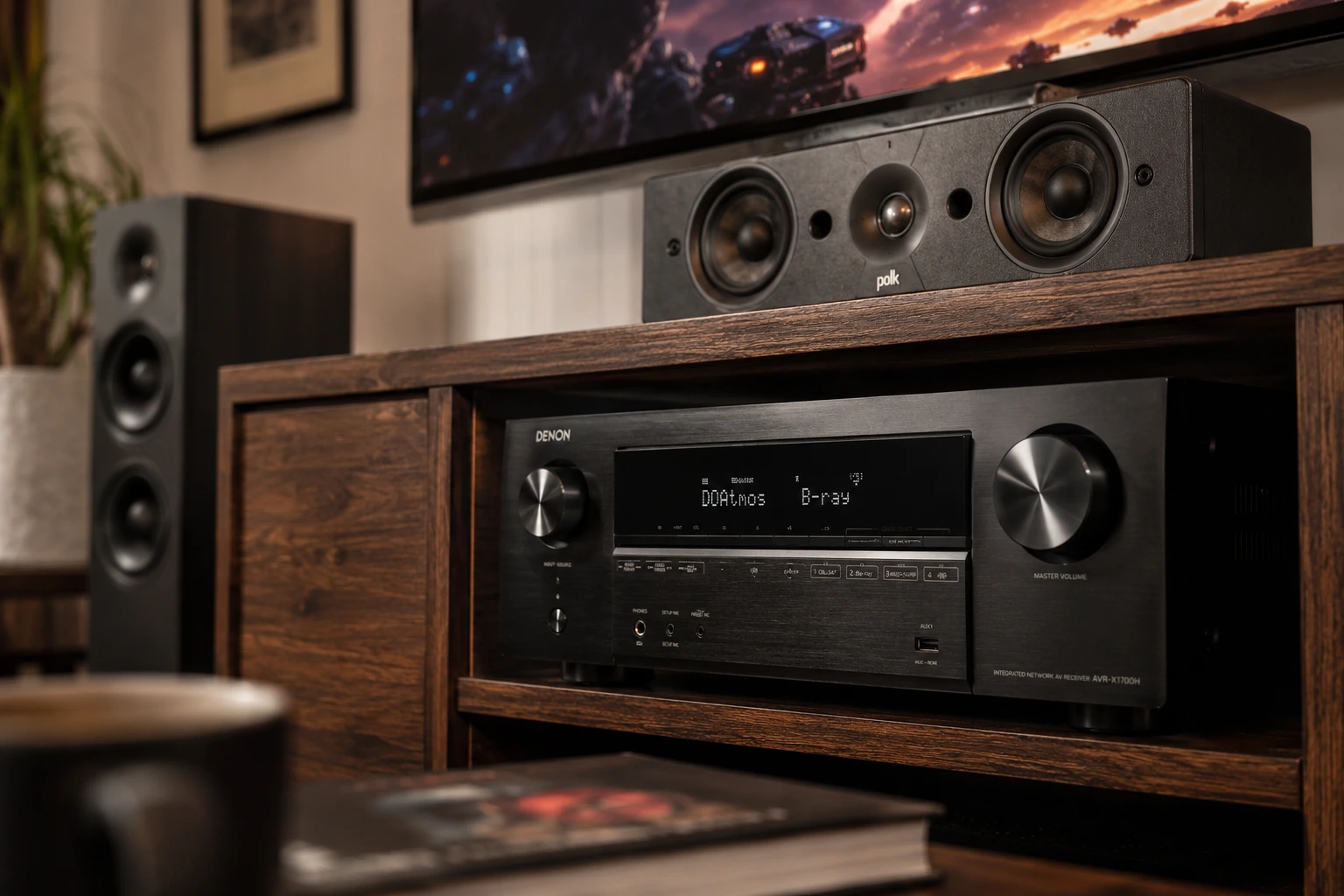
The AVR-X1700H is a step up from the S-series in Denon’s lineup — the X-series carries higher-grade internal components, wider power supply margins, and a more robust chassis. The front panel follows the same clean black aesthetic as the S570BT but with a more premium feel — the selector and volume controls have a more deliberate action, and the front panel display provides more information at a glance. The rear panel is denser than any other receiver in this group: six HDMI inputs, two outputs, seven pairs of speaker binding posts, two subwoofer pre-outs, and the full complement of digital and analogue inputs occupy the panel confidently.
Renewed condition — what to expect physically
Amazon Certified Renewed units may exhibit minor cosmetic differences from a new unit — light scratches on the chassis, marks on the finish, or missing original packaging inserts. Functional performance must meet new-unit specifications under the programme’s standards. The included accessories — remote, calibration microphone, power cable, and basic documentation — are present but may not be the original manufacturer versions. For a component that sits in an AV cabinet or on a shelf where the front face is the only visible surface, minor chassis cosmetics are rarely practically significant.
Audyssey MultEQ XT setup
MultEQ XT is Denon’s most sophisticated room calibration system available below the AVR-X3700H. Unlike the basic Audyssey in the AVR-S570BT — which measures from one position — MultEQ XT measures from up to eight positions throughout the room and applies correction curves based on the aggregate of those measurements. The result is more accurate equalisation across a broader listening area, better room mode correction in the bass frequencies, and more precise distance and level calibration for height speakers. In rooms with significant acoustic challenges — parallel walls, hard surfaces, low ceilings — the multi-point measurement produces a noticeably more coherent and natural surround image than single-point calibration.
Sound Quality
Dolby Atmos — what physical height speakers change
The single most important question about the AVR-X1700H in the context of this group is whether physical Dolby Atmos is meaningfully better than virtual height processing. The honest answer is yes — and the difference is most clearly audible in specific content types. Overhead rain, helicopter rotors, aircraft in flight, and music with spacious reverb tails are the most revealing Atmos content categories. Through physical ceiling speakers, these sounds originate convincingly from above — the brain locates them at the ceiling because that is where the acoustic energy is actually coming from. Through virtual processing from floor-level speakers, the same sounds are suggested rather than located — the effect is real but approximate. In a treated room with well-placed height speakers, the AVR-X1700H’s Dolby Atmos is a qualitatively different experience from any other receiver in this group.
HEOS streaming quality
HEOS handles Spotify, TIDAL, Amazon Music, TuneIn, Deezer, and local NAS storage accessed over Wi-Fi directly from the receiver. Audio quality via HEOS from TIDAL and Spotify streams at the services’ full quality — network streaming bypasses the phone’s audio output entirely. The notable limitation relative to the Yamaha RX-V4A is the absence of AirPlay 2: HEOS does not support Apple Music lossless streaming directly. Apple Music users who want lossless quality need to stream via AirPlay from a phone or Apple TV, which works as a workaround but is less seamless than the RX-V4A’s native AirPlay 2 integration.
Amplifier character for movies and music
Denon’s house sound in the X-series is warm and musically engaged — the same character as the S-series but with more refinement and control at higher power levels. Movie soundtracks through Dolby TrueHD and DTS-HD Master Audio have genuine weight and precision. Dialogue clarity through the centre channel is particularly strong — a characteristic of the X-series’ more capable centre channel amplification. Extended listening sessions on both movie and music content are comfortable and involving.
Denon AVR-X1700H review — the capability gap over the rest of this group
- Dolby Atmos with ceiling speakers: Only this receiver in the group supports physical height channels — the difference over virtual is audible and meaningful
- Six HDMI 2.1 inputs: Two more than every other receiver here — handles multiple consoles, streamers, and Blu-ray simultaneously
- Audyssey MultEQ XT: Multi-point measurement produces more accurate room correction than single-point basic Audyssey or YPAO
- HEOS streaming: Wi-Fi streaming without a separate device — Spotify, TIDAL, Amazon Music, local NAS
- The renewed caveat: Stock fluctuates and the 90-day warranty is shorter than new — verify price and availability before purchasing
Connectivity and Compatibility
Six HDMI 2.1 inputs — the practical advantage
Six HDMI 2.1 inputs with two HDMI outputs is the most generous connectivity in this group by a meaningful margin. In a fully populated gaming household — PS5, Xbox Series X, Apple TV 4K, Blu-ray player, Nintendo Switch, and a media server — all six sources connect simultaneously at HDMI 2.1 bandwidth without any switching or compromises. Both HDMI outputs allow the receiver to feed two displays simultaneously, which suits setups where a projector and a TV share the same source. VRR and ALLM on the gaming inputs handle current-generation console features without manual mode changes.
Ceiling speakers and height channel configuration
Connecting ceiling speakers or upward-firing Atmos modules to the AVR-X1700H uses the same binding posts as standard speaker connections — the height left and height right channel outputs on the rear panel. During setup, Audyssey MultEQ XT identifies the height speaker positions and calibrates their output levels, distances, and frequency response as part of the full-system calibration. The receiver then applies Dolby Atmos object audio metadata to direct specific sound objects to the height channels in real time during playback. The physical process of installing ceiling speakers and routing cables is covered step by step in the ceiling speaker connection guide.
HEOS setup and streaming
Initial HEOS setup connects the receiver to the home Wi-Fi network through the HEOS app on iOS or Android — the process takes approximately five minutes. Once connected, the receiver appears in the app alongside any other HEOS-compatible Denon or Marantz devices in the home, and all can be controlled from a single interface for multi-room audio. Spotify Connect, TIDAL Connect, and Amazon Music are accessible directly through the app without requiring a phone as an intermediate device. For Apple Music lossless, AirPlay from a connected phone or Apple TV routes through the receiver’s HDMI or analogue inputs as a workaround.
How the Denon AVR-X1700H Compares
Denon AVR-X1700H vs Yamaha RX-V4A
The most closely matched competition in this group. Both provide HDMI 2.1 gaming features, Wi-Fi streaming, and strong room calibration. The X1700H leads on physical Dolby Atmos, six HDMI inputs versus four, and Audyssey MultEQ XT versus YPAO. The RX-V4A counters with AirPlay 2 for lossless Apple Music — which HEOS doesn’t provide — a phono MM input, and the certainty of a new unit with full manufacturer warranty. For buyers without ceiling speaker plans and with three or fewer HDMI sources, the RX-V4A is the better value. For buyers with ceiling speakers or a complex multi-source setup, the X1700H’s additional capability justifies the renewed purchase.
Denon AVR-X1700H vs Denon AVR-S570BT
Both are Denon receivers with HDMI 2.1 gaming features. The capability gap between them is significant: the X1700H adds physical Dolby Atmos, two additional HDMI inputs, Audyssey MultEQ XT, HEOS streaming with Wi-Fi, and two extra amplifier channels. At approximately $50 more on the renewed listing, the X1700H provides considerably more hardware. For buyers without ceiling speakers and without streaming needs, the AVR-S570BT handles gaming and movies identically for less. For buyers who want Dolby Atmos or whole-home streaming, the X1700H is the only choice in this group.
Denon AVR-X1700H vs Sony STRDH590
A fundamental capability difference at a comparable price. At approximately $1 less than the X1700H renewed, the STRDH590 uses HDMI 2.0, lacks Dolby Atmos, and provides Bluetooth-only streaming. Meanwhile, the X1700H adds HDMI 2.1 on six inputs, physical Dolby Atmos, HEOS streaming, and Audyssey MultEQ XT. Sony’s advantage remains a new unit with 5,900+ reviews — the X1700H is a renewed unit with less review history at this price. For buyers who prioritise new-unit confidence over capability, the Sony is defensible. For buyers focused on what the hardware delivers, the X1700H outperforms the Sony across every relevant specification.
Best Speaker Pairings
The X1700H’s 7.2ch capability opens configurations not available with 5.2ch receivers. These are the most practical setups:
| Configuration | Speakers needed | Room size | Result |
|---|---|---|---|
| 5.1.2 Dolby Atmos | FL + FR + C + SL + SR + 2× ceiling/upward-firing + sub | Small–large | Excellent — the full Atmos experience with genuine overhead localisation |
| 7.1 surround (no Atmos) | FL + FR + C + SL + SR + RL + RR + sub | Medium–large | Very good — fuller surround envelopment in larger rooms |
| 5.1 standard surround | FL + FR + C + SL + SR + sub | Small–medium | Good — same as any 5.2 receiver; leaves height channels unused |
| Klipsch RP series 5.1.2 | RP-600M + RP-504C + RP-600M surround + R-41SA Atmos + sub | Medium–large | Excellent — Klipsch’s high sensitivity maximises the X1700H’s Atmos performance |
| Polk Audio Reserve 5.1.2 | R200 + R400C + R200 surround + R900 Atmos modules + sub | Medium | Very good — Polk’s Atmos modules pair naturally with Denon’s warm character |
Is the Denon AVR-X1700H Worth It?
For Atmos buyers — unambiguously yes
For any buyer who has ceiling speakers installed or is planning to install them, the AVR-X1700H is the only valid choice in this entire group — full stop. No other receiver under $500 supports physical Dolby Atmos. The renewed condition is a manageable trade-off for the capability it enables: a 90-day warranty, potential minor cosmetic marks, and pricing that fluctuates are reasonable concessions for a receiver that would otherwise cost $599 new. For buyers who want Dolby Atmos and are building their home theater from scratch, the X1700H at $499 renewed is one of the most cost-effective ways to add height channel audio to a real room.
For buyers without ceiling speakers — consider carefully
Without ceiling speakers in the plan, the X1700H’s primary advantages over the Yamaha RX-V4A are six HDMI inputs versus four and Audyssey MultEQ XT versus YPAO — both meaningful but not decisive for most setups. If the HDMI input count and calibration refinement are worth $39 over the RX-V4A’s new-unit certainty and AirPlay 2 advantage, the X1700H is a defensible choice. If not, the RX-V4A is the more rational new-unit purchase for non-Atmos setups.
Renewed stock check: The Amazon Certified Renewed listing for the AVR-X1700H is subject to stock availability. The listing may be unavailable at certain times, may price above $500, or may show extended shipping times. Always verify the current price and availability before making a purchase decision. If the renewed listing is not available or is priced above $500 when you check, consider the Yamaha RX-V4A or Denon AVR-S570BT as alternatives.
Denon AVR-X1700H Review — Final Verdict
The most capable receiver in this group
The Denon AVR-X1700H earns its position as the ceiling pick in this group by providing hardware that simply isn’t available elsewhere under $500 — physical Dolby Atmos with ceiling speakers, six HDMI 2.1 inputs, Audyssey MultEQ XT multi-point room calibration, and HEOS streaming with Wi-Fi. Denon’s warm and musically engaging house sound gives it a satisfying audio character for both movies and music. The X-series chassis and component quality are a step above the S-series receivers in this group. For a buyer who wants the best home theater receiver available under $500 and is comfortable with certified renewed electronics, the AVR-X1700H is the answer without qualification.
Closing the loop
Every receiver in this group serves a different listener — from the JBL MA310 at the entry point to the AVR-X1700H at the ceiling. The right choice is the one that matches the actual use case, the actual speakers, and the actual room. For the complete picture across all five AV receivers currently available under $500, the complete roundup maps every use case and price point in detail.
Approx. price: ~$499 (renewed). Best ceiling pick — Dolby Atmos, HEOS, and MultEQ XT at the top of this budget. Verify stock and price before purchasing.
Frequently Asked Questions
Does the Denon AVR-X1700H support Dolby Atmos with real ceiling speakers?
Yes — and it is the only receiver in this under-500 group that does. The AVR-X1700H powers height left and height right channels for ceiling-mounted speakers, in-ceiling speakers, or upward-firing Atmos modules in a 5.1.2 configuration. Dolby Atmos object audio is processed correctly and directed to the appropriate height channel in real time during playback. DTS:X is also supported for DTS object-based surround content. All other receivers in this group either have no Atmos support or provide virtual height processing only from standard floor-level speakers.
What does Amazon Certified Renewed mean for the AVR-X1700H?
Amazon Certified Renewed means the unit has been inspected, tested against manufacturer specifications, and refurbished by an Amazon-qualified supplier. It comes with a minimum 90-day warranty and is covered by Amazon’s standard return policy. Minor cosmetic imperfections may be present — light marks on the chassis or non-original packaging. Functional performance must meet new-unit standards under the programme’s requirements. The renewed listing stock and price fluctuate — verify the current price and availability before purchasing. If the listing is priced above $500, it falls outside the comparison framework for this group.
How many HDMI inputs does the Denon AVR-X1700H have?
Six HDMI 2.1 inputs and two HDMI outputs. All six inputs support 4K/120Hz, 8K/60Hz, VRR, and ALLM. Two outputs allow the receiver to feed two displays simultaneously — a TV and a projector, for example. Six inputs is two more than any other receiver in this under-500 group, making it the practical choice for households with five or more simultaneous HDMI sources.
Does the Denon AVR-X1700H support AirPlay 2 for Apple Music?
No — HEOS does not support AirPlay 2 natively. Apple Music lossless streaming requires AirPlay from a connected phone, iPad, or Apple TV as an intermediate device — routing audio to the receiver via HDMI or AirPlay from a source device. For native AirPlay 2 integration with Apple Music at lossless quality without an intermediate device, the Yamaha RX-V4A is the only receiver in this group with built-in AirPlay 2. HEOS does support Spotify Connect, TIDAL Connect, and Amazon Music directly without an intermediate device.
What is Audyssey MultEQ XT and how does it differ from basic Audyssey?
Audyssey MultEQ XT measures room acoustics from up to eight positions throughout the listening area and applies correction curves based on the aggregate of those measurements. Basic Audyssey — found in the Denon AVR-S570BT — measures from one position only and applies simpler correction curves. MultEQ XT produces more accurate room mode correction in the bass frequencies, better equalisation across a wider listening area, and more precise calibration for height speakers in Atmos configurations. In acoustically challenging rooms with parallel walls, hard surfaces, or irregular shapes, MultEQ XT’s multi-point approach produces a noticeably more coherent surround image than basic single-point calibration.