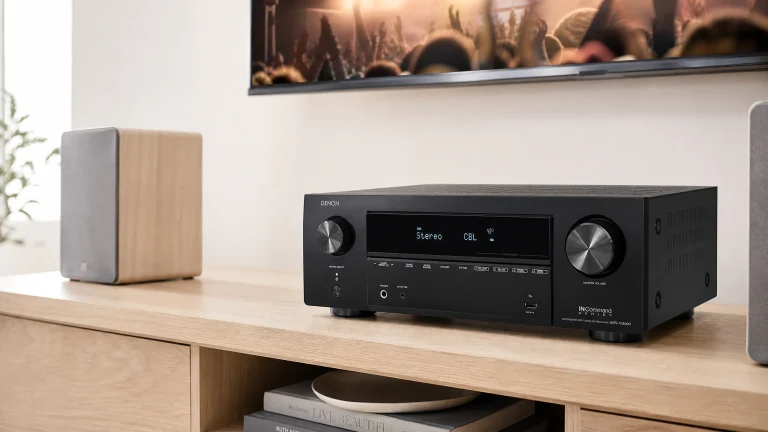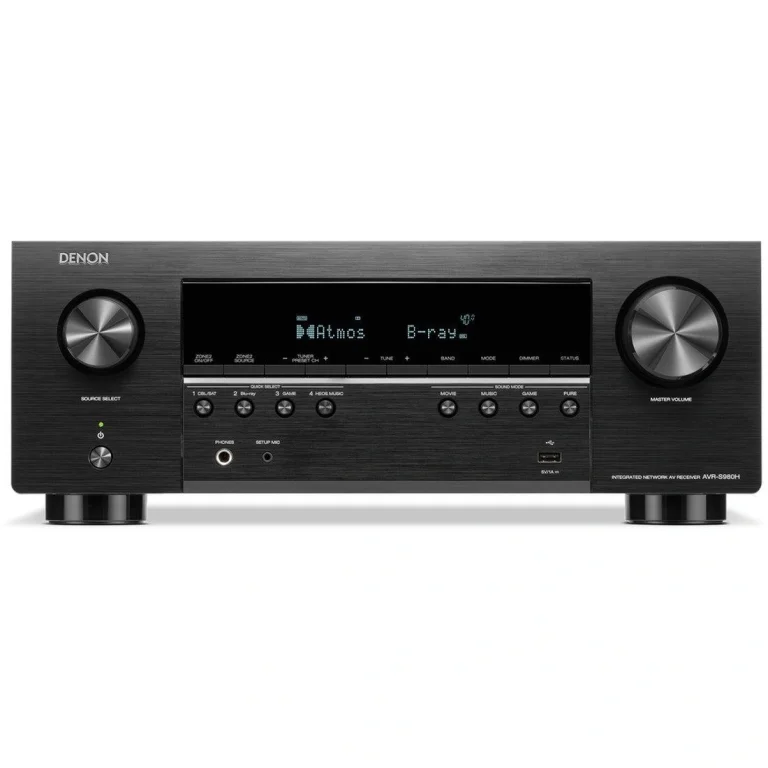
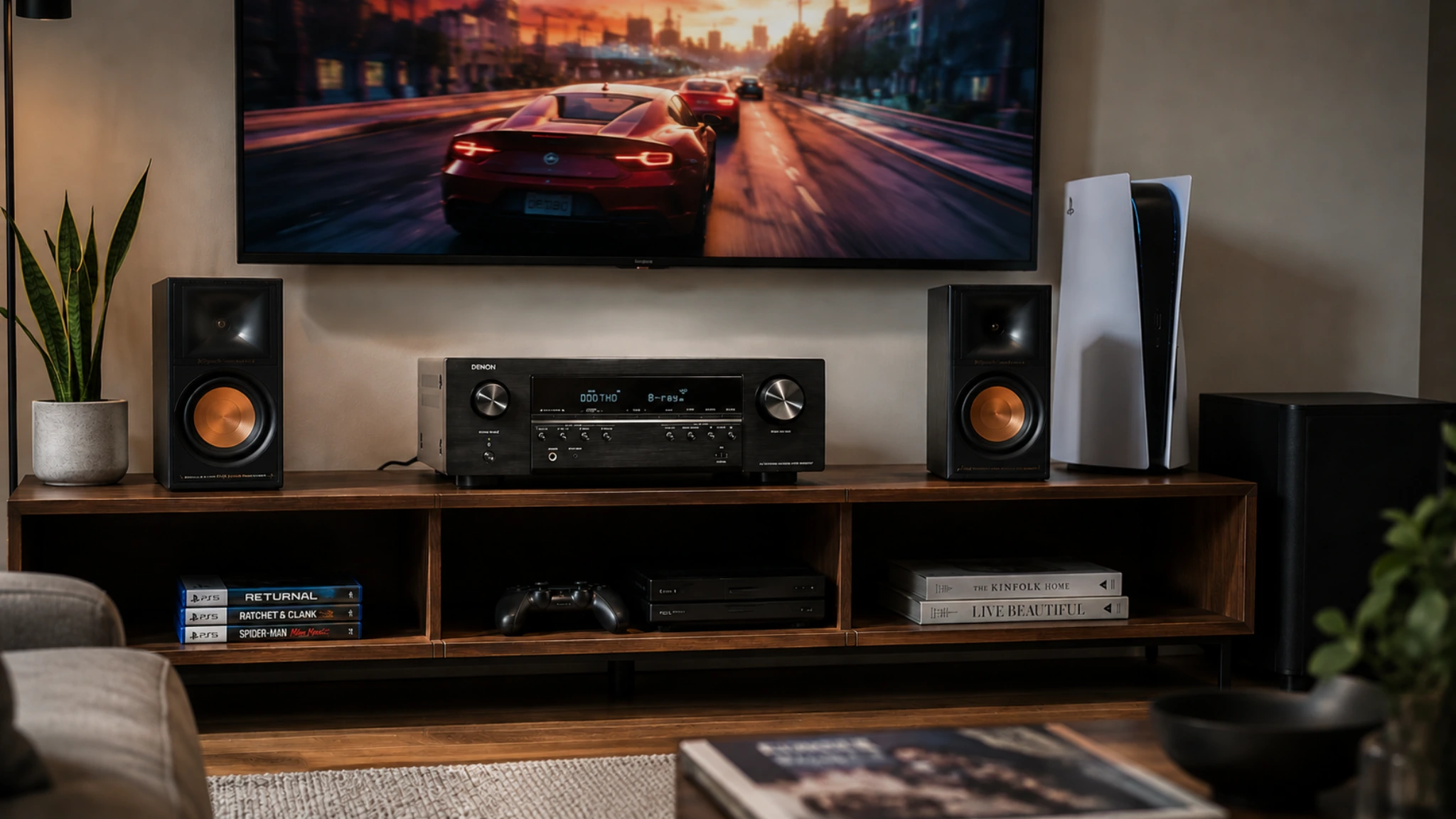
This Denon AVR-S570BT review covers the AV receiver that solves the most frustrating problem in gaming home theater setups: a receiver sitting between a PS5 or Xbox Series X and a 4K/120Hz TV that silently caps the video signal at 4K/60Hz. The AVR-S570BT eliminates that problem with HDMI 2.1 on all four inputs — 4K/120Hz, 8K/60Hz, VRR, and ALLM pass through correctly regardless of what the console and TV support. Its appeal is straightforward: it combines current-generation gaming connectivity with a focused 5.2-channel design, while the absence of network streaming keeps the feature set simpler than many alternatives.
It sits in our roundup of the best AV receivers under $500 as the gaming recommendation. This review goes deeper — examining what HDMI 2.1 actually changes in daily use, how the AVR-S570BT sounds across movie and music content, and precisely which buyers benefit from its specific feature combination versus those who would be better served elsewhere.
Quick Answer: The Denon AVR-S570BT is the best AV receiver under $500 for PS5 and Xbox Series X owners who want 4K/120Hz gaming through their receiver without the signal being capped. HDMI 2.1 on all four inputs, VRR, ALLM, and QFT cover every current-generation gaming feature without relying on mutable marketplace popularity claims. Trade-offs are clear: no Dolby Atmos physical support, Bluetooth-only streaming, and basic Audyssey room calibration. For buyers who primarily stream music throughout the house, the Yamaha RX-V4A with AirPlay 2 and MusicCast is the better fit.
This article contains affiliate links. If you purchase through them, we may earn a commission at no extra cost to you. This helps support AmplifierZone and allows us to keep creating in-depth, unbiased audio guides.
Who Is the Denon AVR-S570BT For?
The buyer it was designed for
The AVR-S570BT is built for the household where gaming and movies share equal priority — specifically the household with a PS5 or Xbox Series X, a 4K/120Hz television, and a desire to run both through a proper surround sound system without any component in the chain limiting the video signal. HDMI 2.1’s 48Gbps bandwidth is what allows 4K/120Hz and VRR to pass through simultaneously; HDMI 2.0’s 18Gbps bandwidth cannot carry the signal at those specifications. An HDMI 2.0 receiver in the chain drops 4K/120Hz to 4K/60Hz, and VRR stops functioning. The AVR-S570BT removes those limitations entirely by providing HDMI 2.1 on all four inputs — not just one or two, which is a common compromise on more expensive receivers.
When to look elsewhere
The AVR-S570BT is a poor fit for music-first households who stream from Apple Music or want whole-home audio through an app ecosystem. Bluetooth-only streaming is a meaningful limitation for daily music use compared to the Yamaha RX-V4A’s MusicCast and AirPlay 2. It also lacks Dolby Atmos physical support — ceiling speakers cannot deliver height audio through this receiver. And for buyers who rarely game at all, paying for HDMI 2.1 over HDMI 2.0 is a capability they won’t use. Whether a 5.1 surround configuration is the right approach for your room versus stereo is worth considering before committing to any AV receiver — the stereo vs AV receiver guide covers that decision clearly.
Quick check: Does your TV support 4K/120Hz? Do you own a PS5 or Xbox Series X and play games that run at 4K/120Hz? If both are true, HDMI 2.1 in the receiver is essential for getting the full signal through. If your TV is 4K/60Hz only, the extra bandwidth doesn’t change anything — and the JBL MA310 or Sony STRDH590 serve the same use case at comparable prices.
Denon AVR-S570BT — Key Specifications
Denon AVR-S570BT 5.2-Channel AV Receiver

- Channels: 5.2 (5 amplified + 2 subwoofer pre-outs)
- Power output: 70W × 5 (8Ω, 20Hz–20kHz, 0.08% THD)
- Dolby Atmos: No — Dolby TrueHD, DTS-HD Master Audio, DTS Neural:X (virtual height)
- HDMI: 4× in / 1× out — HDMI 2.1, 8K/60Hz, 4K/120Hz, HDCP 2.3, ARC/eARC
- Gaming features: VRR (Variable Refresh Rate), ALLM (Auto Low Latency Mode), QFT
- Video: 8K/60Hz passthrough, 4K/120Hz, HDR10+, Dolby Vision, Dynamic HDR
- Room calibration: Audyssey (basic) with included microphone
- Streaming: Bluetooth — no Wi-Fi
- Inputs: 4× HDMI 2.1, optical, coaxial, 2× analogue stereo
- HDMI 2.1 on all 4 inputs — 4K/120Hz and 8K/60Hz passthrough without signal loss
- VRR — reduces tearing in compatible gaming setups
- ALLM — switches to low-latency mode when supported
- QFT (Quick Frame Transport) — helps reduce display latency
- HDR10+, Dolby Vision, Dynamic HDR — broad HDR format coverage
- eARC — sends compatible TV audio back to the receiver
- No Dolby Atmos — 5.2ch, no physical height channel support
- Bluetooth only — no Wi-Fi, no streaming app ecosystem
- Basic Audyssey — less sophisticated room correction than MultEQ XT
- No HEOS streaming platform
- No phono input — turntable requires external preamp
AmplifierZone Editorial Rating
The Denon AVR-S570BT is the definitive gaming AV receiver under $500, offering HDMI 2.1 with VRR, ALLM, and 4K/120Hz on all four inputs — a feature completeness that no similarly priced competitor matches. At 70W × 5 channels, it powers a 5.2 system with clean, headroom-rich output suitable for both film soundtracks and gaming audio.
Reviewed by AmplifierZone Editorial Team · September 2026
Best for gaming — HDMI 2.1 with VRR and 4K/120Hz on all inputs. Marketplace price and availability can change; check the current listing before purchase.
The HDMI 2.1 specification deserves its own explanation because it is the defining feature of this receiver. HDMI 2.0 provides 18Gbps of bandwidth — enough for 4K/60Hz with HDR. HDMI 2.1 provides 48Gbps — enough for 4K/120Hz with HDR, 8K/60Hz, and the variable refresh rate signalling that VRR requires. When a PS5 outputs a 4K/120Hz signal and that signal passes through an HDMI 2.0 receiver, the receiver cannot carry the full bandwidth and drops the signal to 4K/60Hz. HDMI 2.1 removes that constraint. The practical difference is that games running at 120fps on a 4K/120Hz TV display at their native frame rate rather than being throttled.
Design and Build Quality
Chassis and front panel
The AVR-S570BT follows Denon’s standard NE-series design language — a clean black front panel with an alphanumeric display, volume knob, input selector, and a slim profile that fits standard AV furniture without difficulty. Build quality is consistent with Denon’s established reputation at this price: solid chassis, quality speaker binding posts, and a front panel that doesn’t feel fragile. The unit runs warm under extended use — leave ventilation space above the chassis, as with any AV receiver operating at moderate to high power levels.
Remote and setup experience
The included remote handles all primary functions and is straightforward to navigate without consulting the manual. Denon’s Audyssey basic setup process guides through microphone placement and speaker measurement on the TV screen when connected. The HD Setup Assistant walks through initial configuration step by step.
Build for longevity
Denon’s S-series receivers have a consistent track record for long-term reliability. Internal component selection follows the same conservative engineering approach that the higher-end Denon AVR-X series uses, scaled appropriately for the price point. Long-term reliability depends on ventilation, usage, and individual unit condition.
Sound Quality
Movie and game audio
Denon’s audio character in the S-series is warm and musically engaged — the same house sound that appears in the PMA integrated amplifier line, translated into a home theater receiver context. Movie soundtracks through Dolby TrueHD and DTS-HD Master Audio have genuine weight and presence. Action sequences with significant LFE content are handled confidently with appropriate bass extension to the subwoofer. Dialogue clarity through the centre channel is one of the AVR-S570BT’s stronger qualities — voices stay stable and natural during scenes where ambient sound effects surround them.
For gaming audio, the DTS:X virtual processing that the AVR-S570BT provides creates a sense of height and spatial depth from a standard 5.1 speaker layout without ceiling speakers. This virtual height processing is not the same as physical Dolby Atmos, and results vary with the room, speakers, and source content.
Music listening
Via Bluetooth or through the optical and coaxial digital inputs, the AVR-S570BT provides a practical two-channel listening option. The absence of a phono input means turntable users need an external phono preamp between the turntable and one of the analogue RCA inputs.
Denon AVR-S570BT review — the gaming features explained simply
- HDMI 2.1: Allows compatible 4K/120Hz and 8K/60Hz video signals to pass through the receiver
- VRR: Synchronises a compatible display’s refresh rate to the game’s output
- ALLM: Automatically selects a low-latency mode when supported
- QFT: Helps reduce the overall latency of the HDMI signal chain
- eARC: Carries compatible TV audio back to the receiver over HDMI
Connectivity and Compatibility
HDMI inputs and gaming setup
All four HDMI inputs are HDMI 2.1. Having HDMI 2.1 on every input means multiple current-generation sources can connect simultaneously without reserving one specific port for a compatible signal. The HDMI output includes eARC for compatible TV audio.
Digital and analogue inputs
Beyond the four HDMI inputs, the AVR-S570BT includes one optical Toslink input, one coaxial digital input, and two analogue stereo RCA inputs. There is no phono input — a turntable requires an external phono preamp connected to one of the analogue RCA inputs.
Streaming and network
Bluetooth is the only wireless connectivity option — there is no Wi-Fi, no HEOS streaming platform, no AirPlay, and no Spotify Connect directly in the receiver. Households that want the receiver itself to act as the streaming device should consider a model with built-in network features, such as the Yamaha RX-V4A.
How the Denon AVR-S570BT Compares
Denon AVR-S570BT vs JBL MA310
Compared with the JBL MA310, the AVR-S570BT adds HDMI 2.1 on all inputs, VRR, ALLM, QFT, eARC, HDR10+, and 8K passthrough over the MA310’s HDMI 2.0 feature set. Both lack physical Dolby Atmos, and both provide Bluetooth-focused streaming. For a buyer with a current-generation gaming console and a 4K/120Hz television, the Denon’s HDMI 2.1 capability is the more relevant distinction. For movie-only households with no gaming use case, the difference is less meaningful.
Denon AVR-S570BT vs Yamaha RX-V4A
Both provide HDMI 2.1 with VRR and ALLM. The meaningful differences are in streaming and calibration. The RX-V4A adds MusicCast multi-room audio, AirPlay 2, Wi-Fi, Spotify Connect, and YPAO room calibration; it does not provide a dedicated phono input, so turntable users still need a phono preamp. The RX-V4A is a different fit for music-first households.
Denon AVR-S570BT vs Denon AVR-X1700H Renewed
The X1700H Renewed adds genuine Dolby Atmos with physical ceiling speakers, six HDMI 2.1 inputs versus four, Audyssey MultEQ XT room calibration, and HEOS streaming with Wi-Fi; the current renewed listing should be checked for condition and offer details. For buyers with ceiling speakers already installed or planned, that capability gap is decisive. For buyers without ceiling speaker plans and with three or fewer HDMI sources, the AVR-S570BT provides equivalent gaming-focused HDMI capability in a simpler package.
Best Speaker Pairings
With its documented 70W-per-channel rating under Denon’s stated test conditions, the AVR-S570BT can suit many conventional home-theater speaker loads; actual headroom depends on sensitivity, impedance, room size, listening level, and bass-management settings. These general guidelines are more useful than treating any speaker package as universally optimal:
| Speaker characteristic | Typical fit | What to check |
|---|---|---|
| Higher sensitivity, nominal 6–8Ω load | Small to medium rooms | Comfortable headroom at ordinary listening levels |
| Moderate sensitivity bookshelf speakers | Small to medium rooms | Use a subwoofer and sensible crossover settings |
| Low-sensitivity or difficult impedance load | Larger rooms or louder listening | Check the manufacturer impedance guidance and receiver ventilation |
| Any conventional 5.1 layout | Movies and gaming | Confirm the receiver’s five amplified channels meet the intended layout |
For guidance on selecting compatible speakers, see our full article on how to match your amplifier to your speakers.
Is the Denon AVR-S570BT Worth It?
For gaming households — clearly yes
For a household where a PS5 or Xbox Series X is a central part of the entertainment system and 4K/120Hz gaming is a daily use case, the AVR-S570BT is a compelling receiver to consider. The combination of HDMI 2.1 on all four inputs, VRR, ALLM, and eARC is compelling for buyers who need those capabilities. The recommendation is based on the receiver’s documented HDMI and gaming feature set rather than marketplace sales volume.
When the case weakens
For households whose TV is 4K/60Hz only, HDMI 2.1 provides no practical benefit — and the JBL MA310 or Sony STRDH590 serve the same use case at comparable prices. For households who stream music daily through Apple Music or want whole-home audio without a separate streaming device, the AVR-S570BT’s Bluetooth-only streaming is a meaningful limitation. For any buyer with ceiling speakers or Atmos in the plan, this receiver cannot support that configuration.
Check your TV before buying: HDMI 2.1 in the receiver only matters if your TV also supports HDMI 2.1 on at least one input. Check your TV’s specifications for HDMI 2.1 or 4K/120Hz support before purchasing. If your TV is 4K/60Hz only, the AVR-S570BT’s HDMI 2.1 provides no additional benefit over HDMI 2.0 alternatives.
Denon AVR-S570BT Review — Final Verdict
What makes it the gaming recommendation
The Denon AVR-S570BT earns its position as the gaming receiver recommendation by providing the complete HDMI 2.1 feature set — not just the bandwidth, but VRR, ALLM, QFT, and eARC — on all four inputs. Denon’s warm audio character gives movie and gaming soundtracks genuine presence. Audyssey basic calibration handles speaker setup automatically. The focused feature set means nothing requires configuring beyond the initial speaker calibration — a straightforward, practical receiver that does what gaming households need from it.
The natural next step
For households who want the AVR-S570BT’s gaming capability alongside AirPlay 2, MusicCast whole-home audio, and YPAO room calibration, the Yamaha RX-V4A review covers the step up in streaming capability. For the complete picture across all five AV receivers currently available under $500, the complete roundup maps every use case.
Best for gaming — HDMI 2.1 with VRR and 4K/120Hz on all inputs. Marketplace price and availability can change; check the current listing before purchase.
Frequently Asked Questions
Does the Denon AVR-S570BT support Dolby Atmos?
Not with physical height speakers. The AVR-S570BT is a 5.2-channel receiver and cannot power ceiling or upward-firing height speakers for genuine Dolby Atmos. It does include DTS Neural:X virtual height processing, which is not the same as physical Atmos. If genuine Dolby Atmos with height speakers is a priority, the Denon AVR-S980H is the natural step-up.
What is VRR and why does it matter for gaming?
VRR synchronises a compatible display’s refresh rate to the console’s frame-rate output, reducing tearing. ALLM works alongside it by automatically selecting a low-latency game mode when supported.
Does the Denon AVR-S570BT have Wi-Fi or streaming apps?
No. The AVR-S570BT provides Bluetooth but no built-in Wi-Fi, HEOS, AirPlay, or Spotify Connect. A separate streaming device can connect through HDMI or optical.
How does the Denon AVR-S570BT Audyssey calibration work?
The included microphone measures speaker distances, levels, and response through the receiver’s setup process. Treat the result as a starting point and verify the settings in the listening room.
Is the Denon AVR-S570BT good for movies as well as gaming?
Yes. Dolby TrueHD and DTS-HD Master Audio decoding support lossless Blu-ray audio, while the HDMI 2.1 gaming features are an additional capability rather than a replacement for movie playback.