KEF speakers are often described as easy to place and easy to enjoy, but the amplifier still matters. A compact Q150 in a small room does not ask the same questions as an LS50 Meta in a larger listening space. Sensitivity, minimum impedance, listening distance, room size, TV connectivity, streaming, and subwoofer plans all change what “enough power” means.
That is why the best amplifier for KEF speakers is not automatically the one with the largest wattage number. The right choice gives your particular KEF pair enough clean headroom, matches the way you listen, and includes the connections you will actually use. KEF’s own amplifier-matching guidance emphasizes listening level, room size, program material, sensitivity, and impedance rather than a single universal power figure [1].
The short answer: the Marantz MODEL M1 is the strongest all-in-one match for many KEF owners who want streaming, TV audio, room correction, and 100-watt-class headroom. The WiiM Amp is the better compact-value choice for Q150 or Q350 systems in smaller rooms, while the Yamaha A-S501 remains the sensible traditional integrated amplifier for listeners who already have a streamer or want phono and conventional inputs.
Affiliate Disclosure: AmplifierZone is reader-supported. As an Amazon Associate I earn from qualifying purchases. Product availability and offer details can change, so use the product image or Amazon link to check the current listing before you buy.
- How we matched amplifiers to KEF speakers
- Best overall: Marantz MODEL M1
- Best value: WiiM Amp
- Best HEOS TV-and-music option: Denon Home Amp
- Best traditional amplifier: Yamaha A-S501
- Best for Sonos homes: Sonos Amp
- Best power-amplifier building block: Fosi Audio ZA3
- KEF speaker matching table
- How much power do KEF speakers need?
- Final recommendations
- Frequently Asked Questions
How we matched these amplifiers to KEF speakers
We treated this as a system-matching guide rather than a race to the highest rated output. The KEF models most likely to appear in this conversation include the Q150, Q350, and LS50 Meta. The Q150 is rated at 86 dB sensitivity, with a recommended amplifier range of 10–100 watts and a published minimum impedance of 3.7 ohms. The Q350 is slightly more sensitive at 87 dB and carries a 15–120-watt recommendation, while the LS50 Meta is rated at 85 dB, recommended for 40–100 watts, and reaches a published minimum impedance of 3.5 ohms [2] [3] [4].
Those figures do not mean that every Q150 needs 100 watts or that every LS50 Meta needs a dedicated power amplifier. They do explain why a small amplifier can feel effortless with one setup and strained in another. Lower sensitivity, longer listening distance, a large room, bass-heavy material, and sustained high volume all consume headroom. An amplifier that clips when a track demands a peak is not made safer by the fact that its average listening level is normally modest.
We also separated all-in-one streaming amplifiers from conventional integrated amplifiers and power-amplifier building blocks. That distinction matters. A streamer amp can simplify a TV-and-music system, but a conventional integrated amplifier may offer a better phono stage and more physical inputs. A power amplifier can offer excellent output per dollar, but it still needs a source component with volume control.
If you are unsure how room size and listening level affect your target, use the Amplifier Wattage Calculator as a starting point, then treat its result as guidance rather than a laboratory guarantee. KEF speaker matching is ultimately a system decision.
Best overall: Marantz MODEL M1
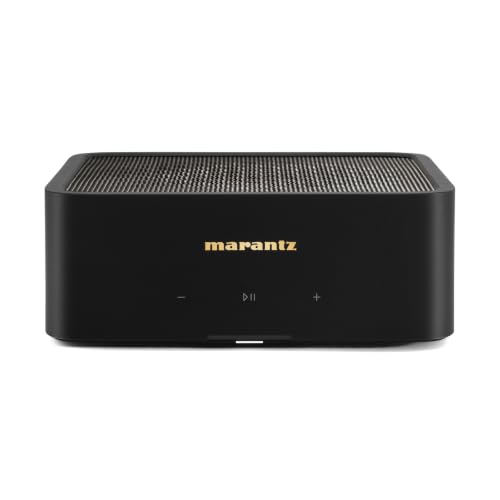
Best for: KEF owners who want a premium, modern all-in-one system for music, television, and a subwoofer.
The Marantz MODEL M1 is the most complete match in this group when the goal is to build one serious stereo system rather than assemble separate boxes. Marantz rates it at 100 watts per channel and combines that output with HEOS streaming, HDMI eARC, high-resolution playback, a subwoofer output, and 2.1-channel support [5].
That combination suits the KEF models that benefit from more headroom without needing the complexity of an AV receiver. With Q350 speakers, the M1 leaves comfortable room for a medium or larger listening space. With LS50 Meta, its power rating is a sensible starting point, though placement and volume still matter because that speaker’s low sensitivity and 3.5-ohm minimum impedance make current delivery more relevant than the headline number alone.
Its other strength is system architecture. HDMI eARC makes the television a normal source instead of a separate problem, while HEOS gives the amplifier a broader multi-room path than a traditional integrated component. Add a powered subwoofer later and the system can grow without replacing the amplifier. The compromise is that the M1 is a modern network component first; listeners who want a built-in phono stage or a large collection of front-panel analog inputs should look at the Yamaha A-S501 or add the appropriate source hardware.
Best value: WiiM Amp
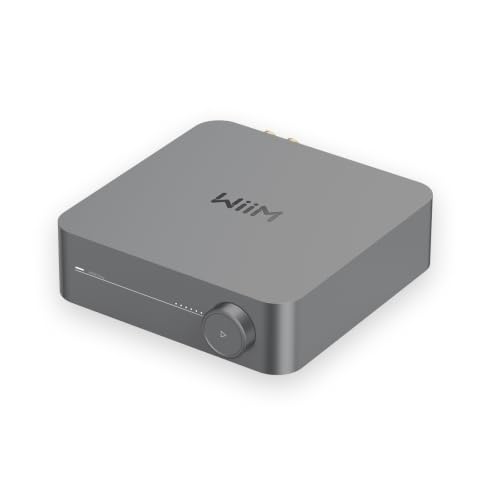
Best for: Q150 or Q350 owners building a compact TV-and-music system in a small or medium room.
The WiiM Amp is the practical value choice because it handles the jobs many KEF systems actually need without requiring a component stack. WiiM lists 60 watts per channel into 8 ohms and 120 watts per channel into 4 ohms, along with HDMI ARC, optical, line input, USB, Ethernet, Wi-Fi, two-way Bluetooth, a subwoofer output, and room-correction tools [6].
That makes it especially attractive with the Q150. The Q150 is not an impossible load, but its published 3.7-ohm minimum impedance means you should not interpret “bookshelf speaker” as “never demanding.” In a typical room at normal listening levels, the WiiM Amp is a coherent match. In a large open-plan room with sustained high volume, the Marantz MODEL M1, Denon Home Amp, or a traditional amplifier with more reserve becomes the safer long-term direction.
The WiiM’s HDMI ARC input is also useful for KEF owners who want a clean stereo television setup. Set the TV’s digital output to PCM stereo, because the WiiM Amp does not decode Dolby or DTS formats through its HDMI ARC or optical inputs. Its subwoofer output and room-correction tools make it easy to extend a Q150 system rather than asking the small bookshelf pair to produce all of the room’s lowest bass.
The main limitation is not sound quality; it is system scope. There is no dedicated phono input, and the amplifier is not a replacement for a surround receiver. Our wireless-versus-streaming amplifier guide explains why network playback is a different proposition from Bluetooth-only listening.
Best HEOS TV-and-music option: Denon Home Amp
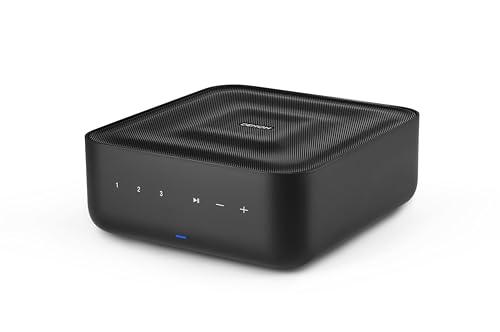
Best for: listeners who want a 100-watt-class HEOS amplifier with HDMI eARC and flexible subwoofer integration.
The Denon Home Amp occupies the space between the compact WiiM Amp and the more premium MODEL M1. Denon publishes 100 watts per channel into 8 ohms and adds HEOS, HDMI eARC, high-resolution streaming, multi-room control, and a subwoofer output with low- and high-pass crossovers [7].
That feature set makes it a natural fit for KEF owners who want one amplifier for music and TV but prefer the HEOS platform. It gives a Q350 system useful power reserve and provides a sensible all-in-one path for an LS50 Meta system in a moderate room. As always, the speaker’s placement, the listening distance, and the level you expect to sustain matter more than treating 100 watts as a magic threshold.
The Denon’s subwoofer controls are particularly useful when the KEF speakers are used in a living room rather than a nearfield desk setup. High-pass filtering can reduce the lowest-frequency work sent to the main speakers, while the powered subwoofer fills in the bass foundation. That is a more disciplined approach than simply turning up the amplifier and hoping a compact bookshelf pair behaves like a floorstander.
Choose the Denon over the WiiM Amp when HEOS, 100-watt-class output, and eARC are more important than the smallest possible chassis. Choose the Marantz instead when you want a more premium feature set and a stronger emphasis on room correction and high-resolution system control.
Best traditional amplifier: Yamaha A-S501

Best for: KEF owners who prefer a conventional integrated amplifier, physical inputs, and a built-in phono stage.
The Yamaha A-S501 is the least network-focused option here, and that is exactly why it remains relevant. Yamaha rates it at 85 watts per channel into 8 ohms and equips it with optical and coaxial digital inputs, an MM phono input, a subwoofer terminal, speaker A/B selection, and Pure Direct mode [8].
With KEF Q150 or Q350 speakers, the A-S501 makes sense when you want the amplifier to behave like a traditional central component. Connect a turntable directly, feed a television through optical, and add a separate network streamer when you want streaming. That modularity is less tidy than the WiiM or Marantz approach, but it avoids forcing every source into one proprietary application.
The A-S501 is also a sensible choice for a larger room or louder listening if you already have a network source. Its published power rating is not dramatically higher than every streamer amp, but its conventional chassis and power supply make it a more natural match for listeners who value physical inputs and long-term component flexibility. It is not, however, the right pick if you expect built-in multi-room streaming out of the box.
Best for Sonos homes: Sonos Amp
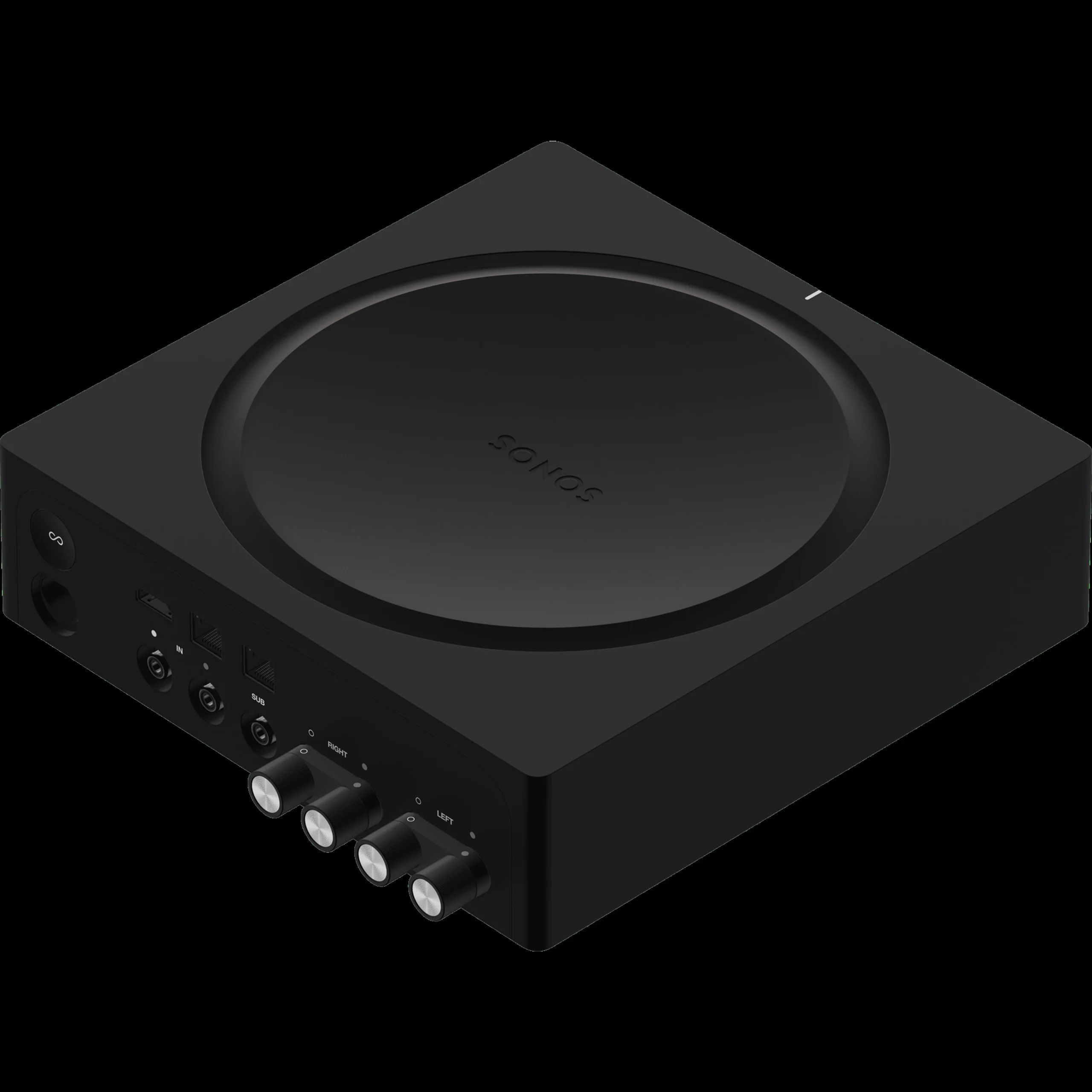
Best for: existing Sonos households that want to bring passive KEF speakers into the same multi-room system.
Sonos Amp is the most ecosystem-specific recommendation in this guide. Sonos publishes 125 watts per channel and positions the amplifier around passive speakers, TV audio, and multi-room control. The official user guide says Amp can drive speakers with nominal impedance above 4 ohms, supports two pairs of 8-ohm speakers wired in parallel, and should not be connected to speakers rated below 4 ohms [9].
That makes Sonos Amp a strong fit for KEF owners who already use Sonos throughout the home and want the same application, grouping, and control experience with passive speakers. Its TV integration is also straightforward, and the platform is easy for families to use once the household is already committed to it.
The trade-off is openness. If you are choosing an amplifier from scratch and want broad network protocols, a traditional source path, or the ability to move between ecosystems, WiiM, HEOS, or a conventional integrated amplifier gives you more flexibility. Also pay close attention to the KEF model’s minimum impedance. Sonos specifically says not to connect speakers rated below 4 ohms, so this is not the recommendation to make casually for a difficult load.
Best power-amplifier building block: Fosi Audio ZA3

Best for: experienced KEF owners who already have a streamer, DAC, or preamp and want a compact power stage.
The Fosi Audio ZA3 belongs in this guide because it solves a different problem. It is not a streaming amplifier or a conventional all-in-one integrated component. Fosi lists RCA, XLR, and 1/4-inch TRS inputs, stereo and mono operation, a passive-speaker output with sub-out, a 2–8-ohm terminating-impedance range, and rated output of 180 watts per channel into 4 ohms in stereo or 235 watts into 4 ohms in mono [10].
That output gives a KEF owner a lot of room to build around a separate source component. A ZA3 can make sense with LS50 Meta speakers when the source already provides volume control and the system owner is comfortable managing gain, cabling, and the boundaries of a small power amplifier. It can also be useful when a subwoofer or a second amplifier is part of a more deliberate system design.
The limitation is just as important as the power figure. The ZA3 has no built-in network streamer, HDMI eARC, phono stage, or room-correction platform. It is a power amplifier first. For a first KEF system, the WiiM Amp or Yamaha A-S501 is easier to live with; for a listener who already owns the front end, the ZA3 is a flexible value-oriented building block.
KEF speaker matching table
| KEF speaker use case | What matters most | Best starting points | Why |
|---|---|---|---|
| Q150 in a small or medium room | Compact streaming, sensible headroom, subwoofer option | WiiM Amp; Yamaha A-S501 | The Q150 is manageable, but its 3.7-ohm minimum impedance still rewards an amplifier that is comfortable with real speaker loads. |
| Q350 in a medium room | More scale and current reserve than a tiny desktop amplifier | Marantz MODEL M1; Denon Home Amp; Yamaha A-S501 | These choices give the larger bookshelf speaker a broader headroom and source-feature envelope. |
| LS50 Meta nearfield or moderate room | Clean headroom, placement, and control of a 3.5-ohm minimum load | Marantz MODEL M1; Denon Home Amp; Fosi ZA3 with a proper preamp | The LS50 Meta is less sensitive and deserves more careful matching than its compact cabinet suggests. |
| KEF speakers in an existing Sonos home | Platform continuity and supported impedance | Sonos Amp | The ecosystem benefit is the main reason to choose it; confirm the speaker load before connecting. |
| KEF system with a turntable | Phono input or a clear external-phono path | Yamaha A-S501; Marantz MODEL M1 with an external phono stage | The Yamaha has an MM phono input; the streamer amps need a separate phono stage. |
This table is a starting map, not a substitute for listening distance and room assessment. If you sit far from the speakers, listen loudly, or have a large open room, move toward the models with more headroom. If you listen nearfield or at moderate levels, features and system convenience can reasonably carry more weight.
How much power do KEF speakers need?
Use KEF’s recommended amplifier range as a boundary, not a promise. The published range tells you something about the intended operating window, but it does not know how far away you sit, how large the room is, how much bass your music contains, or how often you listen near the system’s limits. A 60-watt amplifier can be entirely comfortable in one Q150 system and a poor choice in another.
Headroom matters because music is dynamic. A track can have a moderate average level while still demanding a short peak from the amplifier. If the amplifier has no reserve, it can clip. Clipping is not fixed by turning the volume down after the fact; the useful design goal is to choose a system that remains composed before you reach that point.
Impedance is equally important. The Q150 and Q350 are nominally 8-ohm speakers, but KEF publishes a 3.7-ohm minimum impedance for both. LS50 Meta is also nominally 8 ohms but reaches a published 3.5-ohm minimum. That does not mean every amplifier will fail, but it does mean a buyer should avoid selecting solely from a nominal-impedance label.
Do not chase wattage without checking the system: higher output can provide useful headroom, but it does not excuse poor ventilation, incorrect speaker wiring, an unsuitable impedance load, or listening beyond the speaker’s safe limits.
A subwoofer can also change the decision. If the amplifier offers appropriate bass management or the subwoofer accepts a suitable signal, relieving the main speakers of the lowest frequencies can improve system balance. It is not a requirement for every KEF setup, but it is often a more effective upgrade than simply moving to a larger amplifier.
Final recommendations
Choose the Marantz MODEL M1 if you want the most complete modern KEF system in one box. Its 100-watt-class output, HEOS platform, HDMI eARC, room-correction features, and subwoofer support make it the broadest recommendation here.
Choose the WiiM Amp if your KEF system is compact, your room is small or medium, and value and simplicity matter most. It is a particularly strong Q150 starting point when you want network music and TV audio without a full equipment rack.
Choose the Denon Home Amp if you want HEOS and eARC with a similar 100-watt-class approach, or choose the Yamaha A-S501 if you prefer a conventional integrated amplifier with phono, digital inputs, and an easy path to a separate streamer.
Choose Sonos Amp only when the Sonos ecosystem is already a meaningful part of your home, and choose the Fosi Audio ZA3 when you understand that it is a power-amplifier building block rather than a complete source-and-control solution.
For broader context on whether a stereo amplifier is the right architecture for your room, compare this guide with our stereo amplifier versus AV receiver guide and the existing bookshelf-speaker amplifier roundup. The right KEF amplifier is the one that fits the whole system, not just the loudspeaker label.
Frequently Asked Questions
What is the best overall amplifier for KEF speakers?
The Marantz MODEL M1 is the strongest overall all-in-one choice in this guide because it combines 100 watts per channel with HEOS streaming, HDMI eARC, room-correction features, and subwoofer support. The right choice can change with room size, listening level, and whether you need a phono input.
Is the WiiM Amp powerful enough for KEF Q150 speakers?
For many Q150 systems in a small or medium room, yes. WiiM rates the Amp at 60 watts per channel into 8 ohms and 120 watts into 4 ohms. Because the Q150 has a published 3.7-ohm minimum impedance, large rooms and sustained high-volume listening deserve more headroom than the compact amplifier may provide.
Do KEF LS50 Meta speakers need a powerful amplifier?
They benefit from careful amplifier matching. LS50 Meta is rated at 85 dB sensitivity, with a 40–100-watt recommended amplifier range and a published 3.5-ohm minimum impedance. That does not mandate one specific amplifier, but it makes clean headroom, listening distance, room size, and current capability more important than they are with an easier small-room speaker.
Can I use a Yamaha A-S501 with KEF speakers for streaming?
Yes, but the Yamaha A-S501 is not a network-streaming amplifier by itself. You can feed it from a separate streamer through a digital or analog input. Its advantages are a conventional integrated design, MM phono input, optical and coaxial inputs, subwoofer output, and physical controls.
Is Sonos Amp safe with KEF speakers?
Check the specific KEF model before connecting it. Sonos states that Amp should be used with speakers above 4 ohms and should not be connected to speakers rated below 4 ohms. Sonos also recommends speaker power ratings of at least 125 watts for 8-ohm speakers and at least 200 watts for 4-ohm speakers.
Affiliate Disclosure: AmplifierZone is reader-supported. As an Amazon Associate I earn from qualifying purchases. Product availability and offer details can change, so verify the current Amazon listing through the linked product image or heading before buying.