
Disclosure: AmplifierZone participates in the Amazon Associates program. If you purchase through links on this page, we may earn a commission at no additional cost to you. Our editorial conclusions are independent of any commission.
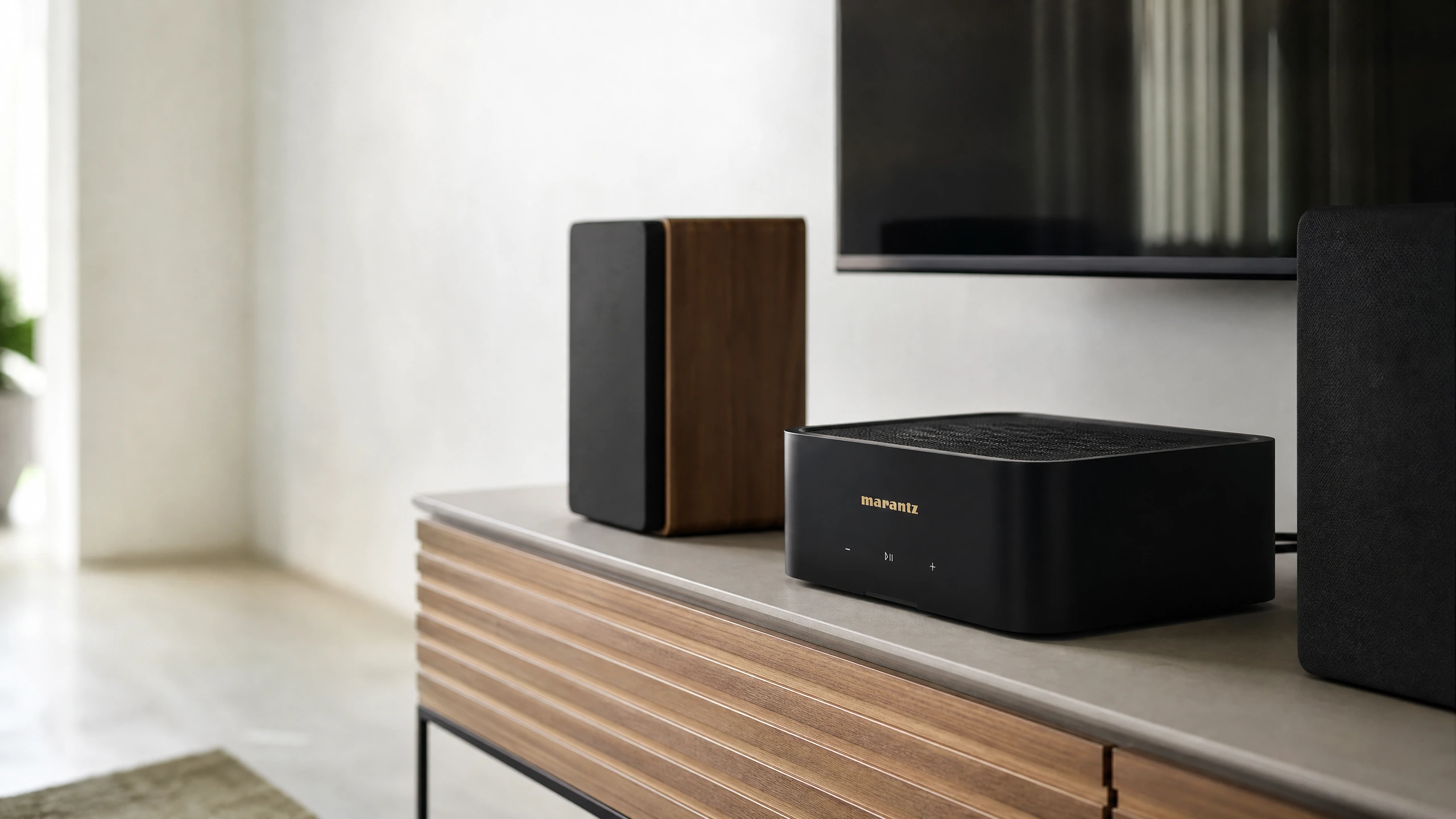
What the MODEL M1 is—and what it is not
The Marantz MODEL M1 is a compact wireless streaming amplifier for listeners who want a serious two-channel system without filling a rack with separate boxes. It combines a stereo power amplifier, network streaming, TV connectivity, digital processing, and bass management in a chassis that can sit beneath a television or disappear into a cabinet.
That description is more useful than simply calling it an integrated amplifier. The MODEL M1 has no phono stage, no headphone output, no front-panel display, and no conventional volume knob. Its intended control center is the HEOS app, with HDMI-CEC, AirPlay 2, Roon, Spotify Connect, Bluetooth, and remote-control learning providing additional ways to operate it. It is closer to a compact two-channel AV hub than to a traditional amplifier with modern streaming added as an afterthought.
The central question is therefore not whether the MODEL M1 includes enough features on a specification sheet. It is whether its combination of compactness, TV integration, HEOS multi-room support, and mature-sounding amplification justifies choosing it over less expensive streaming amplifiers that may offer more visible controls or broader platform support.
Design, connections, and daily usability
Marantz gives the MODEL M1 a restrained, low-profile design. The top panel uses a woven metal mesh rather than a conventional vented lid, while the front face is deliberately uncluttered. Three illuminated touch controls handle basic playback and volume functions, but there is no screen to show the active input, track, or volume level. That simplicity looks good in a living room, although it means the app or television interface becomes more important than it would be with a conventional integrated amplifier.
The chassis measures approximately 217 mm wide, 239 mm deep, and 84 mm high. It is small enough for a media console, but the depth should be checked before installation because speaker plugs and interconnects need room behind it. Marantz specifies a 4–16 ohm loudspeaker range and a class-D amplifier rated at 100 watts per channel into 8 ohms. The amplifier is compact, but it should not be treated like a small desktop accessory; give the top ventilation area room to breathe.
Rear-panel connectivity is focused rather than exhaustive. There is HDMI eARC for a television, optical digital input, stereo RCA line input, Ethernet, Wi-Fi, USB storage playback, speaker binding posts, and a mono RCA subwoofer output. The omissions are equally important: there is no built-in phono stage, no headphone amplifier, and no preamp output for adding a larger external power amplifier.
That input mix works well for a modern TV-and-streaming system. It is less suitable for an expanding traditional hi-fi system in which you expect to add a turntable, headphones, multiple analog sources, or a separate power stage. Readers who are still deciding between a receiver and an amplifier may find the broader explanation in AmplifierZone’s receiver-versus-amplifier guide useful before choosing a component category.
TV audio through HDMI eARC
HDMI eARC is one of the MODEL M1’s strongest reasons to exist. Connect the amplifier to a compatible television and the TV can send its audio to the Marantz while the television remote handles everyday volume changes through HDMI-CEC. That makes the system behave more like a high-quality soundbar replacement than a separate hi-fi component that happens to accept TV sound.
The amplifier supports Dolby Digital and Dolby Digital+ through the HDMI connection and downmixes those signals to two channels. That does not create a multichannel home-theater system, but it does make movie dialogue, music, and effects more convincing through a properly positioned pair of passive speakers. The HEOS sound modes also include options intended to make dialogue easier to follow or give television material a broader presentation.
The limitation is that the MODEL M1 remains a two-channel product. It cannot drive a center speaker, surround channels, or height speakers, and it should not be purchased by someone who wants an expandable AV receiver. Its advantage is different: it gives a stereo listener a cleaner, more music-focused path to better TV audio without adding a soundbar under the screen.
The subwoofer output adds flexibility for smaller bookshelf speakers. With the high-pass and low-pass controls configured sensibly, the main speakers can avoid being asked to reproduce the deepest bass while the subwoofer handles the lowest range. That is particularly useful in a compact room where a pair of bookshelves alone may sound clean but lightweight. Our guide to choosing an amplifier for bookshelf speakers provides the broader speaker-matching context; the MODEL M1 makes the most sense when the speakers and room are chosen as a system rather than in isolation.
HEOS, AirPlay 2, Bluetooth, and streaming
The MODEL M1 is built around HEOS. The platform provides access to supported streaming services, network shares, multi-room grouping, and the amplifier’s configuration controls. It also supports AirPlay 2, Spotify Connect, Roon Ready operation, Bluetooth reception, and playback from USB storage. That combination covers most common household listening patterns, but the experience is not identical across every service. If you are still deciding between phone-dependent wireless playback and independent network streaming, AmplifierZone’s wireless-versus-streaming amplifier guide explains that distinction in practical terms.
HEOS is practical when you already own Denon or Marantz products and want them to share rooms and sources. It is also useful when the amplifier will be controlled by more than one person, because the system can be managed from phones and tablets rather than relying on a single physical remote. The trade-off is that HEOS is the part of the product you will interact with most often, and its interface is not as universally preferred as the operating systems used by some competing streaming amplifiers.
Roon, AirPlay 2, and Spotify Connect reduce that dependence for listeners already invested in those platforms. Bluetooth is convenient for guests and quick listening, but it should be regarded as an occasional source rather than the main reason to buy a network amplifier. The MODEL M1 is at its best when connected to the home network and used as a permanent source-and-amplification hub.
Setup is generally straightforward, although independent reviews have reported that firmware updates can involve several automatic restarts. That is not a reason to reject the amplifier, but it is a reminder to complete updates before mounting the unit in a hard-to-reach cabinet. Once configured, the system offers useful controls such as volume limits, input behavior, IR learning, sound modes, and adjustable bass-management filters.
The 2.1-channel question
Marantz describes the MODEL M1 as a 2.1-channel amplifier because it can run a stereo pair together with a subwoofer. The label should not be misunderstood as a claim of surround processing or a substitute for a multichannel receiver. It describes a two-channel music system with a dedicated low-frequency path. For a broader explanation of how 2.0, 2.1, and 5.1 layouts change the balance between music, TV, bass, and setup complexity, see AmplifierZone’s 2.0 versus 2.1 versus 5.1 audio-systems guide.
That arrangement is valuable because it gives the owner a gradual upgrade path. You can begin with compact passive speakers, then add a subwoofer when the room or listening habits demand more scale. The adjustable high-pass and low-pass filters are more useful than a simple full-range subwoofer feed because they allow the handoff between the main speakers and subwoofer to be treated as part of the system design.
Speaker sensitivity and listening distance still matter. A 100-watt rating does not guarantee the same headroom with every loudspeaker, and a small streaming amplifier should not be forced to reproduce reference-level cinema playback in a very large room. For a living room, office, bedroom, or modest dedicated listening space, the MODEL M1 has a sensible role. For a large room with inefficient speakers and sustained high playback levels, a larger amplifier or separate system is the safer choice.
Sound and system matching
Independent listening reviews describe the MODEL M1 as full-bodied, controlled, and natural, with particularly strong bass authority for a compact class-D component. Those reports are consistent with the product’s intended role: it is not trying to sound like a bare-bones power module. It uses digital processing, selectable reconstruction filters, and bass-management tools to shape a complete listening system.
The choice of digital filter is unusual because reviewers have reported a more audible difference between the two settings than is common on many amplifiers. Filter 1 is positioned as the more relaxed Marantz-oriented choice, while Filter 2 is intended for bench-test use and can sound more incisive with some material. The correct conclusion is not that one filter is universally better. It is that the MODEL M1 gives the listener a meaningful system-tuning option, and that the final choice should be made with the speakers and room in place.
With neutral or slightly lively bookshelf speakers, the MODEL M1’s reported warmth and low-frequency grip could make for an engaging long-term system. With already warm speakers in a heavily furnished room, the more open filter or a careful subwoofer crossover may be preferable. The amplifier’s tone should not be treated as a replacement for speaker placement, room treatment, or sensible level setting.
One important boundary should be kept clear: published listening impressions are not the same as a controlled measurement of every unit. The MODEL M1’s rated output, frequency response, input formats, and impedance range come from Marantz. Sound character, app behavior, and perceived dynamics come from reviewer experiences and system context. That distinction is part of a trustworthy review, especially for a product whose software and signal path are as important as its amplifier stage.
What independent testing adds
The most useful counterpoint to the positive listening reports comes from Audio Science Review’s January 2026 measurement report. That review found that the analog RCA input showed variable low-frequency noise and SINAD behavior during testing, while Toslink and network-streaming inputs produced stronger results. It also noted elevated ultrasonic noise in some power measurements and a chassis that remained warm while idle.
Those findings do not automatically mean that every MODEL M1 will sound defective in every system. They do mean that the amplifier should be judged as a complete signal-chain product rather than by its headline power number alone. A listener who plans to use network streaming, HDMI eARC, or optical input may have a different experience from someone who intends to feed it from a sensitive analog source. Buyers who prioritize laboratory performance above all else should read the full measurement report before deciding.
The practical takeaway is balanced. The MODEL M1 has a compelling feature set and favorable independent listening reports, but it is not an uncomplicated technical benchmark. Its appeal is strongest for the buyer who values a compact TV-and-music system, HEOS multi-room integration, bass management, and an understated physical design. Its appeal is weaker for the buyer who wants maximum analog purity, extensive upgrade paths, a phono stage, a headphone output, or the strongest measured performance in the category.
Who should buy it—and who should skip it
Choose the MODEL M1 if:
- You want one compact component for passive speakers, TV audio, and network streaming.
- You already use HEOS, or you value Denon and Marantz multi-room compatibility.
- You want HDMI eARC and a subwoofer output without moving to a full AV receiver.
- You prefer a screenless, quiet-looking component and are comfortable using an app.
- You want useful bass-management and remote-learning options rather than only a basic volume control.
Think twice if:
- You need a built-in phono stage, headphone amplifier, preamp output, or several analog inputs.
- You want a display, physical volume knob, or fully independent operation without a phone.
- You are building a multichannel surround system or expect to add external amplification later.
- You are highly sensitive to software-platform limitations or want the broadest possible streaming-service support in one native app.
- You plan to use a demanding analog source and want the strongest possible measurement results from that input.
How it compares with alternatives
The MODEL M1 competes in a busy category where compact streaming amplifiers often offer similar headline power with different priorities. Some alternatives emphasize price and app breadth; others add a display, room correction, more inputs, or a larger power supply. The right comparison is therefore about the system you want to live with, not a single wattage figure. Marantz’s more fully equipped Model 40n review is a useful same-brand comparison: it shows what changes when a listener needs a phono stage, headphone amplifier, more conventional controls, and a broader premium integrated-amplifier feature set.
| Question | MODEL M1’s position | Why it matters |
|---|---|---|
| TV integration | HDMI eARC with two-channel Dolby processing | Strong fit for a stereo TV system, not a surround replacement |
| Streaming platform | HEOS, AirPlay 2, Spotify Connect, Roon Ready, Bluetooth | Excellent if your household already fits those ecosystems |
| Speaker expansion | Dedicated mono subwoofer output with adjustable filters | Allows a compact 2.1 system to grow without adding a receiver |
| Traditional sources | RCA and optical inputs, but no phono stage or headphone output | Good for modern digital sources; limited for analog-focused systems |
| Upgrade path | Integrated all-in-one design without a power-amp output | Best bought as a finished system rather than a starting point for separates |
If you are comparing compact amplifiers primarily for smaller passive speakers, the SMSL AD18 review provides a useful perspective on a much simpler and more desktop-oriented design. If a turntable is central to your system, the MODEL M1’s lack of a phono stage means you should budget for a separate phono preamplifier; our ART DJPREII phono preamplifier review covers one practical route.
Check the Marantz MODEL M1 on Amazon
The MODEL M1 is easiest to evaluate when you know exactly what you need from the system: HDMI eARC for TV, HEOS or another compatible streaming route, passive speakers, and optional subwoofer integration. Use the product listing to confirm the current configuration and seller details before purchase.
Check the Marantz MODEL M1 on Amazon
Frequently Asked Questions
Does the Marantz MODEL M1 have a phono input?
Can the MODEL M1 replace a soundbar?
Can the MODEL M1 power a subwoofer?
Is the MODEL M1 compatible with Roon?
Is the MODEL M1 suitable for a large room?
Final verdict
The Marantz MODEL M1 is most convincing when treated as a compact two-channel entertainment system rather than a conventional integrated amplifier. It puts passive-speaker music, HDMI eARC television sound, HEOS multi-room control, network streaming, and subwoofer management in one visually quiet component. Independent listening reports suggest that it can deliver a more mature and substantial presentation than its size implies.
It is not a universal answer. The lack of a phono stage, headphone output, preamp output, and broad analog connectivity narrows its audience. HEOS is central to the experience, and independent measurements raise questions that matter to buyers who prioritize laboratory performance or rely heavily on the analog input. Those are not minor details; they define whether the MODEL M1 fits your system.
Our conclusion: the MODEL M1 is a strong candidate for a listener who wants a refined, compact TV-and-music system with passive speakers and optional subwoofer support, especially when HEOS and Marantz’s ecosystem are already part of the plan. It is a weaker choice for a turntable-first system, a headphone-focused setup, a multichannel theater, or a system intended to grow into separates.
Amazon Associates disclosure: AmplifierZone participates in the Amazon Associates program. Qualifying purchases made through our links may earn us a commission at no additional cost to you. This does not change the price you pay or our editorial judgment.
