
iFi Zen Phono 3 Review: The Most Technically Capable Phono Preamp Under $250

A -151dBV noise floor. Four independent gain settings spanning 36 to 72dB. Additionally, four independent loading settings cover 47kΩ to 100Ω. An intelligent subsonic filter that removes warp frequencies without affecting bass. A 4.4mm balanced output. These are specifications that appear on phono preamps costing three to five times more than the iFi Zen Phono 3’s $249 price. Specifically, the Zen Phono 3 is the top pick in the best phono preamps under $250 roundup because no other unit at this price — or significantly above it — combines this level of technical specification in a single compact unit. This review covers what those specifications translate to in actual listening, who genuinely needs this level of performance, and where the simpler alternatives in this price range are the better choice.

Quick Answer: The iFi Zen Phono 3 is the correct choice for listeners with a low output MC cartridge who need 60–72dB of clean gain with adjustable loading, or for listeners whose vinyl setup has reached a point where the phono preamp is the limiting factor in resolution and noise performance. At $249 it delivers reference-grade specifications that no competing unit at this price approaches. However, the performance advantage over the Pro-Ject Phono Box DC is only fully accessible when the rest of the system can resolve what the Zen Phono 3 delivers.
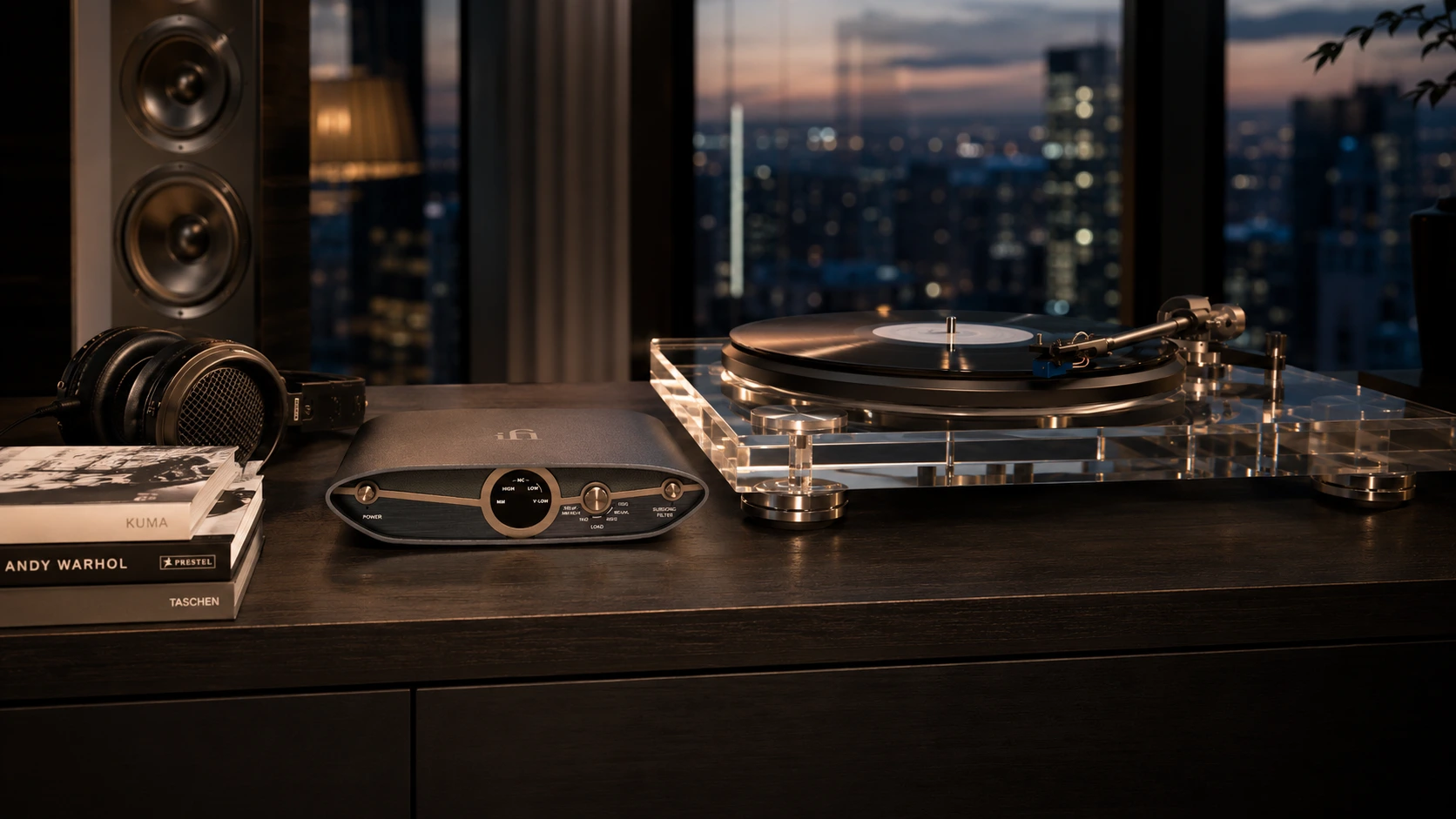
iFi Zen Phono 3 high-end MM/MC phono preamp beside an acrylic audiophile turntable in a luxury penthouse vinyl listening setup
The iFi Zen Phono 3 — -151dBV noise floor, four independent gain and loading settings, intelligent subsonic filter, and 4.4mm balanced output in the most technically capable phono preamp under $250.

This article contains affiliate links. If you purchase through them, we may earn a commission at no extra cost to you. This helps support AmplifierZone and allows us to keep creating in-depth, unbiased audio guides.

Who Is the iFi Zen Phono 3 For?

The Zen Phono 3 is built for two specific listener profiles. First, anyone using a low output MC cartridge who needs the full 60–72dB gain range to bring a 0.2–0.4mV signal to a correct line level — and who wants the loading to be adjustable rather than fixed, so that the cartridge’s tonal balance and resonance characteristics can be properly matched to the phono stage. Specifically, fixed-loading phono preamps like the Pro-Ject Phono Box DC at 100Ω work correctly for most MC cartridges but cannot be tuned for the specific cartridge in use. The Zen Phono 3’s four loading positions (47kΩ, 1kΩ, 470Ω, 100Ω) allow that tuning.

Second, listeners whose vinyl system has reached a level where the phono preamp has become the component limiting resolution, noise performance, and dynamic range. Specifically, this typically means a turntable above £800/$900, a quality MC cartridge, and an amplifier and speaker combination that is resolving enough to reveal differences at the phono stage level. For those listeners, the Zen Phono 3’s -151dBV noise floor and ±0.15dB RIAA accuracy are not theoretical specifications — they are audibly meaningful improvements over what a simpler preamp delivers. The technical background on why MC cartridges specifically benefit from adjustable loading, the MM vs MC phono preamp guide covers the full explanation.

However, the Zen Phono 3 is not the right purchase for every vinyl listener. For MM cartridge users with a budget turntable, the Fluance PA10 at $99.99 delivers correct, clean MM amplification at a fraction of the price — the Zen Phono 3’s performance advantage is masked by system limitations at that level. Buy it when the rest of the system is ready to reveal what it delivers.

System readiness check: If your turntable cost over £800/$900, your cartridge is a low output MC, and you can hear clear differences between high-quality audio sources in your system — the Zen Phono 3’s performance advantage will be audible. If your turntable is an entry or mid-range model with an MM cartridge, invest in the turntable and cartridge first and revisit the phono preamp later.

iFi Zen Phono 3 — Key Specifications

iFi Zen Phono 3 MM/MC Phono Preamp

  • Cartridge compatibility: MM and MC (standard, high, low, very low output)
  • Gain settings: 36dB / 48dB / 60dB / 72dB — four independent settings
  • Loading settings: 47kΩ / 1kΩ / 470Ω / 100Ω — four independent settings
  • Noise floor (EIN): -151dBV — quieter than many Stereophile Class A+ phono stages
  • RIAA accuracy: ±0.15dB from 20Hz–20kHz
  • Subsonic filter: Yes — intelligent warp correction without bass loss
  • Balanced output: Yes — 4.4mm Pentaconn
  • Line output: RCA stereo
  • Headphone output: No
  • Power: Isolated internal power supply
Pros
  • -151dBV noise floor — quieter than many Stereophile Class A+ phono stages
  • Four independent gain settings — 36 to 72dB covers every cartridge type
  • Four independent loading settings — 47kΩ to 100Ω allows precise MC matching
  • Intelligent subsonic filter — warp correction without bass loss or group delay
  • 4.4mm balanced output — lower noise on long cable runs to balanced inputs
  • ±0.15dB RIAA accuracy — reference-grade equalisation
  • Isolated internal power supply — keeps power noise out of the signal path
Cons
  • Most expensive unit in this group at $249
  • Performance advantage fully audible only on higher-quality systems
  • Lower purchase validation than Pro-Ject Phono Box DC
  • No headphone output

View on Amazon

Best overall pick — -151dBV noise floor, 36–72dB gain, adjustable loading, intelligent subsonic filter, 4.4mm balanced output. Most capable phono preamp under $250.

Design and Build Quality

Overall, the Zen Phono 3 has a compact, dark-grey chassis that communicates seriousness without visual drama — a design appropriate for a component whose performance is its distinguishing characteristic. The front panel has no controls. Specifically, all settings are configured via switches on the underside of the unit — gain, loading, and subsonic filter engagement are all set during initial setup and left unchanged unless the cartridge is replaced or the loading is being experimented with.

The build quality is solid — the chassis is heavier than its size suggests, the RCA sockets and 4.4mm Pentaconn output are firmly toleranced, and nothing about the construction suggests compromise. Specifically, the isolated internal power supply — rather than an external wall adapter — keeps power conversion noise physically inside a separate, screened section of the chassis away from the signal path. Furthermore, this is a significant engineering advantage over units that use external switching adapters, which can introduce high-frequency noise at the phono stage’s extremely sensitive gain levels.

However, one setup note: the switches on the underside use small DIP positions that require a pointed implement — a pen tip or SIM card tool — to change. Consequently, they are not intended for casual frequent adjustment. The design assumption is that settings are established once, matched to the cartridge, and left in place. For listeners who want to experiment with loading while listening to hear the tonal effect of different values, the switch access is slightly inconvenient — but manageable.

The Noise Floor — What -151dBV Actually Means

The Equivalent Input Noise (EIN) specification of -151dBV is the figure that makes the Zen Phono 3 technically exceptional. Specifically, this means the preamp’s own noise contribution is 151dB below a 1V reference signal — effectively below the theoretical limit of what can be audibly distinguished from absolute silence at normal listening levels. For comparison, many phono preamps reviewed as Stereophile Class A+ — the highest performance category in the industry’s most respected audio publication — measure at -140 to -145dBV EIN. The Zen Phono 3 is measurably quieter than those units at a fraction of their price.

Specifically, in practice, what -151dBV EIN delivers is background silence on quiet vinyl passages that no other unit in this price range can match. The space between notes on a jazz piano recording, the ambient decay of a reverberant concert hall, and the low-level detail in the recording’s quietest moments are all more clearly resolved when the phono stage’s own noise floor is not masking them. For listeners who have previously heard vinyl described as noisy or hissy compared to digital streaming, the noise floor of the phono preamp is often a significant contributing factor — and the Zen Phono 3 removes it from the equation.

Gain and Loading — Why Adjustability Matters

The four independent gain and loading settings are the Zen Phono 3’s most practically significant feature for MC cartridge users. Specifically, gain determines whether the cartridge signal reaches line level correctly — loading determines the electrical termination presented to the cartridge, which affects both frequency response and tonal character. For MM cartridges, standard values (40dB, 47kΩ) are universal and no adjustment is needed. However, for MC cartridges, both gain and loading interact with the cartridge’s specific design parameters in ways that a fixed-value preamp cannot optimise.

Specifically, the Zen Phono 3’s loading positions allow the listener to tune the MC cartridge’s presentation: 47kΩ typically produces a bright, extended high-frequency character; 1kΩ is an intermediate value; 470Ω suits many high output MC cartridges; 100Ω is the standard value for most low output MC designs. Consequently, experimenting with loading positions with a specific MC cartridge is one of the few genuinely meaningful tuning adjustments available in an analogue vinyl system — and it requires a preamp that offers the adjustment. For a detailed explanation of how MC loading affects cartridge performance and how to identify which value suits your specific cartridge, our MM vs MC phono preamp guide covers the technical detail.

The gain range — 36dB, 48dB, 60dB, 72dB — covers every cartridge category. Specifically, 36dB suits high output MM cartridges. 48dB suits standard MM and high output MC cartridges. 60dB suits standard low output MC cartridges. 72dB suits very low output MC cartridges with outputs below 0.3mV. Furthermore, the gain and loading are independently adjustable — changing one does not force a corresponding change in the other, which is the correct approach for maximising cartridge compatibility across the full range of MC designs.

Sound Quality

Overall, the Zen Phono 3 sounds transparent, silent, and tonally accurate — its character is defined by an absence of character. Specifically, what the listener hears through it is the cartridge, the turntable, and the recording, communicated with maximum fidelity and minimum interference from the phono stage itself. Compared to the Pro-Ject Phono Box DC on the same system, the differences are audible but require a resolving system to appreciate fully: a lower noise floor, a slightly wider and more stable stereo image, and more precise recovery of low-level detail in complex passages.

With low output MC cartridges

This is where the Zen Phono 3’s advantage is most audible. Specifically, a low output MC cartridge — Hana SL, Ortofon Quintet Black, Lyra Delos — through the Zen Phono 3 at the correct gain and loading setting produces a level of detail retrieval, noise floor, and dynamic range that defines what vinyl playback is capable of at this level. The bass is tighter and better defined, high-frequency extension is more resolved, and the spatial information in a well-recorded stereo mix is more clearly presented. The difference between correct and incorrect MC loading is also immediately audible with the Zen Phono 3 — the adjustability makes the impact of loading on the cartridge’s character directly demonstrable.

With MM cartridges

Specifically, at the MM setting (36dB or 48dB, 47kΩ), the Zen Phono 3 correctly handles any standard MM cartridge. The noise floor advantage over simpler preamps is less dramatic with MM cartridges than with MC, since MM cartridges output more signal and the phono stage gain is lower. However, the RIAA accuracy advantage is consistent regardless of cartridge type — the ±0.15dB curve accuracy means the tonal balance across the audio range is more precisely correct than in most competing preamps. Consequently, orchestral recordings and acoustic music with critical tonal requirements benefit from this accuracy in ways that are subtle but cumulative over extended listening.

The Intelligent Subsonic Filter

Specifically, iFi describes the Zen Phono 3’s subsonic filter as “intelligent” to distinguish it from the simple high-pass filters found in entry-level preamps. Specifically, the distinction is in the filter’s design: a simple high-pass filter applies a fixed cutoff curve that can bleed into the lower bass frequencies, slightly reducing bass weight at the filter’s rolloff point. The Zen Phono 3’s filter uses a more sophisticated circuit that removes the sub-20Hz warp frequencies with a steeper cutoff curve and minimal phase shift, preserving the bass frequencies above the filter point with greater accuracy.

Consequently, in practice, woofer pumping on warped records is eliminated without any audible reduction in bass weight in the audible frequency range. Specifically, the bass on a well-pressed record sounds identical with the filter engaged or disengaged. Consequently, the filter can be left engaged as the default setting for all listening without any sonic penalty — which is the correct approach for most vinyl listeners, since warp frequencies waste amplifier power and stress speaker suspension even when not audibly obvious.

Connectivity and Setup

Specifically, setup follows the standard phono preamp process: RCA from the turntable to the Zen Phono 3’s inputs, RCA or 4.4mm balanced from the outputs to the amplifier, ground wire from the turntable to the Zen Phono 3’s ground terminal, and the unit powered on. For the complete signal chain walkthrough, the turntable to amplifier connection guide covers every step including ground connection and input selection.

The DIP switches on the underside set gain, loading, and subsonic filter engagement. Specifically, set gain first — match to the cartridge’s output voltage and type. Then set loading — start at the manufacturer’s recommended value for the cartridge, or at 100Ω for most low output MC designs as a starting point. The subsonic filter is enabled by default and should remain on for most listening. Additionally, the 4.4mm balanced output connects to amplifiers and headphone amplifiers with balanced inputs — the balanced connection reduces noise pickup on longer cable runs and is particularly useful in systems where the phono preamp sits away from the amplifier.

One practical note: the Zen Phono 3’s isolated internal power supply means there is no external wall adapter to manage. Additionally, the unit draws minimal current and can be left powered on without concern — tube warm-up is not required, unlike tube preamps, and the circuit reaches full specification immediately at switch-on.

How the iFi Zen Phono 3 Compares

iFi Zen Phono 3 vs Pro-Ject Phono Box DC

The Pro-Ject Phono Box DC at $148.66 is the most obvious step below the Zen Phono 3. Specifically, the Phono Box DC delivers correct, accurate MM/MC amplification — its 100Ω fixed MC loading works for most cartridges, its noise floor is low, and its transparency is genuine. However, the Zen Phono 3’s -151dBV noise floor is measurably and audibly lower, the adjustable loading allows precise MC matching the Phono Box DC cannot provide, and the intelligent subsonic filter and 4.4mm balanced output are absent from the Pro-Ject. Consequently, for MM cartridge users or listeners with MC cartridges that load correctly at 100Ω, the Phono Box DC at $100 less represents excellent value. For listeners who specifically need adjustable loading or the maximum noise performance, the Zen Phono 3 justifies the premium.

iFi Zen Phono 3 vs Fluance PA10

The PA10 at $99.99 is MM only and $149 less than the Zen Phono 3. For pure MM listeners, the PA10’s dedicated channel amplifiers and lower price represent the correct choice — the Zen Phono 3’s technical superiority is not relevant for the PA10’s target listener. However, the comparison only becomes relevant for listeners who are deciding between an entry-level MM preamp and the Zen Phono 3’s all-in-one capability — in which case the $149 difference should be evaluated against the value of MC capability, adjustable loading, and the noise floor improvement.

iFi Zen Phono 3 vs phono preamps above $250

The Zen Phono 3’s -151dBV noise floor and ±0.15dB RIAA accuracy are specifications that appear on phono preamps costing $500–$1,500. Specifically, units like the Graham Slee Era Gold V at $500 or the Pro-Ject Phono Box DS3 B at $599 offer competing performance but at significantly higher prices. The Zen Phono 3’s primary limitation compared to those units is loading range — high-end phono preamps typically offer loading adjustment down to 10Ω or even 5Ω for ultra-low impedance MC cartridges. For standard MC cartridges with internal impedances above 5Ω, the Zen Phono 3’s 100Ω minimum loading is not a practical constraint at most listening levels.

Is the iFi Zen Phono 3 Worth It?

Overall, at $249, the iFi Zen Phono 3 is worth buying for any listener who meets two conditions: their cartridge is a low output MC that benefits from adjustable loading, and their system is resolving enough to reveal what the Zen Phono 3 delivers. For those listeners, it represents extraordinary value — reference-grade specifications at a price point that makes dedicated high-performance phono amplification accessible without the four-figure investment typically required.

However, it is not worth buying as an aspirational purchase for a system that is not yet ready to reveal its advantages. A listener with a £300 turntable and an MM cartridge will not hear the Zen Phono 3’s noise floor improvement — the turntable itself introduces more noise and resonance than the phono preamp can address. The correct investment sequence is: turntable, then cartridge, then phono preamp. Buy the Zen Phono 3 when the system around it has earned it.

Confirm your MC cartridge’s recommended loading before purchasing. The Zen Phono 3’s minimum loading is 100Ω — correct for most MC cartridges with internal impedances of 5Ω and above. For ultra-low impedance MC cartridges (below 5Ω internal resistance) that benefit from loading at 10Ω or 20Ω, the Zen Phono 3’s minimum loading position may not be optimal. Check your cartridge’s specifications or the manufacturer’s recommended loading value before buying.

Final Verdict

Indeed, the iFi Zen Phono 3 is the most technically capable phono preamp available under $250 — a genuinely reference-grade specification at an accessible price. Its -151dBV noise floor, four independent gain and loading settings, intelligent subsonic filter, and 4.4mm balanced output combine to deliver a performance level that typically requires spending two to five times more. For listeners whose systems are ready to reveal what it delivers, it represents one of the strongest value propositions in analogue audio at any price level.

The limitations are equally specific: no headphone output, minimum loading at 100Ω, and a performance advantage that is only audible on higher-quality systems. Indeed, none of these are design failures — they are deliberate choices that allowed iFi to achieve the noise floor and accuracy specifications within the price. For listeners who need a headphone output, the Douk Audio T9 remains the only option in this group. Listeners who need loading below 100Ω will need a higher-tier preamp. Indeed, for everyone else whose system can justify it — the Zen Phono 3 is the last phono preamp most listeners will ever need at this level.

Check Price on Amazon

Best overall pick — -151dBV noise floor, 36–72dB gain, adjustable loading, intelligent subsonic filter, 4.4mm balanced output. Most capable phono preamp under $250.

Frequently Asked Questions

How do I set the gain and loading on the iFi Zen Phono 3?

The gain and loading settings are accessed via DIP switches on the underside of the unit — a pen tip or SIM card tool is needed to toggle the small switches. For gain: match to your cartridge type — 36 or 48dB for MM, 60dB for standard low output MC, 72dB for very low output MC. For loading: start at the value recommended in your cartridge’s specifications. If no recommendation is given, 100Ω is a correct starting point for most low output MC cartridges. The subsonic filter switch is also on the underside — leave it enabled for most listening.

What does the -151dBV noise floor mean in practice?

The Equivalent Input Noise figure of -151dBV means the Zen Phono 3’s own noise contribution is 151dB below a 1V reference — effectively inaudible at any realistic listening level. In practice, this delivers background silence on quiet vinyl passages that more affordable preamps cannot match. The benefit is most apparent on recordings with wide dynamic range — classical, jazz, and acoustic music where quiet passages and decay are significant parts of the listening experience.

Is the iFi Zen Phono 3 worth the premium over the Pro-Ject Phono Box DC?

For MC cartridge users who need adjustable loading — yes. The Zen Phono 3’s four loading positions allow precise MC cartridge matching that the Pro-Ject’s fixed 100Ω cannot provide. The noise floor advantage is also audible on resolving systems. For MM cartridge users, the $100 premium is harder to justify — the Pro-Ject Phono Box DC delivers correct, accurate MM amplification at a lower price. The Zen Phono 3 is specifically the right upgrade for MC users and listeners with higher-quality systems where the performance difference is accessible.

Can the iFi Zen Phono 3 be used with a turntable that has a built-in phono preamp?

Only if the turntable’s built-in preamp is bypassed. Most turntables with a built-in phono preamp include a line/phono switch — set to line to bypass the internal stage and output a raw cartridge signal, then connect to the Zen Phono 3 as normal. If the turntable has no bypass switch and outputs a line-level signal, connecting it to the Zen Phono 3 would apply double RIAA equalisation — resulting in incorrect, bass-heavy frequency response. Check the turntable’s documentation to confirm the output type before connecting.

Does the 4.4mm balanced output on the iFi Zen Phono 3 make a difference?

Yes, for listeners whose amplifier or headphone amplifier includes a balanced input. The balanced connection uses two signal paths per channel — one carrying the signal and one carrying an inverted version — which cancels common-mode noise picked up along the cable run. The benefit is most relevant for longer cable runs (over 1 metre) or in environments with significant electromagnetic interference. For short cable runs in a typical home listening setup, the difference between RCA and balanced is small but measurable. If your amplifier has a balanced input, using the 4.4mm output is always preferable.