
Tube headphone amplifiers have survived every supposed replacement because they offer something more specific than a simple upgrade in volume. They change how the amplifier interacts with the headphone load, how the circuit handles small signals, and sometimes how the finished system feels as an object on a desk. That does not make every tube amplifier warm, every solid-state amplifier sterile, or every glowing valve worth buying. The circuit topology and the headphone pairing matter more than the presence of glass bottles.
This guide explains what a tube headphone amplifier actually does, how OTL, transformer-coupled, and hybrid designs differ, why output impedance is central to headphone matching, and what tube rolling can and cannot change. It also covers the practical costs: heat, maintenance, noise, startup time, and the situations where a clean solid-state amplifier is the better engineering choice.
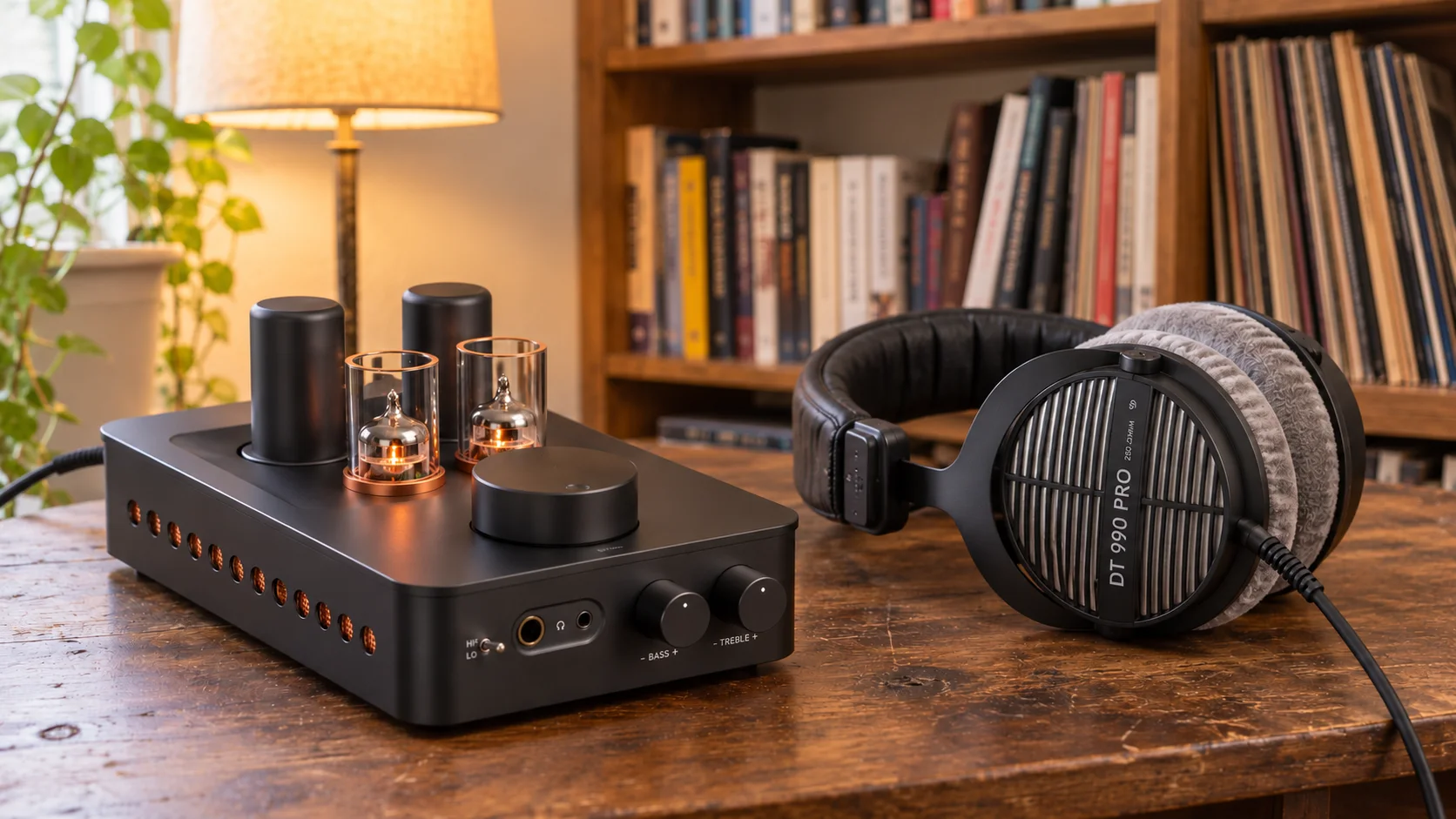
What Is a Tube Headphone Amplifier?
A tube headphone amplifier uses vacuum tubes, also called valves, as active devices in part or all of its amplification circuit. A tube controls the flow of electrons through a vacuum, allowing a small input signal to control a larger output signal. The same basic job is performed by transistors in solid-state amplifiers, but the electrical behavior, operating voltages, biasing, and practical implementation are different.
The tube itself does not automatically determine the final sound. The power supply, circuit bias, output stage, coupling method, feedback level, and load all contribute. Two amplifiers using the same tube type can therefore sound and measure differently. Likewise, a well-designed tube amplifier can be relatively clean and neutral, while a deliberately voiced design may add audible harmonic content.
The most useful distinction is between the tube’s role and the amplifier’s output stage. In a fully tube-based design, the valves may provide both voltage gain and the current needed by the headphones. In a hybrid design, the tube may provide voltage gain or buffering while a solid-state stage supplies current. In a transformer-coupled design, an output transformer helps convert the tube stage’s electrical characteristics into a more suitable headphone load.
That is why the question “Are tube headphone amps better?” has no universal answer. The right question is whether a particular topology, output impedance, power envelope, and noise floor suit your headphones and listening priorities. If you are still deciding whether your headphones need a dedicated amplifier at all, start with our guide on whether you actually need a headphone amp.
The Three Main Tube Headphone Amp Topologies
Tube headphone amplifiers are not one uniform category. Their output-stage topology changes which headphones they suit, how much power they can deliver, and how strongly the headphone