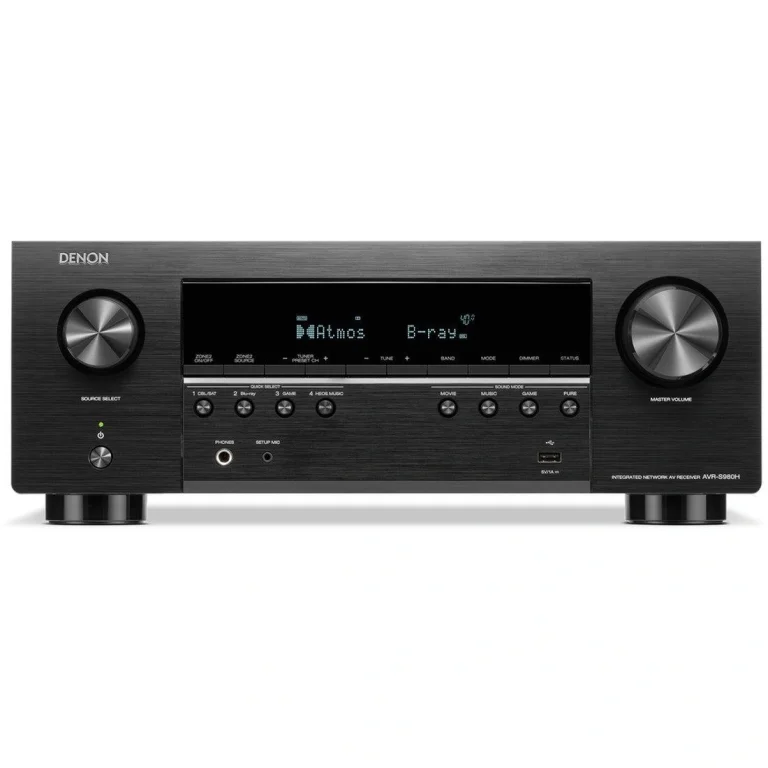
The Denon AVR-X1800H is a seven-channel AV receiver for listeners who want one component to handle serious stereo playback, Dolby Atmos movies, modern game consoles, vinyl, and network streaming. Its headline specification is 80 watts per channel, but the more useful story is how that power is combined with Audyssey MultEQ XT, HEOS, six HDMI inputs, and a 5.2.2-channel ceiling for compact and medium-sized rooms.
This Denon AVR-X1800H review focuses on the practical question behind the specification sheet: can a mid-sized seven-channel receiver remain enjoyable for music while also acting as a complete home-theater hub? The answer is yes, provided your room and speakers fit its power envelope. It is a flexible, well-equipped choice for a system that needs both music and movies, but it is not a substitute for a larger power amplifier when the room, seating distance, or speakers demand sustained high output.
Quick answer: The Denon AVR-X1800H is a strong fit for a small or medium room that needs stereo music, Dolby Atmos, HDMI 2.1 gaming, phono playback, and network streaming in one box. Its cleanest strengths are the mature Audyssey MultEQ XT calibration system, a natural Denon presentation, practical HEOS integration, and a useful collection of modern video features. The main limits are the seven-channel ceiling, one HDMI output, and modest headroom when all channels are driven hard in a large room.
This article contains affiliate links. If you purchase through them, we may earn a commission at no extra cost to you. This helps support AmplifierZone and allows us to keep creating in-depth, unbiased audio guides.
Who Is the Denon AVR-X1800H For?
The AVR-X1800H makes sense for the listener who has outgrown a simple stereo receiver but does not want to split the system into a network streamer, an AV processor, a power amplifier, and a separate phono stage. It can accept a turntable through its phono input, stream music over HEOS or AirPlay 2, switch several HDMI sources, and decode object-based surround formats for a movie system. That broad role is its real value: the receiver reduces the number of boxes without reducing the number of useful sources.
It is particularly well matched to a living room, den, apartment media room, or dedicated room where the main listening position is not extremely far from the speakers. Denon positions it for small-to-medium rooms and for layouts such as 7.2 or 5.2.2. Those limits are not arbitrary. Seven amplified channels can run a conventional 5.1 system with two additional surround channels, or a 5.1.2 Dolby Atmos system with two height speakers. The receiver cannot simultaneously power a full 7.1.2 layout because that would require nine amplified channels.
Before choosing an AV receiver for a music-first setup, it is worth deciding whether you actually need surround processing. Our guide to stereo amplifiers versus AV receivers explains the trade-off: a stereo amplifier can devote its design to two channels, while an AV receiver adds video switching, room correction, surround decoding, and multi-room flexibility.
Be realistic about the power rating. Denon’s 80-watt figure is specified with two channels driven into 8 ohms across the audio band at a stated distortion limit. That is a useful reference, not a promise that all seven channels will deliver 80 watts continuously at the same time. For guidance on matching amplifier output to room size and speaker sensitivity, see how much amplifier power you really need.
Denon AVR-X1800H Key Specifications
| Specification | Denon AVR-X1800H |
|---|---|
| Amplifier channels | 7.2-channel AV receiver |
| Rated power | 80 W per channel into 8 ohms, 20 Hz–20 kHz, 0.08% THD, two-channel drive |
| Supported layouts | Up to 7.2 or 5.2.2 with Dolby Atmos height channels |
| HDMI | Six inputs, one output with eARC; three inputs support 8K |
| Gaming video | 4K/120Hz, VRR, ALLM, and other HDMI 2.1 features |
| Video formats | 8K pass-through, 8K upscaling, Dolby Vision, HDR10+, Dynamic HDR, HLG, HDCP 2.3 |
| Surround formats | Dolby Atmos and DTS:X |
| Room correction | Audyssey MultEQ XT with supplied measurement microphone |
| Streaming | HEOS, Wi-Fi, Bluetooth, AirPlay 2, Spotify Connect, and Zone 2 |
| Inputs of special interest | Phono input, optical and coaxial digital inputs, HDMI eARC |
| Speaker compatibility | Designed for speaker loads in the 4–16 ohm range according to Denon documentation |
| Approximate size and weight | About 17.1 × 13.3 × 6.0 inches and approximately 19 pounds for the North American model |
The specification that matters most in practice is not the highest number in the table; it is the combination of seven channels, room correction, and the receiver’s ability to direct bass to one or two subwoofers. A well-calibrated 5.1.2 system with sensible speaker placement can sound more balanced and more convincing than a higher-powered receiver used without calibration or with poorly integrated bass.
Design and Build Quality
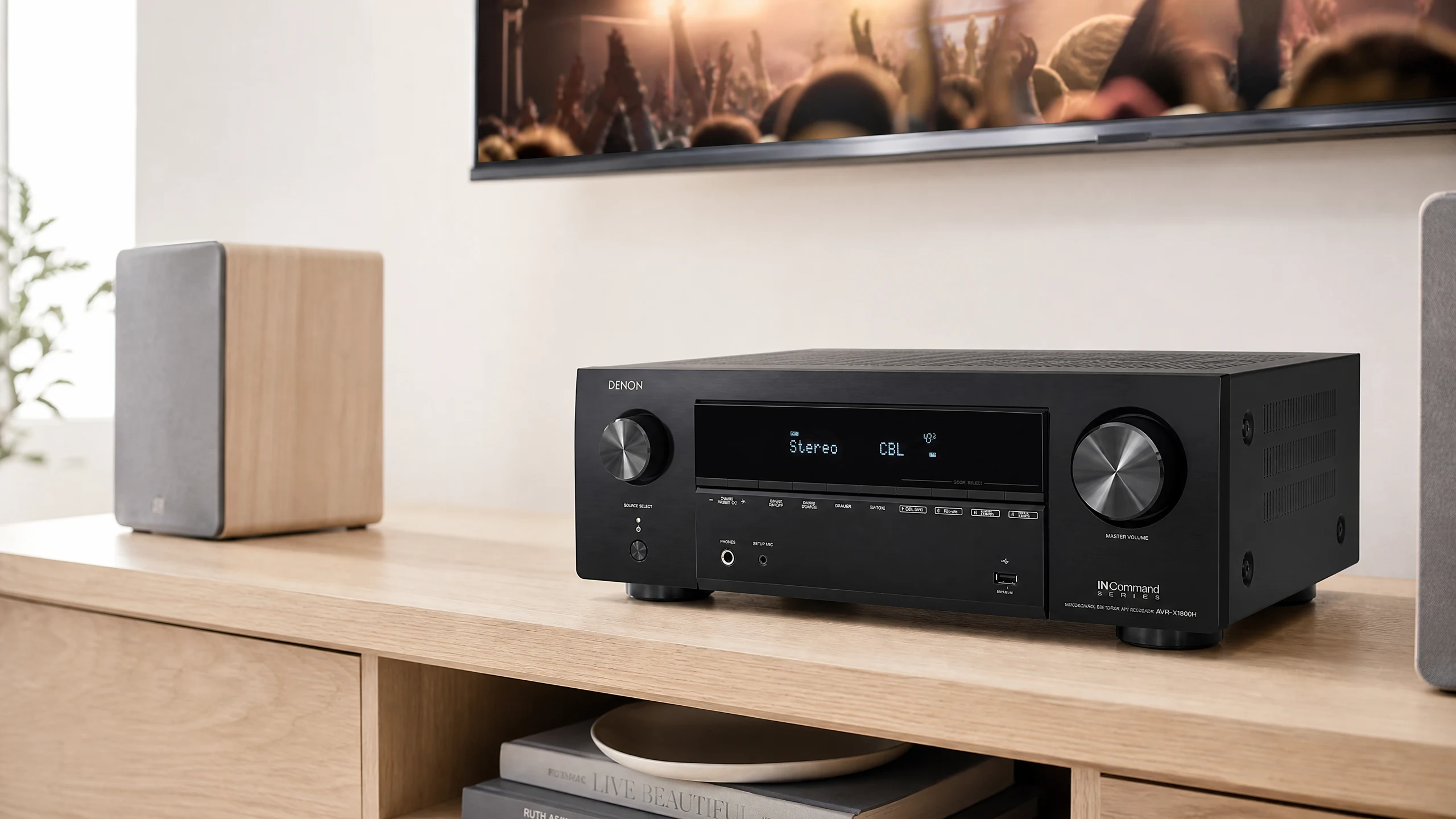
Denon keeps the AVR-X1800H visually restrained. The black front panel uses a central display, a large volume dial, a smaller source selector, and a drop-down door that hides secondary controls. It is not designed to be a decorative centerpiece, which is an advantage in a living-room rack: once the input and volume are set, the receiver recedes into the system rather than competing with the display or speakers.
The chassis is large enough to need thoughtful ventilation. Leave space above the receiver and avoid placing it directly on top of another heat-producing component. This is especially important in a 5.2.2 system, where the receiver may be asked to power seven channels during long movie sessions. Good airflow is a reliability measure, not just a cosmetic installation detail.
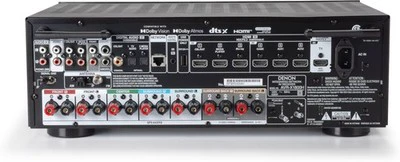
The rear panel is dense but logically arranged. Six HDMI inputs cover the most common combination of game consoles, streaming boxes, disc players, and a television return path. The speaker terminals, two subwoofer outputs, analogue inputs, phono input, and digital audio connections make the receiver usable with both newer HDMI-based systems and older sources. The one-output HDMI design is a practical limitation for owners who need to feed two displays at the same time.
Sound Quality for Stereo and Surround
Stereo music
In two-channel listening, the AVR-X1800H has the balanced, slightly full presentation many listeners associate with Denon’s home-audio equipment. Vocals occupy a stable center position, acoustic instruments have enough body to avoid sounding threadbare, and the upper midrange remains comfortable during long listening sessions. That does not mean the receiver is soft or indistinct. With a competent pair of passive speakers, cymbals and guitar texture remain clear, while bass lines retain enough shape to keep rhythm sections from turning into a general wash.
The receiver is most convincing when the speakers are a reasonable electrical and sensitivity match. It can make a compact bookshelf-speaker system sound substantial, especially after Audyssey has corrected room-related bass peaks. It is less persuasive when paired with large, insensitive speakers in a big room and pushed toward its limits. In that situation, the presentation can lose composure before it becomes obviously distorted, which is a sign that more amplifier headroom would be useful rather than evidence that the receiver has a fundamental tonal problem.
For a turntable system, the built-in phono input is a welcome convenience. It avoids the need for an immediate external phono stage and lets the receiver apply the same system-level volume and bass-management controls used by the other sources. Buyers with a moving-coil cartridge or a specialized analogue front end should confirm the electrical requirements of their cartridge before assuming the internal phono stage is the correct match.
Surround and Dolby Atmos
Movie sound is where the extra channels earn their keep. In a conventional 5.1 layout, the X1800H creates a stable front soundstage, keeps dialogue anchored to the center speaker, and moves effects around the room without making the transitions feel disconnected from the main program. In a 5.1.2 arrangement, the two height channels add a sense of vertical space to rain, aircraft, room ambience, and other object-based effects. The effect is more convincing when the height speakers are placed correctly and the calibration microphone is used carefully.
Independent listening impressions describe the AVR-X1800H as detailed and satisfying for both films and music, with enough output for a small room. They also identify the boundary of the design: compared with substantially more expensive AVRs, it does not deliver the same low-frequency authority, separation, or large-scale theatrical ease. That is a useful distinction. The receiver can be immersive without pretending to be a high-current cinema amplifier.
Subwoofer integration
Two subwoofer outputs make it easier to build a balanced low-frequency system, but the number of outputs does not remove the need for placement and measurement. In a rectangular room, two subs can reduce seat-to-seat bass variation when they are positioned sensibly. Audyssey can then refine the result by setting distance, level, and equalization. If the main speakers are small, using the receiver’s crossover and allowing the subwoofer to handle the deepest bass also preserves amplifier headroom for vocals and midrange detail.
The broader choice between a simple two-channel system, a 2.1 setup, and a surround layout is covered in our 2.0 versus 2.1 versus 5.1 guide. The X1800H is most useful when you actually want the flexibility of the latter two approaches rather than buying surround capability that will never be used.
Connectivity and System Compatibility
The six HDMI inputs are a practical reason to choose the X1800H over a basic stereo receiver or a smaller AV model. A typical system can connect a game console, second console, streaming device, disc player, cable box, and television return audio without immediately needing an external switch. Three HDMI inputs are equipped for 8K-capable sources, while the receiver also supports the 4K/120Hz features that matter more directly to current consoles and gaming PCs.
eARC allows compatible televisions to send higher-quality audio formats back to the receiver over the HDMI connection. This is useful when the television’s internal apps are part of the system, but it depends on the television, cable, and menu settings all supporting the required path. If a television will be the primary source, verify its eARC behavior before assuming every format will pass through automatically.
HEOS is the X1800H’s main network-audio platform. It provides access to supported streaming services and local-network playback through the HEOS app, while AirPlay 2 and Spotify Connect offer simpler paths from compatible phones and computers. Bluetooth is useful for casual playback and for sending audio to compatible headphones, but Wi-Fi-based streaming is generally the better option for a permanent music system because it avoids tying playback to a nearby phone.
The receiver also supports Zone 2, which can send a separate source to another listening area under the limitations of the source and connection type. Buyers who need elaborate multi-zone analogue routing or more than one video output should consider the higher-tier alternatives rather than trying to stretch a compact seven-channel receiver beyond its intended role.
Audyssey MultEQ XT Room Correction
Audyssey MultEQ XT is one of the most important reasons to consider the X-series rather than buying a receiver based only on channel count. The supplied microphone measures several positions around the listening area, then the receiver uses those measurements to set speaker distance, channel level, crossover behavior, and equalization. The goal is not to give every room the same sound; it is to reduce the most obvious effects of the room and make the system behave more consistently across the seats.
Setup quality matters. Place the microphone at ear height, keep it away from the back of the sofa, avoid holding it in your hand, and measure the positions where people will actually sit. The first measurement establishes the main listening position; the remaining positions should describe a realistic listening area rather than a long line extending across the room. After calibration, check that the detected speaker sizes and crossover points make sense. A small bookshelf speaker marked as large, for example, may benefit from a manual crossover adjustment and subwoofer integration.
Audyssey is a starting point, not an instruction to stop listening. Some listeners prefer the corrected result exactly as supplied, while others prefer a slightly different target curve or a less aggressive high-frequency correction. The key advantage is that the receiver gives you a measured baseline. That is usually more reliable than adjusting bass and treble by ear while the room’s strongest modes remain untouched.
Gaming and HDMI Features
The X1800H is well suited to a modern console system. The relevant features are 4K/120Hz support, variable refresh rate, auto low-latency mode, and eARC. VRR helps a compatible display keep motion smooth when a game’s frame rate changes, while ALLM allows the display to switch into a lower-latency mode when gameplay begins. These features matter only when the console, receiver input, television, and cable all support the same signal path, so the receiver should be treated as one part of the chain rather than a guarantee that every display will expose every feature.
For a single-console system, routing the console directly to a compatible display and returning audio through eARC can sometimes be the simplest setup. Routing sources through the receiver is more convenient when you want one remote and one input switch, especially with multiple consoles and media devices. The X1800H gives you both options, which is more useful than a long list of video standards that you cannot practically connect.
How the Denon AVR-X1800H Compares
AVR-X1800H versus AVR-X1700H
The AVR-X1800H follows the same basic seven-channel, Dolby Atmos, Audyssey MultEQ XT concept as the AVR-X1700H. That makes the predecessor review a useful reference, but the two models should not be treated as interchangeable in every system. The X1800H is the newer choice for buyers who want the current feature set and a receiver that sits naturally in a new HDMI 2.1 system. The X1700H may still be relevant when its specific listing, warranty, or availability makes it a better fit, but the decision should be based on the exact unit and not on the assumption that the model names alone determine value. Read our full Denon AVR-X1700H review for the predecessor’s particular trade-offs.
AVR-X1800H versus AVR-S980H
The AVR-S980H is a useful comparison for buyers who want to stay within Denon’s family but are considering a different balance of features and system scale. It offers a similar home-theater-first approach while moving the buyer toward a higher point in Denon’s range. The X1800H remains compelling when Audyssey MultEQ XT, a compact 5.2.2 system, and a straightforward music-and-movies role are the priorities. The S980H deserves closer attention when you need more flexibility or want to move beyond the X1800H’s seven-channel ceiling. Our Denon AVR-S980H review explains where that alternative makes more sense.
Where it sits among budget AV receivers
In a broader comparison, the X1800H belongs near the upper end of the compact AV-receiver class because it combines physical Atmos height channels, room correction, HEOS, phono, and current HDMI features. The right alternative depends on which capability you are willing to give up. A simpler receiver can be enough for a basic 5.1 setup; a stereo receiver may sound more direct for two-channel listening; and a larger AV receiver becomes appropriate when you need more channels or more sustained output. Our roundup of the best AV receivers under $500 provides a wider starting point for that decision.
Speaker Matching and Setup Guidance
Pair the AVR-X1800H with speakers whose sensitivity and impedance are comfortable for an 80-watt-class receiver. Compact and medium-sized passive speakers are the obvious match, especially when a subwoofer takes over the lowest octaves. Speakers that dip to a difficult impedance or need very high continuous output are not automatically incompatible, but they reduce the headroom available in a demanding room. Use the receiver’s bass management rather than expecting the front channels to reproduce deep bass at concert levels.
When connecting speakers, keep the polarity consistent, avoid loose strands touching neighboring terminals, and use the receiver’s on-screen setup to confirm every channel. Then run Audyssey, check its speaker-size decisions, and listen to familiar music before making small adjustments. Our guide to matching an amplifier to speakers covers the broader electrical and sensitivity questions, while Denon’s place within the home-audio market is discussed in Denon amplifiers: who they are for.
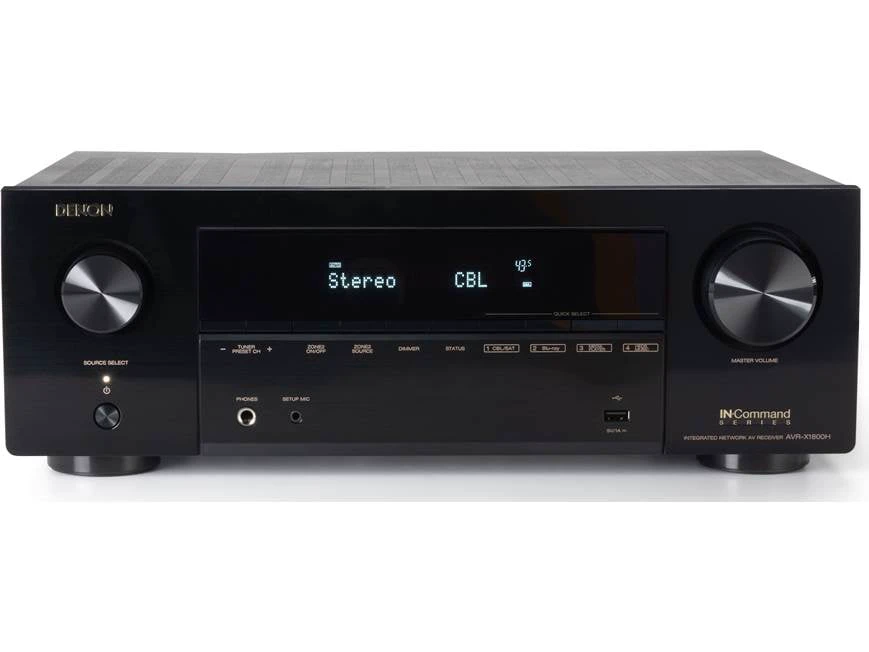
Denon AVR-X1800H Product Image
The Denon AVR-X1800H product image is shown below so you can inspect the receiver’s front-panel design before deciding whether it fits your system.
Check the Denon AVR-X1800H on Amazon
AmplifierZone uses affiliate links, including links to Amazon. If you buy through one of these links, we may earn a commission at no additional cost to you. Our editorial conclusions are based on product research, specifications, and independent review cross-checks rather than on the commission.
Final Verdict: Is the Denon AVR-X1800H Worth It?
The Denon AVR-X1800H is a well-judged all-rounder for a compact or medium-sized music-and-home-theater system. It delivers the functions that matter in daily use: a competent seven-channel amplifier, physical Dolby Atmos support, modern HDMI gaming features, phono playback, HEOS and AirPlay 2 streaming, two subwoofer outputs, and Audyssey MultEQ XT. That combination is more meaningful than any individual badge on the front panel because it lets one receiver handle nearly every common source in a real living room.
Its limitations are equally clear. The single HDMI output is restrictive for dual-display installations. Seven amplified channels prevent a larger nine-channel Atmos layout. And the 80-watt rating should be matched to the room and speakers rather than interpreted as unlimited cinema power. Listeners with large, insensitive speakers, a very wide seating distance, or a desire for high-volume full-range playback should step up to a more powerful receiver or add external amplification.
For the intended buyer, however, the balance is excellent. The X1800H is especially attractive when music quality matters as much as surround effects, when streaming should be built in rather than added later, and when room correction can solve real bass and placement problems. It is a receiver to choose for the whole system, not merely for its channel count.
Frequently Asked Questions
Is the Denon AVR-X1800H good for music?
Yes. The AVR-X1800H has a balanced, comfortable stereo presentation, supports HEOS, AirPlay 2, Spotify Connect, Wi-Fi, Bluetooth, and includes a phono input. It is particularly effective with sensible bookshelf or floorstanding speakers in a small or medium room, especially when Audyssey calibration and a subwoofer are used thoughtfully.
How many speakers can the Denon AVR-X1800H power?
It has seven amplified channels and two subwoofer outputs. That supports a conventional 7.2 layout or a 5.2.2 Dolby Atmos layout with two height speakers. The two subwoofer outputs are line-level connections; they do not represent two additional amplified speaker channels.
Does the Denon AVR-X1800H support 4K/120Hz gaming?
Yes. The receiver supports 4K/120Hz along with features such as VRR and ALLM through compatible HDMI connections. The console, display, HDMI cable, and receiver settings must all support the same signal path for those features to work as expected.
Does the Denon AVR-X1800H have Dolby Atmos?
Yes. Dolby Atmos and DTS:X are supported. With seven amplifier channels, the practical Atmos layout is generally 5.1.2: five ear-level channels, one subwoofer channel path, and two height speakers. The receiver cannot power a full 7.1.2 layout because that requires nine amplified channels.
Is the Denon AVR-X1800H powerful enough for a large room?
It can work in a large room when the speakers are reasonably sensitive, the listening distance is moderate, and a subwoofer handles the deepest bass. However, its 80-watt two-channel rating and seven-channel design are better suited to small and medium rooms than to high-volume, full-range playback across a large seating area. Choose more amplifier headroom if that is your normal use case.