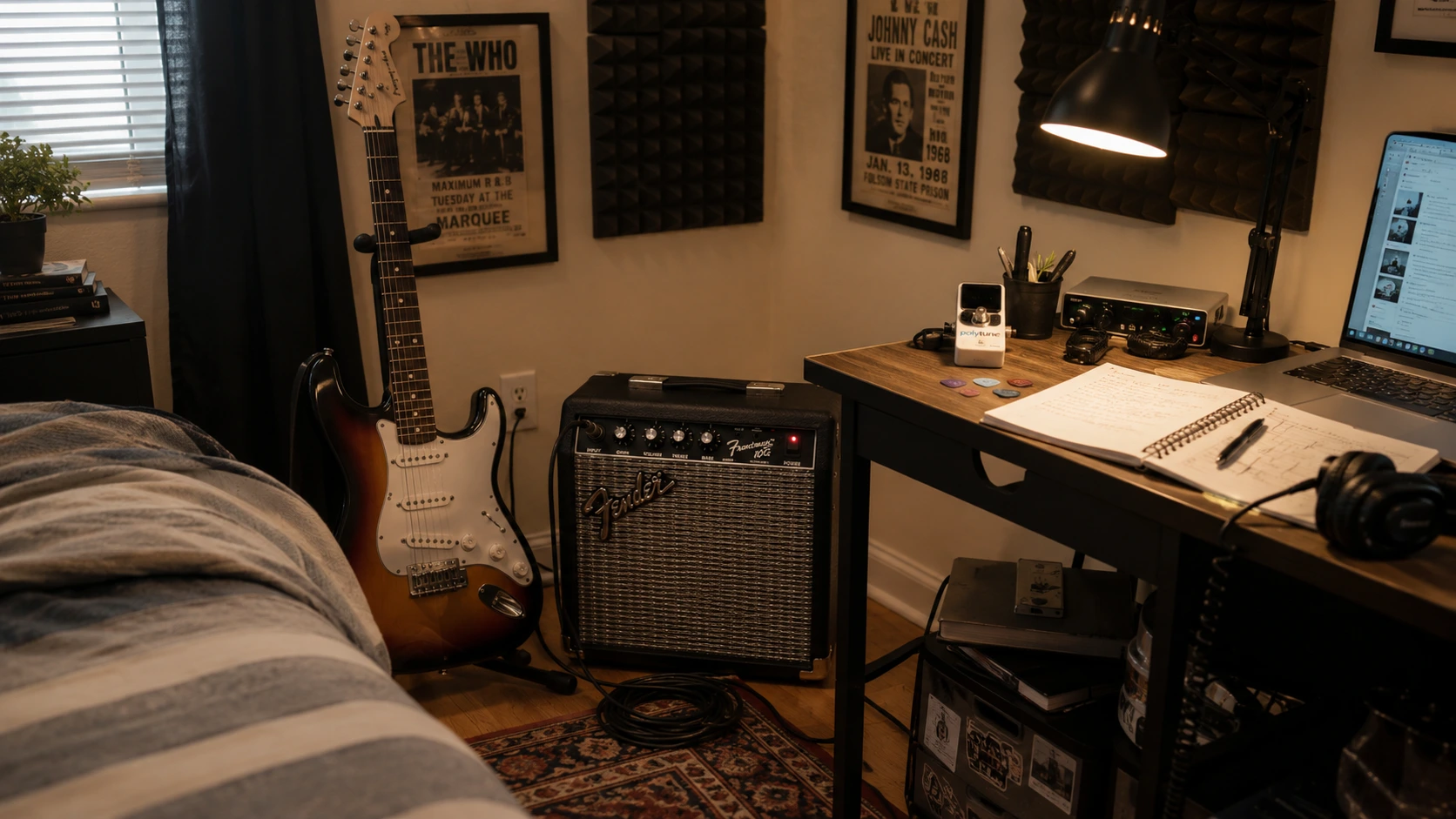
This Fender Frontman 10G review covers the most extensively reviewed guitar amp on Amazon at its price — 13,483 ratings at 4.6 stars, Amazon’s Choice designation, and 800+ purchases per month across years of continuous production. Those numbers represent something specific: the Frontman 10G is not a recent launch with inflated early reviews, it is a product that has been purchased by real beginners in real homes over a sustained period and consistently rated highly enough to maintain that average. It sits at the entry point of our best guitar amps under $200 roundup as the most validated budget pick available.
The honest position upfront: the Frontman 10G is a simple 10-watt solid-state practice amp with a 6-inch speaker, two channels, one tone control, and a headphone output. It does not model amp tones, does not include built-in effects beyond the overdrive channel, and cannot record directly to a computer. What it does is provide clean and overdriven guitar tone at bedroom volumes reliably and without complication — and do so for under $100 with Fender’s build quality and warranty behind it.
Fender Frontman 10G at a Glance
Quick Answer: The Fender Frontman 10G is the safest first guitar amp purchase available — 13,000+ Amazon reviews at 4.6 stars confirm sustained real-world satisfaction. Clean and overdrive channels work well at bedroom volumes, the headphone output enables silent practice, and the aux input plays backing tracks from a phone. Its limitations are appropriate for the price: no modelling, no effects, no USB recording. For a first amp where simplicity and reliability matter most, it is the benchmark recommendation.
This article contains affiliate links. If you purchase through them, we may earn a commission at no extra cost to you. This helps support AmplifierZone and allows us to keep creating in-depth, unbiased audio guides.
Who Is the Fender Frontman 10G For?
The player it was built for
The Frontman 10G is built for the player who is picking up a guitar for the first time and needs a functional, reliable amplifier without spending time learning amp features before learning the instrument itself. Two channels — one clean, one with overdrive — cover the tonal range a beginner actually needs. A single tone control handles brightness adjustment without requiring EQ knowledge. A headphone output enables practice at any hour. An aux input plays music from a phone for play-along practice. Setup takes minutes: plug in the guitar, set the volume, choose a channel, and play.
The 13,000+ review count reflects precisely this use case at scale. The Frontman 10G has been the default first amp recommendation in guitar communities for years — not because it is exceptional in any specific specification, but because it delivers a reliable, uncomplicated experience at the price point where most first guitar purchases happen. Fender’s brand recognition and build quality consistency add confidence for buyers who have no prior amp purchasing experience.
When to look elsewhere
The Frontman 10G is the wrong choice for players who want to record guitar directly to a computer — it has no USB output. It is also the wrong choice for anyone who wants multiple amp tones, built-in reverb or delay, or app-connected preset management. For players who already know they want those features, the Fender Mustang LT25 at a higher price provides all of them. The Frontman 10G is specifically for buyers who want simplicity first and feature breadth later — or never, if the simple setup suits their playing permanently.
The 13,000 review signal: A 4.6-star average across 13,000+ reviews is a meaningful quality signal — not because any individual review is definitive, but because dissatisfied buyers leave reviews disproportionately more than satisfied buyers. Maintaining 4.6 stars across that volume over years means the vast majority of buyers consistently have positive experiences. That is harder to fake or inflate than a smaller review count.
Fender Frontman 10G — Key Specifications

Fender Frontman 10G Guitar Amplifier
- Power output: 10W
- Speaker: 6-inch Fender Special Design
- Channels: 2 — Clean and Overdrive
- Controls: Clean Volume, Overdrive Volume, Tone
- Headphone output: Yes — 3.5mm
- Aux input: Yes — 3.5mm
- USB recording: No
- Built-in effects: None — overdrive channel only
- Type: Solid state
- Warranty: 2 years (Fender)
Pros and cons
- 13,483 Amazon reviews at 4.6 stars — most validated amp at its price by far
- Amazon’s Choice — 800+ purchases per month, sustained over years
- Fender build quality and 2-year warranty — reliable long-term
- Headphone output — silent practice at any hour
- Aux input — play along with music from a phone or computer
- Two channels — clean and overdrive both genuinely usable
- Simple controls — no learning curve before playing
- Lowest price in the under-$200 group
- No USB recording — cannot record direct to a computer
- No built-in effects — reverb, delay, chorus require external pedals
- Single Tone control — limited EQ adjustment range
- 6-inch speaker — less bass extension than 8-inch or 12-inch alternatives
- 10W output — adequate for bedroom, limiting for anything louder
- No modelling — one clean voice and one overdrive voice only
Most validated beginner guitar amp — 13,000+ reviews at 4.6 stars, Amazon’s Choice, and Fender’s 2-year warranty.
Design and Build Quality
Fender’s standard construction
The Frontman 10G uses Fender’s established practice amp construction — a vinyl-covered particleboard cabinet, a fabric-covered speaker baffle with a small Fender logo, and a front panel layout that has remained consistent across Frontman generations. Nothing about the design is exciting or distinctive. Everything about it is properly assembled and built to last. The binding posts and jack sockets feel solid, the controls move with appropriate resistance, and the cabinet does not flex or rattle at practice volumes. For a first amp that may be owned for years before an upgrade, the build quality is appropriate and reliable.
Size and placement
At approximately 27 × 27 × 16cm the Frontman 10G is compact — smaller than a typical gaming controller box. It sits on a desk, bookshelf, or floor without occupying meaningful space. The 6-inch speaker fires from the front baffle, so directional placement matters slightly — facing the amp toward the listening position produces the clearest sound. Weight is minimal and single-handed carrying is comfortable. There is no carry handle, but the size makes one unnecessary.
The 6-inch speaker honestly assessed
The Fender Special Design 6-inch speaker is the Frontman 10G’s most significant physical constraint. A 6-inch driver produces less low-frequency extension than an 8-inch or 12-inch speaker — bass notes are present but not full, and the overall presentation lacks the warmth and body that a larger driver produces. At bedroom practice volumes this is rarely a problem: the frequency range a 6-inch speaker handles well covers the guitar’s midrange and upper frequencies that matter most for technique development. At higher volumes or for players who want to hear their tone fully developed, the 6-inch speaker becomes a real limitation.
Sound Quality
Clean channel
The clean channel produces a bright, direct tone characteristic of Fender’s solid-state practice amp design. Single-coil pickups — Stratocaster and Telecaster style — through the Frontman 10G clean channel produce a clear, defined sound that is useful for developing picking technique because string attack and articulation come through without flattering compression. Humbucker-equipped guitars produce a warmer clean tone. The single Tone control adjusts brightness — rolled back it produces a rounder sound, opened up it adds presence and definition. For the full range of tonal adjustment that the EQ controls on higher-end amps provide, the guitar amp settings for beginners guide explains how EQ and gain interact across different amp types.
Overdrive channel
The overdrive channel delivers light-to-medium gain — it covers strummed rock chords, basic lead tones, and blues crunch convincingly. It is not a high-gain channel and does not produce the tight, articulate distortion required for heavy metal. Within its range it is responsive to the guitar’s volume knob: rolling back produces a cleaner tone, pushing up adds more saturation. The Tone control affects both channels simultaneously, which means the same brightness setting applies to both clean and overdrive — a minor limitation when the ideal EQ for each channel differs.
Headphone and aux performance
The headphone output produces the amp’s signal directly without cabinet simulation — the tone through headphones is thinner and brighter than through the speaker, which is standard for practice amps at this price. It enables silent practice effectively even without simulation. The aux input mixes a phone or computer audio signal with the guitar — useful for playing along with songs, YouTube lessons, or backing tracks. Volume balance between guitar and backing track is controlled by the device’s output volume rather than a dedicated blend control, which requires minor adjustment when switching sources.
How the Fender Frontman 10G Compares
Fender Frontman 10G vs Blackstar Fly 3
Two entry-level amps at a similar price serving different priorities. The Blackstar Fly 3 adds battery operation, a built-in tape delay, ISF tone control, and genuine portability — features the Frontman 10G lacks entirely. The Frontman 10G counters with a 6-inch speaker versus the Fly 3’s 3-inch, a larger cabinet volume, and 13,000+ Amazon reviews versus the Fly 3’s 72. At similar prices, the Fly 3 offers more features; the Frontman 10G offers more validated reliability and a larger speaker. For a fixed-location home practice amp, the Frontman 10G’s larger speaker makes it the more natural-sounding choice. For portability or travel use, the Fly 3 wins clearly.
Fender Frontman 10G vs Fender Champion II 25
A step up within the Fender range. The Champion II 25 at a higher price adds 25 watts, a larger 8-inch speaker, 12 built-in effect models, and a more extensive EQ. For players who want to stay with Fender and develop past the entry level, the Champion II 25 is a natural progression. For players who want the simplest possible first amp at the lowest possible price, the Frontman 10G delivers what they need without paying for features they will not use immediately. Both carry Fender’s 2-year warranty and build quality standard.
Fender Frontman 10G vs Vox Pathfinder 10
The Vox Pathfinder 10 costs more and delivers a distinctly different character — British-voiced tone with authentic Vox chime, tremolo effect, and a more developed tonal character overall. For a buyer who already knows they want that British amp sound, the Pathfinder 10’s character justifies its price premium. For a buyer who is genuinely starting from scratch and does not yet have a preference, the Frontman 10G’s simpler control set, lower price, and validated review history make it the lower-risk first purchase. Tone preference is personal, but reliability and simplicity at this entry level have real value.
Is the Fender Frontman 10G Worth It?
For a first guitar amp — yes, without qualification
No other amp under $100 has earned the level of real-world validation the Frontman 10G carries. Its 13,000+ reviews represent a genuine quality signal — not marketing, not manufactured consensus, but consistent satisfaction from buyers who purchased a first amp and returned to rate it positively. The amp does exactly what a first practice amp should: it makes the guitar audible at bedroom volumes, provides a usable overdrive tone for rock playing, and enables silent practice through headphones. Nothing about it is exciting or distinctive. Everything about it works reliably and consistently.
When to spend more
The case for spending more becomes clear when specific features become priorities. USB recording requires the Fender Mustang LT25. App-connected preset management and AI backing tracks require the Positive Grid Spark 40. A proper 12-inch speaker with power attenuation requires the Boss Katana-50 Gen 3. None of those features are available on the Frontman 10G — but none of them are necessary for a player who is still learning the instrument and developing technique. The Frontman 10G is appropriate for that stage and cost-effective within it.
Fender Frontman 10G Review — Final Verdict
The most validated beginner amp money can buy
The Fender Frontman 10G earns its recommendation not through standout specifications but through standout consistency — 13,000+ buyers across years of production consistently rating it highly enough to maintain 4.6 stars and Amazon’s Choice status. It is simple, reliable, appropriately priced, and backed by Fender’s 2-year warranty. For a first guitar amp where the priority is getting started without complication, the Frontman 10G is the correct purchase. For the complete picture of what a progression from the Frontman 10G looks like — including all the features the next step up adds — the best guitar amp for home use roundup maps the full range.
Next in this review series
For the British-voiced alternative at a step up in price — Vox chime, authentic tremolo, and a character the Frontman 10G does not attempt — the Vox Pathfinder 10 review covers the next pick in the under-$200 group.
Most validated beginner guitar amp — 13,000+ reviews at 4.6 stars, Amazon’s Choice, and Fender’s 2-year warranty.
Frequently Asked Questions
Getting started with the Fender Frontman 10G
Is the Fender Frontman 10G good for beginners?
Yes — it is the most validated beginner guitar amp available under $100. Simple controls, two channels, a headphone output for silent practice, and an aux input for play-along practice cover everything a beginner needs without requiring amp expertise before guitar expertise. The 13,000+ Amazon reviews confirm that buyers at the beginner stage consistently find it meets and exceeds expectations at its price.
Can the Fender Frontman 10G be used for recording?
Not directly — the Frontman 10G has no USB output. Recording through it requires an external audio interface connected via a microphone placed in front of the speaker, or a direct instrument input into a separate interface. For direct USB recording without a microphone, the Fender Mustang LT25 is the step-up option with that capability built in at a higher price.
Features and limitations
Does the Fender Frontman 10G have reverb?
No — the Frontman 10G has no built-in reverb or any effects beyond the overdrive channel. Adding reverb requires an external reverb pedal connected between the guitar and the amp. For a first amp with built-in reverb and additional effects, the Fender Champion II 25 includes 12 effect models including reverb at a higher price, or the Fender Mustang LT25 provides 30 effects including multiple reverb types with USB recording capability.
How loud is the Fender Frontman 10G?
At 10W through a 6-inch speaker, the Frontman 10G is loud enough for bedroom and small room practice without difficulty. At maximum volume it produces enough output to be heard clearly in a normal-sized room and would be audible through thin walls at full power. It is not loud enough for rehearsal with a drum kit or other amplified instruments. For band rehearsal or live use, a minimum of 25–50W through a larger speaker is needed. The headphone output enables completely silent practice at any volume setting.
More questions about the Fender Frontman 10G
What is the difference between the Fender Frontman 10G and the Fender Champion II 25?
Three meaningful differences: the Champion II 25 delivers 25W versus 10W, uses an 8-inch speaker versus 6-inch, and includes 12 built-in effect models including reverb and delay versus no effects on the Frontman 10G. Both carry Fender’s 2-year warranty and comparable build quality. For a beginner who wants the simplest possible starting point at the lowest price, the Frontman 10G is appropriate. For a beginner who anticipates wanting built-in effects and louder output within the first year of playing, the Champion II 25’s additional features justify its higher price from the start.
Is the Fender Frontman 10G good for electric guitar?
Yes — it is designed specifically for electric guitar. Single-coil and humbucker pickups both work well through the clean and overdrive channels. Single-coil guitars produce a bright, defined clean tone particularly well suited to the Frontman 10G’s character. Humbucker guitars produce a warmer, fuller response on the same settings. It is not designed for bass guitar — the 6-inch speaker and power stage are not suited to bass frequencies at meaningful volumes.