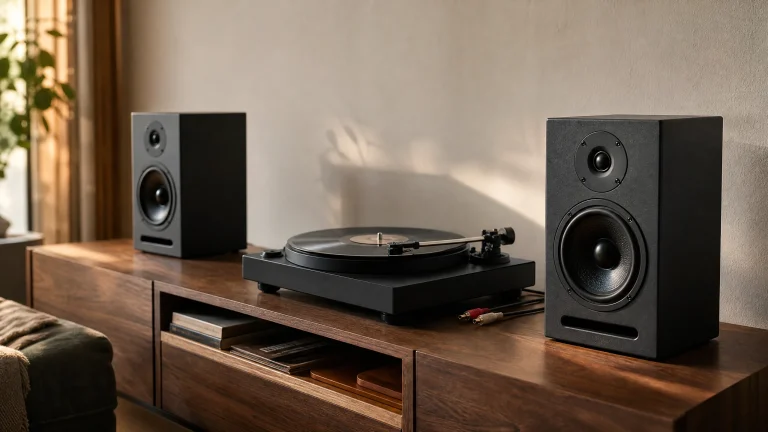
You don’t usually notice it right away. Your speakers still sound good, still get loud, and still do what they’re supposed to do. But over time, something feels restrained — like the system never fully opens up, no matter how much you turn the volume knob.
This is where many listeners start questioning their speakers, their source, or even their own ears. In reality, this kind of frustration is often tied to how well the amplifier and speakers are working together, not whether either one is “bad.” Understanding how to match an amplifier to your speakers — and what amplifier power actually means in real listening — can reveal why a system that looks fine on paper still feels held back.
If you’ve ever wondered whether your amplifier holding speakers back is the reason music feels smaller, flatter, or more fatiguing than it should, this guide will help you read those signals correctly — without jumping straight to upgrades.
- Is Your Amplifier Holding Your Speakers Back?
- Why Your Speakers Feel Capable — But Never Fully Open
- Why “More Power” Rarely Fixes the Problem
- The Real Bottleneck: Control Under Demand
- How to Tell If the Amplifier Is the Limiting Factor
- Behavioral Signs Your Amplifier Is Holding Things Back
- When an Amplifier Change Actually Helps
- When the Problem Isn’t the Amplifier
- System Alignment Beats Chasing Upgrades
- FAQs About Amplifiers and Speaker Performance
Is Your Amplifier Holding Your Speakers Back?
Yes — an amplifier can hold speakers back even when the system gets loud and sounds clean. The issue is rarely raw power, but how confidently the amplifier maintains control as music becomes demanding. When control is lacking, speakers often sound restrained, compressed, or tense instead of open and dynamic.
Why Your Speakers Feel Capable — But Never Fully Open
One of the most confusing experiences in a sound system is knowing your speakers are capable, yet never hearing them fully relax. They image well at lower levels, sound clean on simple tracks, and hint at depth — but the moment the music becomes demanding, something tightens. The system never quite opens up, even though nothing sounds obviously wrong.
This is why speakers are so often blamed first. They’re the most visible part of the system, the most talked-about component, and the easiest place to point when sound feels limited. But true speaker problems tend to announce themselves clearly through harshness, imbalance, or obvious distortion. What most people experience instead is restraint — a feeling that the speakers are being held back rather than failing.
That distinction matters. Restraint feels like potential that never arrives, while distortion feels like something actively breaking. When a system consistently sounds better at modest volume than it does when pushed, the issue usually isn’t what the speakers can do — it’s how confidently the system supports them.

Why “More Power” Rarely Fixes the Problem
When a system feels constrained, the most common advice is to add more power. On the surface, that makes sense — louder systems feel more capable, and amplifier specs seem to promise headroom. But in real listening, volume and control are not the same thing, and chasing higher wattage often leaves the underlying issue untouched.
Two amplifiers with similar power ratings can behave very differently once music becomes complex. As dynamic passages demand more from the system, some amplifiers stay composed while others start to lose grip. This is why systems can sound impressive on paper yet feel unsettled in practice, especially as volume rises.
Part of the confusion comes from how speakers load an amplifier. Impedance changes with frequency, musical content, and listening level, meaning the amplifier is constantly adapting to shifting demands. Understanding how loads behave — especially the differences discussed in 4-ohm vs 8-ohm speaker setups — helps explain why some systems tighten up under pressure while others start to feel strained.
This kind of restraint is most often noticed with compact integrated amplifiers paired with speakers that demand higher current delivery, regardless of brand or price point.
This is why adding power alone doesn’t guarantee better sound. If the amplifier can’t remain stable and composed as demand rises, extra wattage simply raises the ceiling without improving control. The result is often a louder version of the same restraint, rather than the sense of ease listeners are actually looking for.
In practical terms, louder volume does not equal freer sound when control is the real limitation.

The Real Bottleneck: Control Under Demand
The moment a system starts to struggle, the problem usually reveals itself in how sound behaves under pressure. Bass notes lose their shape and begin to blur together, treble stops expanding and instead flattens, and the space between instruments shrinks rather than opening up. Nothing necessarily sounds broken, but the presentation becomes tense and less engaging as complexity increases.
These changes often show up before listeners think to question the amplifier. At moderate levels, the system can feel balanced and enjoyable, giving the impression that everything is working as it should. But as music asks for faster current delivery and tighter grip, weaknesses in control become audible, even if outright distortion never appears.
What makes this especially confusing is that loudness can still increase. The system may play louder than you need it to, yet sound smaller and less composed at the same time. This disconnect is why control, not volume, is often the real bottleneck when speakers feel like they never fully open up.
This is why a system can play louder yet feel smaller — control, not volume, determines how freely speakers perform.

How to Tell If the Amplifier Is the Limiting Factor
- The system sounds better at lower volume. Music feels smoother and more balanced when played quietly, but tightens as levels rise.
- Bass loses shape before it loses volume. Low frequencies blur or thicken even though output remains strong.
- The soundstage collapses as music gets busy. Instrument separation shrinks instead of expanding with complexity.
Behavioral Signs Your Amplifier Is Holding Things Back
When an amplifier is the limiting factor, the clues tend to show up in how the system behaves over time rather than in one dramatic failure. These signs are easy to miss because nothing sounds obviously “wrong” at first — the system simply becomes less satisfying the harder it’s asked to work.
- Dynamics flatten at moderate volume. Music gets louder, but it doesn’t feel more energetic or alive, as if the system is compressing peaks to stay comfortable.
- Bass loses definition before it loses volume. Low notes blur together or feel one-note even though there’s still plenty of output.
- The soundstage shrinks as tracks get busier. Instead of expanding, instruments collapse toward the center and separation becomes harder to follow.
- Listening fatigue sets in sooner than expected. Sessions feel more tiring, not because the system is harsh, but because it sounds tense and unsettled.
- The system sounds better late at night. At lower levels, everything feels smoother, more balanced, and more enjoyable.

When an Amplifier Change Actually Helps
An amplifier change makes sense only when it addresses a specific limitation in the system, not as a general attempt to “improve” sound. If speakers consistently tighten up, lose composure, or sound smaller as music becomes demanding, the amplifier may simply be struggling to stay in control. In those cases, changing amplification can restore ease and confidence rather than just adding volume.
What matters most is alignment. An amplifier that delivers current comfortably into the speaker’s real-world load can allow dynamics to breathe, bass to regain shape, and the soundstage to remain stable as complexity increases. This kind of change often feels less like an upgrade and more like the system finally behaving the way it always should have.
At the same time, it’s important to recognize when an amplifier change won’t solve the problem. If the system already sounds composed at higher levels but lacks character, scale, or emotional engagement, the limitation likely lies elsewhere. Swapping amplifiers in those situations often results in a different presentation, not a fundamentally freer one.
When amplification is properly matched, improvements feel like restored ease rather than added loudness.

When the Problem Isn’t the Amplifier
Not every sense of limitation in a system comes from amplification. Rooms interact with sound in powerful ways, and speaker placement can quietly shape how open or constrained a system feels. When reflections, boundaries, or layout work against the speakers, even a well-matched amplifier can seem like it’s holding things back.
Speaker design also plays a role. Some speakers prioritize compact size, efficiency, or tonal balance over scale and dynamic reach, which can affect how freely they present music at higher levels. Understanding the inherent strengths and limits of different designs — such as those discussed in guides like best bookshelf speakers for home audio — helps separate amplifier limitations from speaker characteristics.
In these cases, changing amplification may alter the sound without addressing the underlying constraint. The system might sound different, but not necessarily more relaxed or expansive, because the bottleneck exists outside the amplifier’s control. Recognizing this prevents unnecessary changes and keeps adjustments focused on what actually matters.
System Alignment Beats Chasing Upgrades
When speakers feel like they’re never quite allowed to open up, the system is usually communicating something important. The amplifier may be playing a role, but not in the simple sense of being “too weak” or “underpowered.” More often, it’s a question of how confidently the system stays composed when music becomes demanding.
This is why meaningful improvements rarely come from chasing bigger numbers or swapping gear at random. When alignment is right, the system feels relaxed, dynamic, and consistent across listening levels. Music gains ease and clarity not because anything is being pushed harder, but because nothing is struggling to keep up.
Approaching the problem this way shifts the focus from upgrading to understanding. Once you learn to recognize restraint, control, and composure in your own system, decisions become clearer and more confident. The goal isn’t to extract more from the speakers — it’s to let the system stop holding them back.

FAQs About Amplifiers and Speaker Performance
Can a weak amplifier damage good speakers?
Yes, but not in the way most people expect. Damage usually doesn’t come from low power itself, but from pushing an amplifier beyond its ability to stay in control. When an amplifier struggles, it can deliver unstable or distorted signals that place sustained stress on speaker components over time.
This is why restraint and tension in sound should be taken seriously. Even without obvious distortion, a system that constantly sounds strained is signaling that something isn’t operating comfortably.
Why do my speakers sound better at low volume?
At lower levels, speakers demand less current and control from the amplifier. This allows the system to stay composed, balanced, and relaxed, which often makes music feel clearer and more enjoyable.
As volume rises and music becomes more complex, the amplifier has to work harder to maintain grip. If it can’t keep up, sound tightens and loses ease, even though loudness continues to increase.
Do more watts always mean better sound?
More watts alone don’t guarantee better sound. While sufficient power is important, how an amplifier behaves under real musical demand matters far more than its maximum rating.
An amplifier that stays stable, controlled, and composed at realistic listening levels will often sound more confident than a higher-powered model that struggles under complexity.