
The Polk Monitor XT20 is the bigger bookshelf speaker in Polk’s Monitor XT range: a 6.5″ paper woofer, a 1″ Terylene dome tweeter, and a rated response of 38Hz to 40kHz. It is aimed at listeners who want fuller bass and a wider dynamic range than a small desktop speaker can give, without moving up to floorstanders. If you are on a tight budget, see our best budget bookshelf speakers guide.
This review is built from Polk’s published specifications, retailer spec sheets, and independent measurements published by Erin’s Audio Corner, plus the amplifier pairing math. We have not lab-tested this speaker ourselves.
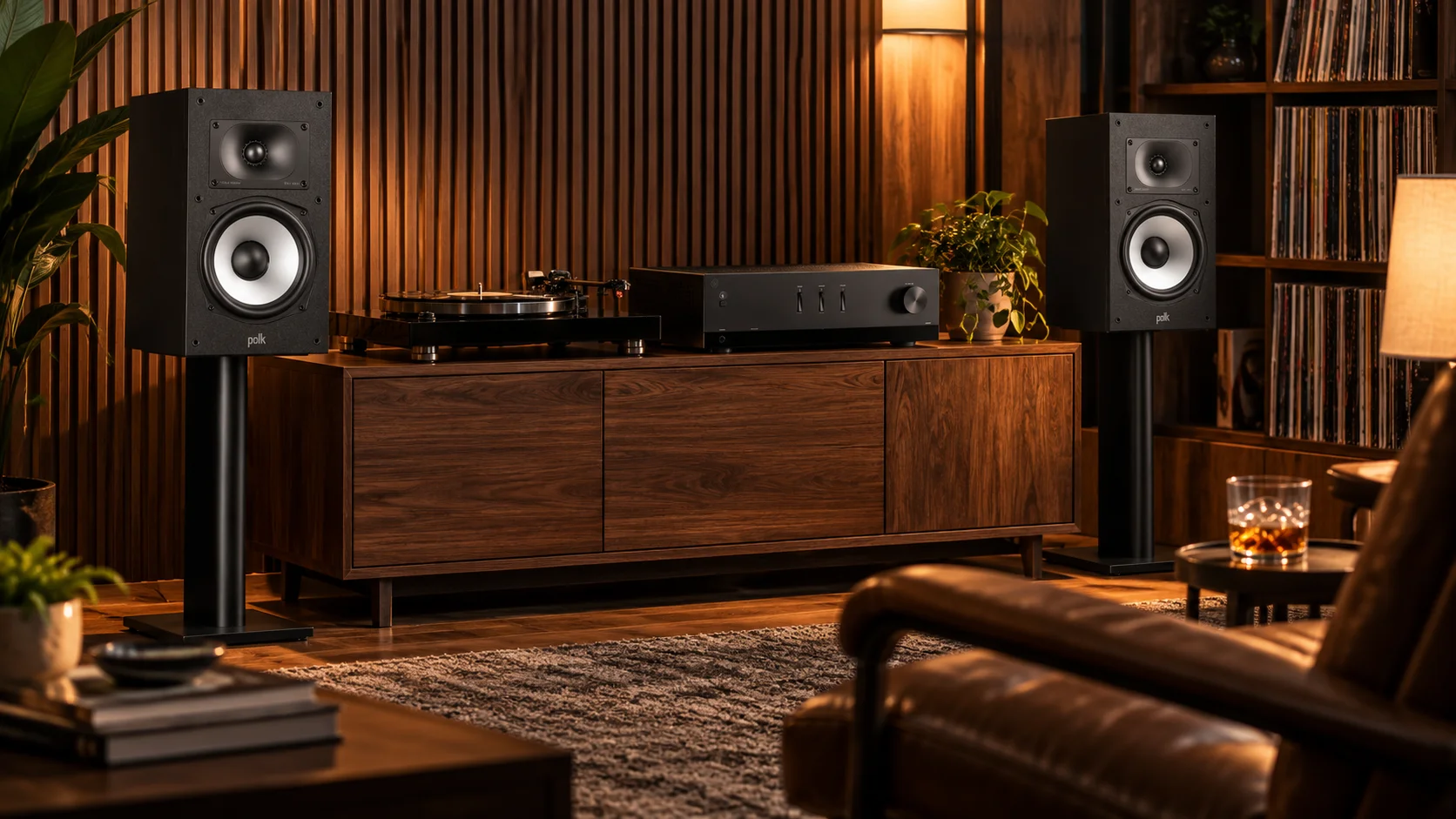
Quick answer: The XT20 is a good fit if you have a small to medium room and want more bass and scale than a 4″ or 5″ bookshelf speaker offers. It asks for a competent amplifier that is comfortable with 4Ω loads, and it takes more room to place. If you want the safest all-rounder, compare the ELAC Debut 2.0 B6.2 and the Polk Audio ES20; if your amplifier is small, the Klipsch R-41M is easier to drive.
This article contains affiliate links. If you purchase through them, we may earn a commission at no extra cost to you. This helps support AmplifierZone and allows us to keep creating in-depth, unbiased audio guides.
Who the Polk Monitor XT20 Is For (and Who Should Skip It)
The XT20 suits listeners with a small or medium room who want more weight in the bass and more dynamic headroom, and who plan to use a proper stereo amplifier. It also makes sense if you may build a home theater later, because Polk designed the Monitor XT line to work together as front, surround and rear speakers alongside its towers and center speaker.
It is a weaker fit if your desk or shelf is tight on space (it is noticeably larger than the compact 4″ speakers), if you are driving it from a very small amplifier, or if you want a lively, high-efficiency speaker, where the Klipsch R-41M is the better match. If you want a cheaper starting point and plan on a subwoofer anyway, the Micca MB42X G2 costs far less.
Polk Monitor XT20: Key Specifications
Polk Audio Monitor XT20 Bookshelf Speakers

- Type: Passive, requires an external amplifier
- Drivers: 2-way: 6.5″ paper woofer, 1″ Terylene dome tweeter
- Crossover: 3,200Hz
- Sensitivity: 87dB (1W/1m)
- Impedance: Compatible with 4Ω and 8Ω amplifiers
- Recommended amplifier power: 30 to 200W per channel
- Frequency response: 38Hz to 40kHz (manufacturer claim)
- Certification: Marketed as Hi-Res Audio certified
- Terminals: 5-way nickel-plated binding posts
- Size and weight (each): about 7.5 x 13 x 11″ (190 x 330 x 280mm), roughly 12lb (5.4kg)
- 6.5″ woofer gives it more bass potential than most compact bookshelf speakers
- Can be matched with Polk’s Monitor XT towers and center for home theater
- Works with both 4Ω and 8Ω amplifiers
- Independent Klippel measurements are published by Erin’s Audio Corner
- Five-way binding posts are easy to connect
- Larger and heavier than 4″ and 5″ budget speakers
- A demanding 4Ω-capable load, so choose the amplifier with care
- Retail listings mix up details with the smaller XT15, so verify the model
- Needs space behind it for the port to breathe
AmplifierZone Editorial Rating
Larger 6.5-inch woofer gives fuller bass than most bookshelf speakers in this class, with a smooth, easy-going tonal balance. Wants a capable amplifier for its 87dB sensitivity.
Reviewed by AmplifierZone Editorial Team · October 2026
These figures follow Polk’s published numbers as quoted in Erin’s Audio Corner’s review. A caution: some retailer pages for the XT20 mix in details from the smaller XT15 (for example a 5.25″ woofer and a 48Hz low-frequency figure). The XT20 is the 6.5″ model, so check the model name before you buy.
What the 6.5″ Woofer Gives You
A 6.5″ woofer moves considerably more air than the 4″ to 5″ drivers in compact budget speakers, which is why the XT20’s claimed response reaches 38Hz against 53Hz to 68Hz for smaller models. Claimed numbers should always be read with a tolerance in mind, but the practical point is simple: the XT20 should sound fuller and play louder with less strain than a compact speaker, and it will need a subwoofer less often.
The speaker uses a 3,200Hz crossover between woofer and tweeter. Erin’s Audio Corner published full Klippel measurements (frequency response, directivity, impedance, distortion and a compression test) and we recommend viewing those graphs if you want to see exactly how the speaker behaves. Because the page presents them as charts rather than written conclusions, we do not draw numeric conclusions from them here.
What to Expect From the Sound
We have not lab-tested the XT20 and the independent review we found does not include written listening notes, so we will not claim a listening impression we do not have. What the specifications support is a conventional 2-way design with a large woofer and a dome tweeter: a fuller bass presentation than compact speakers, comfortable amplifier demands in the mid-range, and the kind of character that suits a general-purpose living room or home theater speaker.
If you want to hear it before buying, retailers with generous return policies are the practical route. Placement matters too, as we cover below.
Amplifier Pairing: How Many Watts You Actually Need
At 87dB sensitivity, a 2.5m (about 8ft) listening distance, and two speakers playing, this is the amplifier power per channel needed for different peak levels. These are rule-of-thumb figures that ignore room gain and speaker compression.
| Peak level at your seat | Amplifier power needed | What it feels like |
|---|---|---|
| 85dB | about 2W | Quiet background listening |
| 90dB | about 6W | Comfortable everyday volume |
| 95dB | about 20W | Lively listening, dynamic music |
| 100dB | about 60W | Very loud; needs a capable amplifier |
Polk recommends 30 to 200W per channel, and the speaker accepts 4Ω and 8Ω amplifiers, so pick an amplifier that is rated for 4Ω loads and has headroom rather than one that is just barely enough. A 50 to 100W stereo amplifier is a sensible target for most rooms. Our best stereo amplifiers under $200 and best stereo amplifiers under $300 lists are good places to start, our amplifiers for bookshelf speakers guide goes deeper, and how to match an amplifier to speakers explains impedance and sensitivity.
Placement and Setup
- Back-wall distance: The port fires out of the cabinet, so leave about 15 to 20cm (6 to 8in) behind the speaker and adjust by ear. Less space boosts bass but can make it boomy.
- Stands: Use sturdy stands or a solid shelf so the tweeters sit near ear level.
- Toe-in: Angle the speakers slightly toward the listening position. Reduce the angle if the treble sounds harsh.
- Room size: The XT20 suits small to medium rooms. In a larger room you will want a subwoofer or a bigger speaker.
- Subwoofer: If you add one, a crossover around 60 to 80Hz is a good starting point.
- Wiring: 16 to 14 gauge speaker wire is enough; keep polarity consistent at both ends.
Polk Monitor XT20 vs the Alternatives
| Speaker | Drivers | Sensitivity | Claimed response | Best for |
|---|---|---|---|---|
| Polk Monitor XT20 | 6.5″ woofer, 1″ tweeter | 87dB | 38Hz to 40kHz | Fuller sound in medium rooms |
| ELAC Debut 2.0 B6.2 | 6.5″ woofer, 1″ tweeter | 87dB | 44Hz to 35kHz | A balanced all-rounder |
| Polk Audio ES20 | 6.5″ woofer, 1″ tweeter | 86dB | 41Hz to 40kHz | Hi-Res-ready stereo pair |
| Klipsch R-41M | 4″ woofer, 1″ horn tweeter | 90dB | 68Hz to 21kHz | Small amplifiers |
Specifications are manufacturers’ claims. The XT20, ELAC B6.2 and Polk ES20 are close rivals on paper, which is why placement, amplifier match and your own taste decide between them. Our best bookshelf speakers for home audio roundup compares all of these with matching amplifiers.
Verdict: Is the Polk Monitor XT20 Worth Buying?
It is worth buying if you want a larger bookshelf speaker with more bass reach, you have a capable amplifier, and you may extend it into a Polk home theater later. The 6.5″ woofer is the main reason to choose it over a compact model.
It is not the best choice for tight spaces or very small amplifiers, and because we could not find written listening notes to confirm the tonal balance, we recommend buying from a retailer with easy returns and comparing it against the ELAC B6.2 or Polk ES20.
- COMPACT BOOKSHELF SPEAKER PAIR - Enjoy lifelike sound in movies, games, & music with Polk speakers. Polk Monitor XT20 features a 1" Tweeter & a 6.5" Dynamically Balanced Woofer for clear audio, open mid-range & punchy bass in an immersive soundstage
- PREMIUM BUILD QUALITY AND MODERN DESIGN - An upgrade to the critically acclaimed Monitor series, the Polk Monitor XT series features latest innovations in affordable but great sounding speakers. Polk audio speakers design blends with any home décor
- HIGH RESOLUTION SOUND FROM ALL INPUTS - Monitor XT20's 4- & 8-Ohm compatibility delivers Dolby Atmos & DTS:X surround sound from your favorite sources, including online streaming via Apple Music, Amazon Music HD, Tidal, Spotify & more
- VERSATILE PLACEMENT OPTIONS - Delivering maximum performance in a compact size, the speakers can be placed on a bookshelf or speaker stand (sold separately). Use the MXT20 as front, surround system or rear speakers for a great home theater experience
- AFFORDABLE HOME THEATER SETUP - Using quality, timbre matched Polk components ensures seamless speaker blending for home theater speakers. Create a unified surround system with MXT60 tower pair, MXT30 center channel, MXT90 height module & a MXT12 sub
Frequently Asked Questions
Does the Polk Monitor XT20 need a subwoofer?
Not necessarily. The 6.5″ woofer is claimed to reach 38Hz, so it should sound reasonably full in small and medium rooms. For films or bass-heavy electronic music, a subwoofer still helps.
What amplifier works best with the Polk XT20?
A stereo amplifier rated for 4Ω loads with roughly 50 to 100W per channel. Polk recommends 30 to 200W per channel.
Is the XT20 the 5.25″ or 6.5″ model?
The XT20 uses a 6.5″ woofer. Some retailer listings mix in specifications from the smaller XT15 (5.25″ woofer), so double-check the model name before buying.
Can I use the XT20 for home theater?
Yes. Polk designed the Monitor XT range to work together, and the XT20 can serve as a front, surround or rear speaker alongside the XT towers and center speaker.
How far should the XT20 sit from the back wall?
Start with about 15 to 20cm (6 to 8in) of space and adjust. Moving the speaker closer to the wall boosts bass but can make it sound boomy.

