
The Micca MB42X G2 is a long-running budget favourite: a compact 2-way bookshelf speaker with a 4″ carbon-fiber woofer and a 0.75″ silk-dome tweeter that sells for far less than most speakers in our roundup. At that price, the question is not whether it is a flagship; it is whether it is good enough to be a smart first pair. Independent measurements help answer that. If you are on a tight budget, see our best budget bookshelf speakers guide.
This review is built from the manufacturer’s published ratings, retailer spec sheets, and Audio Science Review’s Klippel measurements of the MB42X-G2 as summarised by Spinorama, plus the amplifier pairing math. We have not lab-tested this speaker ourselves.
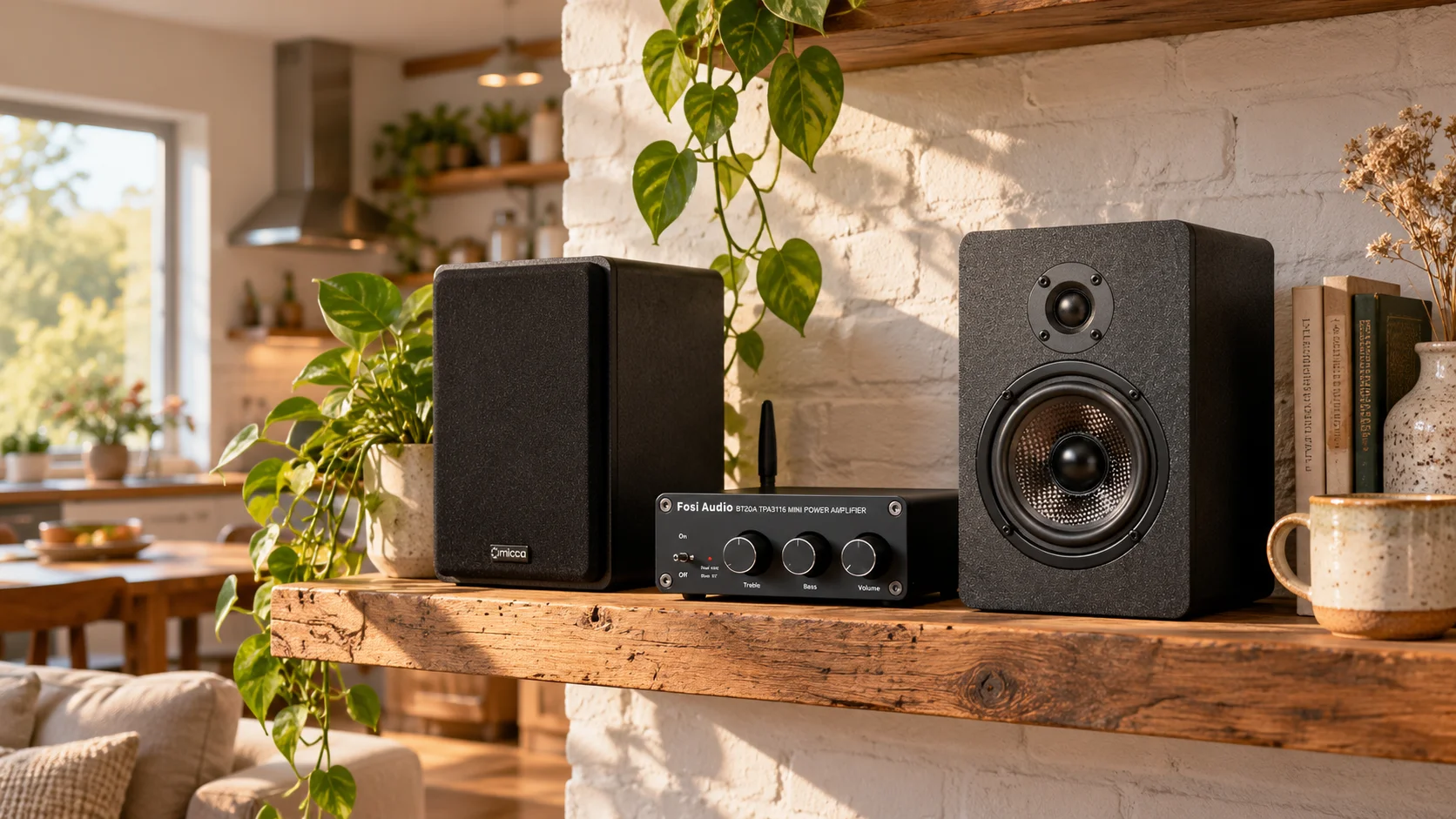
Quick answer: The MB42X G2 is a sensible low-cost first pair for a desk or small room if you accept its limits: bass reaches only about 69Hz, and measured sensitivity is lower than the box suggests, so it needs a capable amplifier. If you can spend more, the ELAC Debut 2.0 B6.2 or Polk Monitor XT20 are fuller-sounding upgrades, and the Klipsch R-41M is easier to drive.
This article contains affiliate links. If you purchase through them, we may earn a commission at no extra cost to you. This helps support AmplifierZone and allows us to keep creating in-depth, unbiased audio guides.
Who the Micca MB42X G2 Is For (and Who Should Skip It)
The MB42X G2 suits anyone building a stereo system on a very tight budget: students, desk setups, bedrooms, or a second system. It is small, easy to place, and independent measurements show a smoother midrange than you might expect at the price. If you plan to add a subwoofer later, it is an even better fit.
It is a weaker choice if you want real bass without a subwoofer, if you listen loudly in a large room, or if your amplifier is small or not rated for lower impedances. For those cases, step up to the ELAC B6.2 or Polk XT20, or pick the more efficient Klipsch R-41M.
Micca MB42X G2: Key Specifications
Micca MB42X G2 Bookshelf Speakers
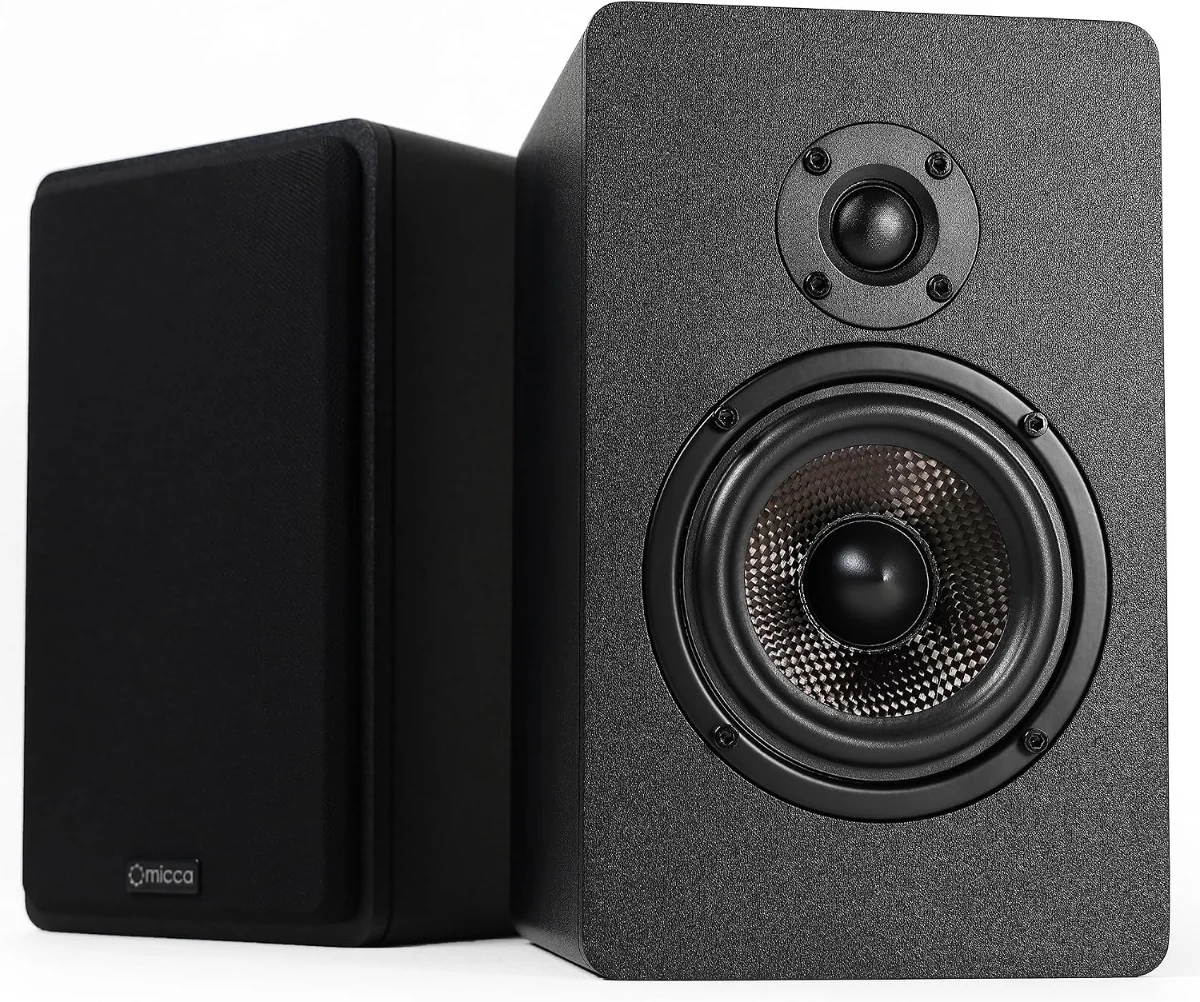
- Type: Passive, requires an external amplifier
- Drivers: 2-way: 4″ carbon-fiber woofer, 0.75″ silk-dome tweeter
- Sensitivity: 86dB rated; about 82.7dB measured (300Hz to 3kHz, 2.83V/1m)
- Impedance: 4 to 8Ω (manufacturer rating)
- Power handling: 80W per speaker (manufacturer rating)
- Frequency response: 55Hz to 20kHz (manufacturer rating); measured -3dB at about 69Hz, -6dB at about 59Hz
- Enclosure: Ported, 12dB/octave crossover
- Size (each): 9.5″ H x 5.8″ W x 6.5″ D (240 x 147 x 165mm)
- One of the lowest-priced passive bookshelf speakers worth considering
- Independent Klippel measurements show a reasonably smooth midrange
- Compact size suits desks, shelves and small rooms
- Responds well to equalisation, with a published EQ starting point
- Carbon-fiber woofer and silk-dome tweeter at an entry price
- Measured bass reaches only about 69Hz (-3dB); a subwoofer is advisable
- Measured sensitivity is lower than the 86dB rating, so it needs more amplifier power
- Rated for 4 to 8Ω, so the amplifier should be comfortable with lower impedances
- Limited maximum volume in larger rooms
AmplifierZone Editorial Rating
A very low-cost passive pair with a 4-ohm load and about 82.7dB measured sensitivity. Good value for a small desk or bedroom, as long as you pair it with an amplifier that handles 4 ohms.
Reviewed by AmplifierZone Editorial Team · October 2026
Ratings come from the manufacturer as quoted by retailers and measurement sites, and the measured numbers come from Audio Science Review’s Klippel data as summarised on Spinorama. Where they differ, we show both.
What the Measurements Show
- Bass: The measured response is down 3dB at about 69Hz and 6dB at about 59Hz. That means little output below the bass guitar range, so a subwoofer is advisable for most music.
- Midrange and treble: Between 300Hz and 5kHz the response varies by about 2.8dB, which is reasonably smooth for a speaker at this price.
- Sensitivity: Measured at about 82.7dB (2.83V at 1m), well below the 86dB rating. Plan on needing more amplifier power than the rating suggests.
- Equalisation: Audio Science Review calculated a preference score of 4.18 for the speaker as measured, rising to about 6 with a suggested EQ, and about 6.8 if paired with a perfect subwoofer. In plain terms, it benefits from bass and treble adjustment and a subwoofer.
Taken together: this is a speaker whose midrange is its strongest suit, whose bass is limited, and whose results improve noticeably with a little EQ or a sub. At the price, that is a reasonable trade.
Amplifier Pairing: How Many Watts You Actually Need
Using the measured sensitivity (about 82.7dB at 2.83V), a nominal 4Ω load, a 2.5m (about 8ft) listening distance, and two speakers playing, the amplifier power per channel needed is roughly:
| Peak level at your seat | Amplifier power needed | What it feels like |
|---|---|---|
| 85dB | about 10W | Quiet background listening |
| 90dB | about 35W | Comfortable everyday volume |
| 95dB | about 100W | Beyond the 80W rating; not advisable |
These are rule-of-thumb figures that ignore room gain and speaker compression, and they assume the 4Ω rating; if your amplifier sees a higher impedance, the numbers fall. The takeaway: a clean 30 to 60W amplifier that is comfortable with 4Ω loads is the sweet spot, and you should not expect loud listening in large rooms. Our best stereo amplifiers under $200 guide is a good starting point, our amplifiers for bookshelf speakers guide covers more options, and how to match an amplifier to speakers explains impedance and sensitivity.
Placement and Setup
- Back-wall distance: The speaker is ported, so leave about 15 to 20cm (6 to 8in) behind it and adjust by ear.
- Height: Put the tweeters near ear level on stands or a sturdy shelf.
- Desk use: A desk surface reflects sound and exaggerates bass boominess, so use small stands or isolation pads.
- Subwoofer: If you add one, set its crossover around 80 to 100Hz to cover the roll-off.
- EQ: If your amplifier or player has bass and treble controls or a parametric EQ, a small bass lift can help.
- Wiring: Basic 16 to 14 gauge speaker wire is enough; keep polarity consistent.
Micca MB42X G2 vs the Alternatives
| Speaker | Drivers | Sensitivity | Claimed response | Best for |
|---|---|---|---|---|
| Micca MB42X G2 | 4″ woofer, 0.75″ tweeter | 86dB rated (about 82.7dB measured) | 55Hz to 20kHz | Very tight budgets |
| Klipsch R-41M | 4″ woofer, 1″ horn tweeter | 90dB | 68Hz to 21kHz | Small amplifiers |
| Sony SS-CS5 | 5.1″ woofer, 1″ tweeter, super tweeter | 87dB | 53Hz to 50kHz | Compact first pair |
| ELAC Debut 2.0 B6.2 | 6.5″ woofer, 1″ tweeter | 87dB | 44Hz to 35kHz | More bass and a balanced sound |
Specifications are manufacturers’ claims unless noted. The Micca’s argument is price, not performance headroom. Our best bookshelf speakers for home audio roundup compares all of these with matching amplifiers.
Verdict: Is the Micca MB42X G2 Worth Buying?
It is worth buying if budget is the main constraint, you want a compact pair for a desk or small room, and you are happy to add a subwoofer or a little EQ over time. The measured midrange is the redeeming feature at this price.
It is not the best choice if you want bass without a subwoofer or if your amplifier is small. In that case, the Klipsch R-41M (easy to drive) or the ELAC B6.2 and Polk XT20 (fuller sound) are better options.
Frequently Asked Questions
Does the Micca MB42X G2 need a subwoofer?
For most music, yes. Independent measurements show the response down 3dB at about 69Hz and 6dB at about 59Hz, so deep bass is missing. Vocal and acoustic music can sound fine without one.
What amplifier works best with the Micca MB42X G2?
A clean stereo amplifier delivering roughly 30 to 60W per channel and comfortable with 4Ω loads. The speaker is rated for up to 80W, and measured sensitivity is lower than the box suggests.
Is the MB42X G2 sensitivity really 86dB?
The manufacturer rates it at 86dB, but Audio Science Review measured about 82.7dB (2.83V at 1m, 300Hz to 3kHz average). Plan around the lower number.
Can EQ improve the Micca MB42X G2?
Yes. Audio Science Review published a suggested EQ that raised the predicted preference score from about 4.2 to about 6. A small bass lift and treble adjustment on your amplifier or player can help.
How far should the MB42X G2 sit from the back wall?
Start with about 15 to 20cm (6 to 8in) because the speaker is ported. Move closer for more bass or farther away if it sounds boomy.

