The Klipsch R-41M takes a different route from most budget bookshelf speakers. Instead of a conventional dome tweeter it uses a 1″ aluminum tweeter loaded into a square Tractrix horn, which makes the speaker unusually efficient: 90dB sensitivity on an easy 8Ω load. That means a small amplifier can make it play loud, and it is one of the few budget passive speakers that makes sense with a tiny stereo amp or a low-power receiver. If you would rather skip the amplifier, the Klipsch The Fives II are powered speakers from the same brand, and the RP-600M II is the bigger passive step up.
This review is built from Klipsch’s published specifications, retailer spec sheets, and the independent Sound & Vision review of the R-41M system, plus the amplifier pairing math. We have not lab-tested this speaker ourselves, and where we are drawing on someone else’s listening, we say so.
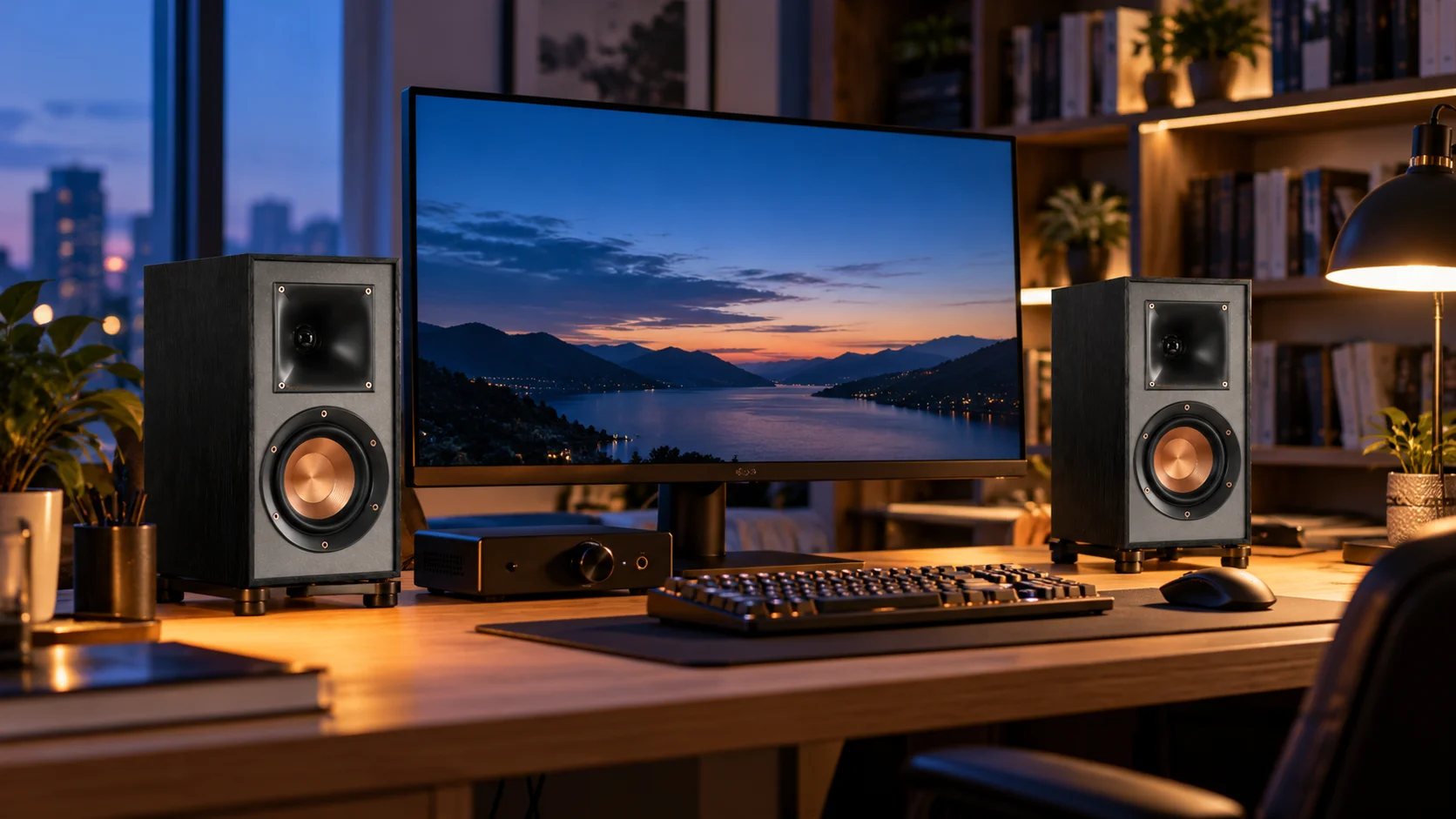
Quick answer: The R-41M is a good fit if you have a small or low-powered amplifier, a small room or desk, and you like a lively, dynamic sound. It is not a bass-heavy speaker (it is rated only to 68Hz) and the horn tweeter’s forward presentation will not suit everyone. For a more balanced, fuller sound at a similar level, compare the ELAC Debut 2.0 B6.2 or the Polk Monitor XT20.
This article contains affiliate links. If you purchase through them, we may earn a commission at no extra cost to you. This helps support AmplifierZone and allows us to keep creating in-depth, unbiased audio guides.
Who the Klipsch R-41M Is For (and Who Should Skip It)
The R-41M is a natural choice if your amplifier is small. Because it needs very little power, it works well with the compact amplifiers in our best mini amplifiers and best amplifiers under $100 guides, and with Bluetooth amplifiers like those in our best Bluetooth amplifiers for passive speakers list. It is also a good pick if you want speakers for a desk, a bedroom or a small living room, and you like music with punch: rock, pop, jazz and film soundtracks.
It is a weaker fit in three situations. If you want deep, full bass from a pair of stereo speakers with no subwoofer, a 4″ woofer will not deliver it. If you are sensitive to bright, forward treble, the horn design may tire you over long sessions. And if you want a furniture-style finish, you only get black vinyl.
Klipsch R-41M: Key Specifications
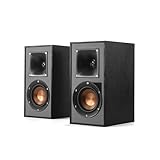
Klipsch Reference R-41M Bookshelf Speakers
- Type: Passive, requires an external amplifier
- Drivers: 2-way: 4″ (101mm) spun-copper IMG woofer, 1″ aluminum LTS tweeter on a 90 x 90° Tractrix horn
- Crossover: 1,730Hz
- Sensitivity: 90dB (2.83V/1m)
- Impedance: 8Ω nominal
- Power handling: 50W continuous, 200W peak
- Frequency response: 68Hz to 21kHz (±3dB)
- Cabinet: MDF, bass reflex with rear-firing ports; black wood-grain vinyl finish with a magnetic grille
- Terminals: One pair of gold-plated binding posts
- Size and weight (each): 5.75 x 11.3 x 7.9″ (146 x 287 x 200mm), about 7lb (3.2kg)
- Very efficient: 90dB sensitivity means small amplifiers get loud easily
- Easy 8Ω load that suits low-power and budget amplifiers
- Lively, dynamic character from the horn-loaded tweeter
- Compact and light enough for desks, shelves and surround duty
- Part of a matching Reference family (center and subwoofer) for home theater
- Bass is limited: rated down to only 68Hz
- Horn tweeter presentation is forward and not to everyone’s taste
- Only one finish (black vinyl)
- Small 4″ woofer is not suited to large rooms or very high volumes
AmplifierZone Editorial Rating
Efficient 90dB horn-loaded design that plays loud from small amplifiers. Bright-leaning presentation that suits lively music, and less forgiving on harsh recordings.
Reviewed by AmplifierZone Editorial Team · October 2026
Specifications come from Klipsch’s published figures as listed by retailers such as Green Toe and in Sound & Vision‘s spec sheet. The 68Hz low-frequency figure is a ±3dB rating, so bass below that falls away quickly.
What the Horn Tweeter Changes
A horn works like a megaphone for the tweeter: it focuses the sound, which raises efficiency and controls how widely the treble spreads (here, 90° horizontally and vertically). The benefit is sensitivity. The 90dB rating is roughly 3dB above a typical 87dB bookshelf speaker, which is equivalent to halving the amplifier power you need for the same volume.
The trade-off is character. Horn-loaded tweeters tend to sound more immediate and forward than soft-dome tweeters, which many listeners hear as exciting and detailed, and others hear as bright. If you listen at a distance or in a lively room the effect is easier to live with; at a desk it is more noticeable. Treat this as a matter of taste and room, not a flaw.
What to Expect From the Sound
We have not lab-tested the R-41M, so this section summarises independent reporting. Sound & Vision‘s review of an R-41M surround system described the speaker as dynamic and lively, with good stereo and surround imaging, and noted that it plays loudly without needing much power. It also described the bass as decent for the size, thanks to a ported cabinet, while noting that the system needed careful setup to perform at its best.
Our read, based on the specifications and that reporting: expect punchy, energetic midrange and treble, clear dynamics at modest amplifier power, and bass that stops well short of the room-filling kind. A subwoofer is the natural upgrade if you listen to bass-heavy music or watch films, and the R-41M was reviewed alongside Klipsch’s matching center and subwoofer for that reason.
Amplifier Pairing: How Many Watts You Actually Need
With 90dB sensitivity, a listening distance of 2.5m (about 8ft) and two speakers playing, here is the amplifier power per channel needed to reach different peak levels. These are rule-of-thumb figures that ignore room gain and speaker compression.
| Peak level at your seat | Amplifier power needed | What it feels like |
|---|---|---|
| 85dB | about 1W | Quiet background listening |
| 90dB | about 3W | Comfortable everyday volume |
| 95dB | about 10W | Lively listening, dynamic music |
| 100dB | about 30W | Very loud; near the speaker’s limits |
The takeaway is that almost any amplifier will do. The 8Ω load is gentle, so even a 15 to 30W Class D amp has plenty of headroom, and the speaker’s 50W continuous rating means you do not need anything bigger. One caution: very efficient speakers make the noise floor of a cheap amplifier easier to hear, so if you notice hiss at idle, a cleaner amplifier is a better fix than a more powerful one. Our guide to matching an amplifier to speakers explains sensitivity and impedance in more depth, and our amplifiers for bookshelf speakers guide covers larger options.
Placement and Setup
- Back-wall distance: The ports fire out of the back, so start with the speakers 15 to 20cm (6 to 8in) from the wall and adjust. Closer boosts bass but can sound boomy.
- Height: Place the tweeters near ear level, on stands or a sturdy shelf.
- Toe-in and distance: The 90° horn gives a fairly controlled spread. Angle the speakers toward your listening seat and sit a couple of metres back if the treble feels intense.
- Grille: The magnetic grilles come off easily, so try listening both ways.
- Subwoofer: If you add one, set the crossover around 80 to 100Hz to take over where the R-41M starts to fade.
- Wiring: Basic 16 to 14 gauge speaker wire is plenty; match polarity at both ends.
Klipsch R-41M vs the Alternatives
| Speaker | Drivers | Sensitivity | Claimed response | Best for |
|---|---|---|---|---|
| Klipsch R-41M | 4″ woofer, 1″ horn-loaded tweeter | 90dB | 68Hz to 21kHz | Small amplifiers and lively sound |
| ELAC Debut 2.0 B6.2 | 6.5″ woofer, 1″ tweeter | 87dB | 44Hz to 35kHz | More bass and a balanced sound |
| Polk Monitor XT20 | 6.5″ woofer, 1″ tweeter | 87dB | 38Hz to 40kHz | Fuller sound for medium rooms |
| Micca MB42X G2 | 4″ woofer, 0.75″ tweeter | 86dB rated | 55Hz to 20kHz rated | Tight budgets |
Specifications are manufacturers’ claims. The ELAC and Polk both use larger woofers and reach lower, but they need more power. The Klipsch’s argument is efficiency and dynamics in a small package. If you are on an even tighter budget, the Sony SS-CS5 and Micca MB42X G2 cost less, with their own limits. Our best bookshelf speakers for home audio roundup compares all of these with matching amplifiers.
Verdict: Is the Klipsch R-41M Worth Buying?
It is worth buying if you have a modest amplifier, a small room, and a taste for energetic, dynamic sound. The efficiency is a real advantage that most speakers at this price cannot match, and the compact size makes it easy to place.
It is not the speaker for deep bass or for listeners who want the smoothest, most relaxed treble. In those cases the ELAC B6.2 or Polk XT20 are better all-rounders at a modest step up in price.
- Single 4" spun-copper IMG woofer
- 1" aluminum LTS tweeter mated to a 90x90 square Tractrix Horn
- 68 hertz - 21 kilohertz +/- 3dB; Nominal impedance - 8 ohms; Compatible crossover frequency – 1,730 hertz
- Sensitivity 90dB @ 2.83V/1M. Power Handling (CONT/PEAK) 50W/200W
- The exclusive Linear Travel Suspension (LTS) minimizes distortion for enhanced, detailed performances. Kapton is an extremely light and rigid material used in the tweeter suspension to provide high efficiency and improve resolution and detail. LTS tweeters are a hallmark of Klipsch speakers, making it a core component of some of the best speakers in the world
Frequently Asked Questions
Do the Klipsch R-41M speakers need a subwoofer?
For bass-heavy music and films, yes. The speaker is rated down to only 68Hz (±3dB), so a subwoofer is a natural upgrade. For vocals, acoustic and jazz, they can sound complete on their own.
What amplifier works best with the Klipsch R-41M?
Almost any. At 90dB sensitivity and 8Ω, even a 15 to 30W amplifier is enough for most rooms. Choose an amplifier with a low noise floor so hiss does not show up through such efficient speakers.
Is a horn tweeter harsh?
Not necessarily, but it is more forward and immediate than most dome tweeters. Some listeners love the detail and dynamics; others find it bright. Listening from a little farther back, or off to one side, often softens it.
Can I use the R-41M for home theater?
Yes. Klipsch designed the Reference family to work together, and Sound & Vision reviewed the R-41M as the front and surround speakers in a 5.1 system with a matching center and subwoofer.
How far should the R-41M sit from the back wall?
Start with about 15 to 20cm (6 to 8in) because the ports fire out of the rear. Move closer for more bass or farther away if it sounds boomy.

