The Denon AVR-X3800H is a nine-channel AV receiver for people who want serious home theater without stepping up to flagship money. It gives you 105 watts per channel, 11.4-channel processing, six HDMI 2.1 inputs and four subwoofer outputs. It also covers music well, with HEOS streaming, AirPlay 2 and a phono input.
This Denon AVR-X3800H review looks at one question: is it still the right mid-range Denon now that a newer model exists? In short, yes, if you have a mid-sized room and a speaker layout with height channels. It is less convincing if your room is large or your speakers are hard to drive.
Quick answer: The Denon AVR-X3800H is a strong pick for a mid-sized room with a 5.1.4 or 7.1.2 layout. Denon rates it at 105 watts per channel with nine amplifier channels, and it adds six HDMI 2.1 inputs, Audyssey MultEQ XT32 and HEOS. Skip it if you have a very large room or hard-to-drive speakers. For a smaller setup, see the Denon AVR-X1800H. For the wider field, browse our best AV receivers under $1,000 guide.
Who Is the Denon AVR-X3800H For?
In general, it suits anyone building a real surround system with height speakers. Nine amplifier channels let you run a 5.1.4 or 7.1.2 Dolby Atmos layout without extra amps. In fact, that is the main reason to choose it over a seven-channel model. If you are unsure which layout fits your room, our guide to 7.1 vs 5.1.2 layouts explains the trade-offs.
It also suits owners who want one box for everything. You get a phono input, two optical and two coaxial inputs, a front USB port and network streaming. Gamers benefit too, because the HDMI ports support 4K/120Hz and VRR.
Skip it if you only need stereo music. A stereo receiver or an AV receiver is a simpler choice in that case. Also skip it if your room is large and your speakers are inefficient, because 105 watts per channel has limits.
Denon AVR-X3800H Key Specifications
Denon AVR-X3800H 9.4-Channel 8K AV Receiver

- Type: 9.4-channel AV receiver with HEOS
- Amplification: Nine channels, 105W per channel at 8 ohms (Denon rating, 20Hz to 20kHz, 0.08% THD, two channels driven); 135W at 6 ohms (Denon rating)
- Processing and pre-outs: 11.4 channels
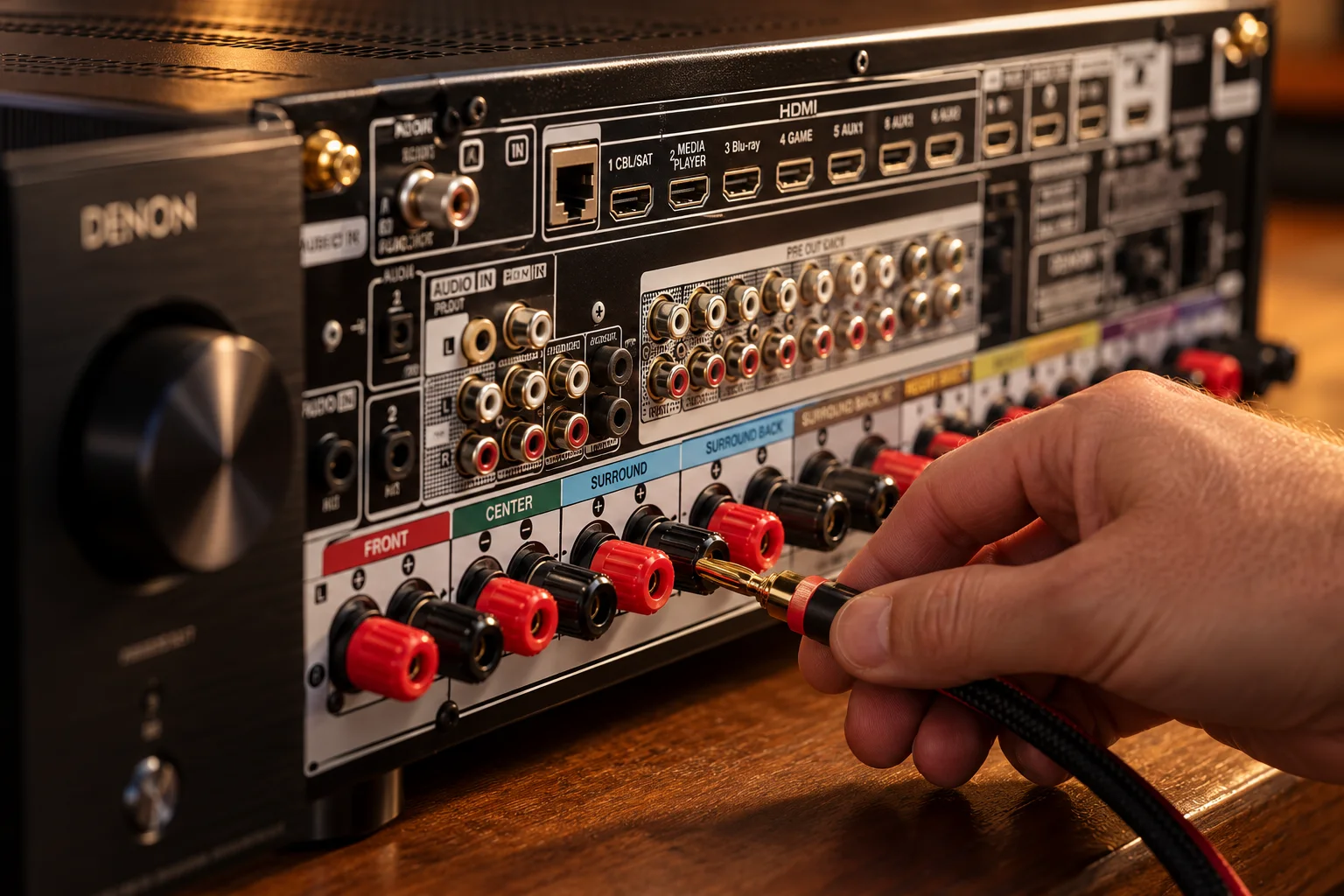
- HDMI: Six inputs, three outputs (one eARC); 8K/60Hz and 4K/120Hz, VRR, ALLM, Quick Frame Transport
- Surround formats: Dolby Atmos, DTS:X, IMAX Enhanced, Auro-3D
- Room correction: Audyssey MultEQ XT32 with microphone; Dirac Live as a paid upgrade
- Streaming: HEOS, AirPlay 2, Bluetooth, Wi-Fi, Ethernet, Spotify Connect
- Other inputs: MM phono, five analog, two optical, two coaxial, front USB
- Subwoofer outputs: Four, independently controlled
- Size and weight: About 17.1 x 15.3 x 6.6 inches, 27.6 lb
- Nine amplifier channels for 5.1.4 or 7.1.2 without extra amps
- Six HDMI 2.1 inputs with 4K/120Hz and 8K support
- Four independent subwoofer outputs and 11.4-channel pre-outs
- Audyssey MultEQ XT32, with Dirac Live as an upgrade path
- HEOS, AirPlay 2 and a phono input cover music well
- 105 watts per channel is modest for large rooms or demanding speakers
- Dirac Live and its bass control cost extra
- Heavy and warm, so it needs good ventilation
- Owner feedback on long-term reliability is mixed
AmplifierZone Editorial Rating
A capable nine-channel receiver with strong connectivity and flexible room correction. A very good choice for mid-sized Atmos rooms, with modest power for large spaces.
Reviewed by AmplifierZone Editorial Team
Nine-channel Atmos receiver with HEOS streaming
Build, Connections and Controls
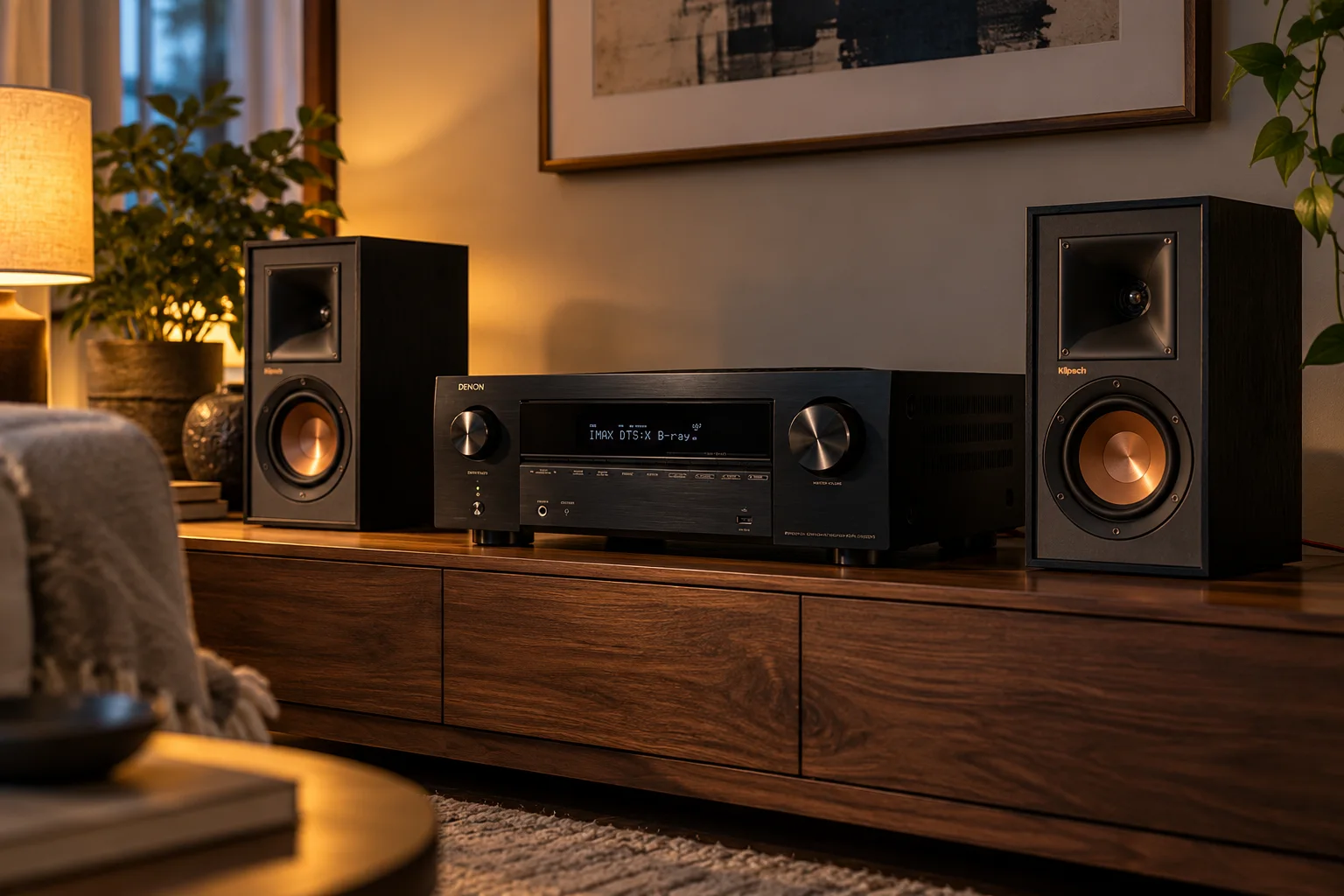
The X3800H is a full-size black receiver. It measures about 17.1 by 15.3 by 6.6 inches and weighs 27.6 pounds. Notably, that weight comes from the power supply and the nine amplifier channels. Leave room above and behind it, because it runs warm under load.
At the front, the layout is clean. A large volume knob sits on the right, a source knob on the left, and a one-line display sits between them. Also, a front USB port is there for quick playback. There is no front HDMI input, so a temporary game console needs a rear port.
The back is where the value shows. You get six HDMI inputs and three outputs, with one output supporting eARC. Also on the back are five analog inputs, two optical, two coaxial and an MM phono input. Eleven speaker terminals handle the nine amplified channels plus Zone 2 and speaker-assignment options.
Using the X3800H as a Processor for External Amps
The X3800H has 11.4-channel pre-outs, and that changes how you can grow the system. First, you can start with the built-in amps. Later, you can add an external amplifier for the front speakers without replacing the receiver.
This matters because the built-in power is the main limit. Owners with large 7.1.2 systems report adding an amplifier for the front channels. In that setup the receiver handles processing, and the external amp supplies the power. Our guide to integrated vs power amplifiers explains the difference, and our best power amplifiers for home audio roundup lists options.
A few rules keep it simple. Add amplification to the front left and right first, because they carry most of the music. Match the amp’s rated power to your speakers. Check the impedance rating too, as covered in what amplifier impedance means. Finally, run room correction again after any change.
That upgrade path is the real selling point. A seven-channel receiver cannot grow this way. Here, the pre-outs mean the receiver stays useful even after your speakers outgrow its amps.
Sound for Music and Movies
Stereo music
For stereo, the X3800H is clean and controlled. Denon’s 105-watt rating covers most bookshelf and efficient floorstanding speakers in a medium room. Pure Direct mode keeps the signal simple when you want music only. With a turntable on the phono input, it also works as a modest vinyl hub. For a closer look at music-focused receivers, see our best AV receiver for music guide.
Movies and Atmos
First, nine channels are the headline here. A 5.1.4 layout gives you four height speakers, while 7.1.2 gives you two. Dolby Atmos, DTS:X, IMAX Enhanced and Auro-3D are all supported. If you have no height speakers, Dolby Height Virtualization creates overhead effects from a conventional layout.
Subwoofers
Four independent subwoofer outputs are rare at this level. Because each output is controlled separately, you can balance two or more subs. As a result, bass response tends to be smoother across the seating area.
Power in real rooms
However, power is the one area to watch. Denon rates the amp at 105 watts per channel into 8 ohms with two channels driven. With all nine channels working, available power per channel is lower. For a small or medium room, that is plenty. In a large room with inefficient speakers, an external amp helps.
Room Correction and Setup
The receiver includes Audyssey MultEQ XT32 and a measuring microphone. The on-screen setup assistant walks you through speaker detection, distances and levels. Take measurements from several seats for the best result. Some owners report calibration results they had to adjust by hand, so check the result and fine-tune it if needed.
Dirac Live is available as an upgrade. You buy the license separately, and Dirac Live Bass Control needs another license. In practice, Audyssey is enough for many rooms. Dirac is worth the cost for rooms with stubborn bass problems. The Onkyo TX-RZ50 is the closest rival here, and it includes full-bandwidth Dirac Live from the start.
The HEOS app handles streaming and multi-room playback, and AirPlay 2 and Bluetooth cover phones. Zone 2 lets you send a separate source to another room. Wire the speakers before powering the receiver on, and keep the vents clear.
Denon AVR-X3800H vs the Alternatives
X3800H vs AVR-X1800H
The AVR-X1800H is a seven-channel model with 80 watts per channel and one HDMI output. Overall, it suits smaller rooms and tighter budgets. The X3800H adds two more amplifier channels, more power and more HDMI outputs. Choose the X1800H if you do not need height speakers beyond a simple 5.2.2 layout. Our AVR-X1700H review covers the model before it.
X3800H vs AVR-X3900H
Denon released the AVR-X3900H in 2026. The core specifications match: nine amplifier channels, 105 watts per channel and four subwoofer outputs. The newer model adds AMD FreeSync, a reworked audio board with a 32-bit DAC and web-based setup. Some early owners also report firmware bugs on the newer model. If the X3800H costs noticeably less, it remains a sound buy. Read our Denon AVR-X3900H review for the full picture.
X3800H vs AVR-X4800H
The AVR-X4800H sits above it with 125 watts per channel and seven HDMI inputs. It suits larger rooms and bigger systems. Pick the X3800H if your room is mid-sized and you want to keep money for speakers.
X3800H vs Yamaha RX-V6A
The Yamaha RX-V6A is a seven-channel model with MusicCast. It is a good value, but it cannot match the Denon’s channel count. For a broader look at the brand, read our Denon amplifiers explained guide.
Verdict: Is the Denon AVR-X3800H Worth Buying?
It is a strong buy for a mid-sized room with height speakers. The X3800H gives you nine amplifier channels, flexible room correction and a path to external amps. However, it lacks the raw power of the larger models, and owner reports on reliability are mixed, so buy from a seller with a clear return policy and register the warranty.
If you only need a seven-channel setup, the AVR-S980H or the X1800H is cheaper. For a full 5.1.4 system, this is the sweet spot. To try it with compact speakers, read our Klipsch R-41M review.
For a direct comparison of the two models, see our Denon AVR-X3800H vs AVR-X3900H guide.
- ENVELOPING 3D AUDIO, GEARED FOR 8K - Featuring 8K/60Hz pass-through, the 9.4-Ch AVR-X3800H (105W X 9) Bluetooth Amplifier delivers video and smooth animations, while the Dolby Surround & DTS Neural:X upmixer offer heightened realism
- GET THE MOST OUT OF YOUR 8K TV - Enjoy the highest quality 3D audio and video with HDCP 2.3 and eARC support. This 2.1/7.1/5.1 surround sound receiver also supports latest video formats like HDR10+ HLG HDR Dolby Vision Dynamic HDR pass-through
- UPGRADE YOUR HOME THEATER - Get immersive surround sound with Dolby Atmos, DTS:X Pro, IMAX Enhanced and Auro 3D. With Dolby Height Virtualization and DTS Virtual:X. Let the AVR create overhead sound in 7.1,5.1 or 2.1 setups without height speakers
- CONNECT WITH HD/UHD TV, SUBWOOFER, BLU-RAY PLAYER & TURNTABLE FOR STEREO SOUND - AV receiver features 9 HDMI 2.1 ports (6 In/ 3 Out) with 8K & 4K/120 support, analog/digital inputs, phono input plus (4) RCA and XLR subwoofer outputs
- EXTEND THE REACH OF YOUR MUSIC TO ANY ROOM - With this Denon 7.2 receiver, you create a multiroom surround sound system. Stream music via built-in HEOS, Wi-Fi, or Bluetooth, and get Hi-Fi audio around your home with Pandora, Spotify, TIDAL, and more
Denon AVR-X3800H FAQ
Is the Denon AVR-X3800H still worth buying now that the X3900H exists?
Yes, for most buyers. Denon introduced the AVR-X3900H in 2026 with the same nine amplifier channels and 105-watt rating, so the older model still covers the same ground. Compare current pricing on both, and pick the X3800H when it costs noticeably less.
How much power does the Denon AVR-X3800H have?
Denon rates it at 105 watts per channel into 8 ohms (20Hz to 20kHz, 0.08% THD, two channels driven) and 135 watts into 6 ohms (1kHz, 0.7% THD, two channels driven). It has nine amplifier channels, so a full 7.1.2 or 5.1.4 layout is possible.
Does the AVR-X3800H support Dirac Live?
Dirac Live is an optional upgrade that you buy separately. The receiver ships with Audyssey MultEQ XT32 and a measuring microphone. Dirac Live Bass Control needs a further license.
Does the Denon AVR-X3800H have a phono input?
Yes. It has a moving-magnet (MM) phono input, so a typical turntable with an MM cartridge connects without a separate preamp. A moving-coil cartridge needs an external step-up or phono preamp.
How many HDMI ports does the AVR-X3800H have?
It has six HDMI inputs and three outputs, one of which supports eARC. The ports handle 8K/60Hz and 4K/120Hz, plus VRR, ALLM and Quick Frame Transport. There is no front-panel HDMI input.
Do I need an external amplifier with the Denon AVR-X3800H?
Not for most rooms. Small and medium rooms with efficient speakers are well served by the built-in amps. A large room, power-hungry tower speakers or a big Atmos layout can justify an external amplifier on the front channels, which the 11.4-channel pre-outs allow.

