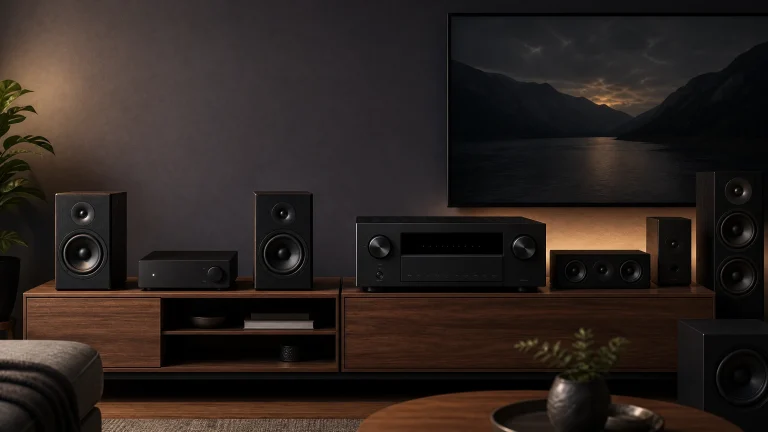
Choosing between 7.1 and 5.1.2 is less about counting speakers than deciding where you want the extra layer of sound to come from. A 7.1 system adds two surround-back speakers behind the seating position. A 5.1.2 system keeps five ear-level speakers but adds two height or overhead speakers for Dolby Atmos effects.
That difference matters because the best layout depends on your room, seating distance from the back wall, receiver channels, and willingness to install speakers overhead. This guide explains the trade-off in practical terms so you can choose a layout that will work in your actual home theater rather than chasing a larger number on a specification sheet.
What 7.1 and 5.1.2 mean
Home-theater notation describes speaker groups in a fixed order. The first number is the number of standard ear-level speakers, the second is the number of subwoofers, and the third is the number of height speakers. Dolby uses this format in its Atmos setup guidance.
In 7.1, the seven main speakers are normally a left and right front pair, a center speaker, left and right side surrounds, and left and right surround-back speakers. The “.1” represents one subwoofer channel, although many receivers provide two subwoofer outputs. The defining addition is the rear-surround pair behind the listening position.
In 5.1.2, the five main speakers are left and right fronts, center, and left and right surrounds. The “.1” again represents the subwoofer channel. The final “.2” adds two height speakers, which can be in-ceiling, on-ceiling, or Dolby Atmos-enabled upward-firing modules supported by the receiver and room.
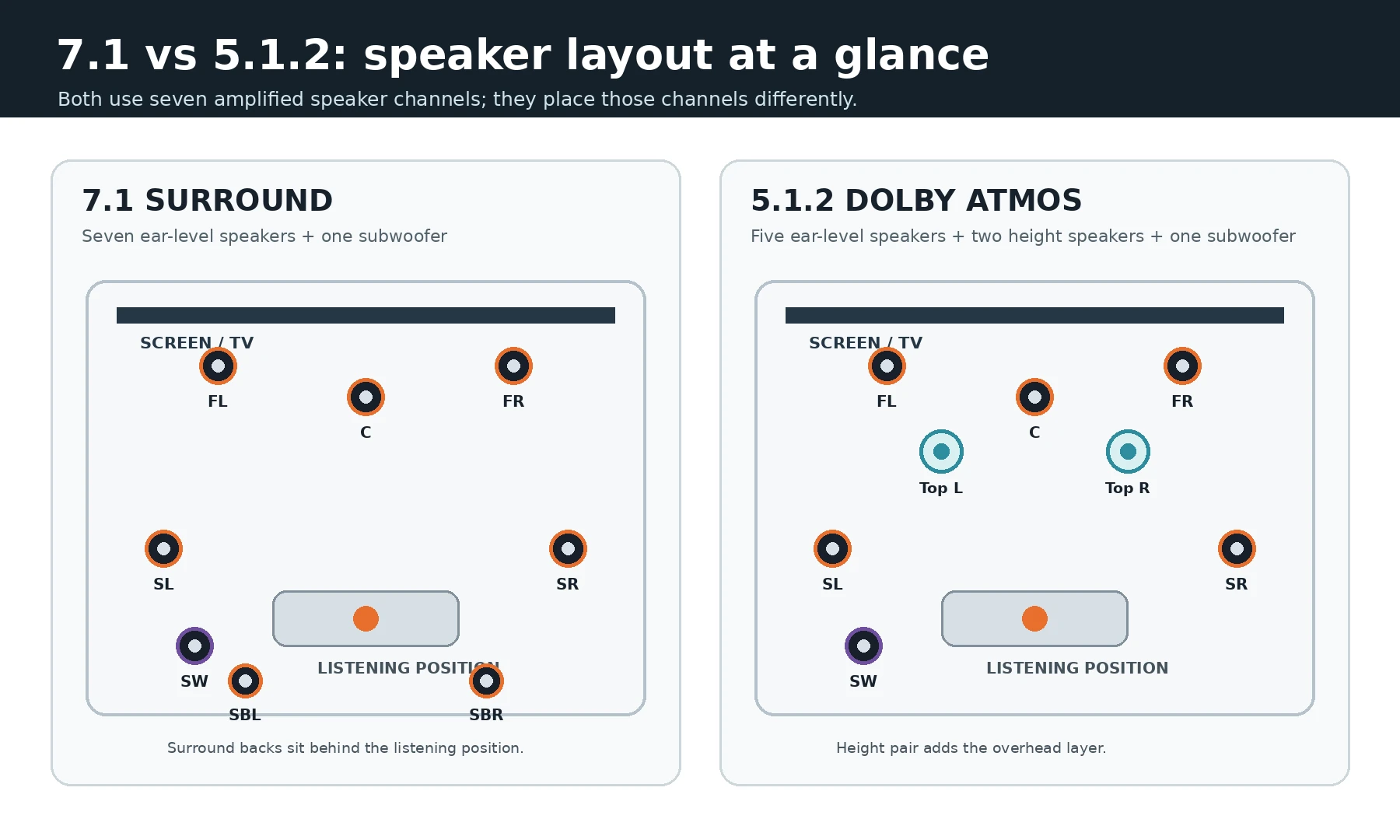
In short, 7.1 extends horizontal rear envelopment, while 5.1.2 adds a vertical dimension for overhead effects and ambience.
7.1 vs 5.1.2: quick comparison
| Consideration | 7.1 | 5.1.2 |
|---|---|---|
| Ear-level speakers | Seven main speakers | Five main speakers |
| Extra speaker pair | Surround-back speakers behind seating | Height or overhead speakers above the listening area |
| Best room shape | Seating well away from the rear wall | Room with workable ceiling or upward-firing reflection conditions |
| Main advantage | More rear-to-side envelopment at ear level | Dolby Atmos height effects and vertical spaciousness |
| Main limitation | Rear surrounds are ineffective when seats touch the back wall | Height speakers lose value when placement or reflection angles are poor |
| Receiver requirement | Seven amplified channels with 7.1 processing | Seven amplified channels with 5.1.2 or Atmos amp assignment |
Neither layout is automatically higher quality. The receiver may be capable of both, but the room decides whether the extra pair can do its job. Speaker position and calibration are more important than simply filling every available terminal.
What 7.1 adds
A 7.1 system extends a conventional 5.1 layout by adding left and right surround-back speakers. The side surrounds remain to the left and right of the main seats, while the rear pair sits behind the seats and aims inward toward the listening area. This gives the system a second rear boundary of sound instead of asking the side surrounds to cover the entire area from beside the listener to behind the listener.
That arrangement makes sense when the seating is meaningfully forward of the back wall, leaving enough room for the rear speakers to sit behind the listeners. In a long room or with multiple rows, 7.1 can improve continuity as sounds travel from the sides toward the rear.
What 5.1.2 adds
A 5.1.2 system uses two additional speakers to create a height layer. With conventional in-ceiling or on-ceiling speakers, the pair is typically positioned above or slightly in front of the main listening area, with the speakers spaced broadly in line with the front left and right channels. The exact placement depends on the room and the receiver’s supported layout options.
Dolby Atmos-enabled modules offer a less invasive alternative. They fire upward and rely on the ceiling to reflect sound toward the seating position. This can work when the ceiling is reasonably flat, reflective, and within the height range supported by the speaker and receiver. It is not equivalent to placing speakers anywhere on a high or acoustically absorbent ceiling; reflection geometry matters.
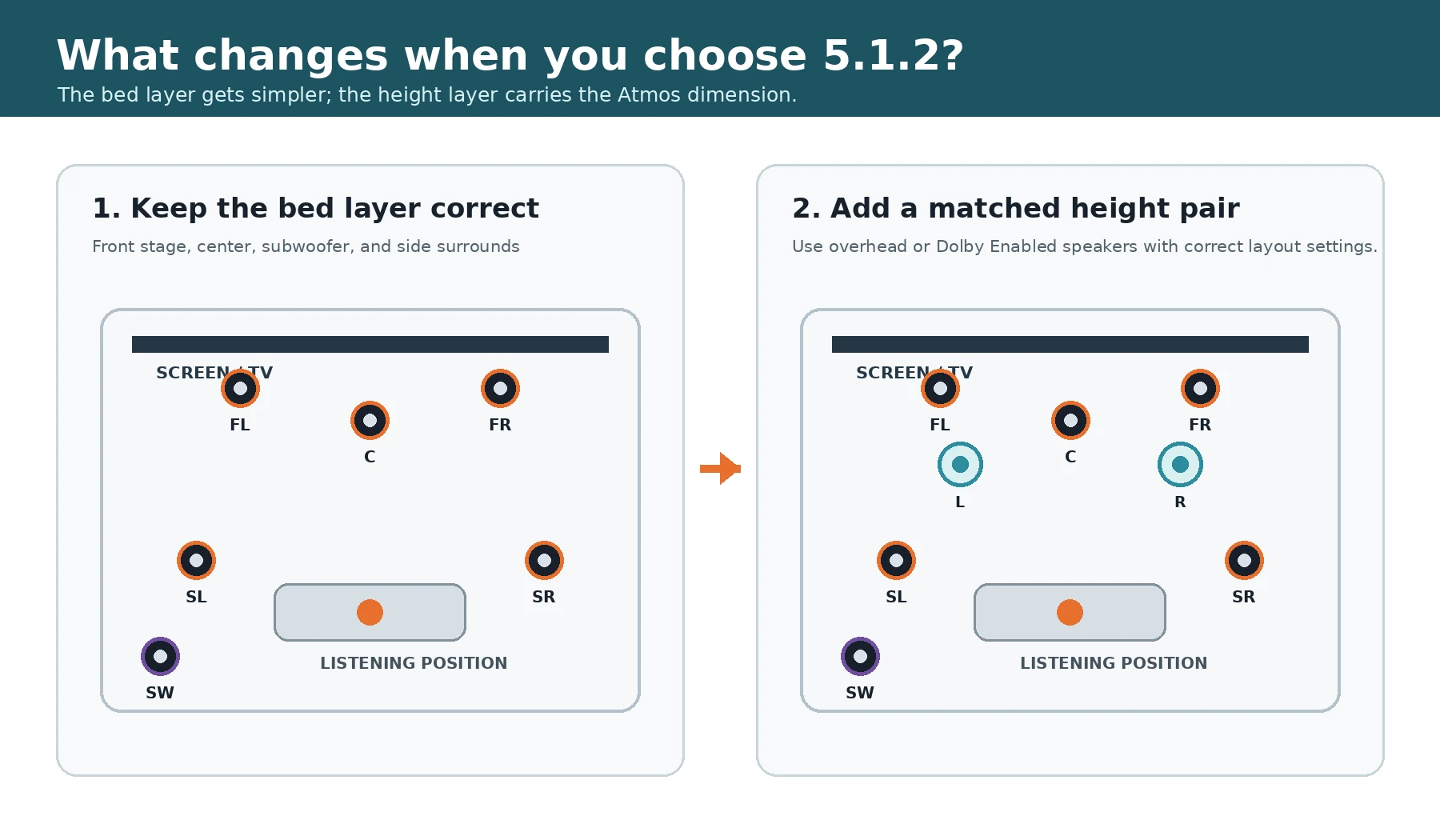
The benefit is not that every sound becomes louder. Instead, compatible Atmos mixes can place effects above the listener, such as aircraft, rain, room ambience, or a moving object. Even when a soundtrack is not a dramatic showcase for overhead effects, the height layer can make the front-to-back sound field feel less confined to the speaker plane at ear level.
5.1.2 also tends to be more practical in a compact living room where the main seats sit close to the rear wall. It does not require a usable strip of floor or wall behind the couch. It does require a ceiling or upward-firing arrangement that meets the placement and reflection constraints.
Room and placement realities
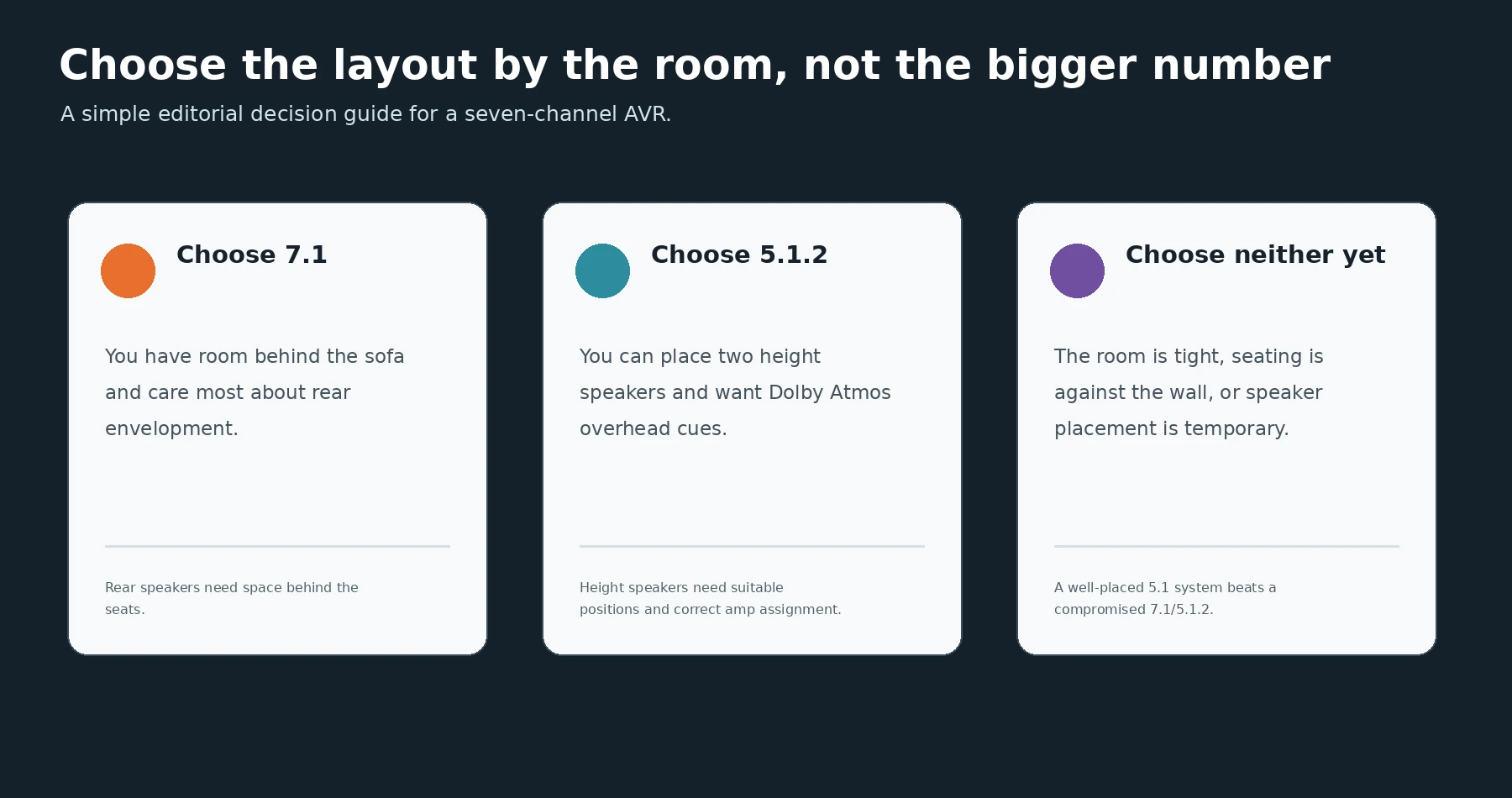
The right choice starts with the listening position, not the receiver. Mark the center seat and look at the surfaces around it. If there is substantial space behind the seating, measure whether the surround-back speakers can sit behind the listener and angle toward the seat. If the seating is close to the wall, 7.1 loses its main advantage.
For 5.1.2, look upward. A pair of in-ceiling speakers should not be placed randomly at the back of the room simply because that is where wiring is easiest. Dolby’s setup material emphasizes a central seating point and speaker angles aimed toward it. The speakers should form a coherent overhead pair rather than two isolated points that are too close together or far outside the listening zone.
Acoustics can change the answer. A low, flat, reflective ceiling is friendlier to upward-firing Atmos modules than a high, open, textured, or heavily absorptive ceiling. An awkward ceiling but excellent rear-wall distance may favor 7.1.
Do not overlook the basic five-speaker layer. The center should anchor dialogue, the front left and right channels should form a stable stereo stage, and the side surrounds should create a believable transition around the seats. A poorly aligned 5.1.2 system is not an upgrade over a carefully positioned 5.1 system because it has more channels.
Receiver and amplifier requirements
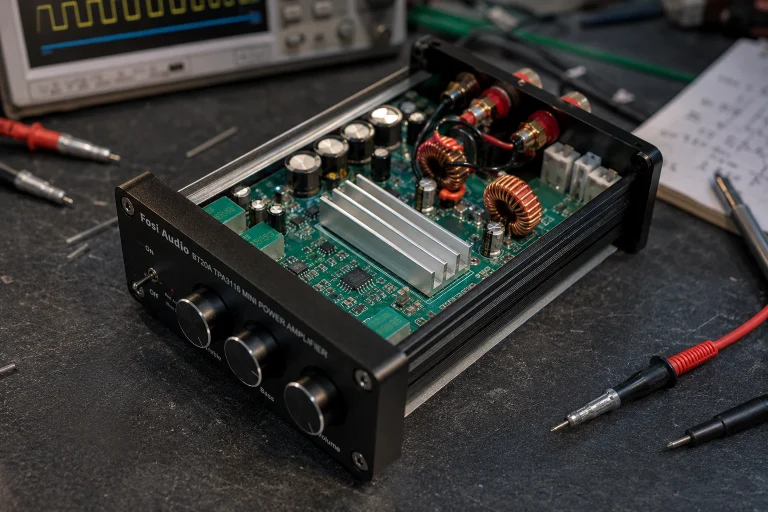
A seven-channel AV receiver can often be configured as either 7.1 or 5.1.2 because both layouts use seven amplified speaker channels. The receiver’s setup menu may call the assignment “Amp Assign,” “Speaker Layout,” “Power Amp Assign,” or something similar. Always check the exact manual before buying cable or installing speakers; menus and supported layouts vary by model.
The important limitation is that seven amplified channels do not normally drive seven ear-level speakers plus two height speakers at the same time. A 7.1.2 layout needs nine amplified channels unless the receiver supports additional external amplification or another channel-management arrangement. A seven-channel model can switch between 7.1 and 5.1.2, but it is not generally a full simultaneous 7.1.2 amplifier.
Receivers can also change processing behavior between surround-back and height assignments. Yamaha’s RX-A780 manual, for example, says its surround-back and presence speakers do not produce sound simultaneously in the same seven-channel arrangement, while Denon’s documentation uses Amp Assign for multiple configurations. The exact menu varies, so the model manual matters.
Before choosing the receiver, confirm four things: it has seven powered channels, its processing supports Dolby Atmos if 5.1.2 is your goal, its speaker terminals can be assigned to the layout you want, and its calibration system recognizes the selected positions. If you want to grow beyond 5.1.2 later, look for pre-outs and enough processing channels rather than assuming a seven-channel chassis will scale indefinitely.
For a real-world seven-channel receiver example and a separate look at features, inputs, and room suitability, see our Denon AVR-X1700H review. If you are still deciding whether your system needs an AV receiver at all, our guide to stereo amplifiers versus AV receivers covers the wider system decision.
What benefits movies, music, and games?
Movies with a Dolby Atmos mix are the clearest reason to choose 5.1.2. The height pair gives the receiver physical speakers for rendering overhead objects and ambience. Streaming services and disc releases vary in how aggressively they use the height layer, but the layout gives compatible content a place to go.
7.1 can be excellent for movies with strong side and rear movement, especially when the seating is forward enough to create a genuine rear soundstage. Older 7.1 mixes and upmixed content can benefit from the extra rear separation. The effect is more horizontal than vertical, so it will not reproduce overhead information in the same way as 5.1.2.
Most stereo music remains fundamentally a two-channel experience, so neither layout is required for accurate stereo playback. Multichannel concert recordings and immersive music mixes can use a height layer, but ordinary stereo listening should not decide the layout by itself.
Games can benefit from either arrangement because modern game engines use positional audio. A 5.1.2 layout can make vertical cues more convincing in games that expose height information, while 7.1 can make side-to-rear movement easier to follow when the room allows proper rear placement. The game, console, receiver mode, and room calibration all influence the result.
Which layout should you build?
If you already own a good 5.1 system, the upgrade path is usually determined by what your room can accommodate. Add two height speakers when ceiling or Atmos-enabled placement is realistic and you want the benefits of object-based movie and game sound. Add surround-backs when the seats are well forward of the rear wall and you regularly feel that the sound behind you lacks continuity.
If you are starting from scratch, build the five-speaker bed layer and subwoofer first. Spend the initial budget on correct positioning, appropriate speaker matching, secure mounting, and calibration. Then add the pair that solves the most obvious limitation in your room. This prevents an impressive specification from masking a weak center channel, badly placed surrounds, or an unintegrated subwoofer.
For readers comparing a receiver purchase with a simpler stereo or streaming system, our AV receiver guide is useful after you have settled the layout. Readers also comparing two-channel system foundations can start with 2.0 versus 2.1 versus 5.1 systems. Those articles address adjacent choices without changing the room-first conclusion here.
7.1 and 5.1.2 setup checklist
- Identify the main listening position and measure its distance from the side and rear walls.
- For 7.1, confirm that the surround-back pair can sit behind the seats with useful separation and clear aiming angles.
- For 5.1.2, choose in-ceiling, on-ceiling, or Atmos-enabled speakers according to the ceiling and the receiver’s supported layout.
- Keep the front left, center, right, side surrounds, and subwoofer working as a coherent 5.1 foundation before adding channels.
- Verify that the AV receiver has seven powered channels and an amp-assignment option for the chosen layout.
- Do not assume that a seven-channel receiver can power 7.1.2 simultaneously; check processing and external-amplifier requirements.
- Run the receiver’s room calibration after speaker placement, then check distances, levels, polarity, and crossover settings.
- Listen with familiar scenes and music before changing the layout. A technically correct placement should also sound stable at the main seat.
Final verdict
For Atmos-focused home theaters, 5.1.2 is the more meaningful seven-channel upgrade because it adds a genuine height layer without requiring space behind the couch. It is especially attractive in compact rooms where surround-back speakers would be too close to the listener.
7.1 remains the better choice when the room provides real distance behind the seating and you value a strong horizontal rear soundstage more than overhead effects. It is also the safer choice when ceiling installation or upward-firing reflection conditions are not practical.
Choose the layout that lets every speaker occupy a sensible position, verify receiver’s amp assignment, and calibrate from the seat you actually use. In a difficult room, a carefully installed 5.1 system will outperform a compromised 7.1 or 5.1.2 setup.
FAQ
Is 5.1.2 better than 7.1 for Dolby Atmos?
Can a seven-channel receiver run either 7.1 or 5.1.2?
Should 7.1 surround-back speakers be behind the couch?
Do upward-firing Atmos speakers work as well as ceiling speakers?
Is a good 5.1 system better than a badly placed 5.1.2 or 7.1 system?
Sources checked
Sources checked include Dolby’s Atmos setup overview, its 5.1.2 overhead guide, its Atmos-enabled guide, and its 7.1 guide. Receiver assignment notes were cross-checked against Yamaha’s RX-A780 manual and Denon’s AVR-X2300W manual, with general placement compared against Crutchfield’s reference.