A headphone amplifier under $100 can be a sensible upgrade, but only if it solves the right problem. Some inexpensive units are DAC/amp combos for computers and televisions. Others add tone controls and a microphone input for gaming. A few are simple analog distribution amplifiers designed to feed several pairs of headphones at once. Treating them as interchangeable is the quickest way to buy the wrong box.
For this guide, we screened current sub-$100 models by product identity, connectivity, headphone-load suitability, independent evidence where available, and the specific listener each model serves. We did not pad the list with unavailable models or repeat products already covered in the larger headphone-amplifier guide. The result is a short list of four genuinely different solutions rather than five versions of the same desktop DAC.
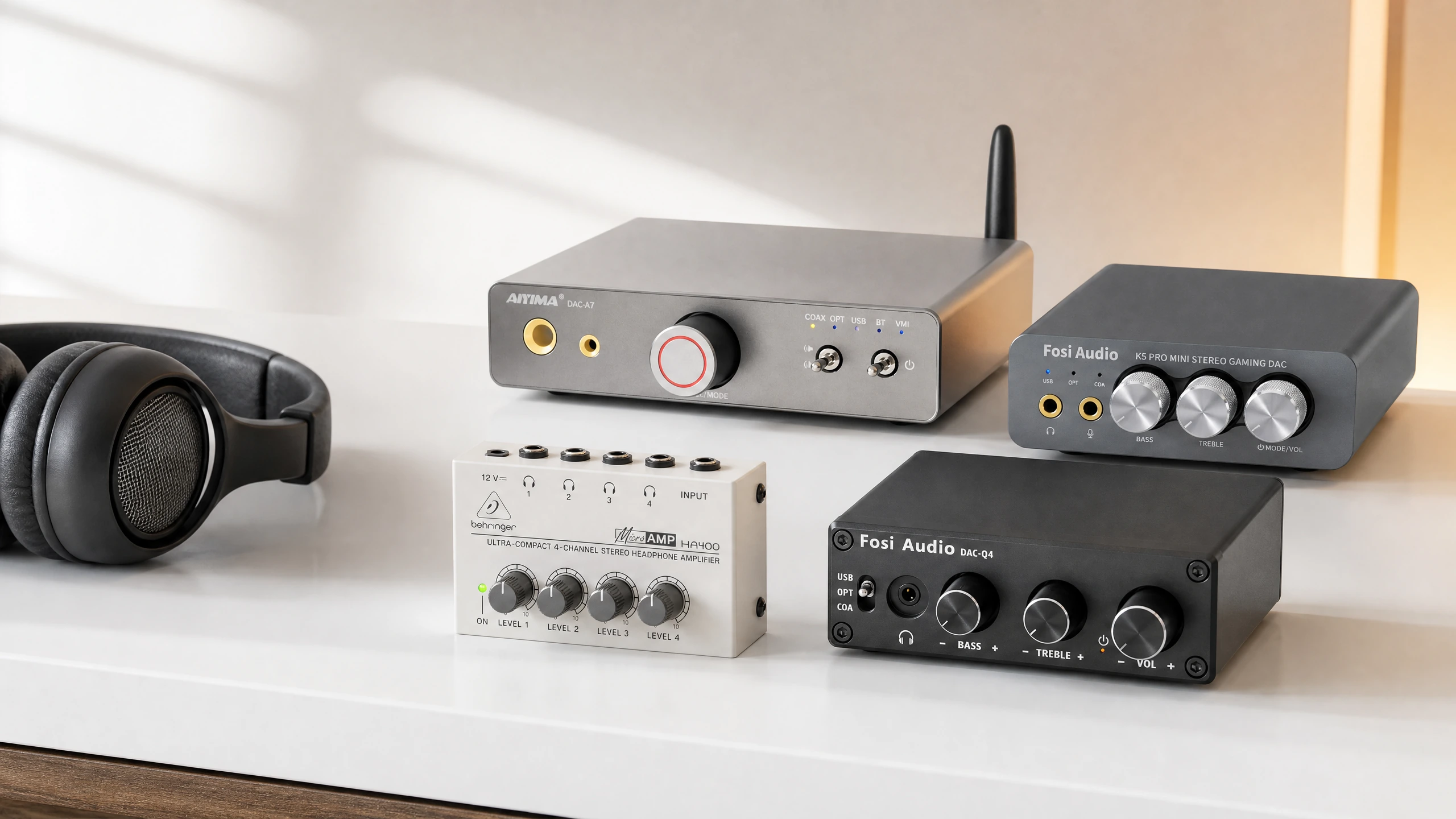
The short answer: the AIYIMA DAC-A7 is the most versatile all-in-one desktop choice, the Fosi Audio K5 Pro is the better gaming and tone-control option, the Fosi Audio Q4 is the simplest TV/PC digital upgrade, and the Behringer MicroAMP HA400 is the right tool when one stereo source must feed four listeners. None should be chosen solely by its advertised wattage; input needs, output type, headphone impedance, and use case matter more.
Affiliate Disclosure: AmplifierZone is reader-supported. As an Amazon Associate I earn from qualifying purchases. Product availability and offer details can change, so use the product image or Amazon link to check the current listing before you buy.
- How we chose these headphone amplifiers
- Sub-$100 headphone amplifier comparison
- Best overall: AIYIMA DAC-A7
- Best for gaming: Fosi Audio K5 Pro
- Best simple TV/PC setup: Fosi Audio Q4
- Best for four listeners: Behringer MicroAMP HA400
- How to match a headphone amp under $100
- Final recommendations
- Frequently Asked Questions
How we chose these headphone amplifiers
The strict ceiling immediately removes many popular desktop amplifiers. The original TOPPING DX1 was excluded because its current U.S. Amazon listing was unavailable during research. FiiO K3 and E10K-TC listings were not consistently within the ceiling, while established pure amplifiers such as Schiit’s current Magni models generally sit above it. A model that is excellent but not reliably actionable under the budget is not a useful answer to this specific search.
We also separated amplifier types. A DAC/amp combo converts digital audio and drives headphones; an analog amp expects an existing line-level signal; and a distribution amp is meant to split one source to several headphone outputs. The honest headphone-amp explainer is useful if you are still deciding whether your existing source is the actual bottleneck.
Manufacturer output figures are labeled as manufacturer specifications, not independent test results. Where third-party measurements or hands-on technical testing exist, they help establish limits and behavior, but they do not automatically transfer from one model generation to another. We do not use Amazon prices, ratings, or temporary offer language as evidence of performance, and every Amazon link below points to a product page rather than a hardcoded Amazon image URL.
Sub-$100 headphone amplifier comparison
| Model | Type | Inputs | Headphone outputs | Best use | Main limitation |
|---|---|---|---|---|---|
| AIYIMA DAC-A7 | Bluetooth DAC + amp | USB-C, optical, coaxial, Bluetooth | 3.5mm and 6.35mm | Most versatile desktop setup | Verify the exact current model and power claims |
| Fosi Audio K5 Pro | Gaming DAC + amp | USB-C, optical, coaxial, microphone input | 3.5mm | Gaming, tone controls, voice chat | No balanced output; manufacturer power figures are not independent measurements |
| Fosi Audio Q4 | Compact DAC + amp | USB, optical, coaxial | 3.5mm | Simple PC or TV upgrade | Limited headroom for difficult headphones |
| Behringer MicroAMP HA400 | Analog distribution amp | One stereo analog input | Four 1/4-inch outputs | Shared listening and studio monitoring | Not a USB DAC and not a single-listener fidelity specialist |
Best overall: AIYIMA DAC-A7
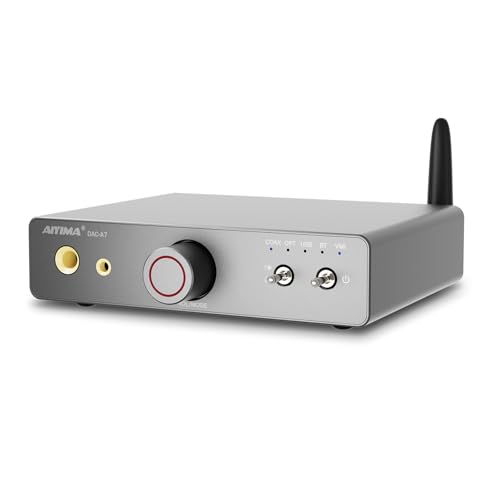
Best for: listeners who want one small desktop box to handle wired digital sources, Bluetooth, headphones, and a line-level output.
The AIYIMA DAC-A7 earns the overall position because it covers the widest range of ordinary desk setups. Its current product identity combines an ESS ES9038Q2M DAC, QCC3084 Bluetooth, USB-C, optical, and coaxial inputs with RCA, 3.5mm, and 6.35mm outputs. That makes it a more complete hub than a basic USB headphone amp and more flexible than the purely analog HA400.
AIYIMA lists support for headphones from 16 to 600 ohms and a high output figure at 32 ohms. Those are manufacturer specifications, not independent measurements, so they should be read as a sign of intended range rather than a guarantee that every demanding planar headphone will perform identically. The strongest practical reason to choose the DAC-A7 is input flexibility: a computer can use USB, a television can use optical, and a phone can stream over Bluetooth without another adapter.
The Bluetooth implementation is the feature that most clearly separates it from the other three picks. It supports modern high-quality wireless codecs, including LDAC according to the current product identity, but wireless performance still depends on the source device and the environment. A wired connection remains preferable when you need the lowest latency for gaming or the most predictable troubleshooting path.
There is also a useful distinction between the DAC-A7 and a powerful pure amplifier. It is an all-in-one convenience product, not a modular stack. If you already own a good DAC and only need a transparent analog power stage, the under-$200 headphone-amp roundup covers more appropriate higher-headroom options.
Choose it if: you want Bluetooth and multiple digital inputs in one desktop unit, use both 3.5mm and 6.35mm headphones, or want a line output for powered speakers.
Think twice if: you require a balanced headphone output, need independently verified high-power performance, or prefer a pure amplifier without an integrated DAC.
Best for gaming and tone controls: Fosi Audio K5 Pro
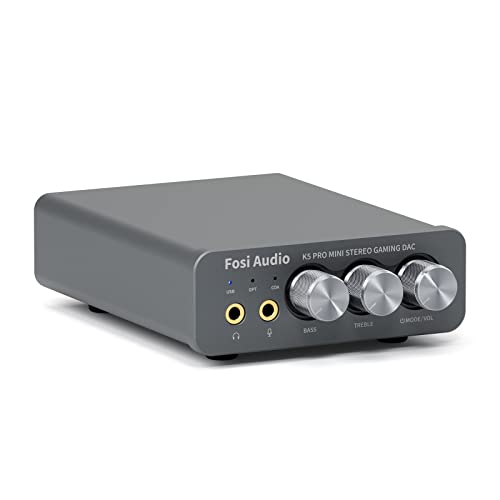
Best for: PC and console players who want a digital headphone amp with a microphone input, front-panel tone controls, and a simple gaming-oriented workflow.
The K5 Pro is not simply a cheaper version of a serious balanced desktop DAC. Its value is practical. Fosi gives it USB-C, optical, and coaxial inputs, a microphone input, RCA line output, a 3.5mm headphone jack, and independent bass and treble controls. That combination is more relevant to a gaming desk than a more expensive amplifier that offers only a cleaner power stage.
The microphone input changes the buying decision. A player can keep game audio and voice-chat routing in one compact unit, while the tone controls offer a quick way to add body or reduce brightness without opening an EQ application. These controls are not a substitute for careful headphone matching, but they are useful when the listener values convenience over a completely fixed signal path.
Fosi’s official specification page lists output figures across several impedances, including 500mW at 32 ohms and 80mW at 300 ohms. Those numbers are manufacturer claims and should not be presented as independent laboratory results. They do, however, explain why the K5 Pro is positioned for a wider headphone range than the Q4. The single-ended 3.5mm output and lack of balanced connection still make it a different proposition from the FiiO and Topping products already covered in the higher-budget guides.
Use the K5 Pro when the extra controls solve a real problem. If you do not need a microphone connection, tone controls, or gaming convenience, the DAC-A7 offers broader source flexibility and the Q4 offers a simpler setup.
Choose it if: you play at a PC or console, use a headset microphone, want quick bass and treble adjustment, or need USB, optical, and coaxial inputs.
Think twice if: your priority is balanced output, a remote control, Bluetooth, or independently measured performance rather than features.
Best simple TV and PC setup: Fosi Audio Q4
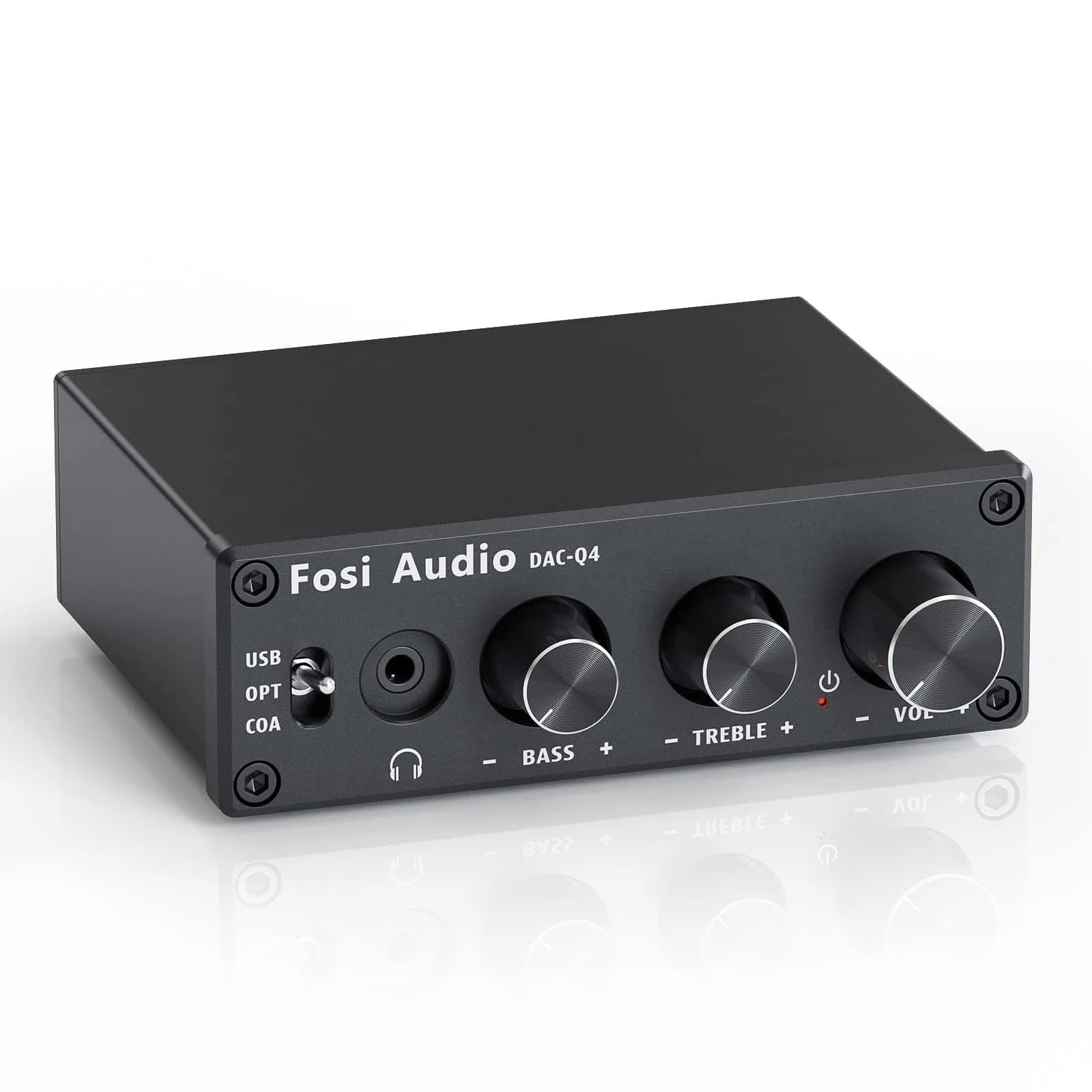
Best for: first-time buyers who want an easy way to add a headphone output to a computer, television, or digital source without building a stack.
The Fosi Audio Q4 is the least complicated recommendation here. It has USB, optical, and coaxial inputs, a 3.5mm headphone output, RCA line output, and front-panel bass and treble controls. It is bus-powered, so a PC setup does not need another wall adapter. A TV listener can use optical, while a computer user can connect over USB and leave the Q4 permanently beside the monitor.
The current Fosi instruction material gives the Q4 a recommended headphone range of 16 to 200 ohms and identifies 24-bit/96kHz USB support plus 24-bit/192kHz optical and coaxial support. The limitation is as important as the connectivity: it is not intended to be a high-power solution for difficult planar headphones or 300-ohm dynamics. If a television is sending a surround bitstream, Fosi’s instructions also call for PCM or RAW-compatible setup rather than expecting the Q4 to decode Dolby or DTS.
The Q4 is therefore a system-fixing purchase. It replaces a noisy or weak laptop jack, gives a television a convenient wired headphone path, and can feed powered speakers through RCA. It does not need to sound “exciting” to be useful; it needs to be quiet, predictable, and easy to connect. The existing Fosi Q4 review goes deeper into its design, limits, and headphone matching.
Choose it if: you need USB, optical, and coaxial inputs in a very simple unit, listen with efficient or moderate-impedance headphones, or want RCA output for powered speakers.
Think twice if: you own demanding planars, need a 6.35mm jack, want Bluetooth, or expect balanced output.
Best for four listeners: Behringer MicroAMP HA400
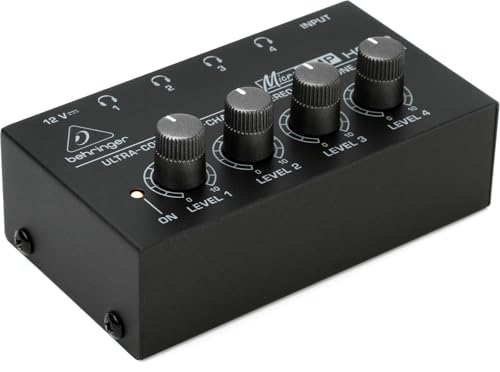
Best for: a recording session, music lesson, shared film listening, or any situation in which one stereo source must feed several pairs of headphones.
The HA400 belongs in this guide because “headphone amplifier” does not always mean a single audiophile listening box. Behringer’s MicroAMP is a four-channel analog distribution amplifier. One line-level stereo input feeds four independent headphone outputs, and each listener gets a separate level control. That is exactly the problem it solves, and none of the three DAC/amps above is a direct substitute.
The HA400 expects an analog source. It does not convert USB, optical, or coaxial audio, and it does not provide Bluetooth. Connect it to the line output of a DAC, mixer, interface, receiver, or other source, then connect up to four headphones through the quarter-inch outputs. For a studio or teaching environment, the individual level controls matter more than a premium DAC chip.
Independent technical reporting on the HA400 shows why expectations should remain practical: it is a compact, inexpensive distribution stage with a relatively high output impedance compared with a modern single-listener desktop amp. That can alter the frequency balance of headphones whose impedance changes substantially across the audible range. It is best used with reasonably well-behaved headphones and a clean analog source, at sensible levels.
This is the specialist pick, not the default pick. If you are the only listener at the desk, buy a DAC/amp instead. If you need four people to hear the same signal with separate volume control, the HA400 is more appropriate than paying for features you will not use.
Choose it if: you need four headphone feeds, individual level controls, and a simple analog path from a mixer, interface, receiver, or existing DAC.
Think twice if: you need USB or optical input, Bluetooth, a built-in DAC, balanced output, or the lowest possible output impedance for sensitive headphones.
How to match a headphone amplifier under $100
Start with the source, not the amplifier wattage. If the source is a laptop or desktop computer, a USB DAC/amp such as the DAC-A7, K5 Pro, or Q4 bypasses the computer’s analog headphone circuit. If the source is a television, optical input is often the cleanest route, but the television should be set to PCM when the amplifier does not decode surround formats. If the source is already analog and several people need to listen, the HA400 is the logical category.
Next, consider headphone sensitivity and impedance together. Impedance alone does not tell you how difficult a headphone is to drive, while sensitivity alone does not tell you how much voltage or current a particular model needs. Efficient 32-ohm headphones and many IEMs do not need a large desktop amp. High-impedance dynamics and power-hungry planar headphones need more voltage or current reserve, and the cheapest compact DAC/amps may reach comfortable volume before they deliver convincing peak headroom.
Use the lowest gain or a modest volume position that gives you a useful adjustment range. Start with the amplifier volume low, play a familiar track, and raise it gradually. If you hear hiss with sensitive IEMs, reduce gain and check whether the source or cable is contributing noise. If you hear clipping or obvious strain on demanding headphones, do not keep turning the knob; move to a higher-headroom amplifier from the DAC/amp guide under $250.
A separate DAC/amp is not automatically better than a phone or laptop output. The upgrade is most defensible when the existing output is noisy, cannot reach the desired level cleanly, lacks the needed digital input, or cannot provide the connections your system requires. If your current source already drives your headphones cleanly and comfortably, a new box may add convenience rather than a dramatic change in sound.
Final recommendations
Choose the AIYIMA DAC-A7 when you want the broadest combination of USB, optical, coaxial, Bluetooth, 3.5mm, and 6.35mm connections in a compact desktop unit. Treat its power figures as manufacturer specifications and verify the exact listing before buying.
Choose the Fosi Audio K5 Pro when gaming, voice chat, tone controls, and easy source switching matter more than balanced output. Choose the Fosi Audio Q4 when your goal is a simple PC or TV upgrade for efficient to moderate-impedance headphones. Choose the Behringer HA400 only when several listeners need the same analog source at once.
These products do not prove that every headphone needs an amplifier. They show why the category is broader than a power contest. A compact DAC/amp can solve a source and connectivity problem, while a distribution amplifier can solve a shared-listening problem that an audiophile desktop unit was never designed to address. Confirm the exact model and current listing before purchase, especially when Amazon displays several generations or seller variations under similar names.
Affiliate Disclosure: AmplifierZone is reader-supported. As an Amazon Associate I earn from qualifying purchases. Product availability and offer details can change, so use the product image or Amazon link to check the current listing before you buy.
Frequently Asked Questions
Can a headphone amplifier under $100 drive 300-ohm headphones?
Some can reach a comfortable volume, but volume is not the only question. High-impedance headphones need enough voltage headroom to reproduce peaks cleanly, and many inexpensive compact DAC/amps are better suited to efficient headphones below roughly 150–200 ohms. Check the specific amplifier’s output data and the headphone’s sensitivity rather than relying on impedance alone.
Is a DAC/amp better than a pure headphone amplifier?
Neither is automatically better. A DAC/amp is useful when your source is digital or its built-in headphone output is noisy or weak. A pure amplifier makes more sense when you already own a DAC with a clean line output and need additional analog drive or a specific output stage.
What is the best headphone amp under $100 for a TV?
The Fosi Audio Q4 is the simplest fit when the TV provides optical output and your headphones are not unusually difficult to drive. Set the TV’s digital output to PCM if the amplifier does not decode Dolby or DTS. The AIYIMA DAC-A7 is more flexible if you also want Bluetooth and additional desktop inputs.
Can four people use the same headphone amplifier?
Not every headphone amplifier is designed for that. The Behringer MicroAMP HA400 is a four-channel analog distribution amplifier with an individual level control for each output. It needs an analog line-level source and is intended for shared monitoring, lessons, sessions, or group listening rather than for USB conversion.
Do I need balanced headphone output under $100?
No. Balanced output can provide more power on some desktop designs, but it is not a requirement for good headphone listening. A well-designed single-ended amplifier with the correct output level, low noise, and suitable output impedance is enough for many headphones. Choose balanced output only when your headphones and use case justify the extra connection.